
Why Build a Backyard Gym? The Case for Outdoor Training
The idea of moving your workout outdoors isn't just about escaping the four walls of your living room. There's a growing body of evidence suggesting that physical activity in natural settings — researchers call it PANS — may produce different physiological responses than indoor exercise. A 2026 review from Verywell Health, citing work from the Texas A&M Center for Health & Nature, notes that outdoor exercise may lower both heart rate and blood pressure compared to indoor sessions. The mechanisms aren't fully understood yet, but the data is compelling enough that the National Institutes of Health continues to fund longitudinal studies on the topic.
There's also the air quality argument. According to the same review, Americans spend roughly 90% of their time indoors, where indoor air can be two to five times more polluted than outdoor air. For anyone who has ever felt stuffy or lethargic during a long indoor session, that statistic helps explain why. Fresh air, natural light, and the simple act of being outside can make a workout feel less like a chore and more like a genuine break in your day.
But the practical case is just as strong. A backyard gym eliminates commute time, frees up indoor square footage, and — if you plan it right — can be built for far less than a commercial membership over the long term. The challenge is that most budget guides skip the one category of expense that consistently derails outdoor builds: the stuff that keeps your gear from rusting into scrap metal within two years.
Budget Tier 1: Under $500 — The Calisthenics Starter
You do not need a power rack or a barbell to get a productive workout outside. The most cost-effective entry point is a calisthenics-focused setup built around a freestanding pull-up and dip station. BodyKore lists pull-up bars and outdoor fitness stations as core outdoor equipment, and Marcy Pro confirms that a viable starter setup can be built around bodyweight-focused gear before adding free weights.
| Item | Estimated Cost | Notes |
|---|---|---|
| Freestanding pull-up / dip station | $150 – $300 | Powder-coated steel; look for a base that accepts ground anchors |
| Heavy-duty resistance band set | $30 – $70 | Latex bands degrade in direct sun; store in a bin when not in use |
| Jump rope | $10 – $20 | Speed rope with ball bearings; negligible maintenance |
| Plywood box or foam plyo box | $60 – $100 | Foam boxes resist moisture better than wood; wood needs sealing |
| Yoga or exercise mat | $20 – $40 | Thicker mats (6mm+) hold up better on uneven ground |
| Weatherproof deck storage bin | $40 – $80 | UV-stabilized resin; keeps bands, rope, and mat dry |
| Total | $310 – $610 | Core setup lands near $400 with reasonable choices |
This tier works because it avoids the two biggest cost drivers in home gym equipment: iron and steel in quantity. Resistance bands provide variable resistance without the weight, and a plyo box gives you a platform for step-ups, box jumps, and incline push-ups. The single most important purchase in this tier is the storage bin. Fringe Sport notes that latex strength bands are subject to dry rot if stored outside, and a $50 weatherproof bin can extend their life from months to years.
If you have a bit more room in the budget, add a set of gymnastic rings ($40–$80). BodyKore includes outdoor gymnastic rings in its recommended equipment list, and they dramatically expand your upper-body pulling and pressing options without adding weight or floor footprint.
Budget Tier 2: $500–$2,000 — Adding Weights and Structure
Once you outgrow bodyweight work, the next logical step is adding a barbell and plates. This tier is where most home lifters find the sweet spot between capability and cost. The core purchases are a power rack or squat stand, an Olympic barbell, a set of bumper plates, and an adjustable bench.
| Item | Estimated Cost | Key Considerations |
|---|---|---|
| Power rack or squat stand | $400 – $700 | Titan T-3 Series ($465–$689, 11-gauge steel, 1,100 lb capacity); powder-coated for outdoor use |
| Olympic barbell | $200 – $400 | Rogue Ohio Bar ($295–$370, 190,000 PSI tensile strength); stainless steel option at 200,000 PSI |
| Bumper plate set (260 lb) | $300 – $600 | Iron Bull Strength HD plates ($63–$189 per pair, virgin rubber); store covered to prevent rubber bloom |
| Adjustable bench | $200 – $400 | REP FB-5000 ($239, 1,000 lb capacity); cover padding when not in use |
| Outdoor rubber flooring tiles | $200 – $500 | 43mm–63mm thickness with built-in drainage; Gym Flooring UK tiles start at ~$13 per tile |
| Total | $1,300 – $2,600 | Mid-range build lands near $1,800 with careful choices |
The power rack is the anchor of this tier. Fringe Sport confirms that powder-coated racks resist surface rust outdoors for years, though non-coated internal steel may still rust over time. The Titan T-3 Series is a common entry point because its 11-gauge steel frame provides a solid foundation without the premium price of stainless steel. If you live in a coastal area, consider upgrading to a stainless steel barbell — the Rogue Ohio Bar in stainless steel runs about $75 more than the standard version but eliminates the need for annual anti-rust treatments.
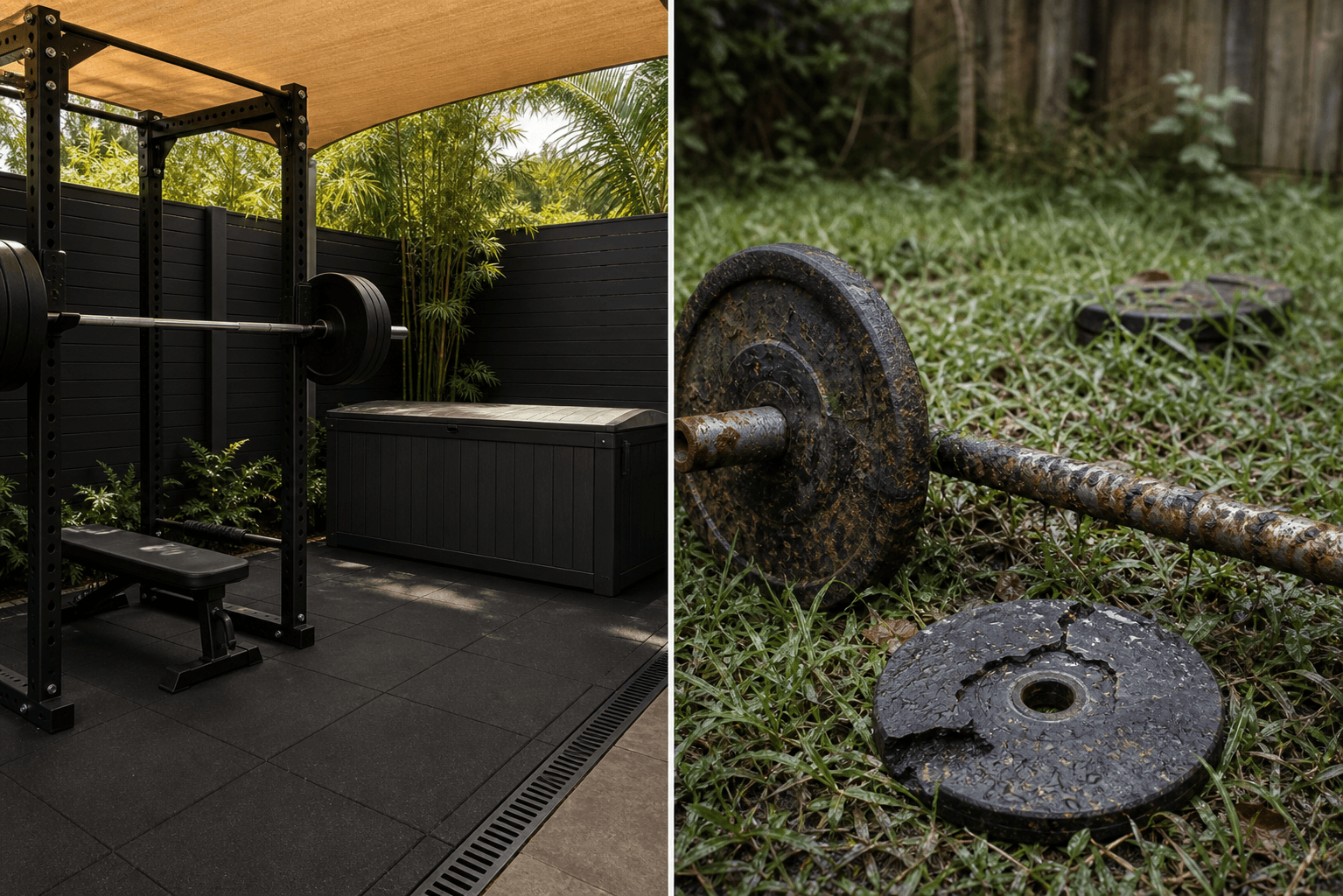
Flooring is the line item most budget guides ignore, and it's the one that matters most for outdoor setups. Standard garage floor mats trap water underneath, leading to mold and accelerated frame rust. Outdoor-rated rubber tiles with built-in drainage channels — like the PRO Antishock tiles from Gym Flooring UK — allow water to flow through rather than pool. At 43mm to 63mm thickness, they also provide enough shock absorption for deadlifts and Olympic lifts without damaging the ground underneath.
Budget Tier 3: $2,000–$5,000 — The Complete Outdoor Gym
At this level, you are building a permanent outdoor training space that can handle any training style — strength, conditioning, and accessory work — without requiring indoor backup. The equipment list expands to include a weatherproofed multi-station rack, a stainless steel barbell, a full set of kettlebells and dumbbells, conditioning tools, and a proper shelter structure.
| Item | Estimated Cost | Notes |
|---|---|---|
| Weatherproofed multi-station rack | $800 – $1,500 | Look for galvanized or powder-coated steel with sealed frame and drainage-friendly base |
| Stainless steel barbell | $350 – $500 | 316L stainless steel is coastal-safe and requires only occasional cleaning |
| Adjustable dumbbell set | $500 – $800 | Snode AD80 ($795, 10–80 lbs, drop-proof from 32 inches); replaces 8 fixed-weight pairs |
| Kettlebell set (2–4 kettlebells) | $150 – $300 | Rubber-coated or cast iron with powder coating; PowerBlock adjustable kettlebell ($169–$299) replaces 4 |
| Conditioning equipment | $100 – $300 | Battle ropes (anchor to post or rack), plyo box, agility ladder, or sled |
| Shelter structure (canopy or pergola) | $200 – $2,000 | Shade sails ($100–$400) provide 70–80% protection; pop-up canopy with sides adds privacy |
| Outdoor flooring (full coverage) | $500 – $800 | Rubber tiles with drainage for the entire footprint; 43mm minimum thickness |
| Total | $2,600 – $5,200 | Premium build lands near $3,500 with mid-range shelter and flooring |
The key upgrade in this tier is the shelter. Quictent recommends shade sails or pop-up canopies with sides as an inexpensive way to prevent rain damage. A shade sail costs $100–$400 and provides roughly 70–80% of the weather protection of a permanent structure. If you have the budget, a pergola with a solid roof adds full protection and increases the usable life of every piece of equipment underneath it.
Adjustable dumbbells are the highest-value space-saving investment in this tier. The Snode AD80, priced at $795 according to Garage Gym Reviews, replaces eight individual dumbbell pairs from 10 to 80 pounds. That means one storage footprint instead of eight, and one set of moving parts to maintain instead of eight pairs of handles that can rust at the knurling. For outdoor use, this consolidation is a major advantage.
The Hidden Costs Beginners Overlook
Every budget guide lists equipment prices. Almost none of them itemize the costs that determine whether your gear lasts five years or five months. Based on data from Fringe Sport, QITELE, Gym Flooring UK, and HYGym, here are the expenses that consistently surprise first-time outdoor gym builders.
| Cost Category | Estimated Range | Why It Matters |
|---|---|---|
| Weatherproof covers | $30 – $100 | Waterproof covers for rack, bench, and barbell prevent surface rust and UV damage |
| Anti-rust coatings and sprays | $15 – $30 per year | Silicone lubricant for J-hooks and adjustable parts; annual re-application of rust inhibitor |
| Outdoor-rated flooring | $200 – $800 | Standard mats trap water; drainage tiles prevent mold and frame corrosion |
| Shelter or shade structure | $200 – $2,000 | Shade sails ($100–$400) provide 70–80% protection; permanent structures cost more but last longer |
| Storage solutions | $50 – $300 | Weatherproof deck bins for bands, jump ropes, mats, and smaller accessories |
| Total hidden costs (first year) | $495 – $3,230 | Flooring and shelter are the two largest variables |
The single most overlooked item is flooring. Most first-time builders assume they can set up on grass or concrete. Grass creates an uneven, muddy surface that accelerates rust on any metal component that touches it. Concrete is better, but without drainage tiles, water pools around the rack feet and bench legs. Outdoor-rated rubber tiles with built-in drainage — like the 43mm–63mm PRO Antishock tiles from Gym Flooring UK — solve both problems but add $200–$800 to the total build cost depending on coverage area.
Shelter is the second-largest hidden cost. A shade sail or pop-up canopy costs $100–$400 and dramatically extends equipment life, but many builders skip it until after the first rainstorm damages an unprotected barbell. Quictent notes that temporary shelters like these effectively prevent rusting of equipment by rain, making them a higher-ROI purchase than upgrading from a standard barbell to a stainless steel one.
For a deeper breakdown of long-term ownership expenses — including warranty implications, maintenance schedules, and replacement timelines — see our Hidden Costs of Home Gym Equipment guide.
Equipment Prioritization: Train by Your Exercises, Not by What Looks Impressive
It is easy to get drawn into buying equipment that looks impressive — a massive power rack with all the attachments, a specialty bar for every lift, a set of kettlebells in every weight. But the most effective approach is to buy based on the exercises you actually do, not the ones you think you should do.
Start by listing the movements you perform most frequently. For most people, that list includes some variation of: squat, hinge (deadlift or kettlebell swing), push (bench press or overhead press), pull (pull-up or row), and carry (farmer's carry or suitcase carry). Then buy equipment that supports those movements in order of frequency.
- If you squat and deadlift most sessions, a power rack and barbell should be your first major purchase — not a cable machine or a set of dumbbells.
- If you do mostly bodyweight work and running, a pull-up bar and a plyo box will serve you better than a barbell set.
- If you travel frequently or have limited time, adjustable dumbbells and a jump rope give you the most versatility per square foot.
This framework also helps with weatherproofing decisions. A barbell that sits unused for weeks because you rarely deadlift is a barbell that will rust faster than one you use three times a week. Buy for your actual training frequency, and you will naturally reduce the number of items that need weather protection.
For a structured approach to deciding what to buy first and what to skip, see our Garage Gym Equipment Priority Tier List.
Three Sample Build-Outs: From Apartment Patio to Large Yard
To make the budget tiers concrete, here are three real-world scenarios with specific equipment lists, total cost estimates, and the key considerations that apply to each space type.
Scenario 1: Minimalist Apartment Patio (Under $500)
Space: 6 ft x 8 ft concrete patio or balcony. No permanent structures allowed. Equipment must be stored indoors when not in use.
| Item | Cost | Storage |
|---|---|---|
| Doorway pull-up bar | $30 – $50 | Stored indoors; no outdoor exposure |
| Resistance band set (5 bands) | $30 – $50 | Stored in a small tote bag indoors |
| Jump rope | $10 – $20 | Stored indoors |
| Yoga mat (6mm) | $25 – $40 | Rolled and stored indoors |
| Adjustable dumbbell set (5–25 lb) | $150 – $250 | Stored in a corner of the patio under a small waterproof cover |
| Total | $245 – $410 | All equipment stored indoors except dumbbells |
Comments
Join the discussion with an anonymous comment.