
Treadmill for Small Apartments: What Actually Fits, What Doesn't, and Which Models Keep the Neighbors Happy
Most 'apartment-friendly' treadmill recommendations ignore the three real constraints: actual folded footprint, noise level in decibels, and daily storage friction. This guide uses measured noise data and real-world dimensions to help apartment dwellers find a treadmill that fits their space and keeps the peace.
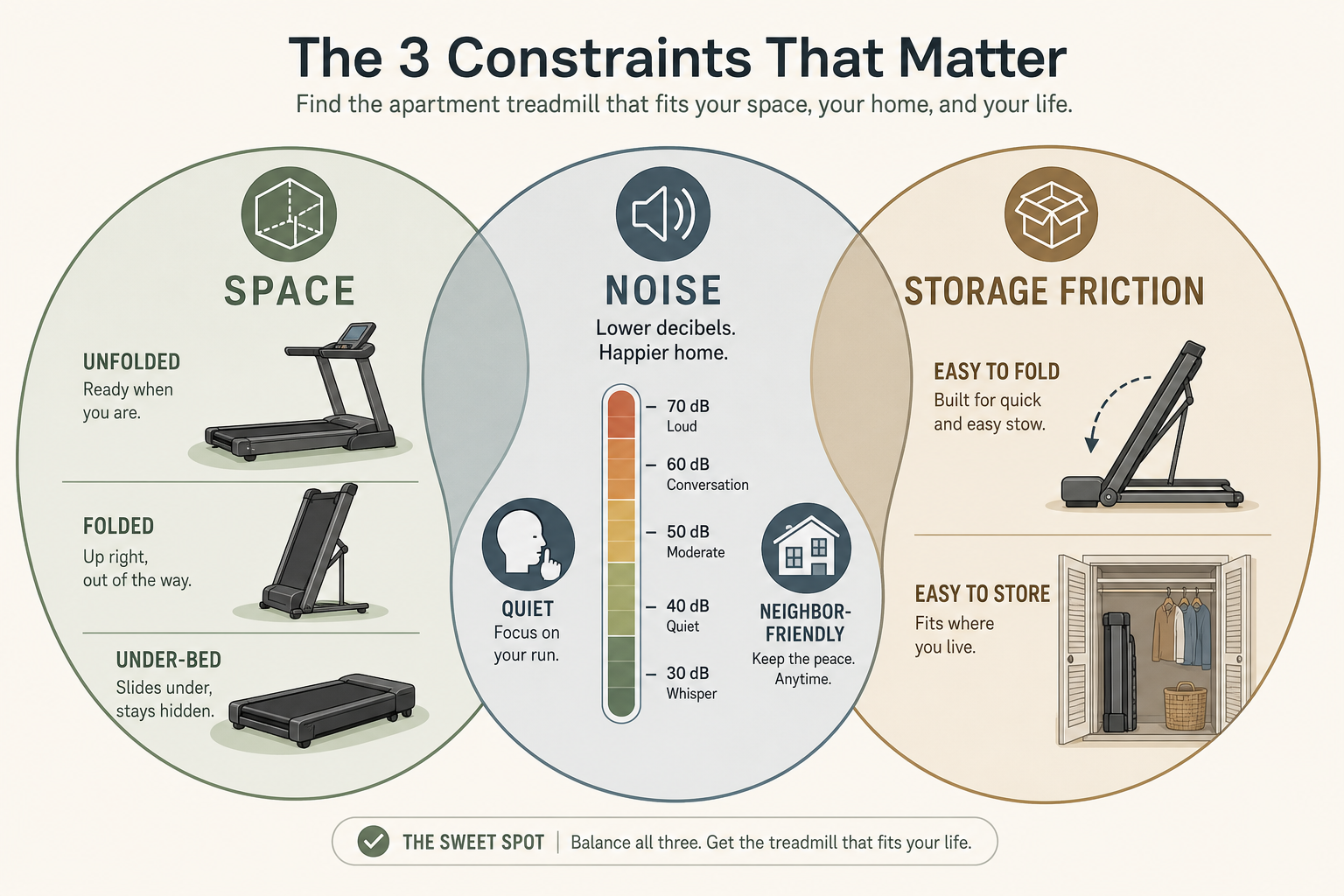
The Three Real Constraints for Apartment Treadmill Buyers
Walk into any big-box fitness retailer or scroll through the major online marketplaces and you will see the same phrase repeated across dozens of product pages: "apartment-friendly." The term is used so loosely that it has lost almost all practical meaning. A machine marketed as apartment-friendly might be a 180-pound folding unit that still occupies 17 square feet of floor space when in use, or it might be a 59-pound under-desk walking pad that slides under the couch. The label alone tells you nothing about whether the machine will actually work in your specific living situation.
After reviewing measured noise data from certified personal trainers, real-world dimensions from multiple testing sources, and feedback from apartment dwellers who have tried and returned machines, three distinct constraints emerge as the actual determinants of success. These are not the specs that manufacturers lead with — motor horsepower, incline range, or touchscreen size — but the physical and acoustic realities of living in close quarters with neighbors.
Constraint 1: Actual Folded Footprint vs. Unfolded Dimensions
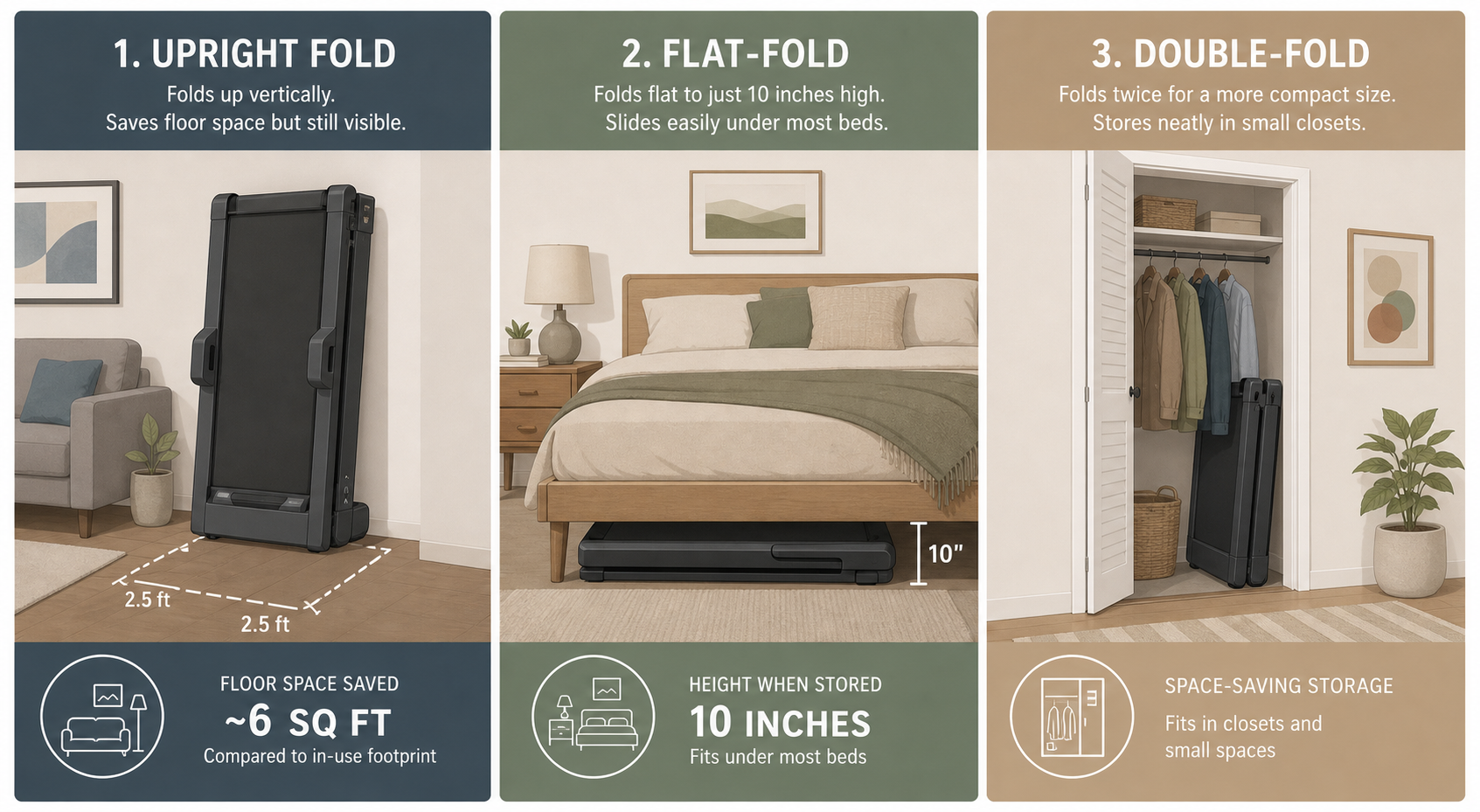
Most buyers measure their available space against the unfolded dimensions listed on the spec sheet. That is a mistake. The unfolded footprint tells you what you need during a workout, but the folded footprint — and how much of your living area it consumes when stored — determines whether the machine is a permanent eyesore or a practical tool. A treadmill like the Horizon T101 measures 71 inches long by 34 inches wide when in use, roughly the footprint of a two-seater sofa. When folded upright, it saves about 6 square feet of floor space, but it remains a tall, visible object leaning against the wall. That is a very different storage reality from a flat-fold model like the Echelon Stride-6, which compresses to just 10 inches in height and slides entirely under a bed frame.
Constraint 2: Noise Level in Decibels — Not Marketing Claims
Noise is the single most underreported spec in treadmill marketing. Manufacturers will tell you about "whisper-quiet motors" and "cushioned decks," but almost none publish measured decibel data. Independent testing tells a different story. According to data compiled by Garage Gym Reviews, the average treadmill produces approximately 68.5 dB at a distance of 5 feet — roughly the same volume as a running dishwasher. That average masks a wide range: the Sole F80 registers about 53.8 dB when walking, which is not much louder than a refrigerator humming, while some models tested exceeded 70 dB, a level that can easily penetrate standard apartment floor-ceiling assemblies.
Constraint 3: Daily Storage Friction
The third constraint is the one that most reviews ignore entirely: how much effort does it take to deploy and store the treadmill on a daily basis? A folding mechanism that requires lifting a 180-pound deck, aligning a latch, and rolling the unit across the room will not get used for a 20-minute walking session on a Tuesday evening. The machine will end up parked permanently in the middle of the living room, defeating the entire purpose of buying a folding model. The difference between a hydraulic-assisted fold that lowers gently and a manual fold that requires significant effort is not a minor convenience feature — it is the difference between a treadmill that becomes part of your routine and one that becomes an expensive clothes rack.
The rest of this guide is organized around these three constraints. Noise data comes first because it is the most overlooked and the most likely to cause real problems with neighbors. Folding type and daily storage friction come next, followed by weight, portability, and the unavoidable trade-off between deck size and running ability. The goal is not to recommend a single "best" model — no single treadmill works for every apartment layout — but to give you the framework to evaluate any model against your specific constraints.
Noise Decibel Data: What the Numbers Actually Mean for Your Neighbors
Before looking at any specific model, it helps to understand how treadmill noise travels through apartment buildings. The sound your neighbor hears is a combination of three sources: the motor (a continuous hum that varies with speed and load), the footstrike impact (the thud of your feet hitting the belt), and the vibration transmitted through the floor into the structure of the building. The motor noise is the easiest to mitigate — quieter motors and better insulation help. Footstrike noise and structural vibration are harder to control and depend more on the deck cushioning system and the surface under the machine.
The table below compiles measured noise data from two independent testing sources. Because the testing conditions differ, the values should be read as directional indicators rather than directly comparable specifications.
| Model | Measured Noise Level | Activity | Source Notes |
|---|---|---|---|
| LifeSpan TR1200-Glow Up | Below 45 dB | Walking (under-desk) | Quietest under-desk option per Garage Gym Reviews; 2.25 CHP motor, 4 mph max speed |
| Sole F80 | 53.8 dB | Walking | Measured by a certified personal trainer using a digital sound meter; described as 'not much louder than a refrigerator humming' |
| Average treadmill | ~68.5 dB at 5 feet | Walking/Jogging | Garage Gym Reviews aggregate measurement; comparable to a running dishwasher |
| Sole F63 | ~70 dB | Running | Measured by TreadmillReviews.net; louder than average |
| Horizon 7.0 AT | Over 70 dB | Running | Measured by Garage Gym Reviews during testing; 3.0 CHP motor, 12 mph top speed |
| Echelon Stride-8S | 50–80 dB range | Walking to Running | Wide range reported by TreadmillReviews.net; varies significantly by speed and surface |
A few patterns emerge from this data. First, the difference between a quiet model and a loud model is substantial — the LifeSpan TR1200 at under 45 dB is barely audible in the next room, while the Horizon 7.0 AT above 70 dB can be clearly heard through a standard floor-ceiling assembly. Second, the noise level varies significantly with activity: a treadmill that is quiet at a walking pace may become noticeably louder at a running pace, as the footstrike impact increases and the motor works harder. Third, the quietest full-size option in the tested data is the Sole F80 at 53.8 dB walking, which benefits from the Cushion Flex Whisper Deck system that reduces joint impact by an estimated 40% and, by extension, reduces the noise transmitted through the floor.
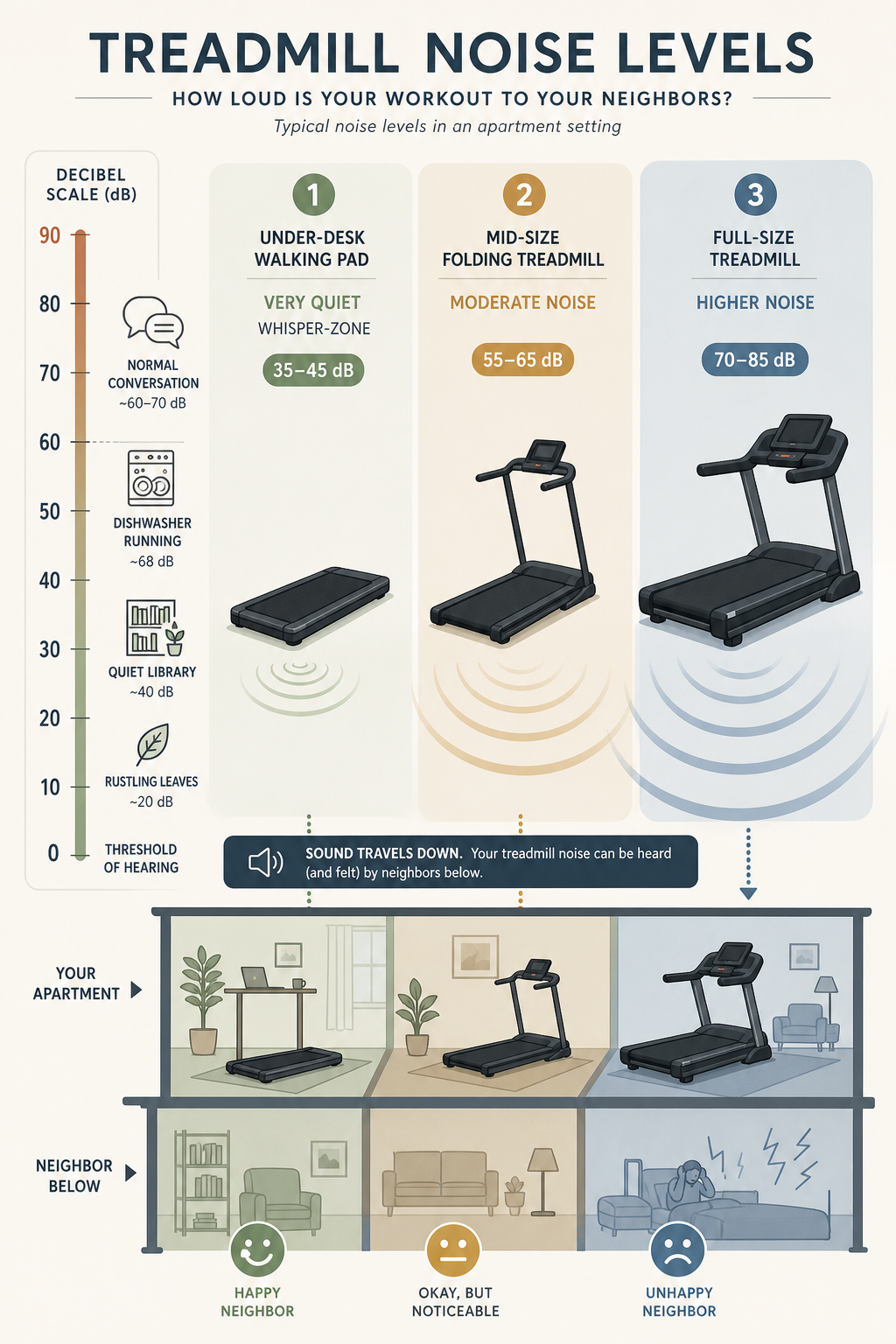
What This Means for Your Apartment
If you live on a ground-floor unit with concrete subfloors, noise is less of a concern — you can prioritize other constraints. If you live on the second floor or above, with wood-frame construction and standard carpet or laminate flooring, noise should be your primary filter. In that scenario, models that test below 55 dB at walking speeds and below 65 dB at running speeds are your realistic options. Models that test above 70 dB are likely to generate complaints, regardless of how well you insulate the machine.
Folding Type and Daily Storage Friction: Upright, Flat-Fold, and Double-Fold Compared
Once you have established your noise tolerance, the next decision point is how the treadmill stores when not in use. The folding mechanism determines not only how much space the machine occupies when stored, but also how likely you are to actually fold it after each workout. There are three primary folding types available in the current market, and they serve very different apartment layouts.
| Folding Type | How It Works | Stored Footprint | Example Models | Daily Friction Level |
|---|---|---|---|---|
| Upright Fold | Deck lifts and locks vertically against the console | Saves ~6 sq ft of floor space; remains tall and visible against a wall | Horizon T101, NordicTrack 1750, Sole F80 | Moderate — requires lifting the deck and engaging a lock; some models have hydraulic assist |
| Flat-Fold | Deck folds flat horizontally, reducing height to 10–12 inches | Fits under most bed frames (requires 10–12 inches of clearance); full footprint remains on the floor | Echelon Stride-6 (10" height), NordicTrack EXP 7i | Low — slides out and back; no lifting required |
| Double-Fold | Deck folds in half twice, creating a compact cube | Fits in a closet or corner; smallest stored footprint of any full-deck treadmill | WalkingPad X21 | Low — compact enough to carry and store in tight spaces |
The upright fold is the most common mechanism and the one most buyers picture when they think of a folding treadmill. Models like the Horizon T101 use a hydraulic-assisted system — Horizon calls it FeatherLight — that makes lowering the deck controlled and safe. When folded, the machine stands vertically and takes up about 6 square feet less floor space, but it remains a large, visible object. In a studio apartment, that vertical presence can dominate a wall. In a one-bedroom with a dedicated corner, it may be perfectly acceptable.
The flat-fold mechanism is a more recent innovation and arguably the most practical for apartment dwellers who have a bed or sofa with sufficient under-clearance. The Echelon Stride-6, for example, folds completely flat to just 10 inches in height. That is low enough to slide under most standard bed frames, which typically have 12 to 14 inches of clearance. The trade-off is that the unfolded footprint — 64.8 inches long by 32.4 inches wide — remains the same; you are not saving floor space during use, only during storage. But the ability to make the treadmill disappear entirely when not in use is a significant advantage for small-space living.
The double-fold mechanism is the most space-efficient but the least common. The WalkingPad X21 folds in half twice, creating a compact package that can be stored in a closet or carried to another room. This design sacrifices some deck stability and maximum speed compared to full-size models, but for walkers and light joggers, it offers the best space-to-function ratio available.
Weight and Portability: Can You Move It Alone?
Weight is a double-edged constraint. Heavier treadmills are generally more stable during use, have higher weight capacities, and feel more solid underfoot. But they are also much harder to move, which directly affects storage friction — the third constraint in our framework. A treadmill that requires two people to reposition will not get moved for a quick vacuuming session, let alone for daily storage.
| Weight Tier | Weight Range | Example Models | Portability Assessment | Best For |
|---|---|---|---|---|
| Ultra-light | Under 100 lbs | WalkingPad P1 (80 lbs), WalkingPad X21 (93 lbs), Urevo 2-in-1 (59 lbs) | Easily moved by one person; can be carried between rooms | Walkers only; under-desk use; very small apartments |
| Light-to-mid | 180–250 lbs | Horizon T101 (180 lbs), Echelon Stride-6 (182 lbs), NordicTrack EXP 7i (228 lbs) | Manageable for one person with effort; easier with transport wheels | Walkers and joggers; apartments with some floor space |
| Heavy | 277+ lbs | Horizon 7.0 AT (277 lbs), Sole F80 (approx. 260+ lbs) | Requires two people or permanent placement; difficult to reposition | Runners; dedicated workout area; ground-floor or concrete subfloor units |
The practical threshold for solo movability appears to be around 200 pounds. The Horizon T101 at 180 pounds and the Echelon Stride-6 at 182 pounds are both at the upper end of what a reasonably fit person can tilt onto transport wheels and roll across a room. Above 250 pounds, the machine becomes difficult to maneuver alone, especially in tight apartment hallways or around corners. The Horizon 7.0 AT at 277 pounds is best treated as a permanent installation — once you set it up, it stays there.
For apartment dwellers who need to store the treadmill in a closet or move it between rooms, the under-100-pound tier is the only realistic option. The WalkingPad P1 at 80 pounds and the WalkingPad X21 at 93 pounds can be tilted and rolled by one person without strain. The trade-off, as discussed in the next section, is that these lightweight models have shorter decks and lower speed limits.
Deck Size vs. Running Ability: The Space Trade-Off
Deck length is the dimension that most directly correlates with running comfort — and it is also the dimension that most directly conflicts with space savings. A longer deck requires a longer frame, which means a larger unfolded footprint and, in most cases, a heavier machine. Every apartment treadmill buyer faces this trade-off, and the right balance depends entirely on how you intend to use the machine.
| Deck Length | Typical Use | Example Models | Space Trade-Off |
|---|---|---|---|
| 49 inches or less | Walking only | Sunny SF-T4400 (49" deck), WalkingPad P1 (47" deck) | Smallest footprint; folds to under 7 sq ft; max speed 3.75–4 mph |
| 55 inches | Walking and jogging; shorter strides | Horizon T101 (55" deck), NordicTrack EXP 7i (55" deck) | Moderate footprint (~17 sq ft unfolded); works for most users under 5'10" |
| 60 inches | Running; longer strides | Echelon Stride-6 (60" deck), Sole F80 (60" deck) | Largest footprint (~20 sq ft unfolded); best for runners but requires more space |
The 49-inch deck category is dominated by under-desk treadmills and walking pads. These machines are designed for walking at speeds up to 3.75 or 4 mph, and their short decks make running unsafe — your stride will exceed the belt length, and you risk stepping off the back. The Sunny SF-T4400, with its 49-inch deck and 10.98 square foot unfolded footprint, is a good example of this category. It folds to just 6.38 square feet, making it one of the most space-efficient options available, but it is strictly a walking machine.
The 55-inch deck is the sweet spot for most apartment dwellers who want to jog as well as walk. The Horizon T101 and NordicTrack EXP 7i both use 55-inch decks, which accommodate a natural walking stride and a moderate jogging stride for users under about 5 feet 10 inches. Taller runners may find the 55-inch deck too short for a comfortable running stride. The unfolded footprint for these models is around 17 square feet — roughly the size of a twin mattress — which is manageable in a one-bedroom apartment but tight in a studio.
The 60-inch deck is the gold standard for running. The Echelon Stride-6 manages to pack a full 60-inch deck into a flat-fold design that compresses to 10 inches in height, which is a remarkable engineering achievement. The trade-off is that the unfolded footprint is larger — 64.8 inches long by 32.4 inches wide — and the machine weighs 182 pounds. If you are a runner and you have the floor space, the 60-inch deck is worth the space premium.
Apartment-Specific Recommendations by Floor Plan and Noise Tolerance
The following recommendations apply the three-constraint framework — noise, storage friction, and deck size — to specific apartment scenarios. These are not generic "best of" picks. Each recommendation is matched to a particular combination of floor plan, noise sensitivity, and intended use.
| Apartment Type | Noise Sensitivity | Primary Use | Recommended Model | Why It Fits |
|---|---|---|---|---|
| Studio (under 400 sq ft) | High — upstairs unit, wood-frame building | Walking, light jogging | LifeSpan TR1200-Glow Up | Below 45 dB is the quietest option tested; under-desk form factor fits in any corner; 330 lb weight capacity is generous for its size |
| Studio (under 400 sq ft) | Moderate — ground floor or concrete subfloor | Walking only | WalkingPad P1 (80 lbs) | Ultra-light at 80 lbs; 47-inch deck sufficient for walking; folds to 5-inch height; can be stored under furniture |
| 1-bedroom (400–700 sq ft) | High — upstairs unit, shared wall | Walking, jogging, occasional running | Echelon Stride-6 | Flat-fold to 10 inches fits under bed; 60-inch deck supports running; 182 lbs is manageable; 12.4 mph top speed and 12-level incline |
| 1-bedroom (400–700 sq ft) | Moderate — ground floor | Walking, jogging | Horizon T101 (180 lbs) | 55-inch deck works for jogging; FeatherLight hydraulic fold reduces storage friction; 180 lbs is movable; saves ~6 sq ft when folded upright |
| Shared living / roommate | High — noise must be contained | Walking, jogging | Sole F80 | 53.8 dB walking is among the quietest full-size models; Cushion Flex Whisper Deck reduces footstrike noise; lifetime frame/motor/deck warranty |
| Shared living / roommate | Moderate — dedicated workout corner | Running | NordicTrack 1750 | 4.25 CHP motor handles running; 60-inch deck; upright fold saves space; iFIT subscription available but not required for manual use |
These recommendations are starting points, not final answers. The right model for your apartment depends on measuring your actual available space — both unfolded and folded — and understanding the noise transmission characteristics of your specific building. If you live in a pre-war building with thick plaster walls and concrete subfloors, your noise tolerance is much higher than if you live in a new-construction wood-frame building with thin floor-ceiling assemblies.
Flooring and Noise Dampening: Protecting Your Floor and Your Lease
Even the quietest treadmill will transmit some vibration through the floor, and that vibration can be amplified by the building structure. A few practical measures can significantly reduce the noise your neighbors hear and protect your flooring from damage.
- Use a treadmill mat. A high-density rubber mat serves two purposes: it absorbs vibration before it reaches the floor, and it protects carpet or laminate from wear caused by the machine's weight and movement. Look for mats that are at least 6mm thick and extend a few inches beyond the treadmill's footprint on all sides.
- Check your lease terms. Some apartment leases explicitly prohibit exercise equipment, or require that it be placed on a protective mat. A few buildings have weight limits for floor loads. Review your lease before purchasing a 300-pound machine.
- Consider additional under-mat padding. For upstairs units, a layer of closed-cell foam under the rubber mat can further decouple the treadmill from the floor structure. This is especially important for wood-frame buildings where impact noise travels easily.
- Level the machine carefully. Most treadmills have adjustable leveling feet. An unlevel machine wobbles during use, which increases noise and can damage the floor. Use a carpenter's level to check both the front-to-back and side-to-side alignment.
- Use the cushioning system. Models like the Sole F80 with the Cushion Flex Whisper Deck are designed to reduce joint impact by an estimated 40%, which also reduces the force transmitted through the floor. If noise is a primary concern, prioritize models with advanced deck cushioning.
Next Steps: Planning Your Apartment Home Gym Around Your Treadmill
Choosing a treadmill for a small apartment is a multi-constraint problem, and the machine is only one piece of the puzzle. Once you have identified a model that fits your noise tolerance, storage capacity, and intended use, the next step is planning the full setup around it.
- Measure your actual available space — both unfolded and folded — before purchasing. The Small Treadmill Buying Guide covers the seven critical specs to check, including folded vs. unfolded dimensions, motor power, and deck length.
- Use the Compact Home Gym Decision Matrix to plan your entire apartment gym setup around your treadmill choice — including flooring, storage solutions, and complementary equipment.
- If you are still deciding between a walking pad and a full-size treadmill, the Walking Pad vs. Treadmill comparison clarifies the trade-offs in deck length, speed, and space requirements.
- For first-time home gym buyers, the First-Time Home Gym Buyer's Decision Framework provides a broader context for choosing equipment by budget, space, and fitness goals.
Before you click "add to cart," take one more measurement of the space where the treadmill will live — both in use and in storage. Check your lease for any equipment restrictions. And if you live above the first floor, consider how the noise will travel. The three-constraint framework — footprint, noise, and storage friction — is designed to prevent the most common mistake apartment treadmill buyers make: buying a machine that fits the spec sheet but not the apartment.
This result comes from one real apartment under the stated conditions — it is a strong signal, not a guarantee your space will measure identically.
Builds this evidence supports
Cable Machine Alternatives That Save Space and Money
Compare the best cable machine alternatives for home gyms – from resistance bands and pulley systems to suspension trainers and compact digital units – and find the right option for your space and budget.
How to Choose a Compact Home Gym That Works for Your Space, Budget, and Noise Tolerance
This article provides a structured decision framework for apartment dwellers and small-space residents to match their specific floor footprint, noise sensitivity, and budget to the most suitable compact home gym strategy — whether that's an all-in-one machine, modular build, smart digital system, or band/bodyweight setup.
The Garage Gym Reality Check: What Equipment Actually Fits in a Single-Car Garage
Most garage gym guides assume a two-car space. This article uses real dimensions, real equipment footprints, and three layout templates to show what fits—and what doesn't—in a single-car garage (10x20 to 12x20 ft).
Spot something off?
If this result didn't match your own space, let us know — floor-damage and noise claims carry real deposit-risk consequences if we get them wrong.