
Fitbit Charge 6 at $99 in 2026: Buy Now or Wait for the Charge 7?
With the Charge 6 at its deepest-ever discount but the next generation still unannounced, this guide helps you decide whether to buy now or hold out—based on your budget, running needs, and device compatibility.
A hundred dollars. That is where the Fitbit Charge 6 sits in June 2026 — $99 to $120 at various retailers, the deepest discount since Black Friday last year. I have logged hundreds of runs with GPS watches across every price tier, and when a tracker drops this low, I look first at what it gives up, not what it saves. The Charge 6 is a good device for the right person. But for anyone who runs outdoors, the single-band GPS is not a compromise — it is a dealbreaker.
The Charge 7 did not launch on June 10. Google confirmed "new Fitbit hardware" in 2026, but no date is set. The wait is real, but so is the price: the Charge 6 is being cleared out at $99–$120, a level seen only briefly last Black Friday. The current Fitbit tracker lineup is thin: the Charge 6 (2023), the Inspire 3 (2022) at ~$90 with no GPS, and the speculative Fitbit Air — a screenless Whoop rival — expected later in 2026. The discount is inventory clearance for a refresh. That alone should make you pause: why is it so cheap?
The GPS Doesn't Work for Running
The Charge 6 uses the same single-band GNSS chip as the Charge 5. That is a hardware limitation, not a software bug. Android Central ran six controlled tests against a dual-frequency Garmin Forerunner 965. Every run showed gaps.
| Metric | Charge 6 | Garmin Forerunner 965 | Difference |
|---|---|---|---|
| Distance (example city run) | 3.4 miles | 3.6 miles | 0.2 miles short |
| Average pace | 8:50 / mi | 8:32 / mi | +18 sec / mi |
| Route tracing | Smooshed corners | Precise street line | Lost detail on turns |
The gap is not random. The antenna in a compact band body cannot deliver the same lock as a larger watch. DC Rainmaker put it bluntly: "Unless worn at the absolute loosest level (hilariously loose), GPS simply won't stay locked on." For runners who move their wrists naturally, the connection drops. The Charge 6 also lacks an altimeter — removed after the Charge 4. Trail runners lose elevation accuracy on climbs.
Unless worn at the absolute loosest level (hilariously loose), GPS simply won't stay locked on.
The workaround — using Connected GPS from your phone — is effectively an admission that the built-in GPS is not usable for serious running. If you already carry a phone, fine. But the whole point of a standalone tracker is to leave the phone behind. I do not consider that a fix.
Who Should Buy the Charge 6 at $99
The discount makes sense for specific profiles. If you match any of these, grab it:
- Budget-first shoppers: $99 for a tracker with heart rate, SpO2, sleep tracking, and seven-day battery is a solid value.
- iOS users: The Charge 6 works seamlessly with iPhones. The Pixel Watch does not. If you are in the Apple ecosystem, this is your best Fitbit option.
- Casual step/health trackers: You walk, you go to the gym, you track sleep. GPS accuracy does not matter.
- Gym-goers: Indoor workouts do not use GPS. The heart rate and step tracking are fine.
Who Should Wait — and What to Wait For
If you run outdoors, even $99 does not make up for a tracker that misroutes your runs by 0.1–0.2 miles and overstates your pace by 20 seconds. That is not a bargain — it is a flawed route map for a marathon build.
- Runners who want accurate pace and distance: Wait for dual-frequency GPS. The Pixel Watch 4 proved it works — DC Rainmaker called its GPS "spot-on" through trees and downtown. The Charge 7 is expected to include the same chip.
- Trail runners: The missing altimeter on the Charge 6 is a real loss. The next generation may bring it back.
- Early adopters: If you want the AI coach on device-optimized hardware, hold out. The Charge 6 runs Google's basic software, not the Gemini-powered coach that is in preview.
- Those who cannot wait: Consider the COROS PACE 3 at $230. It has dual-frequency GPS in a watch form factor and is built for serious runners.
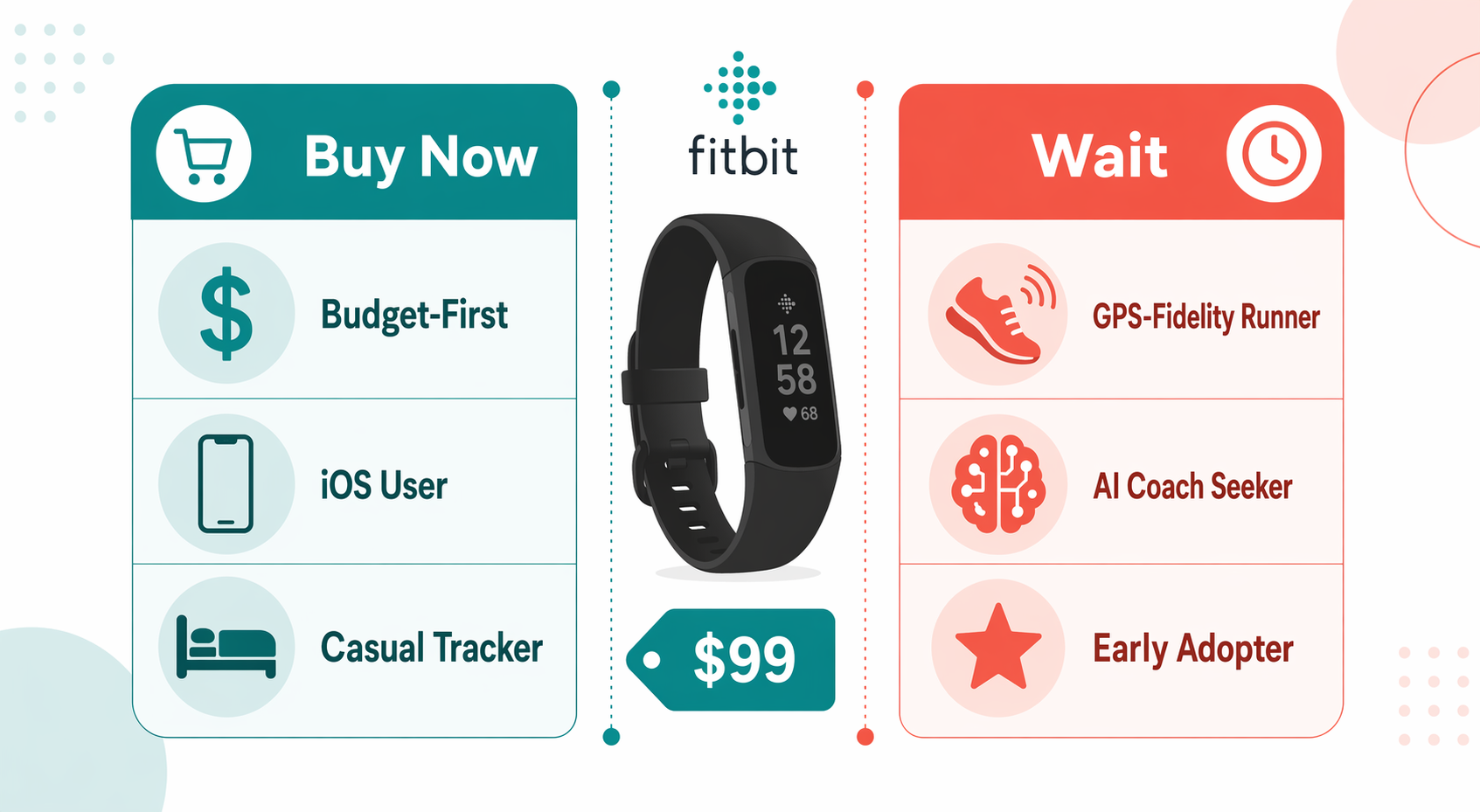
The Charge 6 at $99 is a genuine deal for the right person. But the GPS limitation is not a quirk — it is a design constraint that cannot be fixed. For runners, the wait is not about patience; it is about getting a device that can actually do the job.
This result comes from one real apartment under the stated conditions — it is a strong signal, not a guarantee your space will measure identically.
Builds this evidence supports
No build currently links to this specific test. Browse all builds with a matching tag.
Spot something off?
If this result didn't match your own space, let us know — floor-damage and noise claims carry real deposit-risk consequences if we get them wrong.