
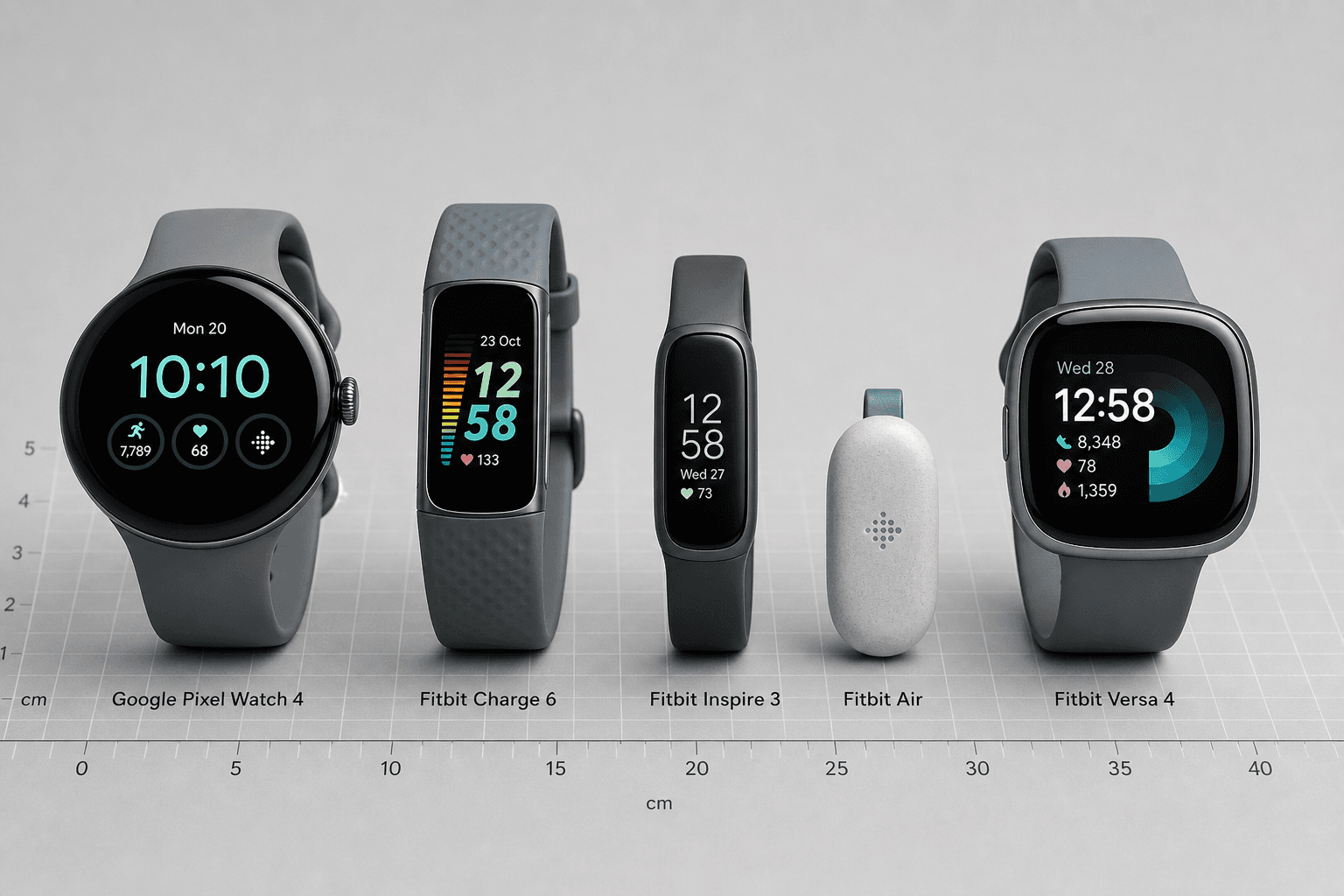
Why Accuracy Matters for Your Home Fitness Decisions
If you wear a Fitbit to guide your home training, you are making decisions based on those numbers — how hard to push during a session, whether you burned enough calories to justify a post-workout meal, or if you recovered well enough overnight. The question is not whether the data looks good on the wrist. The question is whether it is true enough to act on.
This article is an evidence-based audit of Fitbit accuracy across the four metrics home fitness users rely on most: step count, heart rate, calorie burn, and sleep tracking. The analysis draws on the most comprehensive academic review of Fitbit accuracy to date — a 2018 systematic review by Feehan et al. that examined 67 studies involving 2,441 participants — supplemented by hands-on testing from Wirecutter and Forbes. The goal is to give you a clear, honest picture of what you can trust and what you should treat with skepticism.
For a broader look at how Fitbit compares to Garmin, Apple, Whoop, and Oura on accuracy, see our Fitness Tracker Accuracy Report 2026. This article stays focused on Fitbit alone.
Step Count: Fitbit's Strongest Metric — With Important Caveats
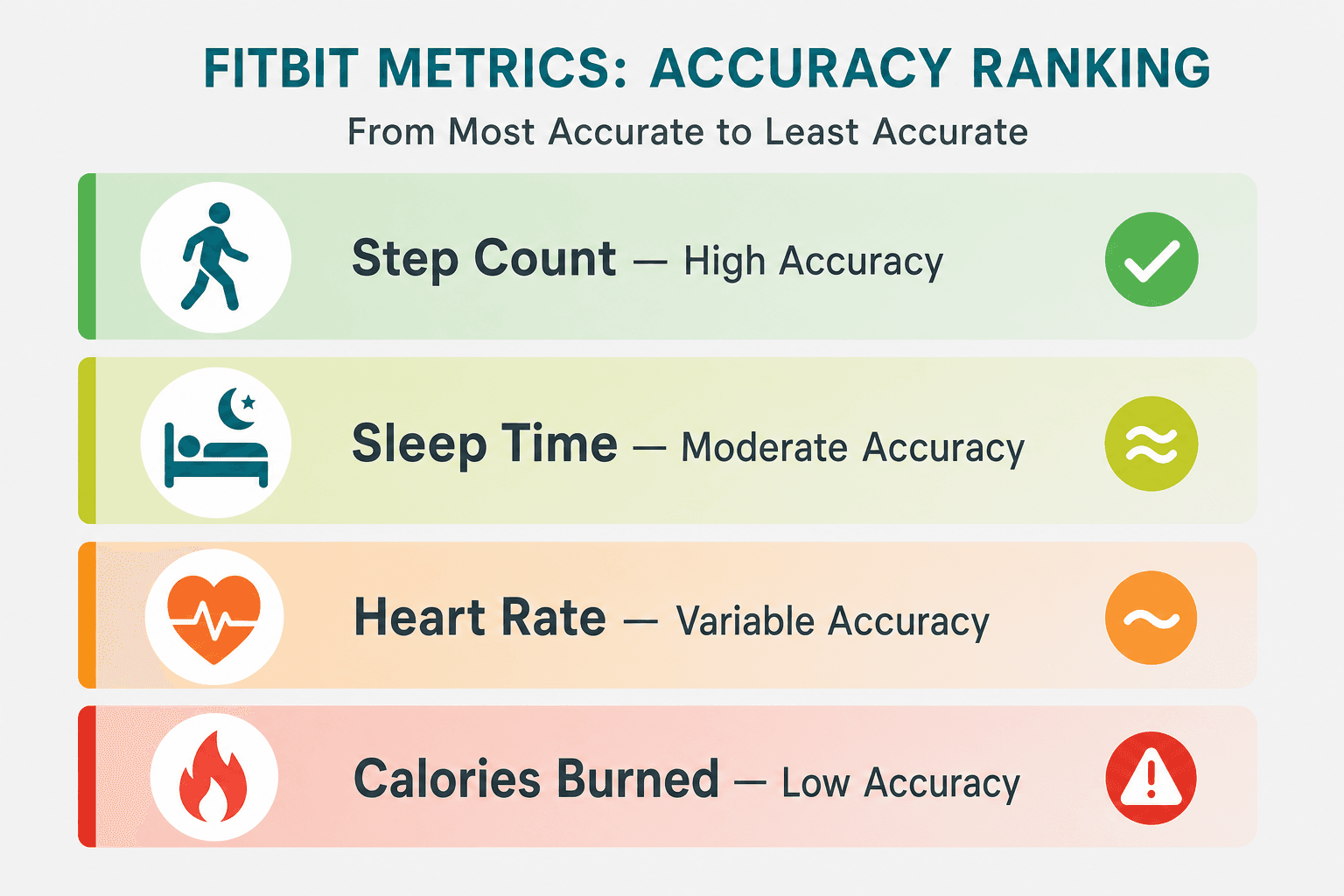
Step counting is where Fitbit performs best, and the data from recent models is impressive. In Wirecutter's 2026 testing, the Fitbit Inspire 3 recorded a step-count error of just 0.32% over a two-day period compared to a manual pedometer readout. In a one-mile distance test, it was over by only 0.03 miles. The Charge 6 posted a 1.3% step-count error and was off by -0.02 miles in the same distance test.
Those numbers suggest that for typical daily walking, a modern Fitbit is highly reliable. But the picture becomes more complicated when you look at the broader evidence base. The Feehan systematic review found that across all controlled testing conditions, Fitbit step counts met the ±3% accuracy threshold only about 46% of the time. The devices also showed a systematic tendency to underestimate steps.
| Metric | Source | Finding |
|---|---|---|
| Inspire 3 step error | Wirecutter (2026) | 0.32% error vs. manual pedometer over 2 days |
| Charge 6 step error | Wirecutter (2026) | 1.3% error vs. manual pedometer |
| Controlled tests within ±3% | Feehan et al. (2018), 67 studies | ~46% of tests met threshold |
| Direction of error | Feehan et al. (2018) | Tendency to underestimate steps |
The discrepancy between the Wirecutter results and the systematic review is partly explained by placement and pace. The Feehan review found that step accuracy improved with torso placement during normal or self-paced walking, with wrist placement during jogging, and with ankle placement during slow walking. A wrist-worn Fitbit during a slow stroll through a grocery store is a fundamentally different measurement scenario than a wrist-worn Fitbit during a brisk outdoor walk.
Heart Rate: Improved Sensors, Persistent Limitations
Fitbit's heart rate tracking has improved noticeably with recent hardware. The Charge 6, for example, uses a redesigned optical sensor that Forbes' tester found to be accurate during high-intensity interval training. During interval sets, the Charge 6 stayed in line with a Polar H10 chest strap control, tracking from approximately 160 bpm during a set down to ~120 bpm during rest within a 30- to 60-second window.
That is a meaningful improvement. Earlier generations of wrist-based optical HR sensors often struggled to keep up with rapid heart rate changes during interval work, producing a smoothed or delayed reading that lagged behind the actual cardiovascular demand.
However, the same Forbes tester noted that during weightlifting sessions, the Charge 6's heart rate tracking got a slow start and was off for several sets compared to the chest strap before catching up. This is a known limitation of optical heart rate sensors: they rely on blood flow changes detected through the wrist, and the combination of muscle contraction, wrist flexion, and rapid movement during strength training can disrupt the optical signal.
| Activity Type | Fitbit HR Performance | Source |
|---|---|---|
| HIIT intervals | Accurate; tracked within Polar H10 range | Forbes Vetted (2026) |
| Weightlifting | Slow start; off for several sets before catching up | Forbes Vetted (2026) |
| Outdoor exercise (Charge 6) | Known GPS and HR accuracy issues reported | Wareable (2026) |
Wareable's 2026 review of the Charge 6 adds another layer of concern, reporting significant problems with the heart rate and GPS accuracy that undermine a huge part of its USP. The site notes that this issue has been well documented by frustrated Charge 6 users in forums over the last couple of years, and that it results in either heart rate or GPS working during outdoor exercise, but not both reliably.
For a deeper look at which trackers perform best for specific workout types, see our guide to the best fitness tracker for your home workout type.
Calorie Burn: The Metric You Should Not Trust
If there is one number on your Fitbit dashboard you should treat with the most skepticism, it is the calorie estimate. The evidence against Fitbit's energy expenditure accuracy is the strongest and most consistent across all metrics.
Fitbit devices were unlikely to provide accurate measures for energy expenditure in any testing condition. — Feehan et al. (2018), systematic review of 67 studies
That is not a hedge. It is a direct conclusion from the most comprehensive academic review of Fitbit accuracy available. The review found that energy expenditure estimates were inaccurate regardless of whether the device was worn on the wrist or the torso, and regardless of the activity being performed. Both overestimates (common with wrist placement) and underestimates (common with torso placement) occurred depending on the testing condition.
Why does this matter for home fitness users? Because calorie estimates are often used to make real decisions — specifically, eating back calories burned during a workout. If your Fitbit tells you that a 45-minute home strength session burned 350 calories, and you eat a 350-calorie snack based on that number, you may be consuming significantly more energy than you actually expended. Over weeks and months, that error can undermine weight management goals.
This accuracy gap also has a financial dimension. If you are paying for Fitbit Premium ($10/month or $80/year) partly for enhanced calorie and nutrition tracking features, you should weigh whether those features deliver value given the underlying data limitations. Our Fitness Tracker Hidden Costs guide breaks down the total cost of ownership across tracker brands.
Sleep Tracking: Decent for Trends, Not for Precision
Sleep tracking is a mixed bag. The Feehan systematic review found that Fitbit overestimates total sleep time by more than 10% compared to polysomnography — the gold-standard clinical sleep measurement — in laboratory settings. That is a meaningful margin of error. If you actually slept 7 hours, your Fitbit might report 7 hours and 45 minutes or more.
| Sleep Metric | Fitbit Performance vs. Polysomnography | Source |
|---|---|---|
| Total sleep time | Overestimates by ~10%+ in lab settings | Feehan et al. (2018) |
| Free-living sleep consistency | Decent for tracking trends night-to-night | Feehan et al. (2018) |
However, the same review found that Fitbit performs reasonably well for tracking sleep time consistency in free-living conditions — meaning, outside the lab, in your own bed, night after night. If your goal is to see whether you slept more or less than your baseline on a given night, the data is useful. If you need precise sleep staging or total sleep time for clinical purposes, it is not.
For home fitness users, this means Fitbit sleep data is best used as a trend tool. If your sleep time drops by an hour for several nights in a row, that is a signal worth paying attention to — your recovery and training performance may suffer. But fixating on the exact number of minutes of deep sleep or REM sleep reported by your wrist is probably not productive, given the accuracy limitations.
If sleep tracking is a primary reason you are considering a wearable, you may want to compare Fitbit's performance against recovery-focused devices. Our best fitness trackers for recovery in 2026 guide ranks devices by sleep, HRV, and readiness accuracy.
What This Means for Your Home Fitness Routine
The accuracy data points to a clear set of practical guidelines for anyone using a Fitbit to support their home training. The device is a useful tool for motivation and trend tracking, but it is not a medical-grade measurement instrument, and treating it as one can lead to poor decisions.
- Use Fitbit for step goals and daily activity tracking. The step count data from modern models like the Inspire 3 and Charge 6 is reliable enough for setting and tracking daily step targets. Just be aware that accuracy drops at very slow walking speeds.
- Use heart rate data during steady-state cardio, but not during strength training. The optical HR sensor works reasonably well for jogging, cycling, and elliptical work. During weightlifting, rely on perceived exertion instead.
- Do not make calorie-based decisions from the estimates. The systematic review is clear: Fitbit energy expenditure data is not accurate enough to guide eating decisions. Do not eat back calories based on what your tracker reports.
- Use sleep data for trends, not precision. Track whether your sleep time is consistent night-to-night, and pay attention to significant drops. Do not obsess over exact sleep stage minutes.
- Treat all metrics as directional, not absolute. The most valuable use of Fitbit data is to track changes over time — is your resting heart rate trending up? Are you walking more this week than last? Trends are more reliable than single-point measurements.
How We Know: Methodology and Source Transparency
The accuracy claims in this article are anchored by the Feehan et al. (2018) systematic review published in the journal JMIR mHealth and uHealth. That review analyzed 67 separate studies involving 2,441 participants, making it the most comprehensive academic assessment of Fitbit accuracy available. It examined step count, energy expenditure, sleep, and heart rate across multiple Fitbit models and testing conditions.
We supplemented the academic review with hands-on testing data from two sources: Wirecutter's 2026 fitness tracker testing (which included controlled step-count and distance tests for the Inspire 3 and Charge 6) and Forbes Vetted's practical testing of the Charge 6's heart rate tracking during HIIT and weightlifting sessions using a Polar H10 chest strap as a reference.
For a broader comparison of accuracy across multiple wearable brands, see our Fitness Tracker Accuracy Report 2026 and our metric-by-metric accuracy deep dive.
Comments
Join the discussion with an anonymous comment.