
Fitbit Fitness Tracker 2026 Buyer's Guide: New Air, Google Health Transition, and Best Model for You
The Fitbit fitness tracker landscape has changed drastically in 2026 with the launch of the screenless Fitbit Air, the Google Health app migration, and the end of standalone Fitbit smartwatches. This guide maps every current Fitbit-compatible device to specific budgets and use cases, explains what's gained and lost in the Google transition, and helps you decide which Fitbit to buy now.
The Fitbit Air is the most interesting wearable Google has released since acquiring Fitbit. It's also the one I'd least confidently recommend to most people. That tension is what makes buying a Fitbit fitness tracker in 2026 genuinely complicated. Three shocks landed within the same month: a screenless $99 pod that looks like a smooth pebble, the forced migration from the Fitbit app to Google Health, and the quiet death of standalone Fitbit smartwatches. If you walked into a store today expecting to pick up a Charge 6 and carry on as before, you'd miss half the story.
Three shocks in one month
On May 7, Google unveiled the Fitbit Air at $99, shipping May 26. Twelve grams, no screen, no GPS, no ECG, no NFC, but a claimed seven-day battery and a five-minute charge that buys a full day. That same week, Google began rolling out the Google Health app to replace the Fitbit app, a transition that completed by May 26. The old app isn't coming back. At the same time, Google confirmed it would not produce new Versa or Sense models — the Pixel Watch is now the only Fitbit smartwatch. By late May, the Fitbit subreddit was flooded with hundreds of negative threads. 600+ upvotes on a post titled "Google Health Ruined Fitbit." That's the context. Now let's look at each piece.
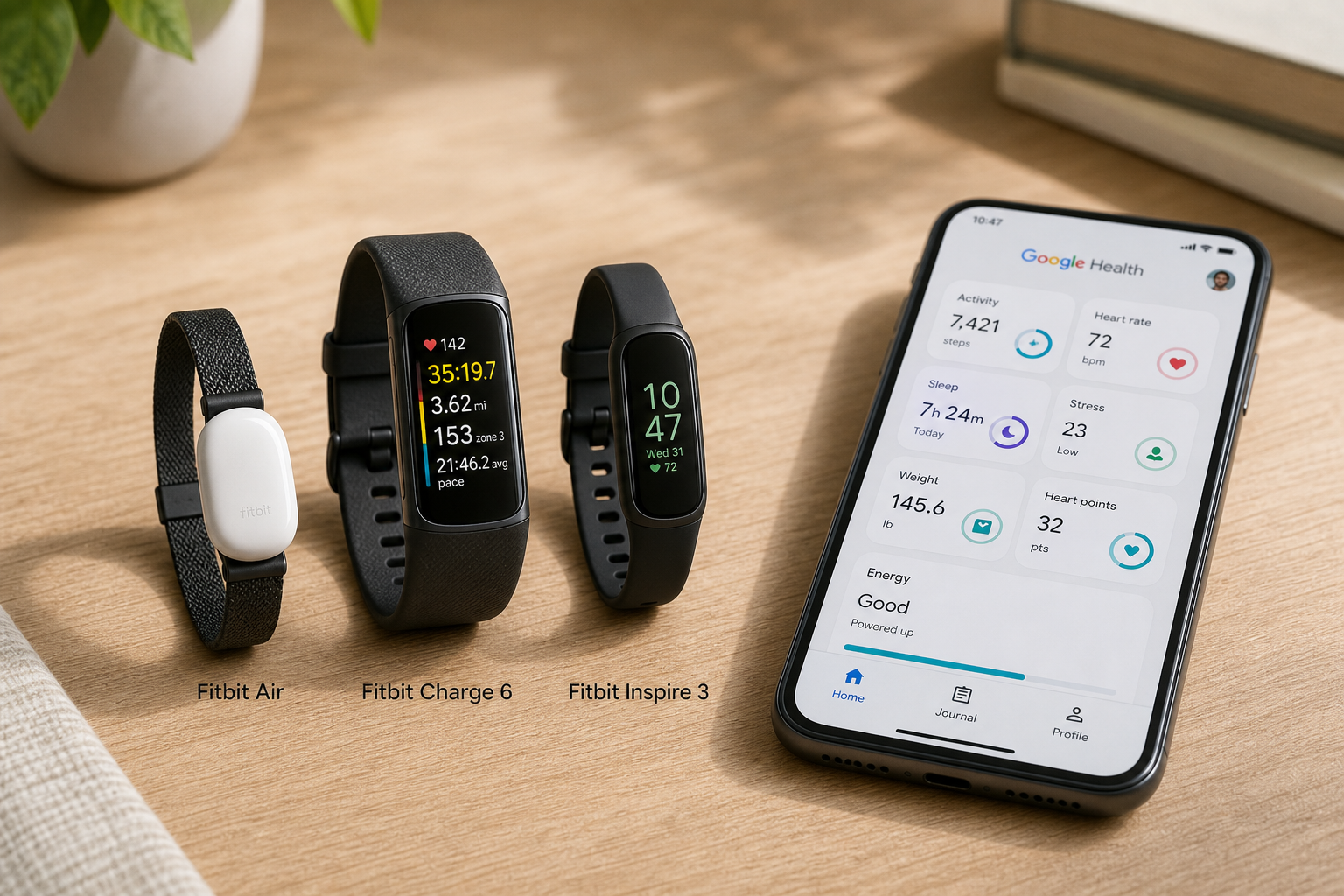
Fitbit Air: lightweight promise, heavy asterisks
The Air is genuinely novel. It weighs 12 grams including the band, fits into a shirt pocket, and its gyroscope helps track swimming and strength training better than a pure PPG clip. Battery life hit the advertised seven days in early reviews — one tester gave it five stars. It uses the same algorithms as the Pixel Watch 4 for VO2 Max and HRV. On paper, it's the kind of minimalism that makes Whoop users think twice.
But the Air has been on the market for exactly one month. Independent accuracy testing — the kind that matters when you're trusting a tracker for HRV trends or daily readiness — simply does not exist yet. Every claim about "15% more accurate sleep tracking" or "120+ bpm HIIT accuracy" comes from Google's marketing or hands-on previews, not a third-party lab. I would not treat those numbers as settled until a Wirecutter or Wareable publishes a controlled test.
The harder problem is the gap between what the Air offers and what many buyers expect. It has no built-in GPS — distance tracking relies on your phone's GPS, which means you need to carry both for outdoor runs. No ECG, no EDA, no NFC for payments. And the AI Health Coach, which is the headline feature after the screenless design, requires a $100/year Google Health Premium subscription. Without it, the Air is a basic step-and-sleep tracker with a Readiness score — fine, but not worth $99 plus recurring cost.
The Air is not a replacement for the Charge 6 or Inspire 3. It's a different category: screenless, subscription-optional-but-costly, and unproven at scale. If you want a minimalist tracker without a screen and you're okay with a $100 annual fee, it's interesting. If you want GPS, a screen, or total cost under $100, skip it.
For a direct comparison with the main screenless competitor, see our Whoop 5.0 vs Fitbit Air guide.
Charge 6's broken GPS vs. Inspire 3's budget reliability
The Charge 6 ($159.95) remains the most feature-packed traditional Fitbit band: built-in GPS, ECG, EDA, NFC, Google Wallet, YouTube Music controls, and over forty exercise modes. It's the obvious pick for someone who wants everything in a band form factor. Except for one thing: the GPS is unreliable. Wareable called it a "huge oversight and issue". Business Insider and Wirecutter also noted connection problems that make it unreliable for runners. If you run outdoors and need accurate distance tracking, the Charge 6's GPS is a dealbreaker — no hedging needed.
The Inspire 3 ($69.95–$99.95), by contrast, has the best step accuracy Wirecutter has ever tested — just 0.32% error over two days against a validated pedometer. It also delivers a measured 8.5 days of battery life, SpO2 monitoring, continuous heart rate, and a color AMOLED display. It lacks GPS, ECG, and NFC, but at half the price of the Charge 6, it's the honest budget king. For sleep tracking, daily steps, and no subscription pressure, the Inspire 3 is still the sensible choice. The thesis that it's "less compelling" in 2026 ignores the fact that it does everything most buyers actually need, better than anything else under $100.
Pixel Watch 4: the daily charger
If you want a Fitbit-compatible smartwatch, the Pixel Watch 4 (and the still-available Pixel Watch 3) is now your only option. Google stopped producing the Versa and Sense lines. The Pixel Watch 4 integrates Fitbit's top heart rate sensors, dual-band GPS, a 3,000-nit display, and the same Gemini AI Health Coach. Battery life: 24–30 hours on the 41mm model with always-on display, up to 40 hours on the 45mm model (without always-on). That is a hard trade-off when a Charge 6 lasts seven days and an Inspire 3 lasts ten. You will charge the Pixel Watch every day. That might be fine for a smartwatch user — but if you came from a Versa 4 with six days of battery, the change is jarring.
For a deeper comparison of screenless trackers vs. smartwatches, see Screenless Fitness Tracker vs. Smartwatch: Which Is Right for Your Home Fitness Setup?
What Google Health actually removed
The Google Health app migration is not a rebrand. It is a feature swap, and the losses are concrete. Here's what disappeared between May 19 and May 26:
- Sleep Profile and monthly sleep animals — removed; you can ask the AI coach about your sleep type instead.
- Fitbit badges — deleted entirely.
- Social features — direct messages, groups, community feed all removed. Social profiles now use your Google account name/picture.
- Stress score — replaced by Resilience (Optimal, Balanced, or Low). No number, no trend line.
- Daily goals — replaced by a weekly cardio target.
- Snore detection and Estimated Oxygen Variation (EOV) — gone.
- Minute-by-minute skin temperature data — removed; daily and weekly trends remain.
- Data associated with removed features can be downloaded until July 15, 2026, after which Google will delete it.
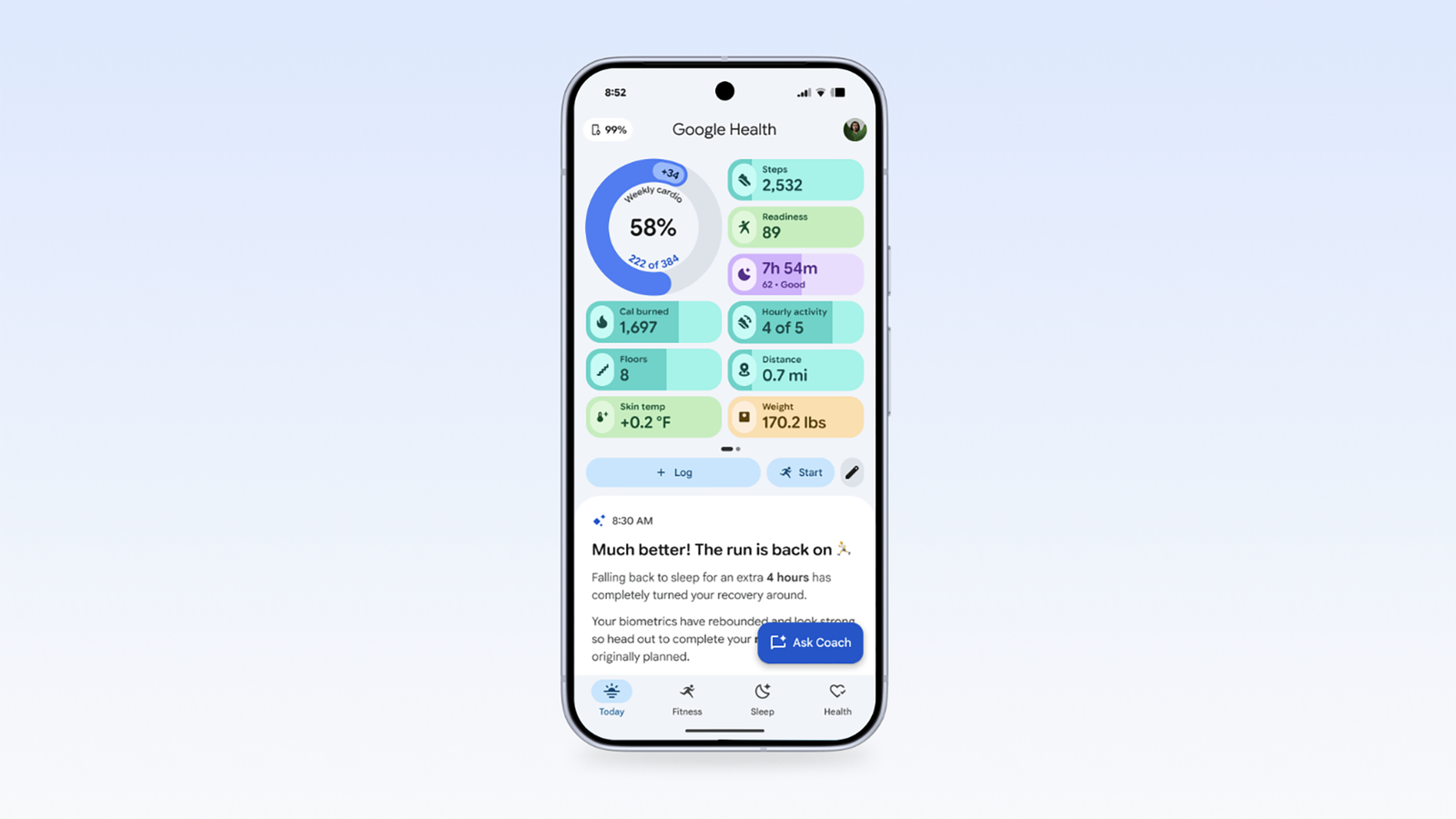
What you get in exchange: a Gemini-powered Health Coach that creates personalized weekly fitness plans, the Resilience metric, a weekly cardio target, and (on compatible devices) a redesigned dashboard. Android Central covered the full list, and user sentiment on Reddit has been overwhelmingly negative. Hundreds of threads in the first week, many from users who said they were switching to Garmin or Polar. I think that's an overreaction — the core tracking (heart rate, sleep, steps, activity) is intact — but the loss of Sleep Profile and badges is real, and for people who relied on social features, the transition is a downgrade.
How much you'll really pay
Fitbit Premium used to cost $80 per year. Google Health Premium is $100 per year. Existing Premium subscribers keep the old rate — for now. The Air requires Premium to use its AI Health Coach. The Charge 6 and Inspire 3 work fine without it, though Premium adds deeper sleep insights and workout libraries. Here's the multi-year cost breakdown:
| Device | Hardware cost | Premium cost (2 years) | Total (2 years) | Subscription needed for full features? |
|---|---|---|---|---|
| Fitbit Air | $99 | $200 | $299 | Yes — no Premium, no AI coach |
| Charge 6 | $160 | $200 (or $0) | $360 (or $160) | No — core features work without Premium |
| Inspire 3 | $99 | $0 | $99 | No — best value without subscription |
| Pixel Watch 4 | $350 | $200 (or $0) | $550 (or $350) | No — but AI coach requires Premium |
Which one actually fits you
Here is the honest breakdown, without hedging.
| Your situation | Best pick | Why not the others |
|---|---|---|
| Budget-conscious, sleep-focused, no subscription wanted | Inspire 3 ($99) | Air requires $100/yr for AI coach; Charge 6 costs more and its GPS is unreliable for outdoor use |
| Outdoor runner needing accurate GPS | Pixel Watch 4 or a Garmin | Charge 6 GPS is unreliable; Air has no built-in GPS |
| Screenless minimalist, okay with subscription | Fitbit Air ($99 + $100/yr) | Only screenless Fitbit option; Whoop costs more per year (see our Whoop vs Air comparison) |
| Smartwatch user who wants apps, notifications, LTE | Pixel Watch 4 ($350) | Versa/Sense are discontinued; Charge 6 and Inspire 3 don't run apps |
| Gym workouts, daily steps, and don't need a screen | Fitbit Air or Inspire 3 | Air if you want screenless form; Inspire 3 if you want a screen and no subscription |
| Already own a Pixel Watch 3 or 4 | Stick with what you have | No need to upgrade unless you want the newer display or battery improvements |
For most people — meaning someone who wants a reliable step tracker, sleep monitor, and occasional workout logging without a monthly fee — the Inspire 3 is still the best Fitbit. It is accurate, long-lasting, and doesn't nudge you toward a subscription. If you need GPS for running, the Pixel Watch 4 is the obvious Fitbit-compatible choice, but be prepared to charge daily. The Charge 6 sits in an uncomfortable middle: feature-rich on paper, but its GPS flaw limits its appeal for the one use case that justifies its price over the Inspire 3.
The Air is the most exciting Fitbit in years — I don't want to understate that. A 12-gram screenless tracker with seven-day battery and real AI coaching is genuinely innovative. But it's a niche product for people who want screenless minimalism and are comfortable with a subscription. It is not a universal replacement for the Charge 6 or Inspire 3, and the thesis that it's the best pick for most buyers overstates the case. If you're curious about screenless trackers beyond Fitbit, check out our Screenless Fitness Tracker Buyer's Guide 2026.
One final reminder: the Google Health transition is still settling. Some features may come back. Third-party apps may fill gaps. But as of June 2026, the honest advice is this: buy the tracker that fits your real use case, not the one with the most headlines. The Inspire 3 and Pixel Watch 4 are the two safest bets. The Air is a bet on a future that hasn't fully arrived yet.
This result comes from one real apartment under the stated conditions — it is a strong signal, not a guarantee your space will measure identically.
Builds this evidence supports
No build currently links to this specific test. Browse all builds with a matching tag.
Spot something off?
If this result didn't match your own space, let us know — floor-damage and noise claims carry real deposit-risk consequences if we get them wrong.