
The 7-Minute Workout: What the Science Actually Says (and Doesn't Say)
The 7-minute workout is famous for being 'science-backed,' but what does the research really support? This article separates fact from fiction, explains the original protocol’s limitations, and tells you who benefits most — and who should look elsewhere.
The 7-minute workout is routinely called "science-backed." The phrase appears in headlines, app descriptions, and casual conversation. But the original 2013 article in ACSM's Health & Fitness Journal was not a clinical trial — it was a literature review and a protocol design. I have watched too many fitness trends lean on that phrase without the receipts. This article is about that gap, and about what the workout actually delivers if you know how to use it.
The 2013 Article Was a Proposal, Not a Trial
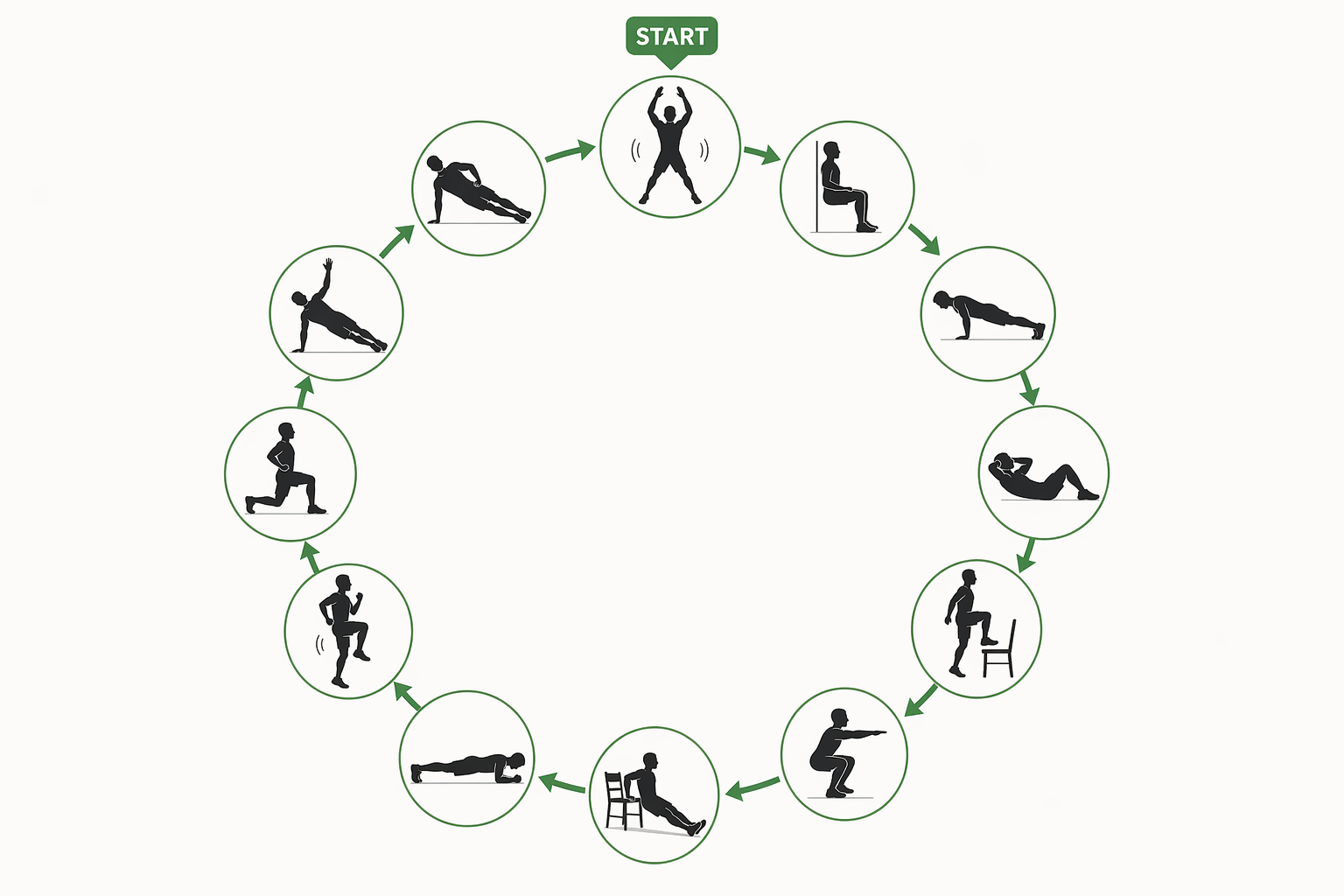
In May 2013, exercise physiologist Chris Jordan and colleagues published a piece in ACSM's Health & Fitness Journal titled "High-Intensity Circuit Training Using Body Weight." It proposed a 12-exercise circuit — jumping jacks, wall sit, push-up, abdominal crunch, step-up, squat, triceps dip, plank, high knees, lunge, push-up with rotation, and side plank — performed for 30 seconds each with 10 seconds of rest. The idea was to alternate upper and lower body movements so one muscle group rests while another works, packing a full-body workout into a short window.
The article reviewed existing research on HIIT and resistance training and synthesized those findings into a time-efficient protocol. It was a well-constructed proposal. It was not a study. As SELF confirmed later, the article "reviewed existing research rather than conducting a new clinical trial." That distinction matters because "science-backed" implies a direct experiment that tested the protocol and found it effective. That experiment came later — and the results are more modest than the hype suggests.
The ‘7-Minute’ Name Is Wrong — It’s 14 to 21 Minutes
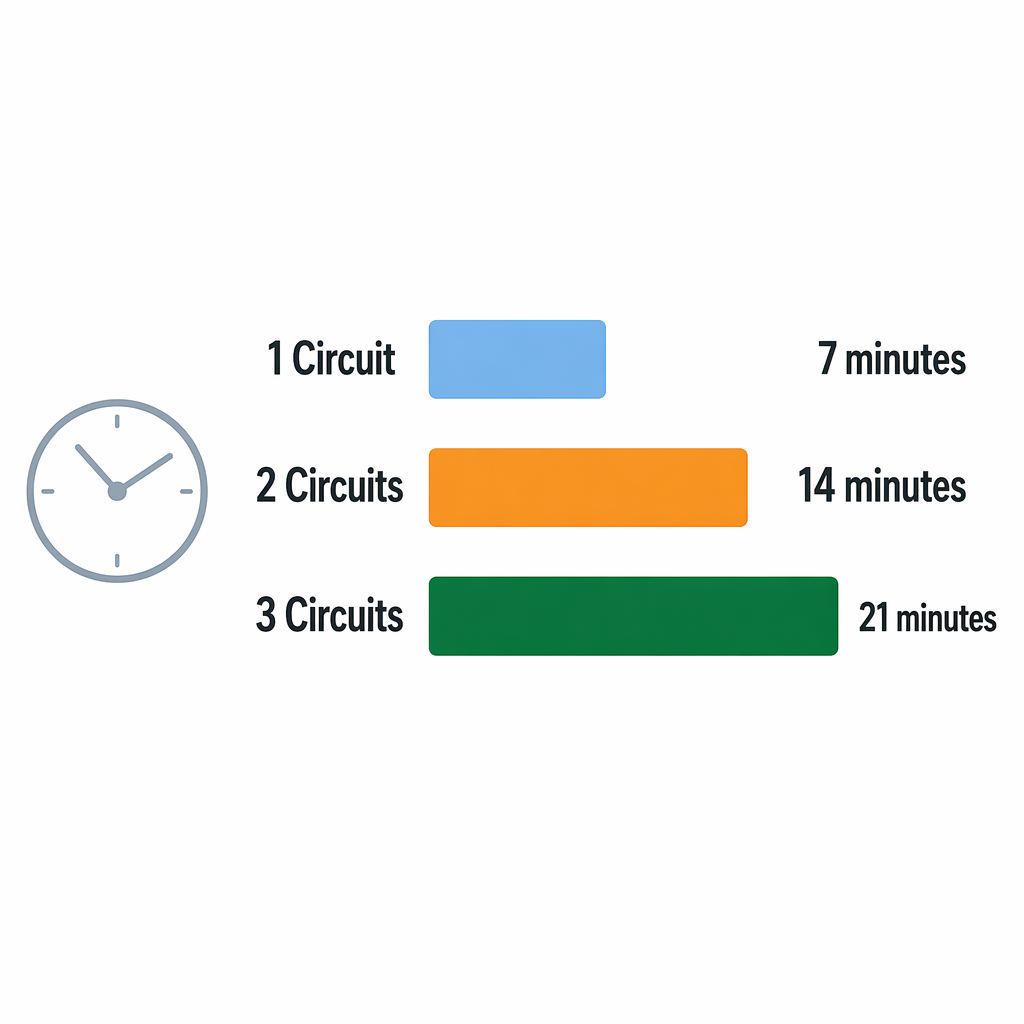
The first thing almost everyone gets wrong is the duration. The original article explicitly states: "The circuit can be repeated 2 to 3 times." Cleveland Clinic says the same: the workout is designed for 2–3 circuits, totaling 14–21 minutes. The workout's creator has repeatedly confirmed that you need to repeat the circuit two or three times to get the intended benefits.
One circuit is a sample. Two or three circuits is the workout.
What the Follow-Up Studies Actually Found
The strongest direct evidence comes from a 2020 crossover study at Texas A&M that compared a single 7-minute bodyweight circuit to a 7-minute cycling HIIT protocol in 12 healthy young adults. The bodyweight circuit produced a significantly lower diastolic blood pressure (2.273 mmHg lower, p=0.002) and a higher average heart rate (145.2 vs. 126.3 bpm). No differences in systolic BP, blood glucose, or triglycerides. So the bodyweight circuit was at least as effective as cycling HIIT for acute cardiometabolic response, and better for diastolic BP.
Other studies looked at longer-term effects. A 2017 study by Mattar et al. had participants perform the 7-minute circuit daily for six weeks without dietary changes. Outcomes: reductions in waist circumference and fat mass. Real but modest — not the kind of transformation you see in ads.
A 2016 study by Schmidt et al. compared both the 7-minute and a 14-minute circuit over eight weeks and found improvements in muscular endurance and strength — proportionally to volume. The 14-minute circuit produced larger effects. That is not surprising.
| Study | Duration | Key Findings |
|---|---|---|
| Texas A&M 2020 | Single session | Comparable cardiometabolic response to cycling HIIT; lower DBP; higher HR. |
| Mattar 2017 | 6 weeks, daily | Reduced waist circumference and fat mass (no diet changes). |
| Schmidt 2016 | 8 weeks | Improved muscular endurance and strength; larger improvements with 14-min circuit. |
None of these studies is perfect. The Texas A&M sample was small and looked only at acute responses. The Mattar study was cited in the NY Post without raw numbers. The Schmidt study confirmed that more volume yields more benefit — which is intuitive. Still, the convergence is hard to ignore: the workout works, within limits.
What It Actually Delivers (and Doesn’t)
An ACE-sponsored study found that a 20-minute bodyweight circuit burned about 15 calories per minute. Scale that: one circuit ~105 calories, two ~210, three ~315. Those numbers are useful if you would otherwise do zero minutes of exercise. They are not a weight-loss protocol. A 30-minute jog will burn more. The 7-minute workout is a filler, not a furnace.
The original ACSM article itself concedes: "HICT may be inferior to traditional programs for creating absolute strength and power." SELF puts it plainly: the 7-minute workout improves muscular endurance but is not sufficient for significant strength gains or hypertrophy. If you want visible muscle growth or a higher one-rep max, this is not your program. That is not a failure of the design — it is a boundary. The workout uses only body weight, short intervals, and no progressive overload. It was never intended to replace a barbell squat, but the marketing often blurs that line.
Who Should Be Careful
The ACSM article includes a specific warning: for individuals with hypertension or heart disease, the isometric exercises (wall sit, plank, side plank) are not recommended. Cleveland Clinic advises that people with cardiovascular disease should have a stress test before starting this workout.
The intensity required (about an 8 on a 1–10 discomfort scale, per the original protocol) is also higher than many beginners expect. It is not a gentle warm-up.
Who Benefits Most — and Who Should Look Elsewhere
After reading the evidence, here is a fair summary:
- Beginners with no equipment and low confidence: The 7-minute workout is an excellent low-barrier entry point. Short, no gear, simple movements. Do two or three circuits.
- Travelers or busy workers: As a filler workout when you cannot access a gym, it holds genuine value. One circuit is better than nothing; two is better.
- Intermediate or advanced trainees: This workout will not replace your strength or hypertrophy program. It can serve as a conditioning finisher or active recovery, but it is not a complete training session.
- Anyone seeking significant cardio conditioning: The heart rate response is real, but the duration is short. For aerobic endurance, longer steady-state or longer HIIT sessions are more effective.
The 7-minute workout is a well-designed tool with a clearly defined use case. It is not a miracle. It is not a complete fitness solution. But for the person who otherwise does nothing, it is a genuinely useful starting point — as long as they ignore the overblown claims and do the full 14 to 21 minutes.
What a small equipment investment adds
We don't have a build tagged to this exact tier yet. Browse all builds.
How often should you repeat this?
See our recovery and rest reference for citation-anchored rest-interval guidance.
Spot something off?
Tell us if a movement, tier assumption, or duration didn't match your experience.