
The 7-Minute Workout for Beginners: A Complete Guide to Doing It Right
Most beginners do the 7-minute workout at insufficient intensity, skip modifications, and miss that the protocol is designed for 2–3 circuits. This guide breaks down each exercise with form cues, beginner modifications, and a progression plan so you get real results.
It Didn't Work? You Probably Did It Wrong
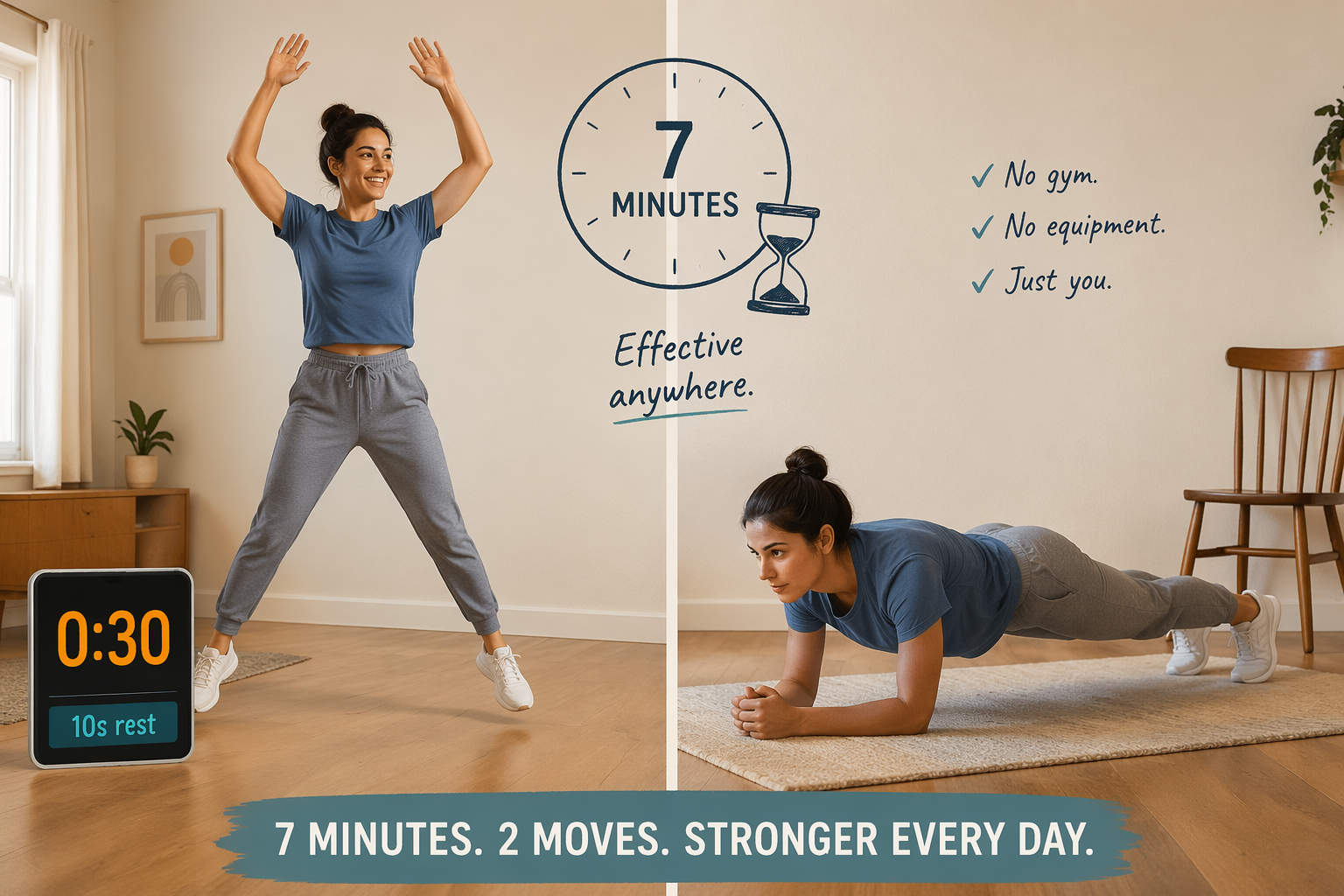
You hit play, went through twelve exercises at a comfortable pace, barely broke a sweat, and told yourself the 7-minute workout is overhyped. I've watched people do exactly that and then dismiss the protocol as useless. The problem isn't the workout. It's how you executed it. Three things separate the version that works from the one that feels like a warm‑up: intensity, modifications, and volume.
You're Not Working Hard Enough: What an 8 Out of 10 Feels Like
The original protocol, published in ACSM's Health & Fitness Journal in 2013, calls for an intensity of roughly 8 on a 0–10 perceived exertion scale. That is not “work fairly hard.” At an 8, you cannot hold a conversation. You can say one word between breaths. You should be aiming for 15 to 20 repetitions in each 30‑second bout. If you're not hitting that range, you're coasting.
One Circuit Is a Warm‑Up, Not a Workout
The name “7‑minute workout” has misled almost everyone. The creators, exercise physiologist Chris Jordan and Brett Klika, designed the circuit to be repeated two to three times. One round is seven minutes; the full protocol is 14 to 21 minutes. The Cleveland Clinic confirms: “The workout is intended to be repeated two to three times (total 14 or 21 minutes).” Healthline says the same. So when you did a single circuit and felt nothing, you missed the point.
The studies that show positive outcomes — decreased waist circumference, reduced fat mass, and weight loss after 6 weeks of daily 7‑minute workouts (Mattar et al. 2017), and improved muscular strength and endurance after 8 weeks of training three times per week (Schmidt et al. 2016) — used the full 2‑ to 3‑circuit dose. Participants were coached on form and intensity, not just told to move through the list.
The Order Matters: Why Upper and Lower Alternate
The twelve exercises are arranged to alternate upper‑ and lower‑body movements. That gives one muscle group a few seconds of active recovery while the other works — the whole point of high‑intensity circuit training. Reorder them or skip one and you break that recovery logic.
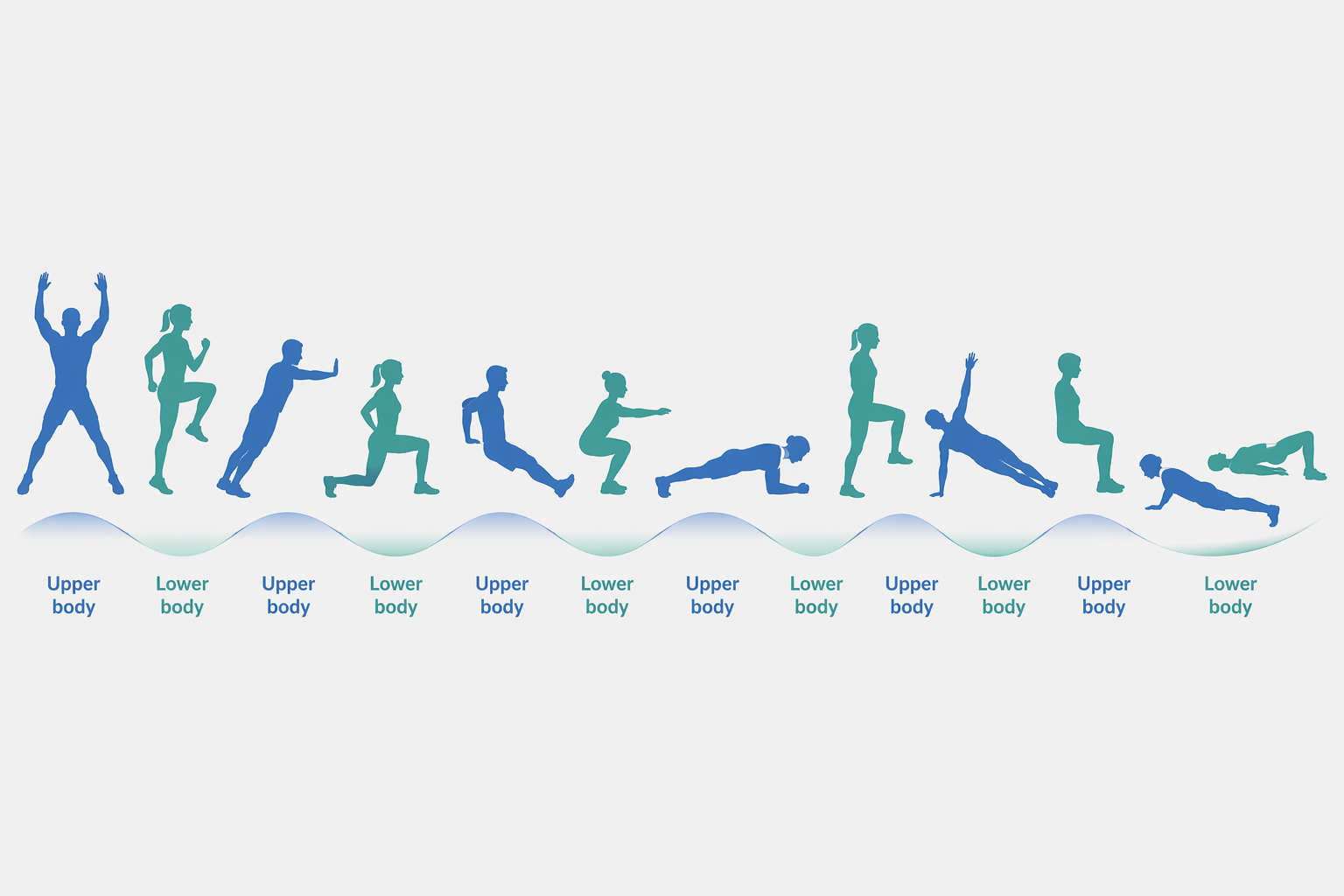
| Exercise | Target | Form Cue | Beginner Modification |
|---|---|---|---|
| Jumping jacks | Full body, cardio | Land softly, keep core engaged | Step side to side, no jump |
| Wall sit | Quads, glutes | Back flat against wall, knees at 90° | Hold for 15 seconds, work up to 30 |
| Push‑up | Chest, shoulders, triceps | Hands shoulder‑width, body a straight line | Knee push‑ups on the floor |
| Abdominal crunch | Rectus abdominis | Lower back pressed to floor, lift shoulders | Small crunch with hands under lower back |
| Step‑up onto chair | Quads, glutes, hamstrings | Full foot on chair, drive through heel | Use a lower step or stool |
| Squat | Quads, glutes, core | Chest up, knees track over toes | Hold a doorframe or wall for balance |
| Triceps dip on chair | Triceps, shoulders | Walk feet out, lower hips toward floor | Use a lower chair or bench |
| Plank | Core, shoulders, glutes | Body straight, don’t sag or pike | Drop to knees, maintain straight line |
| High knees / running in place | Hip flexors, cardio | Lift knees to waist height | March in place with high knees |
| Lunge | Quads, glutes, hamstrings | Front knee at 90°, back knee hovers | Reverse lunge or hold wall for balance |
| Push‑up and rotation | Chest, shoulders, obliques | Push up, rotate to side, extend arm | Perform without rotation, just push‑up |
| Side plank | Obliques, shoulders, glutes | Stack feet, lift hips, hold straight line | Drop bottom knee to floor |
Most people skip modifications because they see them as “easier versions.” I see them as the correct entry point. The workout is designed to be brutal for 30 seconds. If you cannot manage the standard version at the required intensity, the modification lets you still hit an 8 out of 10. That is far more effective than the full version at a 5.
How to Add Circuits Without Burning Out
If you are starting from zero, do not jump straight to three circuits. Your body needs time to adapt. Here is a straightforward four‑week progression based on the studies that produced results:
| Week | Circuits per Session | Effort | Rep Goal per Bout |
|---|---|---|---|
| 1 | 1 circuit with modifications | RPE 7–8 | 12–15 reps |
| 2 | 1 circuit, standard exercise | RPE 8 | 15–20 reps |
| 3 | 2 circuits (2 min rest between) | RPE 8 | 15–20 reps |
| 4 | 3 circuits (2 min rest between) | RPE 8–9 | 15–20 reps |
Track your progress by counting reps in each 30‑second bout. The ACSM recommends 15 to 20 as the target. If you are hitting that range, you are at the right intensity. If you are below, slow down or use a modification. If you are above, you are probably moving too fast to maintain form — or the exercise is not challenging enough and you need a harder variation.
Using a workout tracker app can help you manage timing, rest intervals, and rep logging. Look for one that lets you set custom work/rest intervals and logs reps per exercise.
When to Move On
The signal that you are ready for more is when you can easily hold a conversation or sing while completing the original workout. That means your body has adapted and the same stimulus is no longer challenging. At that point you have two choices: move to Chris Jordan’s Power Workout (a more demanding version) or switch to the low‑impact Gentle Workout if joint issues are a concern. Both are available in the Washington Post’s interactive series.
Check With a Doctor First
The 7‑minute workout is high‑intensity, and high‑intensity is not for everyone without preparation. The ACSM and the Cleveland Clinic both list specific groups who should seek medical clearance before starting:
- People who are overweight or obese and have not exercised recently
- Individuals who are detrained or have been inactive for a long period
- Anyone with a previous injury that may be aggravated by explosive movements or isometric holds
- Older adults, especially those with balance issues or low bone density
- Those with hypertension, heart disease, or other cardiovascular conditions — isometric exercises like the wall sit and plank can spike blood pressure
If any of these apply, talk to your primary care provider before you start. A stress test may be recommended, especially if you have known heart issues. The workout will still be there next week.
I have seen the 7‑minute workout work well for people who treat it with respect — dial up the intensity, use modifications as tools, and commit to the full 2–3 circuits. That version is legit. The version you tried before was not.
What a small equipment investment adds
We don't have a build tagged to this exact tier yet. Browse all builds.
How often should you repeat this?
See our recovery and rest reference for citation-anchored rest-interval guidance.
Spot something off?
Tell us if a movement, tier assumption, or duration didn't match your experience.