
What to Look for in a Workout Tracker App: A Buyer's Framework for 2026
Most fitness app reviews focus on exercise library size and flashy interfaces, but research shows these features don't predict long-term use. This framework helps intermediate users evaluate workout tracker apps based on what actually drives adherence: adaptive programming, structured progression, engagement mechanics, and meaningful progress tracking.
Why Most Fitness Apps Fail to Keep You Consistent
You downloaded a workout tracker app, logged your first three sessions, felt motivated — and then you stopped opening it. If that pattern sounds familiar, you are not alone. Across the health and fitness app category, average 30-day retention hovers around 27%, according to data from Business of Apps (2026). That means nearly three out of four people who download a fitness app have stopped using it within a month.
The problem is not a lack of willpower. The problem is that most app reviews and marketing materials emphasize the wrong signals. They highlight exercise library size, interface polish, and social features — elements that feel impressive on first launch but do not predict whether you will still be using the app six weeks later. The global health and fitness app market reached an estimated $15.9 billion in 2026 (Mobile Squad), yet subscription churn rates have actually increased, climbing from 8.2% per month in 2023 to 11.7% in 2025 (Sensor Tower). The market is growing, but users are leaving faster than ever.
This article offers a different approach. Instead of ranking apps by feature counts, it builds an evaluation framework around what behavioral research actually shows drives long-term adherence. If you have tried and abandoned a workout tracker app before, the framework below will help you identify why — and what to look for in the next one.
The Four Features That Actually Predict Long-Term Use
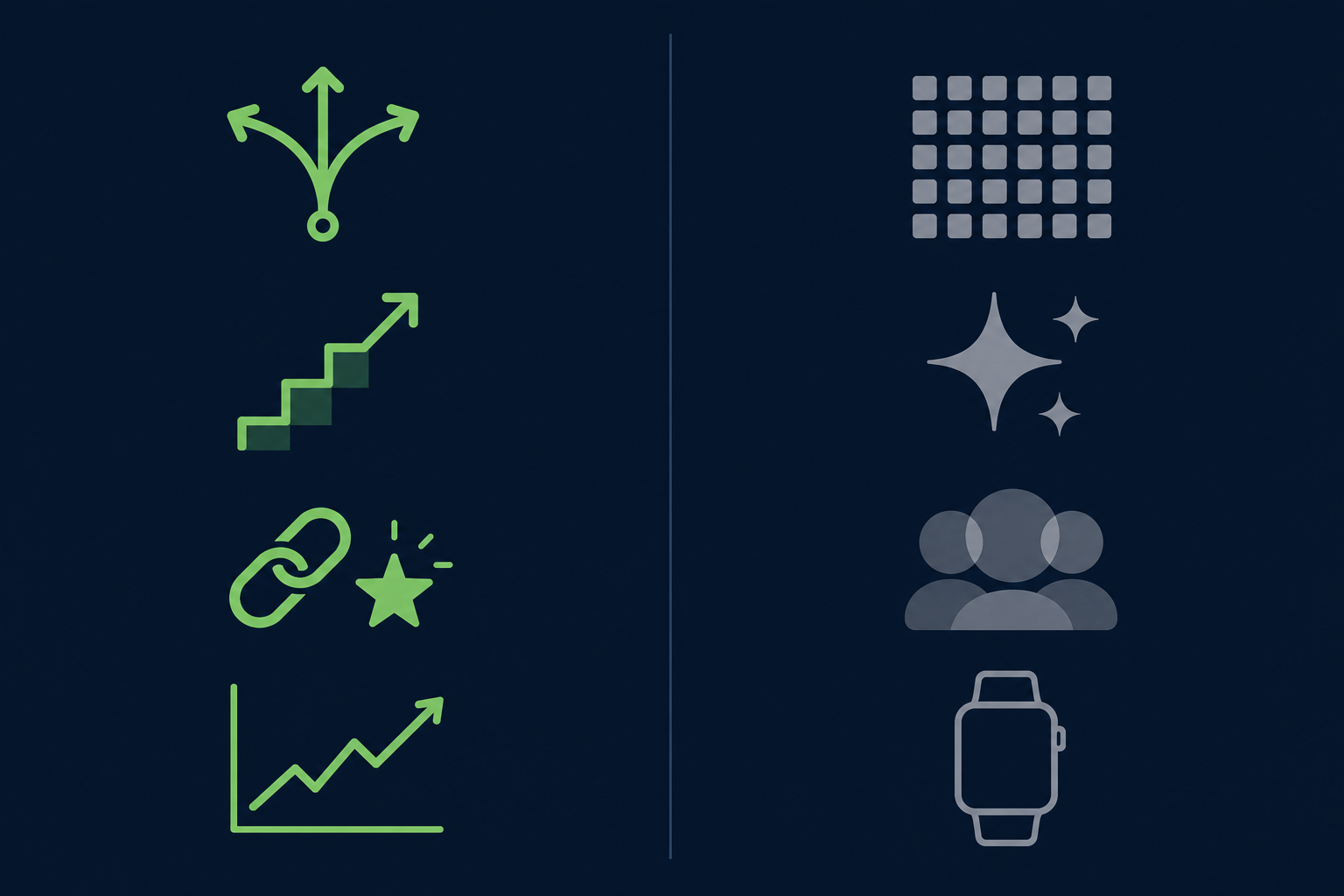
After reviewing the available research on fitness app engagement, four features consistently emerge as predictors of whether a user will still be logging workouts three months later. These are not the features that look best in a screenshot. They are the features that solve the psychological and logistical barriers that cause people to quit.
1. Adaptive Programming
A 2024 systematic review and meta-analysis published in eClinicalMedicine (a Lancet journal) found that apps with adaptive, personalized interventions produced significantly greater improvements in physical activity compared to static or generic programs. In plain terms: an app that adjusts your workout based on your performance, recovery, and progression keeps you engaged because it always meets you where you are. A static program, no matter how well-designed on day one, becomes irrelevant as you improve — or as you miss sessions and need to scale back.
What to look for: Does the app modify your next workout based on the weights you logged, the reps you completed, or the exercises you skipped? Or does it serve the same routine every time until you manually change it?
2. Structured Progression
Progression is the engine of training adaptation, but most apps treat it as an afterthought. A good app does not just log what you did — it tells you what to do next and makes the next session harder in a controlled way. This is the difference between a tracker and a coach. Apps that bake in progressive overload — whether through auto-incrementing weights, volume recommendations, or periodized program phases — give users a reason to return: the app is driving their progress, not just recording it.
What to look for: Does the app suggest weight increases, rep targets, or volume adjustments? Can it handle deload weeks or recovery sessions without you having to manually reset everything?
3. Engagement Mechanics
A 2022 systematic review in JMIR mHealth and uHealth examined gamification across 50 mHealth studies and found that apps using multiple game elements — streaks, progression systems, rewards, challenges — significantly improved physical activity participation compared to non-gamified alternatives. The key word is "multiple." A single streak counter is not enough. The most effective apps layer several engagement mechanics: a visible streak for consecutive log days, a progression system that unlocks features or badges, and periodic challenges that create short-term goals.
What to look for: Does the app make you want to log a workout even on days when motivation is low? Does it celebrate consistency or only performance?
4. Meaningful Progress Tracking
Progress tracking is the most commonly cited feature in app marketing, but most implementations are shallow. A line chart of total volume over time is not meaningful if it does not connect to your goals. Meaningful tracking answers specific questions: Is my bench press going up? Am I recovering between sessions? Which muscle groups am I neglecting? Apps that surface these insights — through volume heat maps, estimated one-rep max trends, or recovery scores — give users a reason to keep logging because the data becomes actionable.
What to look for: Can the app show you a trend for a specific exercise over the last month? Does it visualize muscle group volume balance? Can you export your data if you switch apps?
Features That Sound Great but Don't Predict Retention
The four features above are not the ones most app reviews lead with. Here is why the usual suspects fall short — and what the research says about them.
- Massive exercise libraries: Having 4,000 exercises sounds impressive, but research shows decision fatigue from too many options can accelerate dropout. A smaller, curated library with clear progression paths is more effective than a database you have to search through every session.
- Flashy UI: A beautiful interface creates a strong first impression but does not sustain behavior. Once the novelty wears off, the app's utility — not its aesthetics — determines whether you return.
- Social feeds and leaderboards: For a subset of highly competitive users, social features are motivating. For the majority, they introduce comparison anxiety and social pressure that reduces adherence. The 2022 JMIR review found that social features alone did not predict retention — they need to be paired with other engagement mechanics.
- Wearable integration alone: Syncing with a smartwatch or fitness ring provides data input, but data input is not coaching output. An app that passively collects heart rate data without using it to adjust your training plan is not solving the adherence problem — it is just adding another data stream.
How Top Apps Score Against the Adherence Criteria
The table below scores five popular workout tracker apps — Hevy, Strong, Caliber, Fitbod, and JEFIT — against the four adherence-driving features. Scores are based on publicly available feature sets and testing data from Garage Gym Reviews, LoadMuscle, and Forbes Health as of mid-2026.
| App | Adaptive Programming | Structured Progression | Engagement Mechanics | Meaningful Progress Tracking | Pricing |
|---|---|---|---|---|---|
| Caliber | Strong (free science-based algorithm generates custom programs) | Strong (free version includes periodized programming) | Moderate (community features, no streak system) | Strong (volume tracking, progress graphs) | Free (premium coaching from $200/mo) |
| Fitbod | Strong (AI adjusts based on muscle recovery and session-level fatigue) | Strong (adaptive progression with deload considerations) | Weak (no gamification features) | Strong (muscle recovery scores, volume balance) | $15.99/mo (no free version) |
| Hevy | Weak (no adaptive programming in free or paid) | Moderate (manual progression, auto-increment available) | Strong (streak tracking, heat maps, social features) | Strong (progress graphs, muscle group volume heat map) | Free (premium from $2.99/mo) |
| Strong | Weak (no adaptive programming) | Moderate (manual progression, plate calculator) | Weak (no gamification features) | Moderate (1RM estimates, CSV export in premium) | Free (premium ~$5/mo) |
| JEFIT | Weak (no adaptive programming) | Moderate (pre-built programs, manual progression) | Weak (basic logging, no streak system) | Moderate (training log, progress tracking) | Free with ads (premium ~$7/mo) |
A few patterns stand out. Caliber and Fitbod lead on adaptive programming and structured progression — the two features most strongly linked to adherence by the 2024 eClinicalMedicine meta-analysis. Hevy leads on engagement mechanics, with its streak tracking and muscle group heat maps creating a compelling reason to log consistently. Strong and JEFIT, while popular for their logging speed and exercise databases, score lower on the features that actually predict long-term use.
Your 7-Question Evaluation Checklist
Use this checklist to evaluate any workout tracker app — whether you are choosing a new one or trying to understand why your current app is not sticking. Each question maps to one of the four adherence-driving features.
- Does the app adjust your workout based on your performance from the last session? (Adaptive programming) If the answer is no, you are relying on your own motivation to decide what to do each session — which is exactly what causes dropout.
- Does the app automatically suggest weight increases or volume changes? (Structured progression) Manual progression works for disciplined users, but most people need the app to drive progress, not just record it.
- Does the app have at least two engagement mechanics beyond basic logging? (Engagement mechanics) Streaks, challenges, progression systems, or badges — one is not enough; the 2022 JMIR review found that multiple game elements are more effective than single ones.
- Can the app show you a trend for a specific exercise over the last 30 days? (Meaningful progress tracking) If you cannot see whether your squat is going up, the app is not helping you train — it is just a digital notebook.
- Does the app visualize muscle group volume balance? (Meaningful progress tracking) A heat map or volume breakdown helps you avoid neglecting muscle groups — a common mistake that leads to plateaus and injuries.
- Can you export your data in a standard format (CSV or similar)? (Data portability) If the app locks your data in a proprietary format, switching apps later means losing your history. Most reputable apps offer CSV export (Setgraph).
- Does the app process your biometric data on-device or send it to a server? (Privacy) This question is covered in detail in the privacy checklist below.
When Premium Features Actually Move the Needle
The average workout app costs approximately $34 per month across the apps tested by Garage Gym Reviews. But paying more does not automatically mean better adherence. The question is whether the premium features you are paying for actually support the four adherence criteria — or whether they add complexity you do not need.
Here is where premium features genuinely move the needle:
- Fitbod's adaptive AI ($15.99/mo): This is a legitimate adherence driver. Fitbod adjusts workouts based on muscle recovery and session-level fatigue — directly supporting adaptive programming and structured progression. If you struggle with knowing what to train each day, this premium feature solves a real problem.
- Hevy's advanced analytics ($2.99/mo): At this price point, the premium tier adds meaningful progress tracking features (advanced graphs, data export) without being a major investment. The free version already includes streak tracking and muscle group heat maps — two of the four adherence criteria.
- Strong's premium (~$5/mo): Strong's premium unlocks CSV export, cloud sync, and advanced analytics. If logging speed is your priority and you do not need adaptive programming, this is a reasonable upgrade — but it does not add any of the four adherence-driving features.
- Caliber's free version: Caliber offers a free-forever version with over 500 exercises, video demonstrations, and a science-based algorithm that generates custom workout programs. This is the strongest free option for adaptive programming and structured progression — no premium upgrade needed for those features.
| App | Free Tier | Premium Price | Adherence Features Added by Premium |
|---|---|---|---|
| Caliber | Full adaptive programming, 500+ exercises | $200/mo (coaching) | None for core adherence (coaching adds human oversight) |
| Fitbod | 3-workout trial only | $15.99/mo | All features (adaptive AI is premium-only) |
| Hevy | Streak tracking, heat maps, logging | $2.99/mo | Advanced analytics, data export |
| Strong | Basic logging, limited routines | ~$5/mo | CSV export, cloud sync, advanced analytics |
| JEFIT | Logging with ads, large exercise DB | ~$7/mo | Ad-free, cloud sync |
Privacy Checklist: What to Check Before You Commit
Privacy concerns among fitness app users are rising. A 2025 survey by the International Association of Privacy Professionals (IAPP) found that 68% of fitness app users expressed concern about how their health and exercise data is being used, up from 52% in 2022. A 2019 BMJ study of 24 medicine-related Android apps found that 79% shared user data with outside entities, with a median app's data reaching three unique fourth parties — some as many as 140 different transfers (SensAI).
Use this checklist to evaluate any workout tracker app's data practices before committing your training history:
- Does it process raw biometric data on-device or send it server-side? On-device processing is generally more private. If the app sends your heart rate, sleep data, or workout details to a server, ask what happens to that data after processing.
- What is the LLM provider's data retention policy? If the app uses AI for workout generation, check whether your data is used to train the model. Some providers retain prompts and responses indefinitely.
- Are wearable integrations done via platform privacy boundaries or direct OAuth? Apple Health and Google Fit provide privacy boundaries that limit what data the app can access. Direct OAuth integrations may give the app broader access.
- Are there third-party analytics or ad SDKs? Free apps with ads often include third-party SDKs that track usage data. Check the app's privacy policy for a list of third-party partners.
- Is the privacy policy specific or boilerplate? A vague privacy policy that does not name specific data processors or retention periods is a red flag. Look for specific language about data categories, storage locations, and deletion procedures.
- Can you export your data in a portable format? Most reputable apps offer CSV export (Setgraph). If an app does not allow data export, your training history is locked in — and you cannot easily switch to a competitor.
Applying the Framework: Your Next Step
The framework above is designed to be reusable. Whether you are evaluating a new app or trying to understand why your current one is not working, the same four criteria — adaptive programming, structured progression, engagement mechanics, and meaningful progress tracking — will tell you more about long-term adherence than any feature list or app store rating.
Here is your next step:
- If you are currently using an app, run it through the 7-question checklist. Identify which of the four criteria it is missing — that is likely why you are losing motivation.
- If you are choosing a new app, use the comparison table above to shortlist apps that score well on the criteria you care about most. If adaptive programming matters to you, start with Caliber (free) or Fitbod (paid). If engagement mechanics matter, start with Hevy.
- If you want a pure feature comparison of the top apps as a secondary resource, see the Workout Tracker App Showdown for a head-to-head feature comparison.
- If you are focused on strength training and want to evaluate apps specifically on progressive overload capabilities, the strength training apps guide provides a deeper dive.
- If you are earlier in your fitness app journey and want a beginner-focused framework, the beginner workout app guide covers the fundamentals of making a first choice.
The app that keeps you training consistently is not the one with the most exercises or the prettiest interface. It is the one that adapts to you, pushes you forward, makes you want to show up, and shows you that you are actually making progress. Use this framework to find that app — and stop settling for the ones that look good on paper but fail you after week three.
This result comes from one real apartment under the stated conditions — it is a strong signal, not a guarantee your space will measure identically.
Builds this evidence supports
No build currently links to this specific test. Browse all builds with a matching tag.
Spot something off?
If this result didn't match your own space, let us know — floor-damage and noise claims carry real deposit-risk consequences if we get them wrong.