
Workout Tracker App Showdown: How the Top 5 Apps Actually Compare on the Features That Matter
Stop choosing a workout app by star rating. This comparison breaks the top five apps into two distinct camps—pure loggers and smart trackers—so you can pick the one that matches how you actually train.
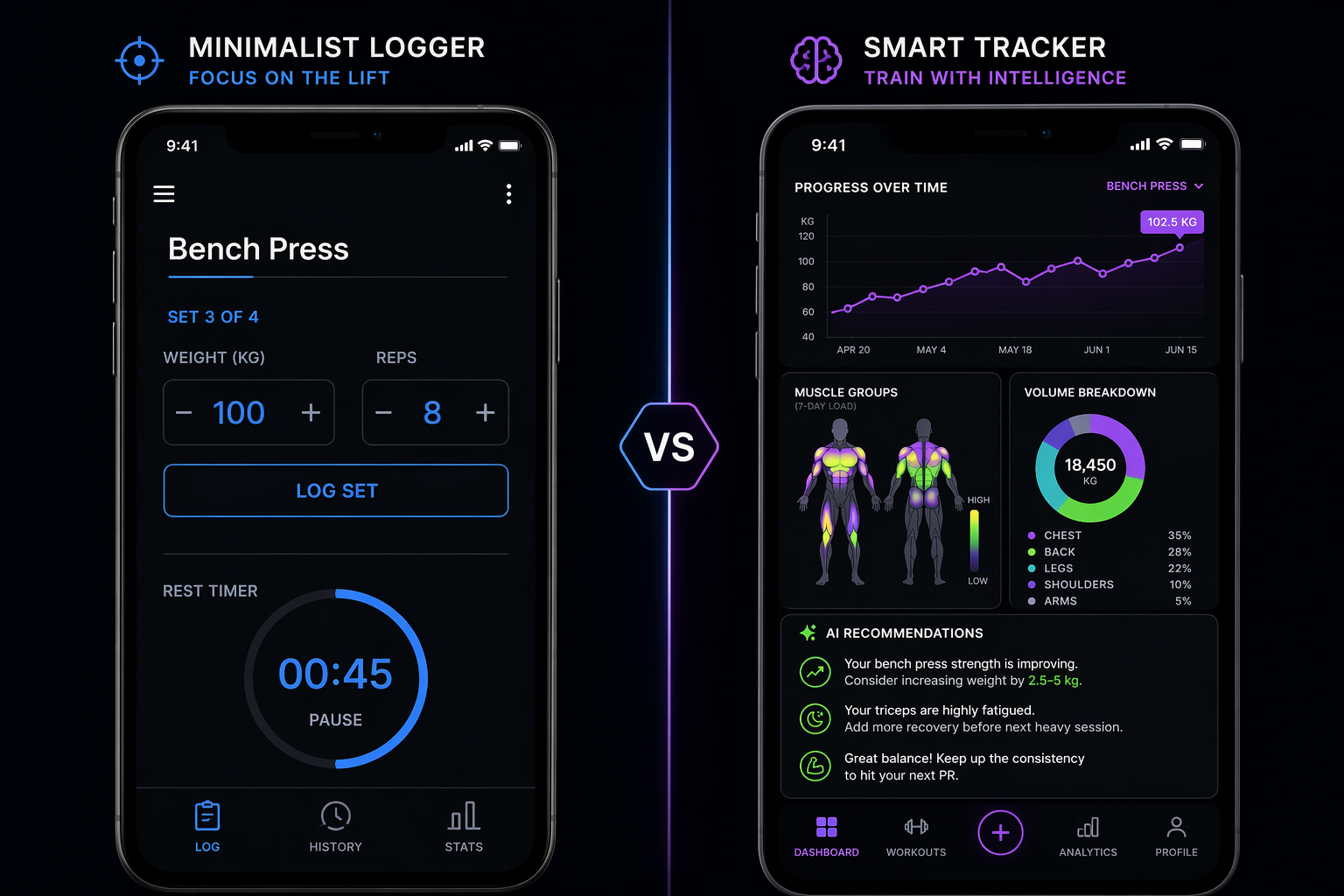
The Logger vs. Smart Tracker Divide: Why Most App Comparisons Get It Wrong
If you have been training consistently for more than a year, you have probably cycled through three or four workout tracker apps. You download one, log for a week, hit a paywall or a missing feature, and move on. The problem is not that the apps are bad — it is that most comparison articles treat them as interchangeable products and rank them by star rating or feature count as if they all serve the same purpose.
They do not. The five apps covered here — Strong, Hevy, Jefit, Fitbod, and Caliber — fall into two fundamentally different categories that serve different training styles and different levels of programming autonomy.
Pure loggers (Strong and Hevy) are built for speed. They assume you already know your program — the exercises, the sets, the rep ranges, the progression scheme. Their job is to get out of your way and let you log a set in under three seconds. They do not tell you what to do; they record what you did.
Smart trackers (Jefit, Fitbod, and Caliber) are built for guidance. They analyze your training history, apply algorithms or coaching input, and recommend what to do next. They are useful when you want the app to handle programming decisions — whether through an AI progression engine, an adaptive volume algorithm, or a human coach.
Choosing between them is not about which app has more features. It is about whether you need a notebook or a coach.
Top 5 Workout Tracker Apps at a Glance: Key Specs Comparison
Before diving into each app's strengths and limitations, here is a side-by-side reference of the specs that matter most for intermediate-to-advanced lifters. Pricing and library sizes are sourced from the apps' own documentation and independent reviews as of mid-2026.
| App | Category | Exercise Library | Free Tier Quality | AI / Progression Features | Monthly Price (Paid) | Platform |
|---|---|---|---|---|---|---|
| Strong | Logger | ~200 exercises | Limited to 3 routines | None (manual logging only) | $4.99 / mo | iOS, Apple Watch |
| Hevy | Logger | ~300 exercises | Unlimited logging, progress graphs, social features | Hevy Trainer (AI plan generator, paid tier) | $2.99 / mo | iOS, Android |
| Jefit | Smart Tracker | 1,400+ exercises | Limited logging, basic tracking | Progressive overload algorithm, NSPI score | $12.99 / mo | iOS, Android |
| Fitbod | Smart Tracker | ~400 exercises | 3-workout trial only | Adaptive AI based on muscle recovery | $15.99 / mo | iOS, Android |
| Caliber | Smart Tracker | 500+ exercises | Full logging, progress tracking, ad-free | Human coaching (paid tier: $19/mo group, $200/mo 1:1) | Free (coaching extra) | iOS, Android |
Pure Loggers: Strong and Hevy — Fast, Minimal, and Built for Lifters Who Know Their Program
If you follow a structured program — whether it is a 5/3/1 variant, a PPL split, or a custom routine you built over years of training — you do not need an app that second-guesses your programming. You need a tool that logs your sets faster than you can write them in a notebook. Strong and Hevy are the two best options in this category, but they take different approaches to the free tier and feature set.
Strong: The Speed King with a Hard Cap
Strong's interface is the gold standard for logging speed. You open the app, tap the exercise, enter your weight and reps, and start your rest timer — all in about two seconds. The Apple Watch integration lets you log from your wrist without touching your phone, which is a genuine advantage during heavy squat or deadlift sessions.
The catch is the free tier. Strong limits free users to three saved routines. If you run a program with multiple training days (push, pull, legs, upper, lower), you will hit that cap immediately. Premium costs $4.99 per month or $3.99 per month billed annually, according to Forbes Health's 2026 audit. The exercise library sits at roughly 200 movements — adequate for most lifters but noticeably smaller than competitors.
Strong is best for lifters who have a fixed, unchanging program and want the absolute fastest logging experience. If you frequently swap exercises or run block periodization, the three-routine limit becomes a friction point.
Hevy: The Most Generous Free Tier Among Loggers
Hevy's free tier is unusually generous. According to Hevy's own guide, free users get unlimited workout logging, progress graphs, a rest timer, social features, and up to four saved routines. The paid tier at $2.99 per month or $23.99 per year unlocks unlimited routines, custom exercises, full data history export, and Hevy Trainer — an AI workout plan generator.
The exercise library is moderate — around 300 movements — and the app does not include AI-driven progression guidance in the free tier. The social features (following other lifters, sharing workouts) are more developed than Strong's, which matters if you train with a partner or want community accountability.
Hevy is the better choice for lifters who want a logger but do not want to pay for the privilege of running more than three routines. The free tier is genuinely functional for most training styles.
- Strong: Fastest logging interface, Apple Watch support, but free tier capped at 3 routines ($4.99/mo). Best for lifters with a fixed, unchanging program.
- Hevy: Unlimited logging on free tier, social features, lower price ($2.99/mo), but no AI progression and a moderate exercise library. Best for lifters who want a free logger with room to grow.
Smart Trackers: Jefit, Fitbod, and Caliber — Data-Driven Coaching and AI Progression
Smart trackers are for lifters who want the app to handle at least part of the programming load. Whether through an algorithm, adaptive AI, or human coaching, these apps analyze your training data and make recommendations. The three apps in this category serve different definitions of "smart."
Jefit: The Data Scientist's Choice
Jefit's standout feature is its exercise library — over 1,400 movements with HD video demonstrations, according to Jefit's own guide. That is roughly seven times the size of Strong's library and four times Hevy's. For lifters who use specialty movements (Zercher squats, Bulgarian split squats, landmine presses), Jefit almost certainly has them.
The real differentiator is the progressive overload algorithm. Jefit monitors your performance across sessions and tells you exactly when to increase weight or reps. It also produces the NSPI (North Star Progress Index), a weekly score that reflects volume across muscles, movement balance, strength gains, and consistency. This is the closest any app in this comparison comes to a data-driven coaching dashboard.
The trade-off is price. Jefit Elite costs $12.99 per month or $69.99 per year. The free tier is limited — basic logging and tracking without the algorithm or NSPI score. For lifters who want deep data analysis and a massive exercise library, Jefit is the strongest option.
Fitbod: Adaptive AI with a Recovery Focus
Fitbod's adaptive AI adjusts workout volume based on muscle recovery across sessions. If you hammered your quads on Monday, Fitbod will reduce quad volume on Wednesday and shift focus to hamstrings and glutes. This is useful for lifters who train with high frequency and want to avoid accumulating fatigue in specific muscle groups.
The downside is that Fitbod has no free tier beyond a three-workout trial. After that, it is $15.99 per month, making it the most expensive app in this comparison. Garage Gym Reviews rates it 3.8 out of 5, noting that the AI logic can feel unpredictable for advanced lifters who prefer consistent programming. Fitbod is best for lifters who want variety and recovery-based adjustments, but the cost and AI unpredictability may frustrate those who prefer a fixed program.
Caliber: The Free Tier That Competes with Paid Apps
Caliber occupies a unique position. Its free tier includes over 500 exercises, full workout logging, progress tracking, demonstration videos, and is completely ad-free. Garage Gym Reviews gives Caliber a 4.6 out of 5, calling its free version genuinely complete. For lifters who want a smart tracker without a subscription, Caliber is the clear winner.
The paid tier adds human coaching: $19 per month for group coaching or $200 per month for 1:1 coaching. This is a fundamentally different value proposition from Jefit's algorithm or Fitbod's AI. If you want a human to review your form, adjust your program, and hold you accountable, Caliber's coaching tier is the only option in this comparison that offers it.
- Jefit: Largest exercise library (1,400+), progressive overload algorithm, NSPI score. Paid tier unlocks the data-driven features ($12.99/mo). Best for data-focused lifters.
- Fitbod: Adaptive AI based on muscle recovery. No free tier beyond trial ($15.99/mo). Best for lifters who want variety and recovery-based adjustments.
- Caliber: Genuinely complete free tier (500+ exercises, ad-free). Paid coaching from $19/mo group or $200/mo 1:1. Best for lifters who want a free smart tracker or human coaching.
Which App Fits Your Training Style? A Decision Framework for Intermediate-to-Advanced Lifters
The logger vs. smart tracker divide gives you a clear decision axis. Here is how to map your training style to the right app.
- You follow a fixed program and want the fastest logging experience: Choose Strong. The three-routine limit is irrelevant if your program does not change. The Apple Watch integration is a bonus for hands-free logging.
- You want a free logger with no hard caps: Choose Hevy. Unlimited logging, progress graphs, and social features on the free tier. The $2.99/mo upgrade is optional unless you need unlimited routines or the AI plan generator.
- You want AI to tell you when to increase weight: Choose Jefit. The progressive overload algorithm and NSPI score provide data-driven progression that no other free-tier app matches. Be prepared to pay $12.99/mo for the full feature set.
- You want variety and recovery-based adjustments: Choose Fitbod. The adaptive AI is good for lifters who train with high frequency and want to avoid overtraining. The $15.99/mo price is the highest in this comparison.
- You want a free smart tracker with the option of human coaching: Choose Caliber. The free tier is genuinely complete. Upgrade to coaching only if you want a human to program for you.
For a more detailed decision tree that maps specific training styles (powerlifting, bodybuilding, CrossFit, general strength) to specific apps, see our decision-based workout tracker app guide.
Free vs. Paid: What You Actually Get at Each Price Tier (Through the Logger/Smart Tracker Lens)
Instead of a general free vs. paid comparison — which is already covered in depth by our Free vs Paid Exercise Tracker Apps article — here is how the free vs. paid decision changes depending on whether you are a logger user or a smart tracker user.
| App | Free Tier Value | Paid Tier Value | Who Should Pay |
|---|---|---|---|
| Strong | Functional but capped at 3 routines | Unlimited routines, custom exercises, data export ($4.99/mo) | Lifters who run more than 3 routines or want data export |
| Hevy | Unlimited logging, progress graphs, social features | Unlimited routines, custom exercises, AI plan generator ($2.99/mo) | Lifters who want the AI plan generator or unlimited routines |
| Jefit | Basic logging and tracking only | Progressive overload algorithm, NSPI score, full library ($12.99/mo) | Lifters who want data-driven progression recommendations |
| Fitbod | 3-workout trial only | Full adaptive AI, unlimited logging ($15.99/mo) | Lifters who want recovery-based AI adjustments and are willing to pay |
| Caliber | Full logging, 500+ exercises, ad-free | Human coaching: $19/mo group or $200/mo 1:1 | Lifters who want human coaching; free tier is sufficient for most |
For loggers (Strong, Hevy), the free tier is functional but has a specific cap — routines for Strong, AI features for Hevy. For smart trackers (Jefit, Fitbod, Caliber), the free tier ranges from limited (Jefit) to non-existent (Fitbod) to genuinely complete (Caliber). The decision to pay depends on whether you need the specific feature behind the paywall, not on a general "premium is better" assumption.
Verdict: The Best Workout Tracker App Depends on Whether You Need a Notebook or a Coach
There is no single best workout tracker app. The right choice depends entirely on whether you need a fast digital notebook or a data-driven coach.
- If you know your program and just need to log sets fast: Choose Strong (iOS) or Hevy (iOS/Android). Strong for speed, Hevy for a better free tier and cross-platform support.
- If you want AI to guide your progression: Choose Jefit for data-driven overload and the largest exercise library, or Fitbod for recovery-based volume adjustments.
- If you want a free smart tracker with the option of human coaching: Choose Caliber. Its free tier is the most complete in this comparison.
- If you want both: Pair a logger (Strong or Hevy) with a smart tracker (Jefit or Caliber) for hybrid training. See our pairing guide for details.
The logger vs. smart tracker divide is not a marketing gimmick — it is a real difference in how these apps approach training. Pick the category first, then pick the app within that category. That will save you the trial-and-error cycle of downloading, logging for a week, and moving on.
This result comes from one real apartment under the stated conditions — it is a strong signal, not a guarantee your space will measure identically.
Builds this evidence supports
No build currently links to this specific test. Browse all builds with a matching tag.
Spot something off?
If this result didn't match your own space, let us know — floor-damage and noise claims carry real deposit-risk consequences if we get them wrong.