
Home Gym Workout Plan: 5 Complete Weekly Programs by Equipment Tier
Choose the right plan based on what you own. This article provides five complete weekly workout programs — one for each equipment tier: bodyweight, resistance bands, dumbbells, barbells, and all-in-one machines — each with warm-up, sets/reps/rest, cool-down, and progression rules.
A home gym workout plan should start with the equipment you can actually touch, not the goal you typed into a search box. “Build muscle,” “lose fat,” and “get stronger” all change shape when the room contains only a mat, a door anchor and bands, two dumbbells, a barbell setup, or a cable-based all-in-one machine. The exercises change. The split changes. Most importantly, the progression rule changes.
Use the tier that matches what you own today. If you are still deciding what belongs in the room, start with a beginner equipment framework, a compact gym trade-off guide, or a space-tier layout guide. If you already know your tier, pick the matching plan and run it for at least four weeks before changing the structure.
| Equipment tier | Use this plan if you have | Best default schedule | Main progression tool |
|---|---|---|---|
| Tier 1: Bodyweight | Floor space, a mat, possibly a sturdy chair or step | 3 full-body days | Reps, tempo, leverage, range of motion, density |
| Tier 2: Resistance bands | Loop bands or tube bands with a safe anchor | 3 full-body days | Band tension, reps, anchor setup, tempo |
| Tier 3: Dumbbells | Fixed or adjustable dumbbells, ideally with enough load for lower-body work | 3 full-body days plus optional conditioning | Load, reps, unilateral work, set quality |
| Tier 4: Barbell | Rack, barbell, plates, bench, and safety arms or spotter setup | 4 days with upper/lower structure | Load increases, planned rest, lower-rep strength work |
| Tier 5: All-in-one machine | Cable, lever, Smith-style, or multi-station home gym | 3 full-body days with movement-pattern logic | Exercise selection discipline, cable load, reps, setup consistency |
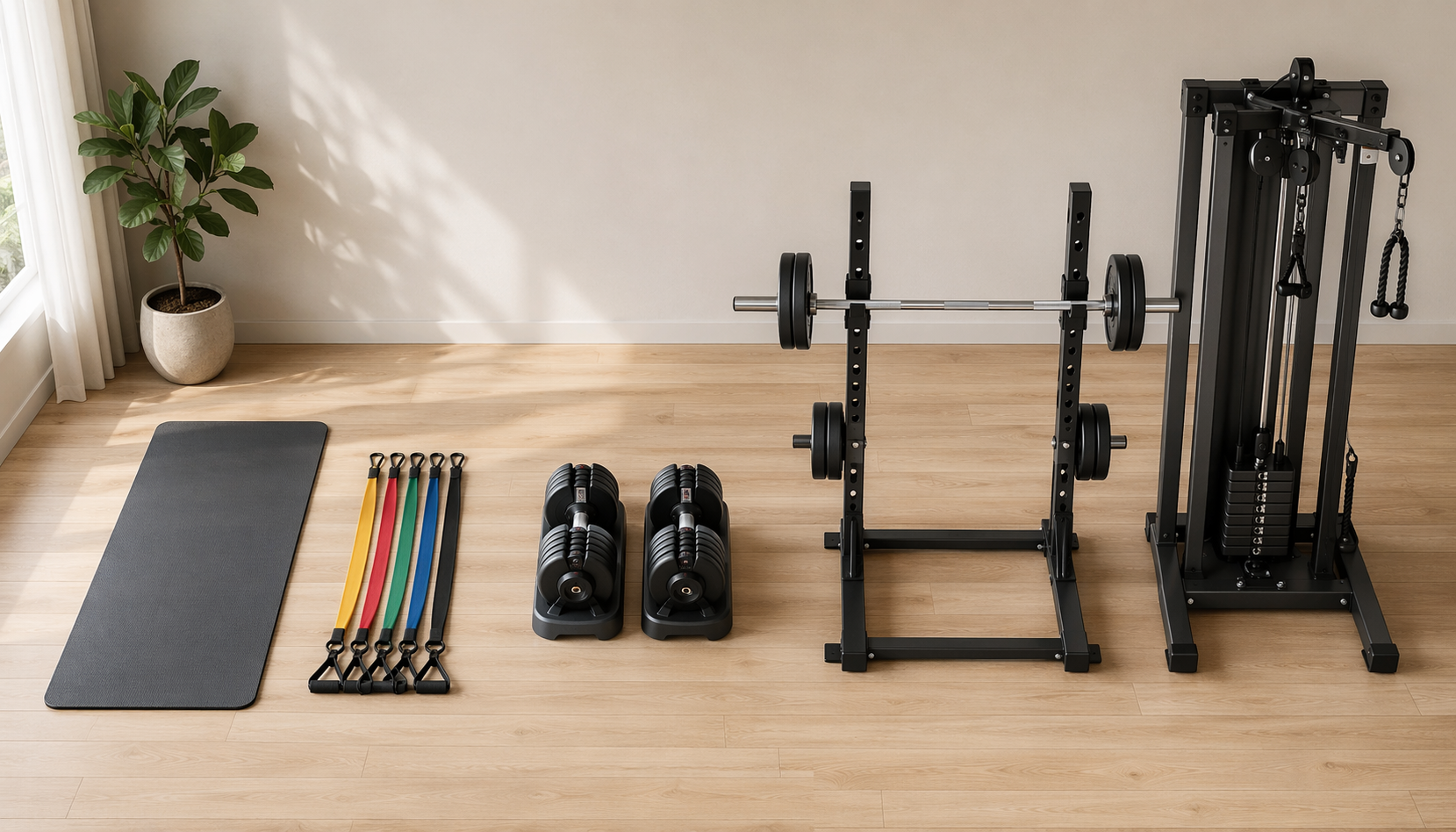
The five tiers here are an organizing model for choosing a usable plan, not an official classification from one authority. The programming underneath is built from common strength-training principles: compound exercises save time, progressive overload can come from more than just heavier weight, and weekly work performed consistently matters more than finding a perfect split on paper.
Multi-joint exercises deserve the first slots in most home plans because they train more muscle with fewer setup changes. A 2017 Frontiers in Physiology study by Paoli and colleagues, cited by Garage Gym Reviews, found that multi-joint exercises produced greater strength increases than single-joint exercises, which is exactly the kind of efficiency a home plan needs when the workout has to fit between normal obligations.[1]
That does not mean every plan below is the same full-body routine with different exercise names. Bodyweight work needs leverage and tempo. Bands need repeatable setup. Dumbbells need a way around limited loading. Barbells need rest days placed carefully enough that heavy work stays productive. All-in-one machines need fewer options, not more.
How Hard Each Plan Should Feel
For the main exercises, finish most working sets with 1 to 2 reps in reserve. That means you could perform one or two more good reps if you had to, but you stop before your form starts negotiating with the furniture. Cleveland Clinic’s progressive overload guidance describes overload through weight, reps, duration, or intensity and recommends changing one factor at a time for safer, more sustainable progress.[2]
Accessory work can be pushed harder, especially in safer exercises such as band curls, lateral raises, or machine rows, but failure should be used sparingly. If the next rep would require twisting, bouncing, cutting range of motion, or holding your breath through a shaky grinder, the set is over.
| Effort cue | What it means | Where to use it |
|---|---|---|
| 2 RIR | Two good reps left | Most first sets, heavier lower-body and pressing work |
| 1 RIR | One good rep left | Final sets of main lifts when form is stable |
| 0 RIR | No good reps left | Occasional low-risk accessory sets only |
| Stop early | Pain, joint irritation, or form breakdown appears | Any exercise, any tier |
Rest periods are part of the plan, not wasted time. Most of the sessions below use 60 to 90 seconds for moderate full-body strength work, in line with NASM-style guidance for efficient full-body sessions using multi-joint exercises and 2 to 3 sets of 8 to 12 reps.[3] Heavier barbell sets get more rest because pretending a heavy squat is a circuit exercise usually just makes the next set worse.
Tier 1: Bodyweight-Only Weekly Plan
Bodyweight training fails most often when “progress” is left vague. Adding random reps forever works for a while, then push-ups become a test of patience and squats become cardio with knee bend. This plan uses three full-body days and progresses through reps, tempo, range of motion, and harder variations.
If you are brand new to floor-based training and need slower exercise instruction, use this beginner bodyweight workout routine alongside the plan.
| Day | Workout |
|---|---|
| Monday | Full Body A |
| Tuesday | Rest or 20-30 minutes easy walking |
| Wednesday | Full Body B |
| Thursday | Rest |
| Friday | Full Body C |
| Saturday | Optional mobility or easy walk |
| Sunday | Rest |
Warm-Up
- March in place or brisk walk: 2 minutes
- Arm circles: 10 forward and 10 backward
- Hip hinges with hands on hips: 10 reps
- Bodyweight squats to comfortable depth: 10 reps
- Incline plank shoulder taps: 10 total reps
| Full Body A | Sets | Reps or time | Rest |
|---|---|---|---|
| Squat | 3 | 8-15 | 60-90 sec |
| Incline or floor push-up | 3 | 6-12 | 60-90 sec |
| Glute bridge | 3 | 10-20 | 60 sec |
| Reverse lunge | 2 | 8-12 each side | 60-90 sec |
| Forearm plank | 3 | 20-45 sec | 45-60 sec |
| Full Body B | Sets | Reps or time | Rest |
|---|---|---|---|
| Split squat | 3 | 8-12 each side | 60-90 sec |
| Pike push-up or elevated hand push-up | 3 | 5-10 | 60-90 sec |
| Single-leg hip hinge reach | 3 | 8-12 each side | 60 sec |
| Prone Y-T-W raise | 2 | 6-10 each shape | 45-60 sec |
| Dead bug | 3 | 8-12 each side | 45-60 sec |
| Full Body C | Sets | Reps or time | Rest |
|---|---|---|---|
| Tempo squat, 3 seconds down | 3 | 8-12 | 60-90 sec |
| Push-up variation | 3 | 6-12 | 60-90 sec |
| Step-up to sturdy surface | 3 | 8-12 each side | 60-90 sec |
| Side plank | 2 | 15-40 sec each side | 45-60 sec |
| Mountain climber | 3 | 20-40 sec | 45-60 sec |
Cool down with 3 to 5 minutes of slow breathing and easy stretching for the hip flexors, hamstrings, chest, and upper back. The cool-down does not need to become a second workout.
Progression Rule
- Stay with the same variation until all sets reach the top of the rep or time range with 1 to 2 reps in reserve.
- Then make one change: add a set, slow the lowering phase, increase range of motion, reduce rest slightly, or move to a harder variation.
- For push-ups, progress from wall to incline to floor to feet-elevated only when the current version is controlled.
- For lower-body work, move from two-leg squats to split squats, step-ups, tempo reps, and single-leg variations before worrying about buying load.
- If joints feel worse week to week, reduce range of motion or total sets before adding difficulty.
Tier 2: Resistance Band Weekly Plan
Bands are useful, but they are also easy to lie with. A band chest press from one anchor height is not the same exercise as a band chest press from another. Two steps farther from the anchor can turn a clean set into a sloppy one. Write down the band color, anchor point, and body position for your main movements.
| Day | Workout |
|---|---|
| Monday | Full Body A: Squat, press, row |
| Tuesday | Rest or easy cardio |
| Wednesday | Full Body B: Hinge, vertical pull, shoulder work |
| Thursday | Rest |
| Friday | Full Body C: Unilateral legs, chest, back, arms |
| Saturday | Optional 15-25 minutes easy conditioning |
| Sunday | Rest |
Warm-Up
- Easy marching or step-back lunges: 2 minutes
- Band pull-aparts with light tension: 15 reps
- Good-morning pattern without load: 10 reps
- Bodyweight squat: 10 reps
- One light warm-up set of the first band exercise
| Full Body A | Sets | Reps | Rest |
|---|---|---|---|
| Band front squat or band goblet squat | 3 | 8-12 | 60-90 sec |
| Band chest press | 3 | 8-12 | 60-90 sec |
| Seated or standing band row | 3 | 10-15 | 60-90 sec |
| Band Romanian deadlift | 2 | 10-15 | 60 sec |
| Pallof press | 2 | 8-12 each side | 45-60 sec |
| Full Body B | Sets | Reps | Rest |
|---|---|---|---|
| Band deadlift or good morning | 3 | 8-12 | 60-90 sec |
| Lat pulldown with high anchor | 3 | 10-15 | 60-90 sec |
| Band overhead press | 3 | 8-12 | 60-90 sec |
| Band face pull | 2 | 12-20 | 45-60 sec |
| Band resisted dead bug or plank | 2 | 8-12 each side or 20-40 sec | 45-60 sec |
| Full Body C | Sets | Reps | Rest |
|---|---|---|---|
| Band split squat | 3 | 8-12 each side | 60-90 sec |
| Band push-up or band chest fly | 3 | 8-15 | 60-90 sec |
| One-arm band row | 3 | 10-15 each side | 60 sec |
| Band lateral raise | 2 | 12-20 | 45-60 sec |
| Band curl superset with band pressdown | 2 | 10-15 each | 45-60 sec |
Cool down with gentle shoulder circles, child’s pose or lat stretch, hip flexor stretch, and slow nasal breathing for 3 to 5 minutes. Check the anchor before every session; a strong program does not survive a weak door setup.
Progression Rule
- First add reps until all sets hit the top of the range with stable band path and 1 to 2 reps in reserve.
- Then increase tension by stepping slightly farther from the anchor, shortening the band, or moving to the next band.
- Change only one setup variable at a time; do not switch band color, stance, anchor height, and rep target in the same week.
- For rows, presses, and pulldowns, keep a repeatable start position so next week’s work is actually comparable.
- If a stronger band ruins the first half of the movement, use the lighter band with slower tempo instead.
Tier 3: Dumbbell Weekly Plan
Dumbbells are the most flexible tier for many homes, until the lower body outgrows the rack. The answer is not to turn every leg exercise into a marathon set. Use unilateral work, pauses, tempo, and careful load jumps so the plan remains strength training rather than an endurance contest with handles.
| Day | Workout |
|---|---|
| Monday | Full Body A: Squat emphasis |
| Tuesday | Rest or easy walking |
| Wednesday | Full Body B: Hinge and upper-back emphasis |
| Thursday | Rest |
| Friday | Full Body C: Unilateral and accessory emphasis |
| Saturday | Optional 20 minutes Zone 2-style easy cardio or mobility |
| Sunday | Rest |
Warm-Up
- Brisk walk, bike, or march: 3 minutes
- Bodyweight squat: 10 reps
- Hip hinge with light dumbbells or no load: 10 reps
- Scapular push-up or wall slide: 10 reps
- One lighter warm-up set for the first loaded lower-body exercise
| Full Body A | Sets | Reps | Rest |
|---|---|---|---|
| Dumbbell goblet squat | 3 | 8-12 | 90 sec |
| Dumbbell floor press or bench press | 3 | 8-12 | 60-90 sec |
| One-arm dumbbell row | 3 | 8-12 each side | 60-90 sec |
| Dumbbell Romanian deadlift | 3 | 8-12 | 90 sec |
| Suitcase carry | 2 | 30-45 sec each side | 60 sec |
| Full Body B | Sets | Reps | Rest |
|---|---|---|---|
| Dumbbell Romanian deadlift | 3 | 8-10 | 90 sec |
| Dumbbell overhead press | 3 | 6-10 | 60-90 sec |
| Chest-supported row or bent-over row | 3 | 8-12 | 60-90 sec |
| Reverse lunge | 3 | 8-10 each side | 60-90 sec |
| Dead bug or weighted dead bug | 2 | 8-12 each side | 45-60 sec |
| Full Body C | Sets | Reps | Rest |
|---|---|---|---|
| Bulgarian split squat or step-up | 3 | 8-10 each side | 90 sec |
| Incline or flat dumbbell press | 3 | 8-12 | 60-90 sec |
| Dumbbell pullover or row variation | 3 | 10-12 | 60-90 sec |
| Dumbbell lateral raise | 2 | 12-20 | 45-60 sec |
| Dumbbell curl superset with overhead triceps extension | 2 | 10-15 each | 45-60 sec |
Cool down with 3 to 5 minutes of easy walking, hamstring stretching, chest stretching, and slow breathing. If your grip is the limiting factor on every lower-body lift, add straps or use goblet and split-squat variations rather than pretending your legs are finished because your hands are.
Progression Rule
- Use double progression: keep the same dumbbell load until all sets reach the top of the rep range with 1 to 2 reps in reserve.
- Then increase the dumbbells by the smallest available jump and return to the lower end of the rep range.
- If your dumbbells are too light for squats or hinges, move to split squats, step-ups, single-leg Romanian deadlifts, pauses, or slower eccentrics.
- Do not add load and add sets in the same week; choose one progression lever.
- When adjustable dumbbells make setup slow, pair non-competing exercises only if load changes are practical.
Tier 4: Barbell Weekly Plan
A barbell home gym gives you the clearest path for adding load, which is also why it needs guardrails. Heavy squats, presses, deadlifts, and rows are not just “better dumbbell exercises.” They create more fatigue, ask more from technique, and deserve a weekly layout that does not stack every hard lower-body decision into the same 48 hours.
| Day | Workout |
|---|---|
| Monday | Lower A: Squat emphasis |
| Tuesday | Upper A: Bench and row emphasis |
| Wednesday | Rest or easy walking |
| Thursday | Lower B: Deadlift emphasis |
| Friday | Rest |
| Saturday | Upper B: Press and pull emphasis |
| Sunday | Rest |
Warm-Up
- General warm-up: 3-5 minutes easy bike, walk, or marching
- Movement prep: bodyweight squat, hip hinge, plank, and band pull-apart for 8-12 reps each
- Specific ramp-up: 2-4 lighter sets of the first barbell lift before working sets
- Safety check: rack height, safeties, collars, floor clearance, and exit path
| Lower A | Sets | Reps | Rest |
|---|---|---|---|
| Back squat or front squat | 3 | 5-8 | 2-3 min |
| Romanian deadlift | 3 | 6-10 | 2 min |
| Split squat or lunge | 2 | 8-10 each side | 90 sec |
| Standing calf raise | 2 | 10-15 | 60 sec |
| Plank | 3 | 30-60 sec | 60 sec |
| Upper A | Sets | Reps | Rest |
|---|---|---|---|
| Bench press | 3 | 5-8 | 2-3 min |
| Barbell row | 3 | 6-10 | 2 min |
| Overhead press | 2 | 6-10 | 90 sec |
| Pull-up, band-assisted pull-up, or inverted row | 3 | 6-12 | 90 sec |
| Curl or triceps extension | 2 | 10-15 | 60 sec |
| Lower B | Sets | Reps | Rest |
|---|---|---|---|
| Deadlift | 3 | 3-6 | 2-3 min |
| Paused squat or lighter squat variation | 3 | 5-8 | 2 min |
| Hip thrust or glute bridge | 3 | 8-12 | 90 sec |
| Reverse lunge | 2 | 8-10 each side | 90 sec |
| Side plank | 2 | 20-45 sec each side | 60 sec |
| Upper B | Sets | Reps | Rest |
|---|---|---|---|
| Overhead press | 3 | 5-8 | 2 min |
| Incline bench press or close-grip bench press | 3 | 6-10 | 2 min |
| Barbell row or chest-supported row | 3 | 8-10 | 90 sec |
| Pull-up or pulldown variation if available | 3 | 6-12 | 90 sec |
| Lateral raise or rear-delt raise | 2 | 12-20 | 60 sec |
Cool down with easy walking, light hip and chest mobility, and breathing drills for 5 minutes. On heavy barbell days, the cool-down is less important than not rushing the ramp-up sets and not cutting the planned rest because the timer makes you feel lazy.
Progression Rule
- For the first lift of the day, add a small amount of weight next week only if every working set stayed within the rep range with 1 to 2 reps in reserve.
- If you miss the low end of the rep range, keep the same load next week or reduce it slightly.
- For accessory lifts, add reps first, then load.
- Keep at least one rest day between the squat-emphasis and deadlift-emphasis sessions.
- Every fourth to sixth week, reduce load or sets if bar speed, sleep, joints, or motivation are clearly trending down.
Tier 5: All-in-One Machine Weekly Plan
All-in-one machines create a different problem: too many acceptable choices. A cable station, lever arm, Smith-style track, or compact multi-gym can train almost everything, which means an unplanned session can become twenty minutes of changing attachments and five minutes of useful work. This plan chooses movement patterns first, then exercises.
If your machine is compact or space-limited, compare exercise options with this guide to all-in-one home gym machines for small spaces. The plan below assumes you can perform some version of squat or leg press, press, row, pulldown, hinge or hip extension, and cable accessory work.
| Day | Workout |
|---|---|
| Monday | Full Body A: Squat, horizontal press, horizontal pull |
| Tuesday | Rest or easy cardio |
| Wednesday | Full Body B: Hinge, vertical press, vertical pull |
| Thursday | Rest |
| Friday | Full Body C: Legs and upper accessories |
| Saturday | Optional machine conditioning circuit, light effort |
| Sunday | Rest |
Warm-Up
- Easy cardio or dynamic movement: 3-5 minutes
- Light cable row: 12 reps
- Light press: 10 reps
- Bodyweight squat or unloaded machine squat pattern: 10 reps
- One lighter setup set of the first loaded exercise
| Full Body A | Sets | Reps | Rest |
|---|---|---|---|
| Machine squat, Smith squat, or leg press | 3 | 8-12 | 90 sec |
| Machine chest press or cable chest press | 3 | 8-12 | 60-90 sec |
| Seated cable row or machine row | 3 | 8-12 | 60-90 sec |
| Cable pull-through or machine hip extension | 2 | 10-15 | 60 sec |
| Cable anti-rotation press | 2 | 8-12 each side | 45-60 sec |
| Full Body B | Sets | Reps | Rest |
|---|---|---|---|
| Cable Romanian deadlift, Smith Romanian deadlift, or hip hinge station | 3 | 8-12 | 90 sec |
| Machine shoulder press or cable shoulder press | 3 | 8-12 | 60-90 sec |
| Lat pulldown | 3 | 8-12 | 60-90 sec |
| Leg curl or hamstring-focused option | 2 | 10-15 | 60 sec |
| Cable face pull | 2 | 12-20 | 45-60 sec |
| Full Body C | Sets | Reps | Rest |
|---|---|---|---|
| Split squat, lunge, or single-leg press pattern | 3 | 8-12 each side | 90 sec |
| Incline press, decline press, or push-up using machine handles | 3 | 8-12 | 60-90 sec |
| One-arm cable row | 3 | 10-12 each side | 60 sec |
| Cable lateral raise | 2 | 12-20 | 45-60 sec |
| Cable curl superset with cable pressdown | 2 | 10-15 each | 45-60 sec |
Cool down with unloaded machine movements through comfortable ranges, then stretch the lats, chest, hip flexors, and hamstrings for 3 to 5 minutes. Before leaving the room, record the attachment, pulley height, seat setting, and load for your main lifts. On machines, setup is part of the load.
Progression Rule
- Pick one exercise for each movement pattern and keep it for at least four weeks.
- Add reps until all working sets reach the top of the range with 1 to 2 reps in reserve, then increase machine load by the smallest practical jump.
- Do not rotate cable angles every session unless pain or equipment limitations require it.
- If two exercises train the same pattern equally well, choose the one that is easier to set up and repeat.
- Use accessories to fill gaps, not to turn a 45-minute plan into an attachment tour.
Why These Plans Favor Full-Body Work
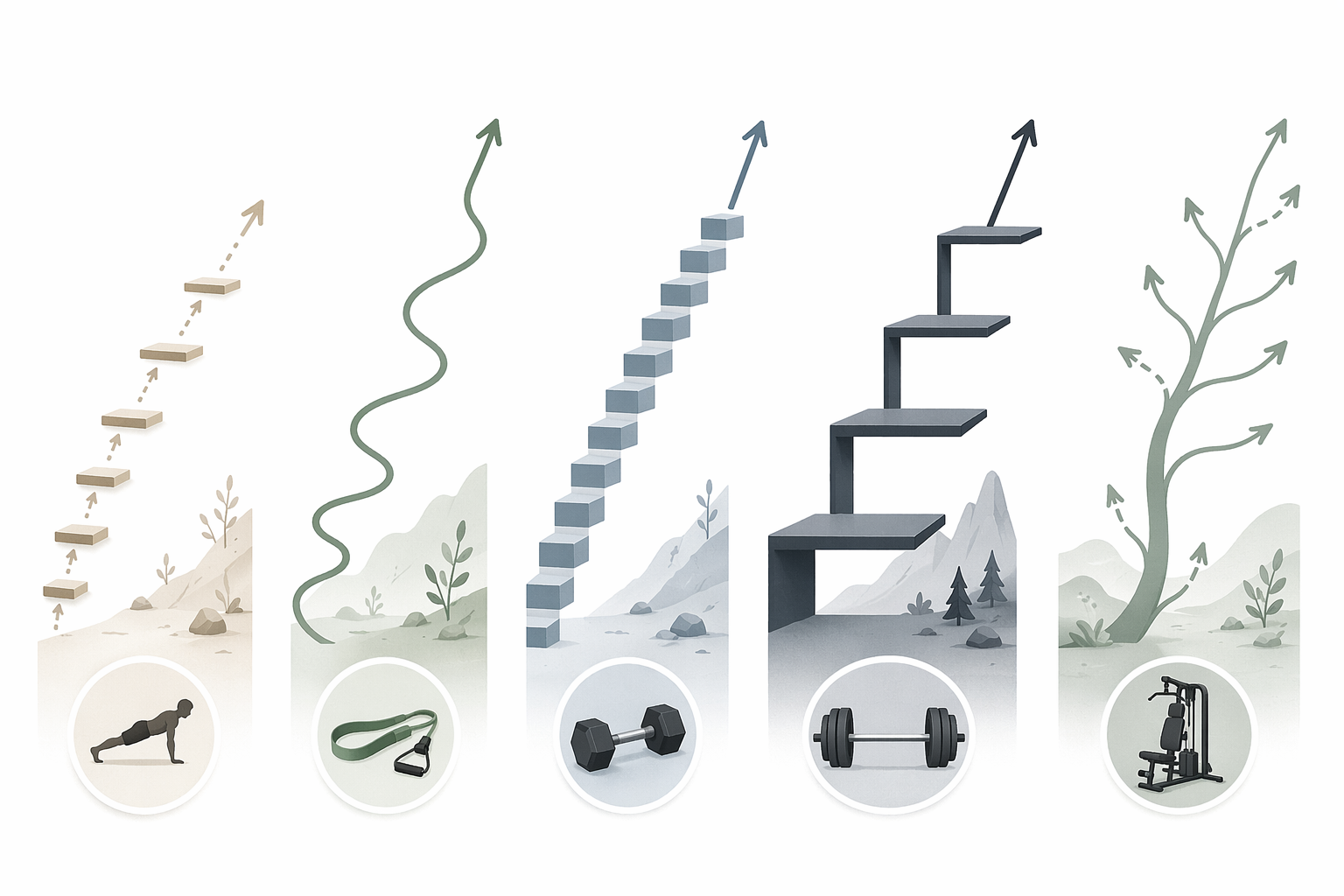
Most home trainees do better when the plan gives each training day a lot of useful work and fewer chances to miss an entire muscle group because Thursday got swallowed by life. Full-body training is not magic, but it is forgiving. It also lets compound lifts carry the session instead of forcing six isolation exercises into a room that may not have the right bench, cable angle, or load.
There is some evidence in favor of full-body formats for body-composition outcomes, but it should not be oversold. A 2016 Biology of Sport study in male rugby players found that full-body workouts burned nearly three times more fat mass over four weeks than split training, while both approaches improved strength and body composition similarly.[1] That is useful context, not a promise to a general home trainee training unsupervised in a garage, spare bedroom, or apartment.
The more dependable programming idea is weekly volume. Muscle & Strength summarizes growth-oriented volume guidance as roughly 10 to 12 working sets for larger muscle groups and 6 to 8 sets for smaller muscle groups per session, while noting that more volume beyond a useful ceiling does not automatically create more hypertrophy.[4] The plans here stay moderate because a plan that leaves room for next week usually beats a heroic first week.
Frequency is less sacred than many templates make it sound. When weekly volume is equated, a 2019 Schoenfeld-led analysis cited by Hevy found that training two versus three times per week did not significantly affect muscle growth.[5] That is why the bodyweight, band, dumbbell, and all-in-one plans can work well on three weekly sessions, while the barbell plan earns a four-day split because heavier loading and recovery logistics justify it.
What Home-Training Research Can and Cannot Promise
Home training can produce meaningful results, but the cleanest-looking study numbers often come from conditions that are cleaner than real life. In a 12-week study of home training systems combined with diet, Roberts and colleagues reported 94% session attendance, a 6.8 kg fat-mass reduction, a 38% visceral-fat reduction, a 7.9 mmHg drop in diastolic blood pressure, and a 7 bpm drop in resting heart rate.[6]
Those outcomes are encouraging, but they came with prepared meals, an approximate 500 kcal deficit, and supervised group training.[6] That is not the same as a self-directed person training alone after dinner. The useful takeaway is narrower: home-based systems can work when attendance, nutrition, and progression are controlled well enough. This article can give you the training structure; it cannot secretly add supervision, sleep, or a controlled diet.
Logging the Plan Without Turning It Into Homework
Track four things: exercise, load or variation, reps or time, and how many reps you had left. Bands need one extra note for setup. Machines need seat, pulley, and attachment settings. Bodyweight work needs the variation and tempo. That is enough information to know what to do next Tuesday.
If you want app support, use an app that lets you log limited-equipment substitutions instead of forcing a commercial-gym template onto your room. This guide to strength training apps for limited-equipment home gyms is a better fit than a generic bodybuilding split if your setup is still modest.
When to Stay, Progress, or Upgrade
Stay in your current tier if you can still make one clean progression every week or two: more reps, slightly harder leverage, better tempo, more load, or cleaner execution at the same load. A plan that is still producing measurable work does not need new equipment just because another setup looks more serious.
Progress within the tier when the limitation is effort or organization. If you skip sessions, forget loads, change exercises constantly, or take every set to sloppy failure, the equipment is not the bottleneck yet. Fix the plan before buying around the problem.
Consider upgrading only when the plan exposes a real ceiling: bodyweight leg work has become all endurance, bands cannot give repeatable resistance for your main lifts, dumbbells are too light even with unilateral variations, or your all-in-one machine lacks a movement pattern you consistently need. If you are expanding in stages, use a phased compact gym build instead of collecting equipment the program never asks for.
References
- The Best Science-Based Full Body Workout for Growth, Garage Gym Reviews
- Progressive Overload: What It Is and How To Do It, Cleveland Clinic, October 2025
- How Many Exercises Per Muscle Group?, NASM Blog
- How Many Sets Per Muscle Group Per Week To Force Growth?, Muscle & Strength
- Training Frequency for Hypertrophy: How Often Should You Train Each Muscle?, Hevy
- Effects of Exercise and Nutritional Intervention on Body Composition, Metabolic Health, and Physical Performance in Adults, PMC, 2019
What a small equipment investment adds
We don't have a build tagged to this exact tier yet. Browse all builds.
How often should you repeat this?
See our recovery and rest reference for citation-anchored rest-interval guidance.
Spot something off?
Tell us if a movement, tier assumption, or duration didn't match your experience.