
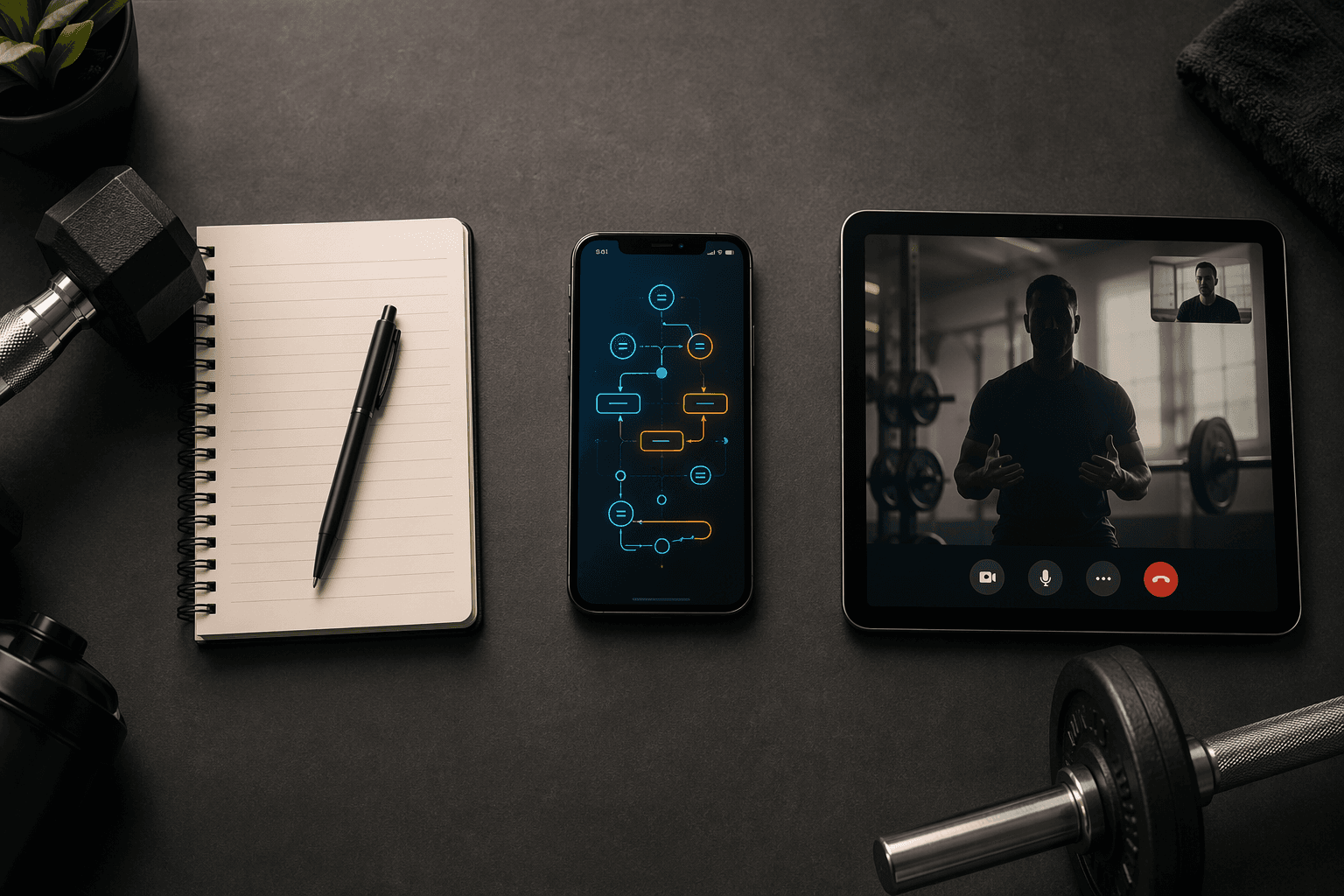
Most intermediate lifters do not need the “best strength training app” in the abstract. They need the app that removes the thing slowing next week’s training: writing the plan, logging it fast enough to stick with it, or having someone keep them honest.
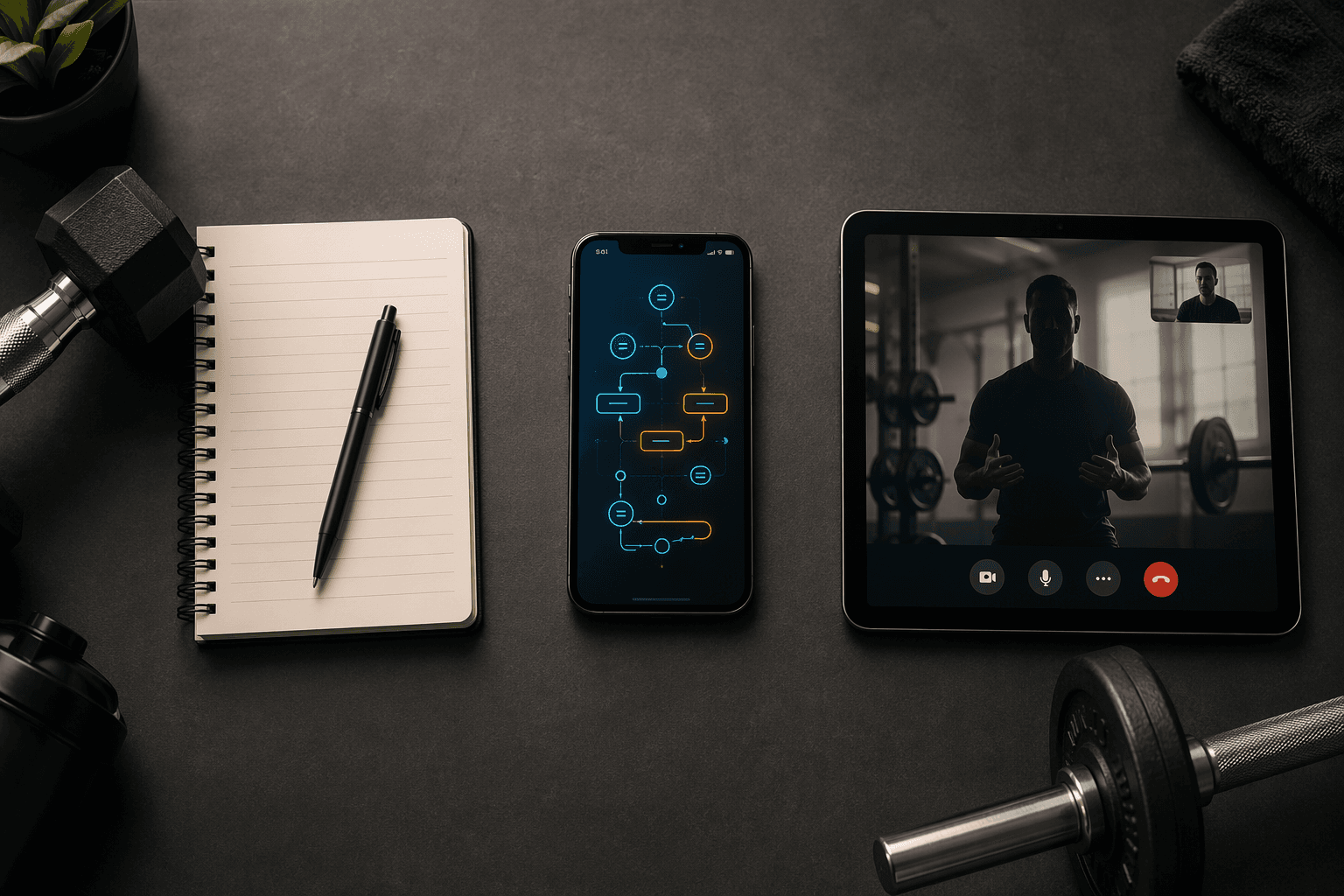
Start with the bottleneck, not the app names
The useful split is simple. Either you already know how to program and just need a faster way to record work, or you need software to write and adjust the plan, or you need a human to keep you consistent and check your form. Those are different jobs, so comparing every app as if it should do all three is how lifters end up paying for features they do not use.
| Your actual bottleneck | App architecture that fits | What it is doing | What it is not doing |
|---|---|---|---|
| I can program, but logging is slow | DIY tracker | Records sessions, routines, and progress with minimal friction [2] | It does not replace programming knowledge |
| I need programming written for me | AI-coached app | Auto-adjusts future training from performance and recovery inputs [3][4] | It is not the same as a person watching your lifts |
| I keep missing sessions or need form feedback | Human coach | Adds check-ins, accountability, and video review [5] | It is not a cheap digital logbook |
That distinction matters because app categories do not live on the same scoreboard. GGR tested more than 70 strength apps and found the average cost around $34 per month, which is a reminder that price alone does not tell you whether the product is solving your problem [1]. A logbook, an autoregulating coach, and a real coach can all be useful, but they are useful in different ways.
DIY trackers are for lifters who already know what to do next
If progressive overload, exercise selection, and routine structure are already familiar, the app’s main job is to stay out of the way. That is why Strong and Hevy still make sense for a lot of serious lifters. Strong is built around speed; it behaves like a very good digital logbook rather than a coach. Hevy is the stronger free option because its no-cost tier includes workout logging, progress graphs, routine management, and social features without ads [2].
The contrast is useful because it shows what trackers actually solve. Strong helps when you want fewer taps between sets and do not need the app to think for you. Hevy helps when you want a free tool that still covers the basics without turning the experience into a sales funnel. Neither one is trying to write your mesocycle.
- Choose Strong if you already have a program and want the fastest possible logging flow.
- Choose Hevy if you want a surprisingly complete free tier and do not need coaching.
- Skip both if you keep opening the app hoping it will decide what to train.
AI coaching helps when programming is the bottleneck
AI-coached apps solve a different problem: you know you need progression, but you do not want to build it yourself. JuggernautAI is the clearest consumer example of that idea. It adjusts daily training loads using inputs like soreness, sleep, and motivation, then changes the next session’s volume and intensity based on how the previous work went [3]. That is more than a generic workout generator; it is real autoregulation.
Fitbod sits in the same broad category but feels different in practice. It tracks recovery across more than 900 exercises and adapts future workouts from performance data, which is useful if you want variety and automated planning [4]. The problem, especially for serious strength lifters, is that the workouts can change often enough to feel unanchored. If the app keeps moving the pieces around and never builds a coherent long-term structure, it can be hard to tell whether you are progressing for a reason or just getting a new workout.
That is the real tradeoff with AI coaching. Automation removes planning labor, but too much unpredictability can interfere with the kind of repetition and continuity that strength work usually rewards. JuggernautAI leans harder into autoregulation; Fitbod leans harder into generation and variety. Neither is magic, and neither replaces judgment.
Human coaching solves the problem software cannot reliably see
Once the real issue is missed sessions, sloppy reps, or training that keeps drifting because nobody is checking it, another workout generator is only a partial fix. Future is built around a real coach who writes the plan, checks in daily, and reviews form videos [5]. That changes the product from “app with suggestions” to “coach with a phone interface.”
The price reflects that difference. Future is listed at $199 per month, which puts it in a completely different bracket from trackers and most AI apps, but that is the wrong comparison if you are really comparing it to in-person personal training. In many metro areas, one or two sessions can run into that range already [5].
That is also where hybrid products like Caliber Premium fit. They blur the line between software and coaching, which is why the category map should stay loose rather than pretending every app is either a logbook or a person. The practical question is still the same: are you paying for programming, accountability, or both?
Which approach fits your training problem
If you already understand overload, exercise order, and how to progress a block, use a tracker. If you can follow a program but do not want to write one, use AI coaching. If the real leak is skipped sessions, ugly technique, or no outside pressure, pay for a human.
- DIY tracker: best when the bottleneck is speed and you are self-sufficient.
- AI coach: best when the bottleneck is programming knowledge.
- Human coach: best when the bottleneck is accountability or form.
That is the cleanest way to choose the best strength training app for an intermediate lifter: not by which one sounds smartest, but by which one removes the specific friction that is holding your training back.
References
- Best Strength Training Apps 2026 — Garage Gym Reviews — https://www.garagegymreviews.com/
- Hevy and Strong strength-app review coverage — Garage Gym Reviews — https://www.garagegymreviews.com/
- JuggernautAI review coverage — Garage Gym Reviews / BarBend — https://www.garagegymreviews.com/
- Fitbod review coverage — Garage Gym Reviews / findyouredge.app — https://www.garagegymreviews.com/
- Future review coverage — Garage Gym Reviews / PCMag / Men's Journal — https://www.garagegymreviews.com/
Comments
Join the discussion with an anonymous comment.