
All-in-One Home Gym Machines for Small Spaces: Which Ones Actually Fit Your Floor, Ceiling, and Walls
This guide helps apartment dwellers and small-space owners choose an all-in-one strength machine that fits their actual footprint, ceiling height, and noise constraints, with honest trade-offs on resistance and storage.
If you are shopping for all in one home gym equipment for an apartment, condo, basement, spare bedroom, or any room under 100 square feet, start with the boring measurements. Ceiling height first. Then the real workout area, not the advertised footprint. Then wall permissions and noise. Resistance numbers, screens, coaching, and exercise libraries only matter after the machine physically works in the room you actually have.
“Compact” gets used too loosely in this category. A foldable smart gym, a wall-mounted rack, a single cable tower, and a narrow Bowflex-style machine can all be sold as small-space solutions, but they fail in different places. One needs studs. One needs ceiling clearance. One stays in the room all day. One technically fits until you put a bench, a person, and cable travel around it.
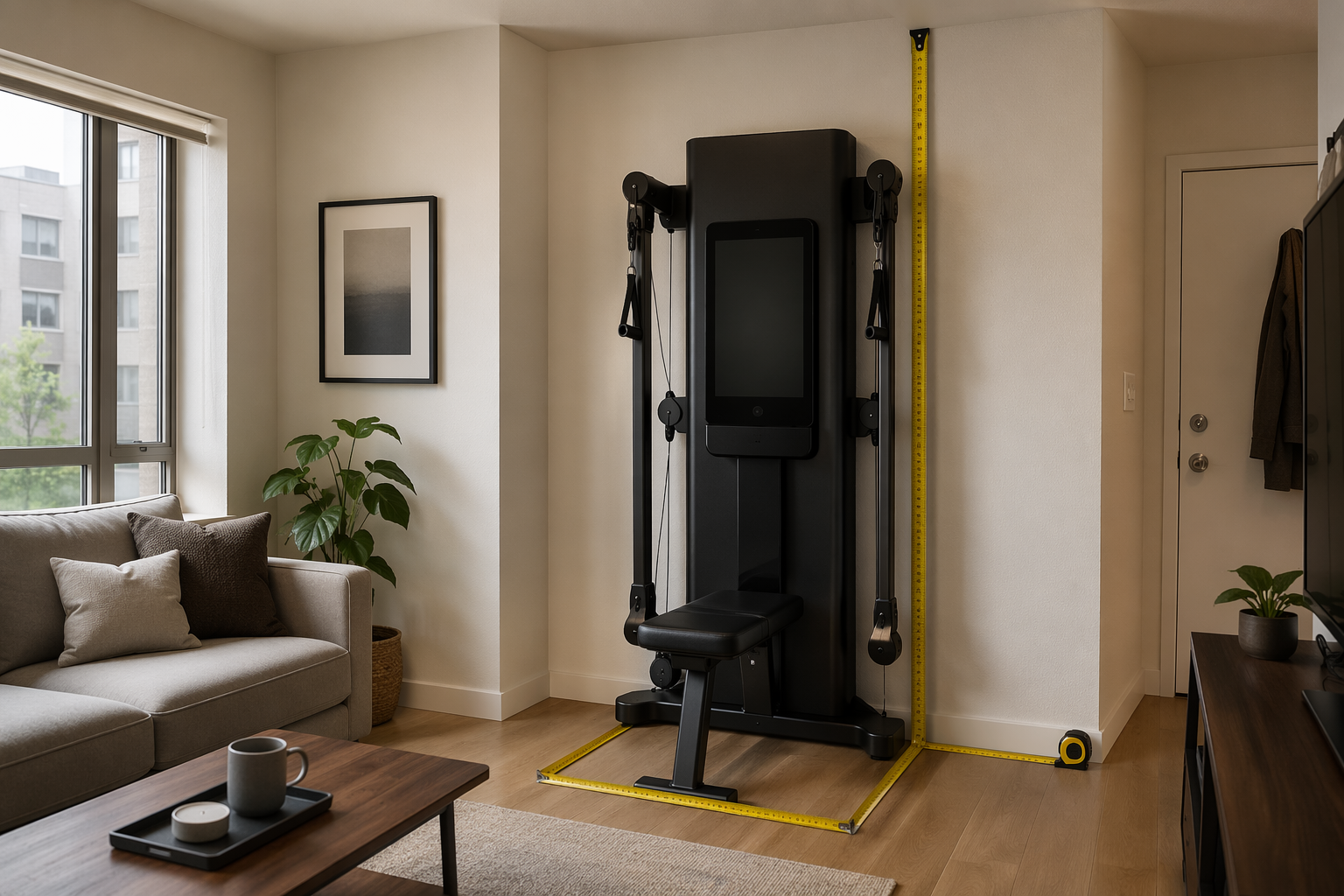
First cut: which machines are even plausible in a small room?
This table is not a final ranking. It is the elimination round. If a machine is too tall, needs wall drilling you cannot do, or occupies the only walking path in the room, the rest of the spec sheet is just decoration.
| Machine / type | Listed size | Storage mode | Wall drilling? | Resistance | Likely noise profile | Subscription status | Best small-space scenario |
|---|---|---|---|---|---|---|---|
| Speediance Gym Monster / foldable freestanding smart gym | 49.2" W x 28.3" D x 72.8" H; folds to 15" deep [1] | Folds vertically to reduce depth | No wall mounting required | Digital resistance up to 220 lb [1] | Likely among the quieter options because there are no plates or weight stack drops | Subscription-free core use; optional connected features may vary by package [1] | Low-ceiling apartment or condo where drilling is not allowed and quiet matters |
| PRx Profile Pro / wall-mounted fold-up rack | Folds to about 9" off the wall [2] | Folds flat against the wall | Yes — must be installed into studs [2] | Traditional barbell/rack setup; load depends on bar, plates, and attachments | Depends heavily on barbell use; plate handling can be loud in shared buildings | No coaching subscription requirement stated in the cited product material [2] | Owner-occupied room, garage, or permitted rental where wall installation is allowed |
| Bells of Steel Cable Tower / compact freestanding cable tower | 31" W x 28.5" D x 80.75" H [3] | Stays upright; does not fold away | Freestanding configuration; anchoring requirements depend on setup and use | Traditional cable-stack training; strong resistance-per-square-foot for its footprint [3] | Moderate: stack movement, cable travel, and vibration can carry through floors | No training subscription required [3] | Corner strength station where you can leave the machine ready all day |
| Tonal 2 / wall-mounted smart gym | 21.5" W x 5.25" D x 50.9" H body [4] | Wall-mounted unit with folding arms | Yes — professional wall installation into suitable studs is required [4] | Digital resistance up to 250 lb [4] | Likely one of the quietest strength options; no plates or stack clanking | $4,295+ hardware with required monthly membership listed around $60/month as of Q2 2026 [4] | Quiet smart-gym setup for an owner or renter with explicit wall-installation permission |
| Bowflex Xtreme 2 SE / full-size freestanding home gym | 63" L x 49" W x 83.25" H [5] | Does not fold meaningfully for daily living | No wall mounting required | Power Rod resistance system [5] | Usually quieter than plate-loaded work, but the frame and movement still occupy a large room zone | No required coaching subscription stated in the cited product material [5] | Small house room or larger basement corner, not a tight apartment nook |
The table also shows why a single “best compact all-in-one” answer is usually fake. Speediance and Tonal are compact because they remove iron plates and stacks. PRx is compact only after you accept wall installation. Bells of Steel is compact for a cable tower, but it still lives in the room. Bowflex is an all-in-one machine, but calling it apartment-friendly takes a generous definition of apartment.
Ceiling height eliminates machines faster than floor space does
Most people measure the floor first because that is what product pages emphasize. In real small rooms, ceiling height often kills the purchase earlier. A machine that is 72.8 inches tall, like the Speediance Gym Monster, gives you more room under a standard 8-foot ceiling than a machine in the low-80-inch range [1]. The Bells of Steel Cable Tower at 80.75 inches and Bowflex Xtreme 2 SE at 83.25 inches can still work under an 8-foot ceiling on paper, but you have less margin for uneven floors, mats, pull angles, and the awkward reality of assembling a tall frame indoors [3][5].
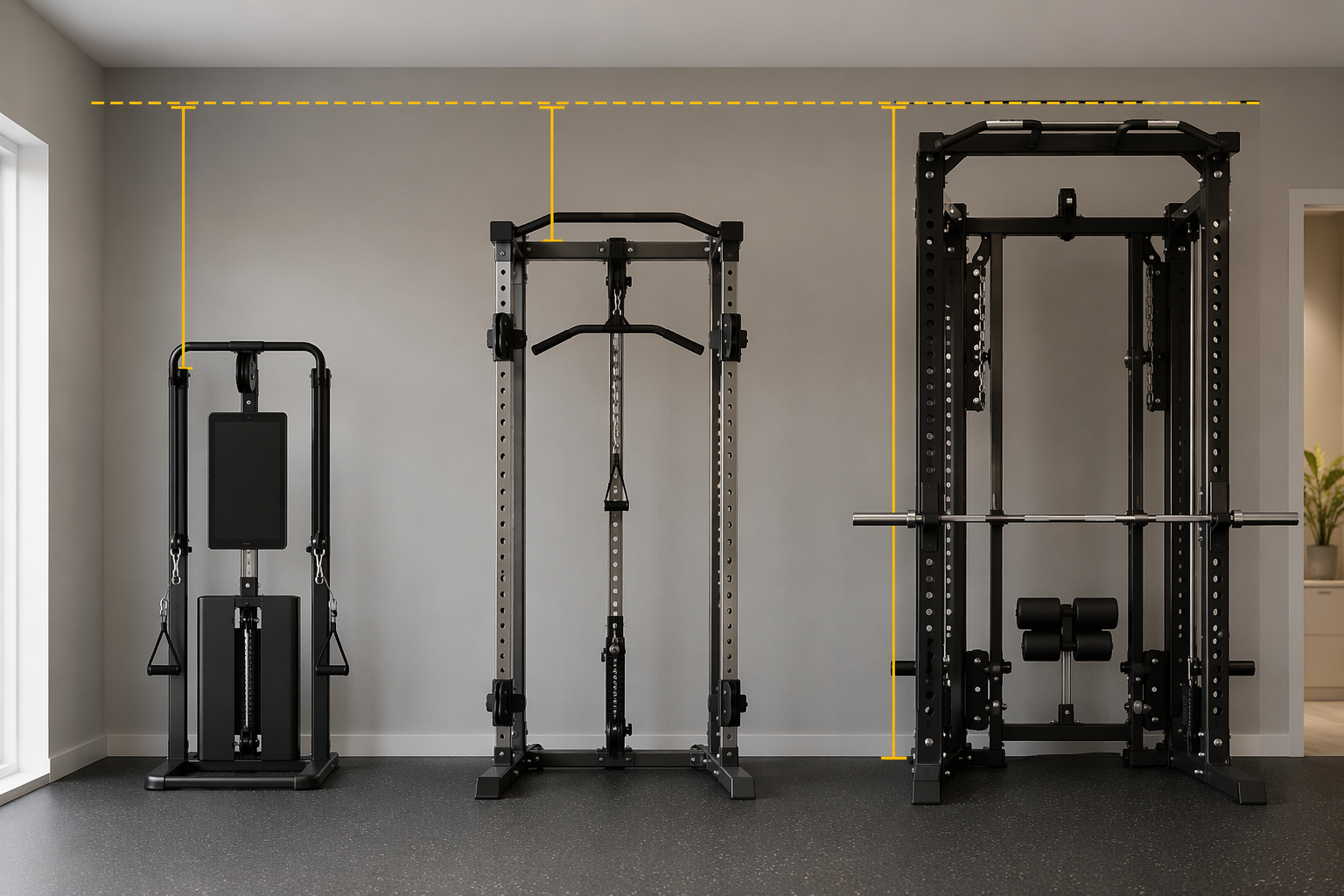
Once a machine gets into the upper-80-inch range, the buyer with a normal apartment ceiling should slow down. The Force USA G3, for example, is listed at 87 inches high, which makes it a warning example for anyone assuming every “compact trainer” works under standard residential ceilings [6]. It may be a serious machine, but serious does not help when the top crossmember is crowding the ceiling or the machine cannot be assembled upright.
This is where I would use the same discipline laid out in the Compact Home Gym Decision Framework: measure the room first, then measure the machine against the movement you plan to do. If your ceiling is under 8 feet, the difference between a 72.8-inch machine and an 83.25-inch machine is not trivia. It is the difference between comfortable clearance and living with a piece of equipment that always feels too big.
The listed footprint is not the workout footprint
Manufacturer dimensions tell you the machine’s body size. They do not tell you what happens when the cable arms open, a bench slides in, a lifter steps back, or plates need to be loaded from the side. That gap is where many small-space purchases go wrong.
Speediance folding to 15 inches deep is genuinely useful if the machine needs to share a living room wall with a couch or desk [1]. But during a workout, you still need standing space in front of it, lateral room for cable paths, and enough distance to avoid pulling against a coffee table. Tonal’s wall body is only 5.25 inches deep, which is impressive as a storage measurement, but the arms and your body create the actual training zone [4].
The Bells of Steel Cable Tower has a tidy 31-by-28.5-inch base, which is why it looks so good for resistance-per-square-foot [3]. Still, it is not a wall poster. You need room to stand, pull, kneel, set attachments down, and sometimes angle away from the pulley. A narrow cable tower tucked into a corner can be excellent, but only if the corner gives you open air in front of it.
Bowflex is the easiest place to see the mismatch. The Xtreme 2 SE is listed at 63 by 49 inches with an 83.25-inch height [5]. That is not outrageous in a basement, but in a second bedroom it can consume the room’s usable center. If you still need a desk, bed, dresser, or walking path, the machine may technically fit while making the room worse every day.
- Tape the machine’s listed footprint on the floor.
- Add the space where your body stands, lunges, rows, presses, or benches.
- Add cable-arm travel, bench length, and side access for attachments or plates.
- Walk through the room with the tape still down. If you have to turn sideways to reach a closet, the machine is not really compact for that room.
For room-by-room planning, the guide Compact Home Gym by Room Size: What Fits in Under 50, 100, and 150 Square Feet is the better next step than another generic product list.
Storage mode changes how annoying the machine is to live with
Small-space machines usually solve storage in one of four ways. None is automatically best. The right choice depends on whether you are allowed to drill, whether you will tolerate setup, and whether the equipment can stay visible without taking over the room.
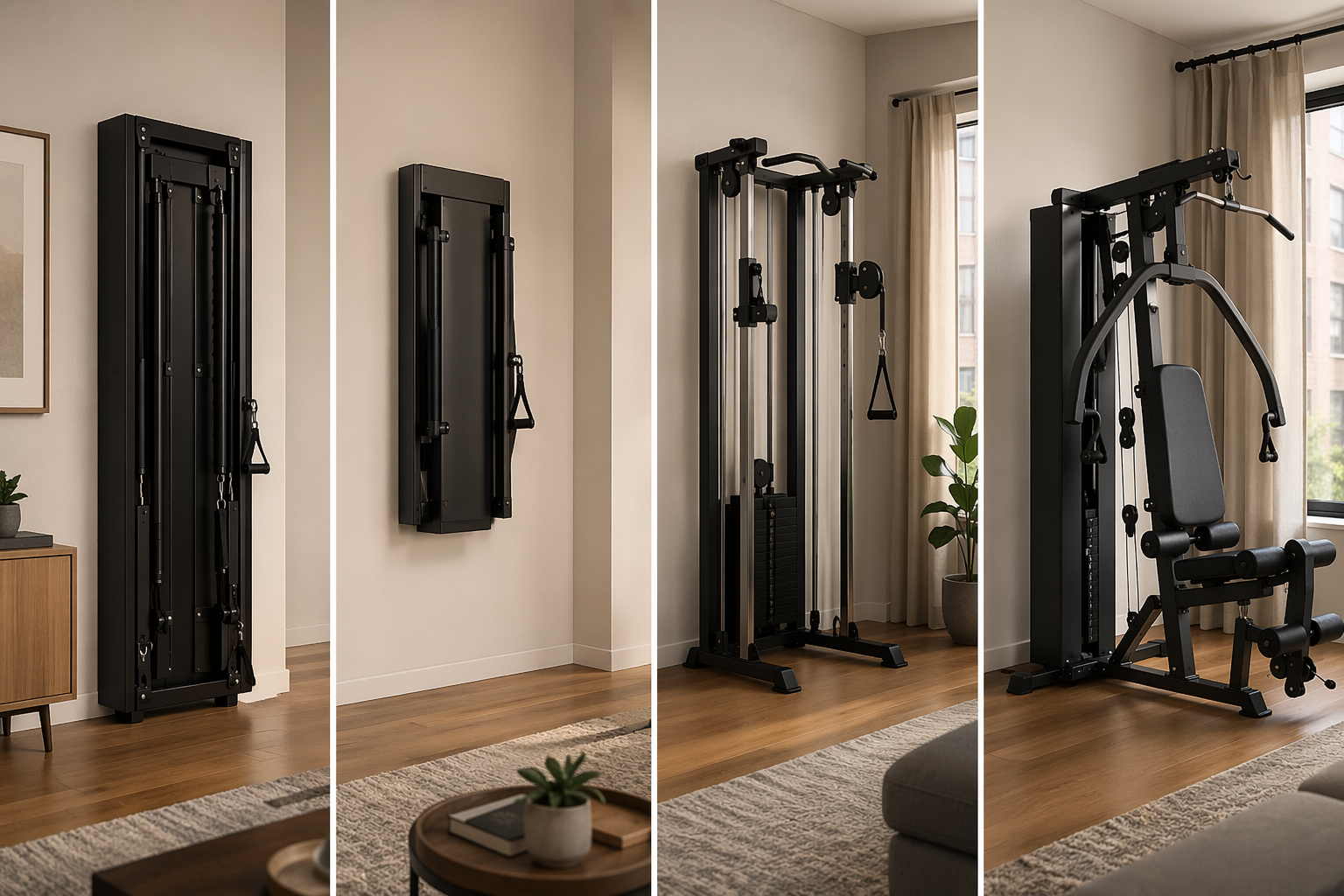
Foldable freestanding: best when you cannot drill
Speediance is the cleanest example here. It stands on its own, folds to a shallow depth, and avoids the wall-permission problem [1]. That combination matters in rentals and condos because the machine can be moved without patching studs or explaining a wall installation to a landlord or HOA.
The trade-off is behavior. If folding and unfolding becomes a pre-workout chore, some people will train less. I tend to overvalue leave-it-ready equipment for this reason. A machine that is always ready has a boring but powerful advantage: there is no little setup tax before the first set. Still, if folding is what keeps the living room usable, that trade can be worth it.
Wall-mounted: smallest floor presence, biggest permission problem
Tonal 2 and PRx Profile Pro are attractive because they give the floor back when stored. Tonal’s body is only 5.25 inches deep, and PRx’s rack folds to about 9 inches off the wall [2][4]. Those numbers are exactly what a small-room buyer wants to see.
But wall-mounted does not mean renter-friendly. Both concepts depend on a proper wall structure and installation into studs [2][4]. If you cannot drill, cannot confirm stud spacing, or do not want to repair a wall later, the storage advantage may be irrelevant. The apartment guide, Your Compact Home Gym in an Apartment: Train Heavy Without Losing Your Deposit, is worth reading before falling in love with any wall-mounted setup.
Compact freestanding cable tower: strong use of a corner
A compact cable tower such as the Bells of Steel unit is less glamorous than a smart gym, but the format makes sense if you want traditional cable training without giving up a whole room. At 31 by 28.5 inches and 80.75 inches high, it can live in a corner and stay ready [3].
The limitation is that it remains furniture-sized equipment. It does not vanish. It also does not solve every lift. If your idea of an all-in-one machine includes heavy squats, barbell-style pressing, and multiple stations, a single compact tower is a compromise, not a magic trick.
Full-size freestanding: only small-space friendly by comparison
Bowflex-style home gyms are freestanding and familiar, which is useful if you do not want subscriptions or wall drilling. The problem is that they often belong to a different idea of “small.” A 63-by-49-inch machine can work in a dedicated spare room, but it is hard to recommend for a tight apartment unless the room has more open floor than the buyer thinks [5].
Noise is a decision filter, especially above another person’s ceiling
Published noise data is thin for most all-in-one machines, and the same machine can sound different on concrete, carpet, a platform, or a second-floor wood frame. So the safest way to compare is by resistance type rather than pretending every machine has a reliable decibel number.
| Resistance type | Small-space noise expectation | What usually creates the problem |
|---|---|---|
| Digital resistance | Quietest overall | Motor or cable sound rather than plates or stack impact |
| Weight stack / selectorized cable | Moderate | Stack clank, cable movement, and vibration through the floor |
| Plate-loaded systems | Loudest in shared housing | Plate handling, missed re-racks, drops, and floor transmission |
This is one reason smart gyms can be genuinely useful in apartments. Speediance and Tonal avoid the classic plate-and-stack noise problem while still offering meaningful resistance [1][4]. That does not make them silent, and it does not erase footsteps, bench movement, or floor vibration, but it changes the kind of sound your neighbor hears.
A weight-stack tower is workable in many buildings if you control the eccentric, avoid letting the stack slam, and use appropriate flooring. A plate-loaded rack or heavy barbell setup is where second-floor apartments get risky fast. For a deeper breakdown, use Which Resistance Type Is Best for Your Small-Space Home Gym? together with Home Gym Flooring for Small Spaces and Apartments. Flooring will not make bad behavior quiet, but it can reduce vibration and protect the room.
Resistance capacity matters after the room passes
Resistance numbers are still important. They are just not the first filter. Tonal 2 lists up to 250 pounds of digital resistance, while Speediance lists up to 220 pounds [4][1]. Those numbers will be enough for many general strength trainees and not enough for some stronger lifters, especially for lower-body patterns.
The honest limitation is simple: if you need more than 250 pounds of serious cable resistance in a tiny apartment, the compact all-in-one category gets thin quickly. A traditional rack, heavier cable stack, or plate-loaded system may serve your training better, but those choices usually demand more ceiling height, more floor clearance, more noise tolerance, or all three.
For a broader taxonomy of machine formats, the guide All-in-One Home Gym Types: Which Category Matches Your Training Style, Space, and Budget is more useful than comparing max resistance claims in isolation.
Price and subscriptions come later, but they still sting
Compact all-in-one machines are not automatically cheap. The compact category spans roughly from about $1,300 for the Bells of Steel Cable Tower to $4,295+ for Tonal 2 hardware, while Garage Gym Reviews’ 2026 cost context places many home gym builds around $1,500 to $2,500 [3][4][7].
Tonal’s subscription is the clearest long-term cost issue. At about $60 per month as of Q2 2026, the membership adds about $3,600 over five years before any taxes, accessories, delivery, or installation costs are considered [4]. That may be acceptable if the coaching, tracking, and quiet wall-mounted format are exactly what make you train consistently. It is still real money, not a footnote.
Speediance and Bells of Steel are less subscription-locked options in this comparison, but that does not make them automatic winners [1][3]. Speediance still asks you to accept digital resistance and a newer smart-gym ownership model. Bells of Steel still asks you to live with a physical cable tower and the sound of a traditional stack. Lower ongoing cost solves one problem, not every problem.
If the subscription question is the sticking point after the machine has already passed your space test, read Smart vs Traditional All-in-One Home Gyms: Is the Subscription Worth It Over 5 Years? before comparing app libraries.
Small-space recommendations by constraint
Once ceiling, floor, wall, and noise constraints narrow the field, the ranking becomes much more useful.
| Best fit | Pick | Why | Watch-out |
|---|---|---|---|
| Best if your ceiling is low | Speediance Gym Monster | At 72.8 inches tall, it gives better ceiling margin than taller towers and full-size home gyms [1]. | You still need workout clearance in front of it, and folding adds a setup habit. |
| Best if you can drill into studs and want the quietest smart-gym footprint | Tonal 2 | The wall body is extremely shallow, digital resistance is apartment-friendly, and the arms fold away [4]. | Wall installation and the required monthly membership are the real gates. |
| Best resistance-per-square-foot without a smart-gym subscription | Bells of Steel Cable Tower | The 31-by-28.5-inch base gives a lot of traditional cable utility for a small corner [3]. | It stays visible and can transmit stack noise through floors. |
| Best wall-folding traditional rack option | PRx Profile Pro | Folding to about 9 inches off the wall is excellent storage efficiency [2]. | Stud installation and barbell noise make it better for permitted spaces than fragile rentals. |
| Avoid unless you have more open floor than you think | Bowflex Xtreme 2 SE | It is freestanding and subscription-free, but the 63-by-49-inch footprint and 83.25-inch height are large for tight rooms [5]. | A spare room can handle it; a shared living room probably cannot. |
For a side-by-side footprint-first comparison beyond these models, use Compact Home Gym Comparison: Find the Right Fit for Your Floor Space. The right comparison is not “which machine has the most exercises?” It is “which machine survives my room, my lease, my floor, and my training needs?”
Measurement-first buying checklist
- Measure ceiling height where the machine will actually stand, including mats or platforms.
- Tape the machine footprint on the floor, then add body position, bench space, cable travel, and walking clearance.
- Confirm whether you can drill into studs before considering Tonal, PRx, or any wall-mounted system.
- Decide what your building can tolerate: digital resistance, weight-stack noise, or plate handling.
- Only then compare resistance capacity, exercise library, app polish, and five-year subscription cost.
References
- Speediance Gym Monster — Speediance
- Profile PRO Squat Rack — PRx Performance
- Cable Tower — Bells of Steel
- Tonal 2 — Tonal
- Bowflex Xtreme 2 SE Home Gym — Bowflex
- Force USA G3 All-In-One Trainer — Force USA
- How Much Does a Home Gym Cost? — Garage Gym Reviews, 2026
This result comes from one real apartment under the stated conditions — it is a strong signal, not a guarantee your space will measure identically.
Builds this evidence supports
Cable Machine Alternatives That Save Space and Money
Compare the best cable machine alternatives for home gyms – from resistance bands and pulley systems to suspension trainers and compact digital units – and find the right option for your space and budget.
How to Choose a Compact Home Gym That Works for Your Space, Budget, and Noise Tolerance
This article provides a structured decision framework for apartment dwellers and small-space residents to match their specific floor footprint, noise sensitivity, and budget to the most suitable compact home gym strategy — whether that's an all-in-one machine, modular build, smart digital system, or band/bodyweight setup.
The Garage Gym Reality Check: What Equipment Actually Fits in a Single-Car Garage
Most garage gym guides assume a two-car space. This article uses real dimensions, real equipment footprints, and three layout templates to show what fits—and what doesn't—in a single-car garage (10x20 to 12x20 ft).
Spot something off?
If this result didn't match your own space, let us know — floor-damage and noise claims carry real deposit-risk consequences if we get them wrong.