
The 7-minute workout only becomes beginner-friendly when you change it
The tension is simple: WebMD treats the standard workout as too intense for beginners, while Cleveland Clinic and Healthline present modified versions that beginners can actually use [1][2][3]. The original ACSM protocol was meant as a repeated circuit rather than a single pass, so one easier round is a starting point, not a universal finish line [4].
If you only need an entry-level on-ramp, the beginner-only modifications guide is the faster route. If joint pain is the real limit, the low-impact equipment guide is more useful. Once volume starts rising, the recovery piece and the broader cardio framework help with the next decision.
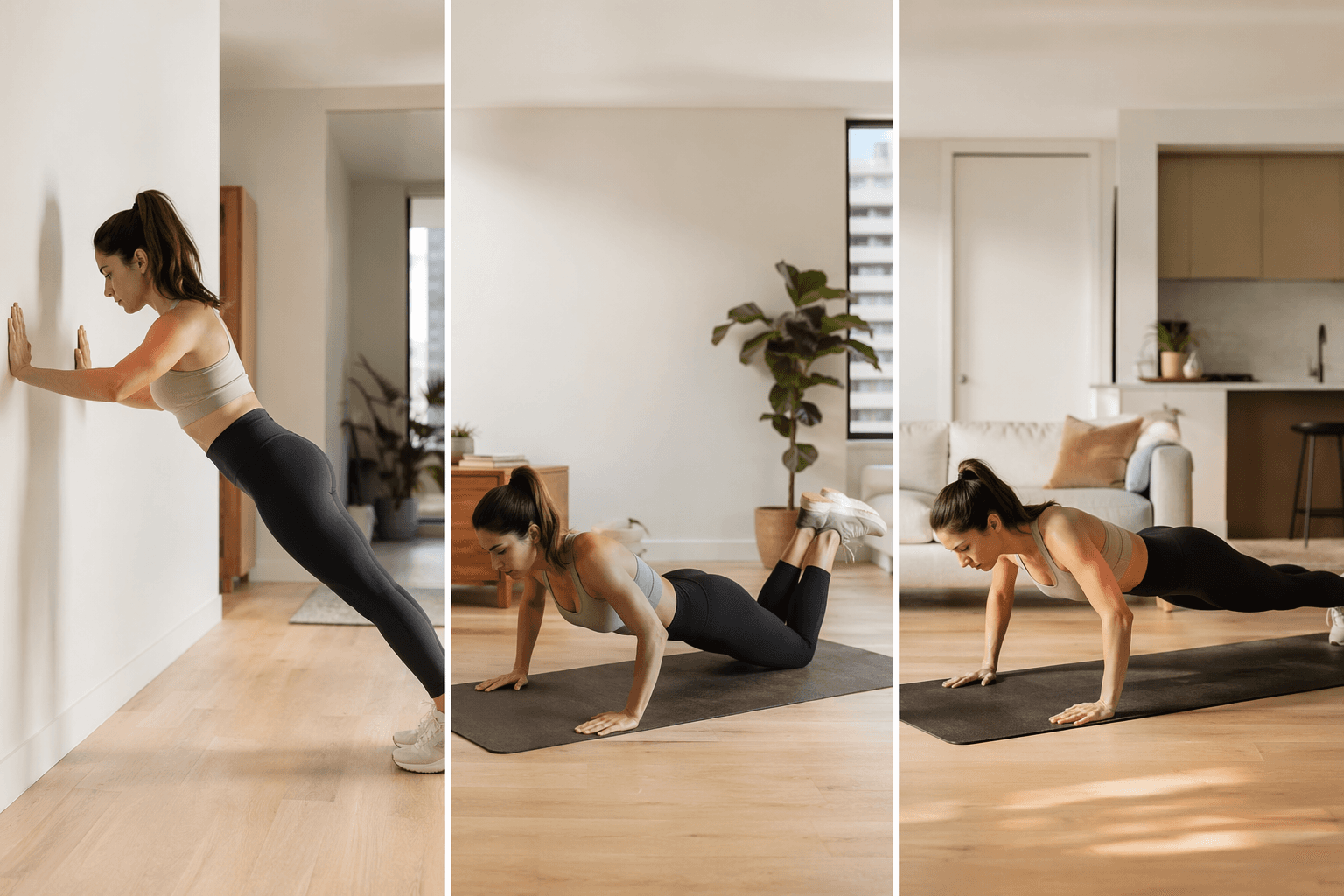
The 12-exercise matrix
The rows below keep the circuit shape intact while changing the load. The useful move is not to swap in a random easier exercise; it is to stay inside the same movement pattern and move one step up or down as needed.
| Exercise | Easier start | Standard version | Harder progression |
|---|---|---|---|
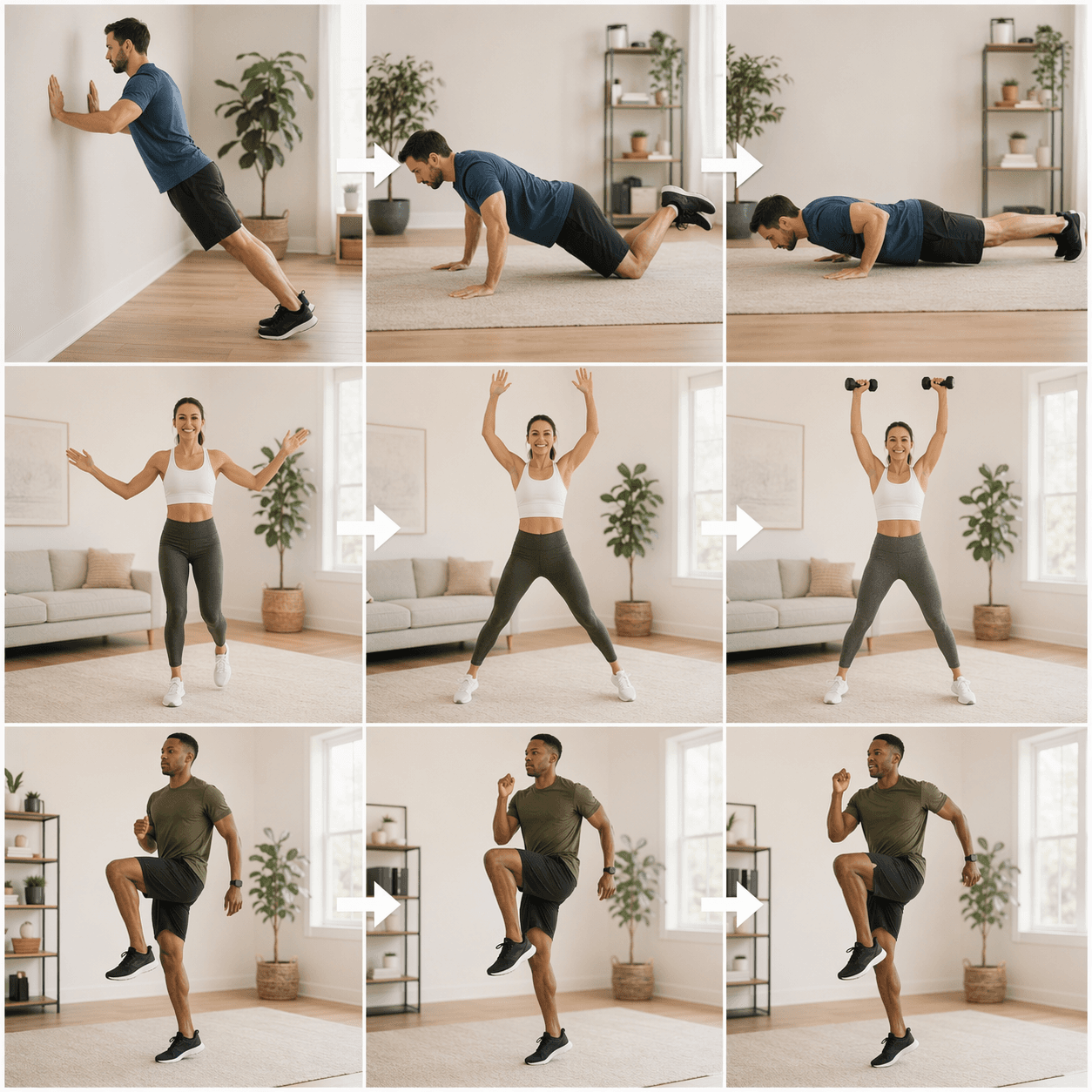
| Jumping jacks | March in place or step-touch | Step-out jacks | Full jumping jacks or weighted jacks |
| Wall sit | Shallow wall sit above parallel | Standard wall sit | Longer hold, single-leg bias, or added load |
| Push-up | Wall push-up | Knee push-up | Full push-up or decline push-up |
| Abdominal crunch | Dead bug or shortened crunch | Standard crunch | Slow-tempo or weighted crunch |
| Step-up onto chair | Toe tap or low step-up | Standard step-up | Step-up with knee drive or load |
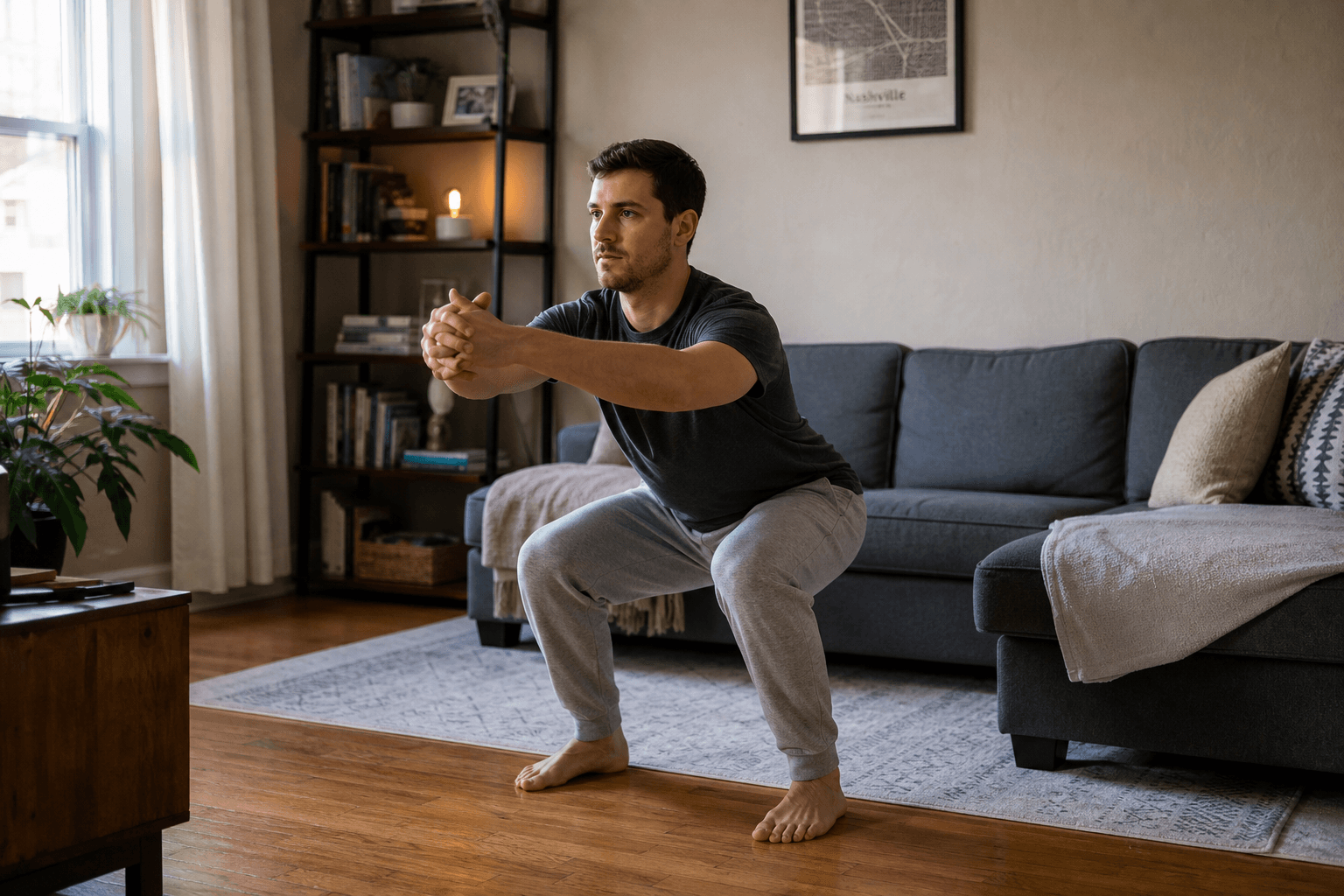
| Squat | Chair squat | Bodyweight squat | Tempo squat or jump squat |
| Triceps dip | Bench-supported partial dip | Standard bent-knee dip | Slower straight-leg dip or feet-elevated dip |
| Plank | Incline plank | Forearm plank | Full plank with shoulder taps |
| High knees | Marching in place | High knees | Faster high knees with arm drive or sprint-in-place |
| Lunge | Supported split squat | Reverse lunge | Walking lunge or jump lunge |
| Push-up with rotation | Incline shoulder tap or kneeling rotation | Full push-up with rotation | Feet-elevated or slow-tempo rotation |
| Side plank | Side plank on knees | Full side plank | Side plank with reach-through or leg lift |
A few practical guardrails make the matrix work: if wrists complain, stay on incline pushing; if knees complain, reduce impact before you shorten range; if dips irritate the front of the shoulder, do not force depth just because the original sequence says triceps dip. The point is to keep the protocol usable, not to defend every original exercise choice.
Circuit variables should change separately
The standard 10-second rest does not have to stay fixed. Cleveland Clinic and Healthline both allow beginners to stretch rest to about 20 to 30 seconds, and that change alone can keep form intact long enough for the workout to become repeatable [1][2].
| Variable | Beginner setting | Base setting | Progressed setting |
|---|---|---|---|
| Rest | 20-30 seconds | 10-20 seconds | 10 seconds only if form stays clean |
| Rounds | 1 round | 2 rounds | 3 rounds only if recovery stays solid |
| Impact | Marching, step-touch, or other low-impact substitutions | Mixed impact | Full impact |
| Progression rule | Change one move or one variable at a time | Keep the same structure long enough to learn it | Move one step harder before adding more volume |
That is the part most fixed plans miss: a person can increase difficulty through the exercise choice, the rest interval, the round count, or the impact level, and those do not have to rise together. A beginner may need longer rest but the same movement pattern. An intermediate user may keep the rest but move from wall push-ups to knee push-ups. An advanced trainee may keep the movements and shorten rest only after the pattern has stopped feeling like a challenge.
The plateau problem is why this matters. A small six-week study of 29 adults aged 18 to 30, all with normal BMI, reported early changes that included about a 4 cm waist reduction and a 0.3 BMI drop, but progress flattened around weeks 3 to 4 when the identical daily protocol was repeated [5]. That does not mean the workout stops working. It means repeating the same dose eventually turns into maintenance.
A four-week progression path
| Week | Main goal | What to change | What to watch |
|---|---|---|---|
| Week 1 | Find a sustainable starting version | Choose the easiest exercise level that preserves the circuit; use 20-30 seconds of rest if needed | Breathing, joint comfort, and whether every rep stays controlled |
| Week 2 | Tighten the same pattern | Keep the same exercise choices and trim rest toward the base range | Whether form is still stable when fatigue appears |
| Week 3 | Increase one stressor | Upgrade one or two exercises one step, or add a second round if recovery is good | Whether any movement starts to fall apart before the timer ends |
| Week 4 | Prevent the plateau | Rotate several moves one step harder, or keep the movements and add a third round only if recovery still supports it | Signs that the workout has become automatic instead of challenging |
The safest order is usually exercise version first, then rest, then round count. That order keeps the movement quality from collapsing before the stimulus has a chance to rise. If you can already complete two or three rounds cleanly, the 7-minute workout should probably become one conditioning block inside a broader program rather than the whole plan. It also still leaves out pulling work, so even a well-modified version does not replace a complete strength routine [4].
For readers who want the 7-minute workout to stay in the rotation, the useful question is not whether the protocol is clever. It is whether today’s version matches the body doing it, and whether next week’s version is slightly more demanding in the right place.
References
- Cleveland Clinic. 7-Minute Workout. Oct. 2023.
- Healthline. 7-Minute Workout.
- WebMD. Seven-Minute Workout. July 2025.
- American College of Sports Medicine. The 7-Minute Workout. 2013.
- PubMed Central record for PMC10499152.
Comments
Join the discussion with an anonymous comment.