
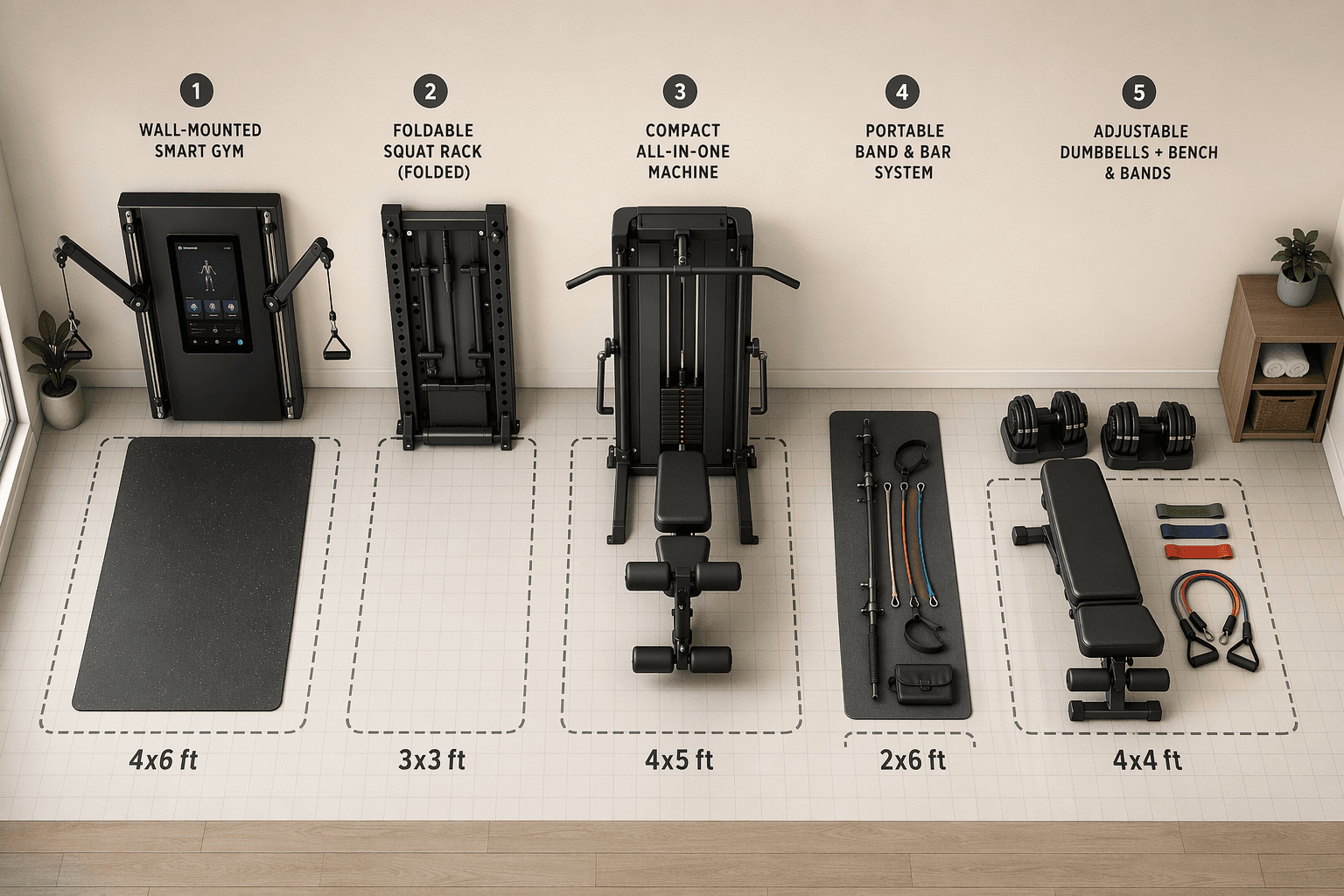
I lost a security deposit over a wall-mounted gym. The rack itself was fine. The holes I drilled into the plaster to anchor it were not.
That mistake taught me something the buyer's guides never mentioned: equipment that works in a garage or basement often fails in an apartment because of four constraints most reviewers ignore. Noise transmission. Floor damage. Drilling restrictions. And whether you can actually assemble the thing in a 10×12 room without calling for backup.
Nearly 39 million Americans live in apartments (NAHB data, via the National Apartment Association). That is a lot of people getting advice that treats their most critical constraints as afterthoughts. This is not another product list. It is a filter. If your lease says no drilling, you skip an entire category. If you live above someone, you skip an entire noise profile. The right compact home gym for an apartment is the one that survives all four checks.
What your downstairs neighbor hears (and what your landlord sees)
I used to think any compact home gym would be quiet enough. I was wrong. The difference between digital resistance and plate-loaded steel is not subtle. It is the difference between your downstairs neighbor knocking on the door and never knowing you exist.
Here is the noise spectrum, from quietest to loudest.
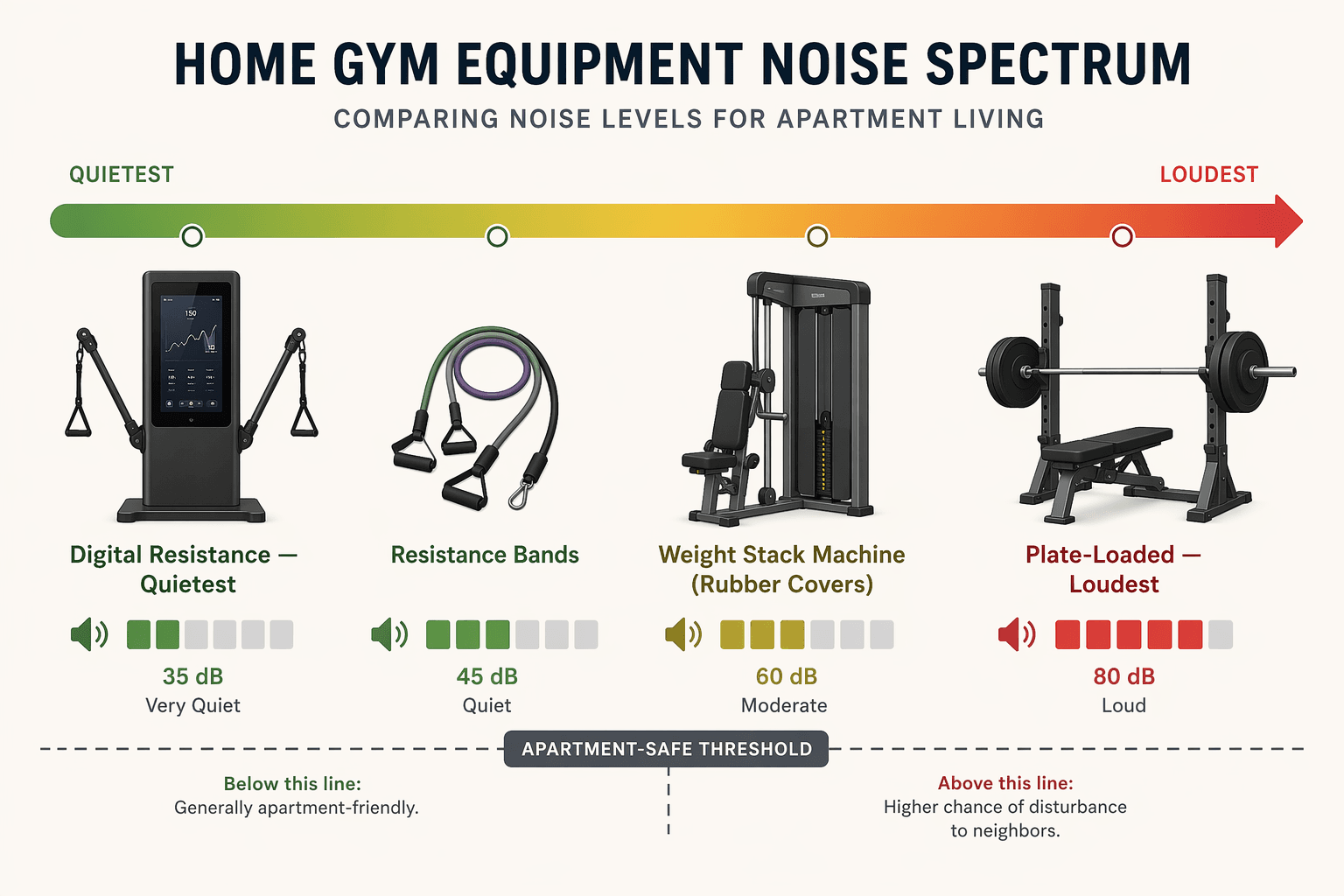
| Type | Noise Level | Example | Renter Verdict |
|---|---|---|---|
| Digital resistance | Near silent | Tonal 2, Speediance Gym Monster 2 | Best for noise, but check drilling requirements |
| Band-based systems | Very low | X3 Bar, resistance bands | Excellent – no impact noise |
| Weight stacks with rubber mats | Moderate clank | Bells of Steel Cable Tower | Acceptable with flooring mitigation |
| Plate-loaded | Loudest – steel on steel | Traditional barbell + plates | Skip unless you have a ground-floor concrete slab |
Digital resistance machines like the Tonal 2 and Speediance use electromagnets. No plates clank. No weight stacks slam. They are genuinely quiet. But Tonal requires professional wall mounting – that brings us back to drilling. Band-based systems like the X3 Bar generate near-zero impact noise because the bands absorb the force. The X3 Bar produces up to 300 lbs of resistance (600 lbs with the Elite Band) and sits on a ground plate that is 10" × 19" – no dropping, no slamming.
Weight stack machines fall in the middle. The Bells of Steel Cable Tower uses a 210-lb stack. The weight plates moving on guide rods produce a moderate clanking sound. With 3/4" rubber flooring mats, you can reduce impact noise by roughly 60–70%. Still, if your bedroom is directly above your neighbor's, that clank may carry.
Noise and floor protection are the same battle. A thin yoga mat will not protect your hardwood from a 200-lb weight stack. It will also not stop the downstairs neighbor from hearing your workout. The choice of flooring is a noise and deposit protection decision.
| Material | Cost | Noise Reduction | Best For |
|---|---|---|---|
| 3/4" rubber horse stall mats | ~$2–$4 per sq ft (Tractor Supply) | High – absorbs impact and vibration | Heavy equipment, weight stacks, any dropping |
| 1/2" rubber mats | ~$1.50–$3 per sq ft | Moderate | Mid-weight gear, dumbbells |
| Interlocking foam tiles (Amazon Basics) | ~$25 for 24 sq ft | Low – cushions but does not absorb heavy impact | Bodyweight, bands, light cardio |
| Carpet + thin mat | Varies | Poor – sound travels through carpet fibers | Not recommended for anything beyond stretching |
For most apartment dwellers, the sweet spot is a 1/2" or 3/4" rubber mat. You can buy horse stall mats from Tractor Supply for roughly $2 to $4 per square foot. They are heavy (about 100 lbs for a 4×6 ft mat), smell like rubber for a few days, and require some maneuvering to get into an apartment, but they are the best noise and floor protection per dollar. If you are on a tighter budget or only doing bodyweight work, the Amazon Basics Foam Interlocking Mats (under $25 for 24 sq ft) will get you started – just do not expect them to protect against 200-lb drops.
For a deeper dive on mat types, installation, and what to avoid in rentals, see our full flooring guide for small spaces and apartments.
The hole in your wall (and your deposit)
This one cost me a deposit. If your lease says no drilling, or if you are not prepared to patch holes at move-out, wall-mounted equipment is off the table. Full stop.
The Tonal 2 is a standout smart home gym – quiet, compact, up to 250 lbs of digital resistance. But it requires professional installation that involves drilling into studs. It also needs a clear 7×7 ft space to use safely. If you are in a typical apartment living room, that space may not exist. The PRx Profile PRO Squat Rack folds to 9–12 inches against the wall, which is brilliant for space, but it also requires drilling into the wall for the mounting bracket.
If your lease allows drilling, these are great options. If it does not, move on. There are solid no-drill alternatives.
- Speediance Gym Monster 2 – no drilling required, folds up when not in use, requires about 40 sq ft of floor space. Costs $3,689 with free shipping and a free lifetime membership. Note: its unfolded height is 72.83 inches, which may be tight under an 8-ft ceiling.
- X3 Bar band system – no drilling, footprint 10" × 19", weighs 17 lbs. Resistance up to 600 lbs. Silent.
- Perfect Fitness Multi-Gym Doorway Pull-Up Bar – costs under $40, holds 300 lbs, no drilling. Attaches to the door frame with tension.
- Tempo Move – uses your phone and a wall marker (no drilling) to track movement. Lightweight, storeable.
Can you actually install it alone in a 10×12 room?
Even if something passes noise, flooring, and drilling checks, it can still fail the final test: does it fit through a 30-inch doorway, and can you assemble it alone in a small room?
Most reviews ignore this. Here is the reality: the Speediance Gym Monster 2 unfolds to 72.83 inches tall – that is just over 6 feet. If your ceiling is the standard 8 feet, you have about 23 inches of clearance, which is fine. But if you have a ceiling fan or low-hanging light, you may need to reposition. The Bells of Steel Cable Tower is 80.75 inches tall – that will be tight under an 8-ft ceiling, and impossible under a 7-ft basement ceiling.
On the other end of the spectrum, the LEIKE X Bike folds to 46" × 16" × 9" and weighs 38.5 lbs. It can be carried in one hand and assembled without tools. The X3 Bar fits in a duffel bag. The Niceday Elliptical has a 15.5-inch stride length and is compact enough to roll under a bed.
Assembly difficulty varies wildly. The Speediance requires two people to set up the cable arms. The PRx Profile PRO wall bracket needs a stud finder, a drill, and a level. The X3 Bar is ready out of the box. If you live alone, the assembly step can turn a promising purchase into a week-long frustration. Read the manual (or customer reviews about assembly) before you buy.
The shortlist: which machines survive the four filters?
By now you understand the trade-offs. No single machine is perfect for every apartment. The right choice depends on which constraints hit you hardest. Here is how the picks map to the four filters.
| Constraint | Top Pick | Why | Trade-Off |
|---|---|---|---|
| Quietest cardio | Niceday Elliptical ($600) | Magnetic drive, ultra-quiet, 400-lb capacity | Not foldable, needs floor space |
| Quietest strength | X3 Bar band system ($400) | Silent, 300–600 lb resistance, 10"×19" footprint | Resistance maxes out for serious lifters |
| No-drill smart gym | Speediance Gym Monster 2 ($3,689) | Digital resistance, folds up, free membership | 40 sq ft footprint, 72.83" unfolded height |
| No-drill budget | Perfect Fitness pull-up bar ($40) | Doorway mount, 300 lbs, no tools | Only upper body |
| Foldable rack (drill allowed) | PRx Profile PRO ($1,100) | Folds to 9–12" deep, 1,000-lb capacity | Requires wall anchors and studs |
| Weight stack (moderate noise) | Bells of Steel Cable Tower ($1,200) | 210-lb stack, limited lifetime warranty | 80.75" height, needs rubber mats |
If you are still in the early research phase, start with our compact home gym buyer's guide of eight questions to answer before buying a single piece of gear. It covers space, budget, goals, and timeline – the pre-work that makes the constraint framework easier to apply.
For a broader product list that includes options not evaluated here, see our compact home gym equipment guide for apartments. That article is a roundup; this one is a filter. Use both together: the filter tells you what category to look in; the roundup gives you the options.
The final judgment is yours. But I will leave you with this: start with the two non-negotiable filters – noise and drilling. If a machine is too loud for your building or requires wall anchors your lease bans, it does not matter how compact or affordable it is. Those two constraints alone will eliminate most of the market. The few that remain are the ones worth your time, your floor space, and your deposit.
Comments
Join the discussion with an anonymous comment.