
Why your living-room cardio doesn't stick
I know someone who marched in place for 15 minutes, three times a week, for two months. Her heart rate stopped climbing after the second week. She never felt winded. She figured she had hit some kind of ceiling, so she added five minutes. Nothing changed. She had not actually hit a ceiling. She had stopped applying progressive overload.
A structured progressive plan is more effective for building cardiovascular endurance than random exercise sampling. The problem is that most people default to extending duration when they want to improve — run longer, march longer. That works for about two weeks, then you adapt. The real lever is the work-to-rest ratio, not the minute count.
The lever that works: less rest, not more minutes
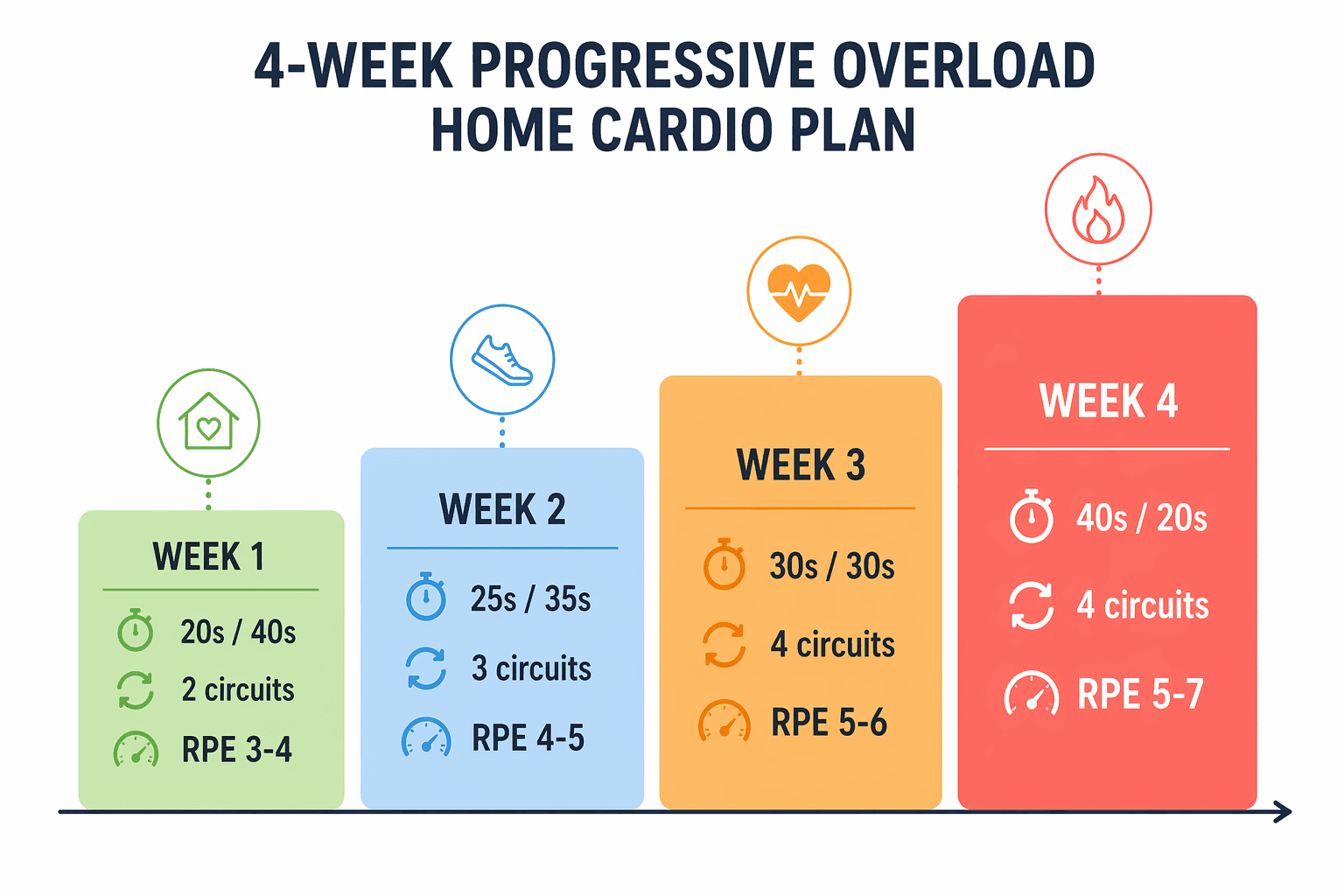
If you reduce the rest period between intervals, your heart rate stays elevated for a longer portion of the session. If you lengthen the work interval while keeping rest short, you build the capacity to sustain effort. That's the principle behind interval protocols used in controlled studies — and it works without a treadmill or a gym membership. The ratios below (20/40 → 25/35 → 30/30 → 40/20) are drawn from multiple sources, not a single trial. They form a logical progression based on interval training principles, not a proven formula.
| Week | Work / Rest | Circuits | RPE target | Feel |
|---|---|---|---|---|
| 1 | 20s / 40s | 2 | 3–4 | You can talk comfortably |
| 2 | 25s / 35s | 3 | 4–5 | You need to pause after a sentence |
| 3 | 30s / 30s | 4 | 5–6 | You can say only a few words |
| 4 | 40s / 20s | 4 | 5–7 | Breathless but not failing |
No chest strap? Use the talk test
The plan gives you RPE targets each week, but numbers on a scale are useless if you can't translate them into body feel. The simplest tool is the talk test. Nike's guide maps RPE to conversational ability this way:
- RPE 1–3: you can sing or hold a full conversation – easy effort.
- RPE 3–5: you can speak a few words but need to pause for breath – moderate effort. This is your week 1–2 zone.
- RPE 5–7: you can say only a word or two before gasping – vigorous effort. Week 3–4 targets sit here.
- RPE 7–10: completely breathless, unable to speak. You will hit short bursts in week 4.
You do not need a heart rate monitor. If you can recite a full sentence, push harder. If you cannot say a single word, back off for a few seconds. The plan's RPE range gives you permission to adjust in the moment.
The four weeks, one progression
The first week is deliberately easy. You work for 20 seconds, rest for 40 seconds, and repeat a circuit of four exercises twice. Total work time: about 6 minutes. The goal is habit and form, not fatigue. Start with a 5‑minute warm‑up: arm circles, leg swings, slow marching. Then the circuit:
- Marching in place – keep knees soft, arms swinging.
- Bodyweight squat – stand hip‑width, lower as if sitting in a chair.
- Standing side reach – alternate reaching one arm overhead while shifting weight to the opposite leg.
- Glute bridge – lying on back, feet on floor, lift hips toward ceiling.
Perform each exercise for 20 seconds, rest 40 seconds, move to the next. After the fourth exercise, rest 60 seconds, then repeat the circuit once more. Finish with a 5‑minute cool‑down: slow walking, deep breathing. RPE during work intervals should be 3–4 — you can talk comfortably. If you cannot, your pace is too high. Slow down.
In week 2, you work 25 seconds and rest 35 seconds. The ratio is tighter, and you add a third circuit. Replace marching with a lateral shuffle to introduce lateral movement. The other three exercises stay the same. RPE target: 4–5 — you can speak a few words, then you need to pause for a breath. If you find yourself breathing through your nose the whole time, pick up the pace on the lateral shuffle.
- Lateral shuffle – step quickly side to side, keeping hips low.
- Bodyweight squat (same as week 1).
- Standing side reach (same).
- Glute bridge (same).
Weeks 3 and 4 are where the plan really tests you. Equal work and rest (30/30) in week 3 with four circuits. Then 40 seconds of work with 20 seconds of rest in week 4, also four circuits. I am skeptical of plans that assume linear improvement, so week 3 is designed to be the sticking point. If you need to repeat it for an extra week, do that.
The exercise list introduces plyometric options: jumping jacks, jump squats, burpee variations. Jumping is completely optional. The plan works without any jump at all. For each plyometric move, a low‑impact alternative is given.
- Jumping jacks → stand jacks (step out to side instead of jump).
- Jump squat → bodyweight squat (as before).
- Burpee → step‑out burpee (step back into plank, step forward, stand).
- Mountain climbers (can be done at a walk instead of running).
By week 4 you have enough base to sustain a genuine elevated heart rate for the session. I would not call this a guaranteed outcome — individual fitness varies — but it is a realistic target for someone who followed the progression faithfully. The exercises shift to full‑body compound moves:
- Squat to knee drive – squat down, then drive one knee up as you stand, alternating legs.
- Mountain climbers (walk or run).
- Jumping jack variation (or stand jacks).
- Standing oblique crunch – one leg lifted, elbow moving toward the raised knee, as shown below.
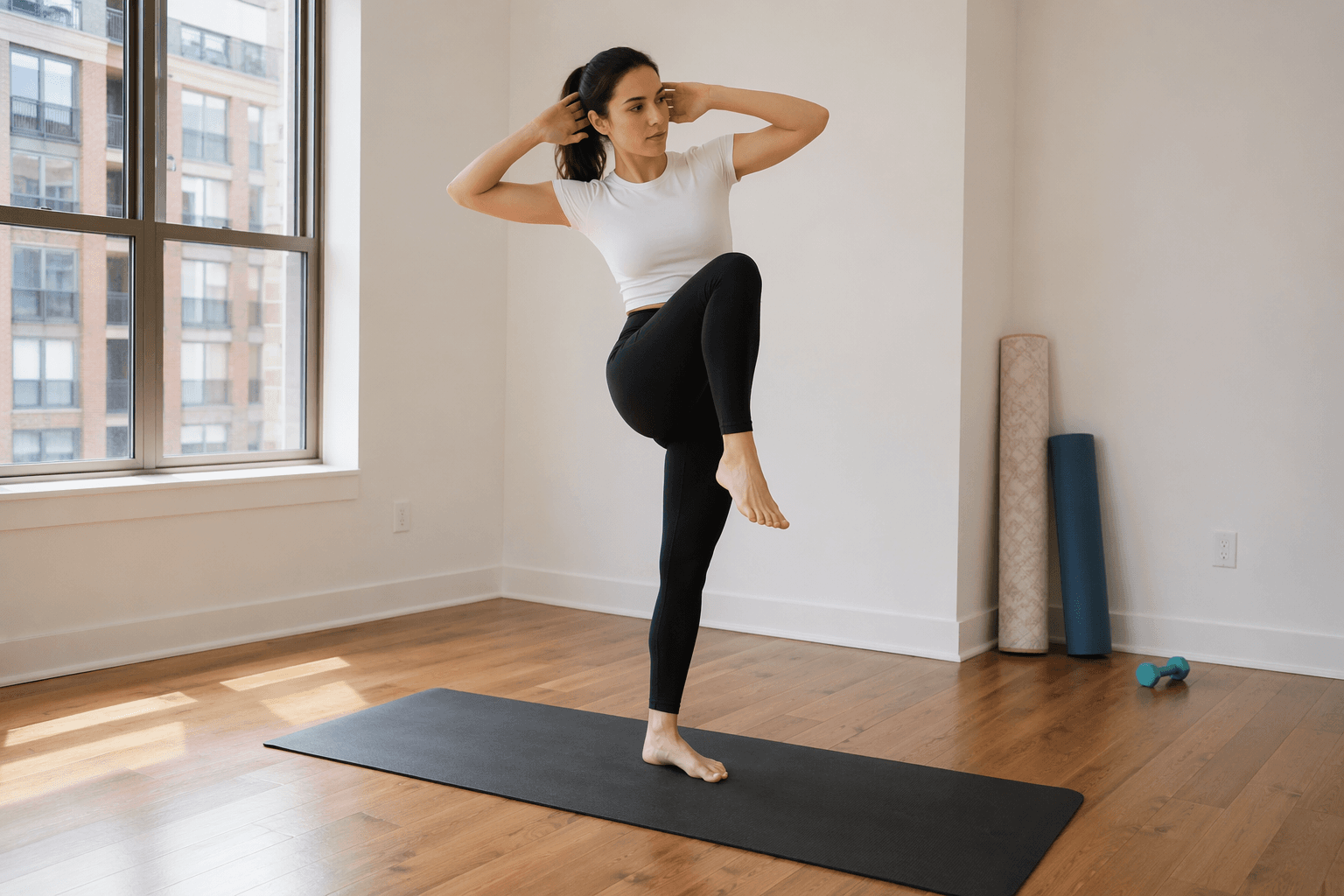
RPE target: 5–7 — breathless but not failing. If you hit 7, you are in the vigorous zone. That is fine for short intervals. If you hit 8 or above consistently, shorten your next work interval by 5 seconds until you find a sustainable pace.
What this plan does (and doesn't do) for the 150‑minute guideline
Three sessions per week, each lasting 15–25 minutes total (including warm‑up and cool‑down), equals roughly 45–75 minutes of exercise. The CDC and American Heart Association recommend at least 150 minutes of moderate‑intensity aerobic activity per week (or 75 minutes of vigorous). This plan alone does not hit that target. It is a starter base. Combine it with walking, cycling, or an additional session on the weekend, and you will get there.
The same principle — reduce rest, extend work — can be applied further. The 6‑week progressive cardio program on this site extends the overload into longer intervals and adds intensity variations. If week 3 felt hard, repeat it for another week. The plan is a starting point, not a straightjacket. The goal is not to finish four weeks; it is to build a habit that keeps progressing.


Comments
Join the discussion with an anonymous comment.