
The Progressive At-Home Leg Workout System: Beginner to Advanced (No Equipment Needed)
This three-tier leg workout system gives beginners through intermediates a clear path to build strength at home without equipment. Each tier includes specific rep/set schemes and advancement thresholds so you know exactly when to progress to harder variations.
- Duration
- 20 min
You found a YouTube video titled "10 Minute Leg Workout – No Equipment." You did it. It burned. Next week you did it again. The burn came later. After a month you can finish the whole thing without breathing hard, but your legs look the same and you can't squat any lower.
The problem is not the exercises. The problem is there was no system for making them harder. A flat list of moves repeated without progression does not build strength beyond the first few weeks. The Centr article that reviewed over 40 studies put it plainly: to build leg muscles with bodyweight exercises, you need to utilize progressive overload — continuously challenge those muscles so they are forced to get stronger.
This article gives you that system. Three concrete tiers, each with its own exercises, rep schemes, and a single clear rule for when to move up. No equipment, no guessing, and no motivational poster language.
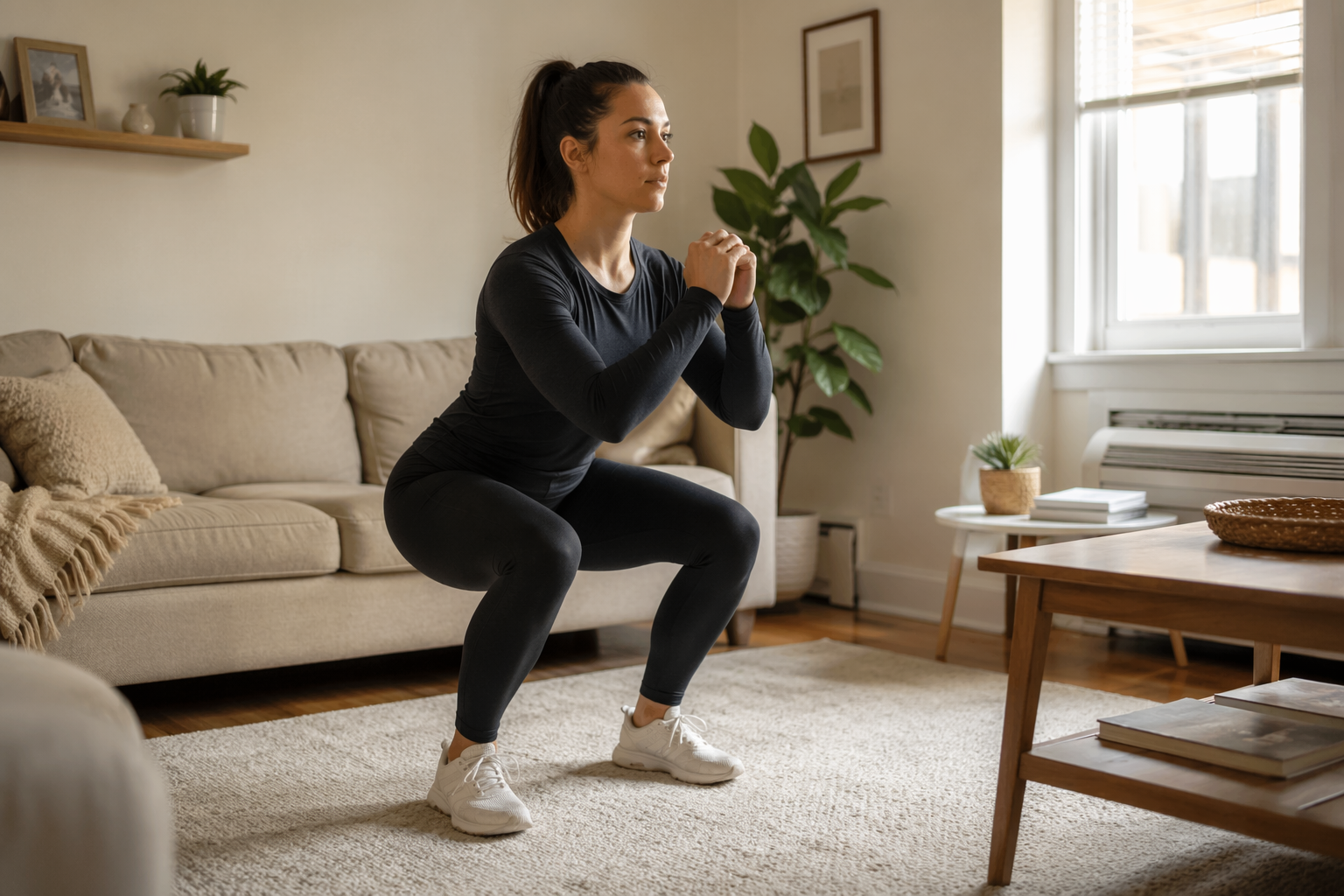
The Only Number That Matters: 15–20 Clean Reps
The entire progression hangs on a single threshold: when you can complete 15 to 20 controlled, full range-of-motion reps of an exercise, you are ready for the next tier. Centr's analysis puts the number at 15–20 reps before introducing harder exercises. PureGym suggests 12 reps and then add weight — but since you do not have weight, the higher end of the rep range gives you more runway before you need load.
What does "clean" mean? Controlled descent, pause at the bottom if the movement requires it, full extension on the way up. No bouncing, no using momentum. If you have to jerk your torso forward to complete a squat, that rep does not count. The number matters less than the quality — advancing with poor form is a reliable way to stall progress or hurt yourself.
This threshold appears across multiple sources — SELF, Verywell Fit, Centr — because it has been tested against real training populations. The numbers are consistent. SELF recommends that beginners start with 2 sets of 12–15 reps, then work up to 3 sets — that intermediate step within the tier is how you build toward the 15–20 cut-off.
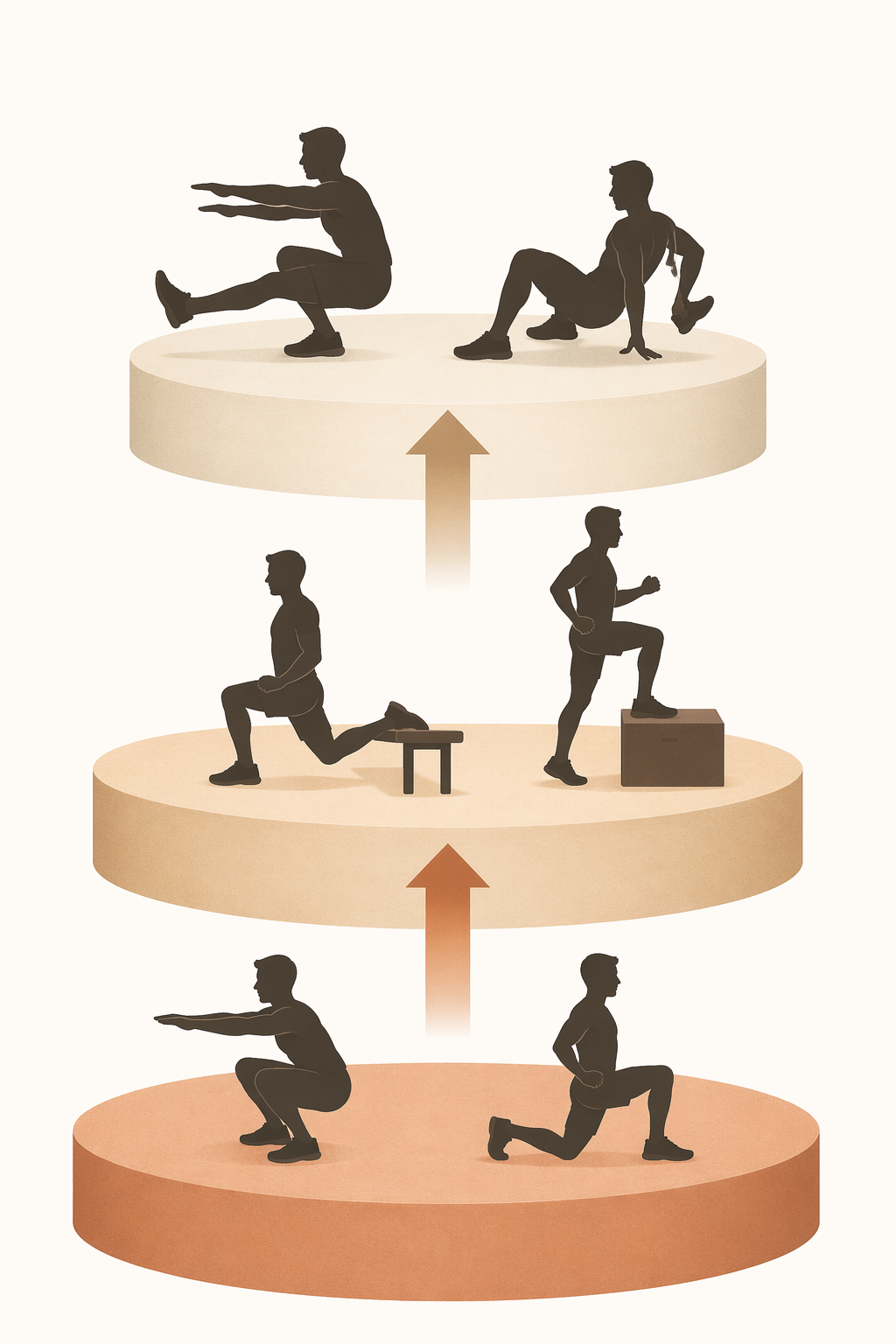
Beginner Tier: Build Your Foundation (2–3 Sets of 12–15 Reps)
This tier is for anyone who has never consistently trained legs, or who can do fewer than 15 clean reps of a basic bodyweight squat. The goal is to establish the movement patterns and build the base of strength and endurance that the harder variations will demand.
- Bodyweight squats — feet shoulder-width apart, chest up, hips back, go as low as you can without your lower back rounding.
- Reverse lunges — step back, lower until both knees are at 90 degrees, drive through the front heel to return.
- Glute bridges — lie on your back, feet flat on the floor, lift your hips until your body forms a straight line from shoulders to knees.
- Standing calf raises — rise up onto your toes slowly, pause at the top, lower with control.
- Wall sits — slide down a wall until your thighs are parallel to the floor, hold for 30–60 seconds.
Do 2 sets of each exercise for the first two weeks. If you can complete all 12–15 reps of every set with clean form, add a third set. That is the progression inside the tier. SELF specifically notes that beginners start with 2 sets then work up to 3 — do not jump straight to 3 sets on day one.
Perform this workout 2–3 times per week with at least 48 hours between sessions. That frequency is supported by Verywell Fit and the 2015 study from The Journal of Strength and Conditioning Research which found that training three times per week produced greater muscle mass gains than once per week with the same total load.
If you cannot yet do a full squat, use a wall or chair to support your descent. For glute bridges, you can cross your arms over your chest to keep balance. Seated calf raises on a chair are an acceptable regression for standing raises.
Intermediate Tier: Unilateral Challenges and First Plyometrics (3 Sets of 10–15 Reps)
Once you can complete 15–20 clean reps of the beginner exercises — especially bodyweight squats and reverse lunges — it is time for harder variations. The intermediate tier introduces unilateral work, which SELF notes requires you to rely on the strength of one leg, making the exercises feel more intense. It also adds your first plyometric movement (squat jumps) to increase power demands.
- Bulgarian split squats — back foot on a chair or couch, front foot far enough forward that your shin stays vertical when you lower. The lowering phase is where the real work happens.
- Lateral lunges — step to the side, keep the working leg bent, the other leg straight, sit back into the hip.
- Single-leg glute bridges — same as the beginner version but only one foot on the ground. The raised leg stays straight or bent at 90 degrees.
- Step-ups — use a sturdy chair or low table. A 2020 study in Journal of Sports Science & Medicine found step-ups to be one of the best lower body strengthening exercises, ranking them alongside the back squat for glute and quad activation.
- Squat jumps — lower into a squat, then jump up explosively, land softly, and immediately go into the next rep.
Use 3 sets of 10–15 reps per exercise. The range is slightly lower than the beginner tier because the exercises are more demanding, but you still aim for 15–20 clean reps before moving to advanced. The squat jumps should be done with control — the landing is more important than the jump height.
Stay at 2–3 leg days per week. Your recovery needs have not changed; the intensity has.
Advanced Tier: When Bodyweight Hits Its Ceiling (3–4 Sets of 8–12 Reps)
The advanced tier is where bodyweight-only training starts to hit its ceiling. The exercises require considerable balance, mobility, and strength. If you are here, you can already do 15–20 clean Bulgarian split squats and step-ups. Now you push further, but honestly, the options are limited.
- Pistol squat progression — start with a box or chair, lower slowly onto it with one leg extended, then stand up. Gradually reduce the height.
- Shrimp squats — similar to a pistol but the non-working leg is bent behind you, allowing for a deeper range of motion.
- Jump lunges — alternating explosive lunges. Landing is everything: keep your front knee stable, do not let it cave inward.
- Single-leg hip thrusts — same as the bridge but on one leg. Use a sofa for support under your shoulders.
Use 3–4 sets of 8–12 reps per exercise. The ACSM's 2026 guidelines — reported by Lose It — recommend 3–5 sets of 4–6 reps for strength with heavy loads, but for bodyweight you are working in the hypertrophy range (6–12 reps) because you cannot load beyond roughly 70% 1RM with just your body. That is fine. The higher volume will still drive growth, but progress will slow.
To keep advancing without adding weight, you have two tools: tempo and load.
Tempo means slowing down the lowering phase. Centr suggests a 3–4 second lowering phase as a progression marker. I will be honest: the evidence for tempo as a strength builder is largely anecdotal. It will make the movement harder and increase time under tension, which drives muscular endurance and growth, but it is not a substitute for added resistance. The more reliable tool is load — a backpack filled with books, a water jug, a sack of oranges. Centr explicitly recommends using weighted household objects to increase intensity. That is how you keep progressing without buying dumbbells.
If you are ready for dumbbells, the Home Leg Workout Progression Guide: From Bodyweight Beginner to Dumbbell Advanced picks up exactly where this system ends.
Sample Week and Progress Log
The system will only work if you actually do it regularly. Here is a sample week for each tier.
| Tier | Days per week | Example schedule |
|---|---|---|
| Beginner | 2–3 (with 48h rest) | Monday, Wednesday, Friday or Tuesday, Thursday |
| Intermediate | 2–3 | Monday, Wednesday, Friday |
| Advanced | 2 | Monday, Thursday (to allow recovery from higher intensity) |
Warm up every session. Centr reports that a proper warm-up can boost your performance by up to 79% while reducing injury risk. Five minutes of walking on the spot, leg swings, and bodyweight lunge holds will prepare your hips and knees.
Cool down after each workout. Anytime Fitness notes that cooling down kickstarts muscle recovery and prevents soreness. Hold a standing quad stretch, a seated hamstring stretch, and a glute stretch for 30 seconds each.
Track your progress in a simple log: date, exercises, sets, reps, and a note on whether the reps were clean. If you hit 15–20 clean reps on every exercise in a session, you are ready to test the next tier. If you are stuck and cannot reach 15 reps after four weeks, check your form or add a third set if you have not already.
FAQ: When You Plateau, What's Next?
A few questions come up regularly. Here are direct answers.
What if I can't do a single clean pistol squat?
Use a box or chair. Lower slowly onto it, then stand up using only the working leg if possible. Gradually reduce the height of the box until you can go all the way down without help. The regression is not a failure — it is the path to the skill.
What happens when I can do 20 clean pistol squats?
The bodyweight-only path has peaked. You have two genuine options: add external load (backpack, then dumbbells) or change your goal. If you want to train for explosive power, do squat jumps and box jumps. If you want pure strength, you need weight. That is not a weakness of the system — it is a honest limit of physics. A body can only provide so much resistance.
For a structured path into dumbbells, see The Home Leg Workout Progression Guide.
How do I know when to switch from a strength goal to endurance or power?
That depends on your personal training priorities. If you are enjoying the progression system and want to continue with bodyweight, shifting to higher-rep sets (15–25 reps) for muscular endurance or adding plyometrics for power is a legitimate next step. I cover that decision in detail in How to Program Leg Day at Home for Strength, Hypertrophy, or Endurance.
Can I combine this with a full-body or upper-body routine?
Yes. Treat the leg tier as separate sessions on non-overlapping days. If you train full body three times a week, use the beginner or intermediate leg exercises as your leg portion. Do not add more than three leg sessions per week.
What if I have knee pain?
First, get a professional assessment before relying on this or any program. For general knee sensitivity: avoid deep squats — stop at parallel. Do reverse lunges instead of forward lunges (less stress on the patella). Reduce the range of motion on step-ups and single-leg work. Pain that is sharp or persistent means stop and seek medical advice.
Bottom line: this system will take you from complete beginner to someone who can do 20 clean pistol squats. After that, you need weight. The progress log will tell you when you have arrived. The dumbbell guide will tell you where to go next.
What a small equipment investment adds
We don't have a build tagged to this exact tier yet. Browse all builds.
How often should you repeat this?
See our recovery and rest reference for citation-anchored rest-interval guidance.
Spot something off?
Tell us if a movement, tier assumption, or duration didn't match your experience.