
The Complete Single-Dumbbell Full-Body Workout: Build Strength Anywhere with Just One Weight
You don't need a rack of dumbbells or even a pair to train your entire body. This single-dumbbell workout uses unilateral and compound exercises to hit every major muscle group in 20–30 minutes, complete with a 4-week progressive plan and equipment guidance for beginners and small-space dwellers.
- Duration
- 30 min
You Think You Need a Pair — Here’s Why You Don’t
Most full-body dumbbell workouts assume you have two identical weights. That assumption is so baked into routine design that even asking “Can I do this with one dumbbell?” feels like a rookie question. But the barrier isn’t the number of dumbbells — it’s exercise selection. A single weight, used strategically, can hit every major muscle group in 20 to 30 minutes. The real question is whether the stimulus is strong enough to drive progress.
A 2022 Sports Medicine study (Fyfe et al.) found that lower training intensities performed at higher frequencies — even with minimal equipment — improve strength and reduce cardiometabolic risk. The nuance matters: it’s not that one weight works forever, but that the combination of load, frequency, and exercise selection can produce meaningful adaptations. This isn’t a blank check for permanent gains, but it is a solid foundation for anyone who doesn’t have a rack of dumbbells.
For context on why full-body training itself is efficient, see our comparison of full-body dumbbell workouts versus split routines. The takeaway is simple: one dumbbell is enough to start, and for many home lifters, it’s enough to maintain.
Why Unilateral Training Is the Secret Advantage
When you only have one dumbbell, each side of your body has to work independently. A single-arm row forces the left side to pull its own weight; the right can’t cheat. That isn’t a limitation — it’s an advantage most people overlook.
New York Times–featured trainers Chloe Bardos and Priscilla Del Moral both highlight that dumbbells allow independent limb work, which helps correct muscle imbalances. In a paired-dumbbell bench press, the stronger side can unconsciously take over. With a single dumbbell, each arm and leg is on its own. You get a built-in corrective mechanism that paired weights don’t enforce.
There’s also a safety upside: exercises like the goblet squat and single-leg Romanian deadlift naturally limit how much weight you can load. You can’t pile on 200 pounds and risk a back injury. The self-limiting nature of these movements makes them a good fit for solo home training, where there’s no spotter and no safety rack.
The Weight Question: How to Choose Your Single Dumbbell
The single most common question I get from readers: “What weight should I buy?” The honest answer is one that works for the hardest exercise in the routine. For most beginners, that means an adjustable dumbbell in the 5–50 lb range. Adjustable models from Core Home Fitness, PowerBlock, or Nuobell replace a rack of fixed dumbbells in the footprint of a shoebox — ideal for apartment dwellers.
CNN’s Dana Santas recommends choosing a weight that is manageable for all repetitions with good form. That’s the practical rule: test the overhead press. If you can press 50 lb overhead for 10 clean reps, great. But if you can already press 50 lb for 10 reps, a single 50 lb dumbbell won’t challenge your pressing strength. The workout would still hit your legs and core, but your shoulders and triceps would get a conditioning stimulus, not a strength stimulus. This article is for readers who can match a weight to their current pressing strength — or who are buying their first dumbbell.
The 6-Move Circuit That Hits Everything
This circuit combines unilateral and compound exercises to cover your full body in a single session. I’ve adapted the structure from Men’s Health UK’s 20-minute AMRAP format and CNN’s 10-minute protocol, but made it approachable for beginners by using straight sets instead of a timed race.
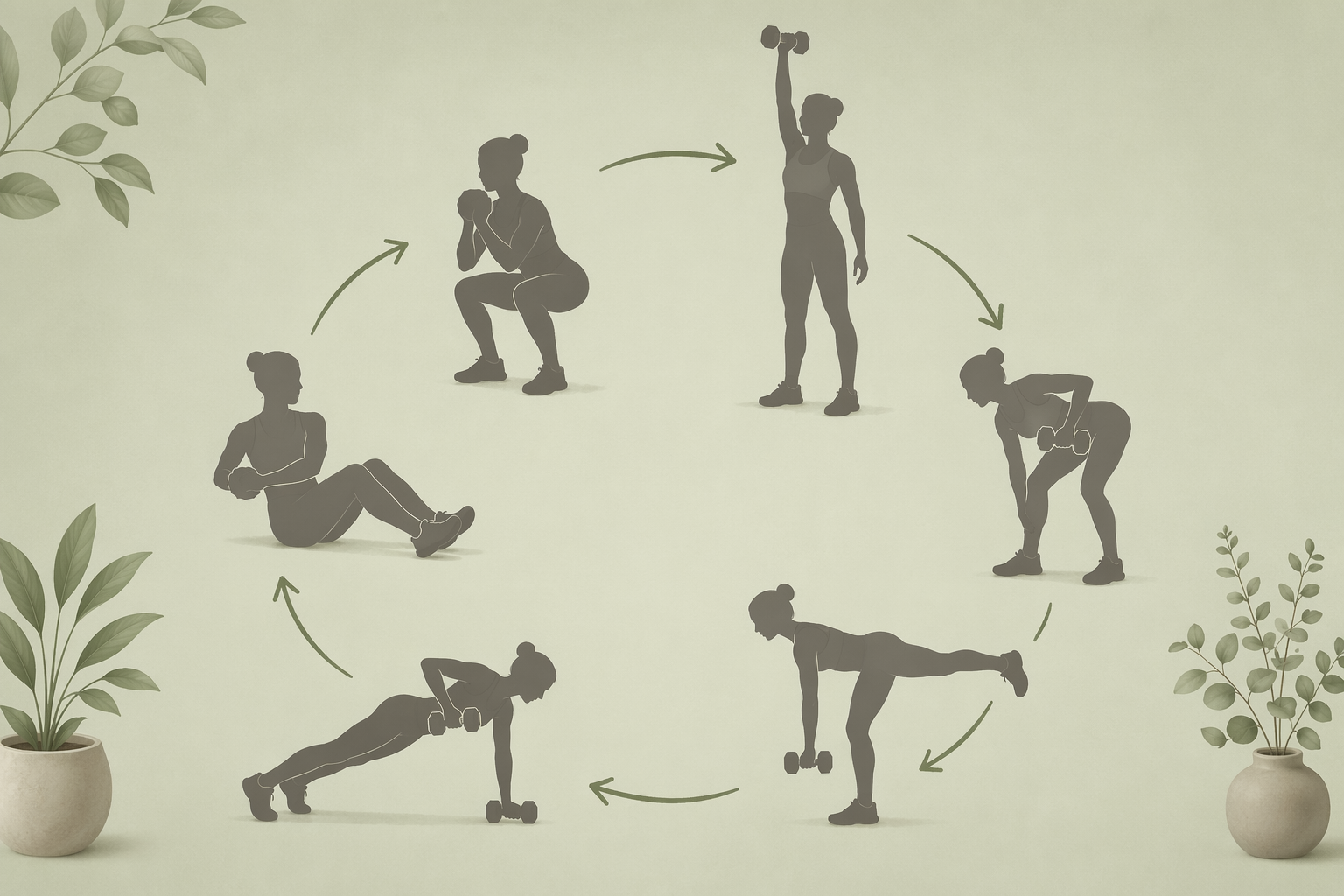
Perform each exercise for 8–12 reps per side (where applicable), rest 60 seconds between exercises, and complete 2–3 rounds. Rest 60–90 seconds between rounds. The whole workout takes 20–30 minutes.
| Exercise | Reps | Notes |
|---|---|---|
| Goblet squat | 10–12 | Hold dumbbell close to chest, sink hips back, elbows between knees at bottom. |
| Single-arm overhead press | 8–10 each side | Stand tall, press directly overhead, avoid arching lower back. |
| Single-arm row | 10–12 each side | Hinge at hips, pull dumbbell to ribcage, squeeze lat. |
| Single-leg Romanian deadlift | 8–10 each side | Keep back straight, hinge at hip, dumbbell in opposite hand to working leg. |
| Plank row | 8–10 each side | Sturdy plank position, row dumbbell one side at a time. |
| Seated twist and tap | 10–12 each side | Sit with feet off floor, rotate torso, tap dumbbell to floor beside hip. |
Why these exercises? The goblet squat trains quads, glutes, and core with a single weight held front-loaded — safer than a barbell back squat for solo training. The single-arm overhead press demands core stability to prevent leaning. The single-arm row hits lats and biceps unilaterally. The single-leg RDL works hamstrings and glutes while challenging balance. The plank row combines anti-rotation core work with a back exercise. The core finisher closes the session.
Modifications
CNN’s modifications apply here: use a chair for support during the single-leg RDL if hamstring flexibility is limited. Perform the plank row from hands and knees if a full plank is too demanding. Eliminate the overhead press and substitute a lateral lunge if shoulder mobility is an issue. The goal is completing the circuit with good form, not hitting a target set of reps at any cost.
How to Progress When You Can’t Add Weight
With a fixed weight, the traditional progression — add 5 lb — isn’t available. Instead, you manipulate volume and density. I’ve built a 4-week plan using three levers: increase reps, reduce rest, and add rounds. The idea is to do more work in less time.
| Week | Reps | Rest between exercises | Rounds |
|---|---|---|---|
| 1 | 8–10 | 90 sec | 2 |
| 2 | 10–12 | 75 sec | 2 |
| 3 | 12–15 | 60 sec | 2 |
| 4 | 10–12 | 60 sec | 3 |
This progression works, but it has a ceiling. After four weeks, you’ll likely need a heavier dumbbell or a different stimulus to keep gaining strength. If you can’t buy a heavier one, you can switch to two dumbbells or increase the frequency of sessions. Don’t expect to keep adding reps forever. I’ve seen people stall and then blame the workout — it’s not the workout, it’s the weight. Plan for that upgrade.
What a small equipment investment adds
We don't have a build tagged to this exact tier yet. Browse all builds.
How often should you repeat this?
How Whoop and Oura Ring track recovery for home workouts
For home exercisers deciding between WHOOP and Oura Ring, the better sleep and recovery tracker depends on training style: WHOOP's strength-aware tracking fits dumbbell and grip-heavy sessions, while Oura's sleep-first scoring suits yoga and indoor cycling. The verdict hinges on how each builds its daily recovery score, their home-workout tracking gaps, and who pays for hardware versus subscription.
Spot something off?
Tell us if a movement, tier assumption, or duration didn't match your experience.