
Compact Home Gym Trade-Offs: Which Sacrifices Are Worth It
Every compact home gym demands trade-offs between resistance, footprint, exercise variety, and total cost. This article maps those trade-offs across five gym archetypes to help you choose the setup that matches your priorities.
The uncomfortable part of shopping for a compact home gym is realizing that “compact” only describes what the equipment takes from your room. It says almost nothing about what it takes from your training, your patience, your lease, or your budget six months from now.
A compact home gym can be excellent. It can also be the wrong kind of excellent: tiny but underloaded, powerful but annoying to set up, sleek but tied to a monthly bill, cheap but easy to outgrow. The better question is not which one is best overall. It is which compromise will irritate you least after the novelty has worn off.

The compact home gym trade-off map
Most small-space setups fall into five useful archetypes: smart gyms, folding wall-mounted racks, cable towers, adjustable dumbbell and bench kits, and band-based systems. If you want a broader explanation of those categories before comparing them, start with this home gym equipment types guide. For the decision here, the labels matter less than the trade they force.
| Archetype | What it tends to protect | What it tends to sacrifice | The buyer who usually tolerates it best |
|---|---|---|---|
| All-in-one smart gym | Guided workouts, fast transitions, polished experience | High upfront cost, monthly subscription exposure, locked ecosystem | Someone who will train more because the system removes decision-making |
| Folding wall-mounted rack + barbell | Heavy loading, classic strength progression, no subscription | Wall commitment, installation, barbell space, plates, noise management | Someone who wants real barbell training and can dedicate a wall |
| Cable tower | Exercise variety, adjustable angles, compact standing footprint | Assembly, loading limits, slower setup than dumbbells | Someone who values pulldowns, rows, flyes, curls, and unilateral work |
| Adjustable dumbbells + bench | Low setup friction, simple ownership, flexible placement | Floor space while in use, lower cable-style variety, dumbbell ceiling | Someone who wants to start lifting without installing anything |
| Band-based system | Storage footprint, portability, low price, quiet training | Resistance feel, progression clarity, likely plateau for stronger lifters | Someone with severe space limits or a lower-cost starting point |
That table is more useful than a “best compact home gym” badge because the sacrifices are not interchangeable. A renter may happily accept a lower resistance ceiling to avoid drilling into studs. A garage lifter may accept installation hassle because a folding rack lets them squat and bench seriously. Someone who hates changing attachments may get more training done with adjustable dumbbells than with a more versatile cable system.
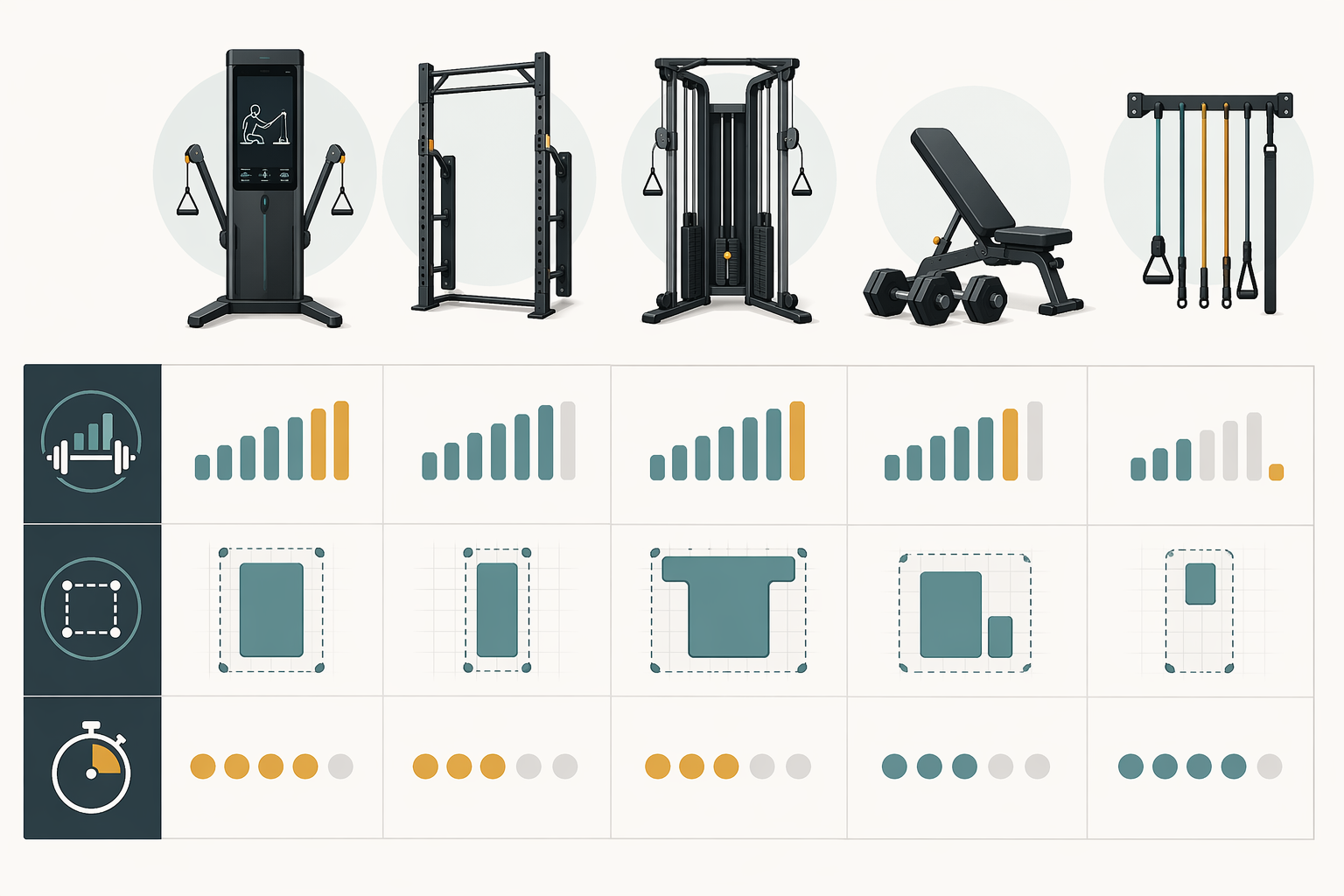
Axis one: resistance ceiling versus floor footprint
The first compact-gym bargain is load. You can shrink the footprint, but resistance has to come from somewhere: a motor, a weight stack, plates, dumbbell mechanisms, or stretched bands. Each source has a different ceiling and a different feel.
A folding wall-mounted rack is the most honest answer for people who care about heavy barbell progression. The PRx Profile PRO is listed at $1,099 and has no subscription, but the price tag is only part of the commitment; you still need a barbell, plates, safe installation, and enough room in front of the wall to actually move under load [1]. The folded footprint looks tidy. The training footprint is the part people forget.
Band-based systems sit at the opposite end. The X3 Bar’s appeal is obvious: a claimed 300 pounds of resistance and a storage footprint of about 10 inches by 19 inches is elegant in the way only tiny equipment can be [2]. For a small apartment, that matters. The catch is not that bands cannot build strength; the catch is that the loading curve, setup feel, and long-term progression may not satisfy everyone, especially lifters who already know what heavy barbells or dumbbells feel like.
Adjustable dumbbells with a bench live in the middle. They do not disappear into a closet as neatly as a band platform, but they keep training simple. The hidden issue is operating space: a dumbbell-plus-bench setup may need around 18 square feet once you account for lying down, placing the dumbbells, and moving safely around the bench [2]. If floor space is your main constraint, compare storage footprint and workout footprint separately. For a more granular space breakdown, the compact home gym footprint comparison is the detour worth taking before buying.
Axis two: exercise variety versus setup friction
Exercise variety is one of the easiest features to overvalue on a product page. A machine can technically allow dozens of movements and still be annoying enough that you repeat the same four. The daily question is more boring: how many steps stand between you and the set you meant to do?
Cable towers are the clearest example. The Bells of Steel Cable Tower offers 33 height positions, which genuinely expands what you can do: low rows, high pulldowns, face pulls, pressdowns, curls, lateral raises, flyes, chops, and a long list of single-arm variations become plausible in a small footprint [1]. That range is useful, not decorative.
But variety has a transaction cost. You adjust pulley height, attach handles, set the load, move your body position, and sometimes change the bench angle. None of that is hard. It is just repeated friction. For the person who enjoys cable work, this is normal gym behavior. For the person who wants a 25-minute session between dinner and bedtime, it may become the reason the tower turns into a coat rack.
Adjustable dumbbells such as REP Quickdraw dumbbells pull in the opposite direction. Their strength is low-friction setup: pick a weight, pick them up, start the set [1]. You give up the clean cable path and some movement variety, but you gain a setup that does not ask you to reconfigure the room. For many first-time home gym owners, that is not a small convenience. It is the difference between training and negotiating with the equipment.
Smart gyms try to solve friction with software. Guided programming, digital resistance changes, screens, tracking, and compact profiles can make the start of a workout feel almost automatic. That is a real advantage for someone who stalls when asked to design a session from scratch. The trade is that the system’s convenience is usually inseparable from its ecosystem, its subscription, and its hardware ceiling.
Axis three: upfront cost versus recurring fees
This is where compact home gym shopping gets slippery. A $1,100 rack can become much more expensive after plates, a bar, bench, and floor protection. A smart gym can look clean because the hardware arrives as one polished object, then keep billing you every month. A cheap band kit can be financially brilliant or simply a first purchase before the second purchase.
Pricing checked in June 2026 puts Tonal 2 at $4,295 plus a $59.95 monthly membership [3]. That is outside the $500–$3,000 range many budget-conscious buyers start with, but it belongs in this discussion because it anchors the smart-gym trade-off: the screen and guidance are not just features; they are part of an ongoing cost structure. More broadly, current smart-gym subscriptions commonly sit in the $39–$60 per month range, and manufacturer pricing can change [1][3].
That monthly number deserves more respect than it usually gets. At $59.95 per month, the subscription alone is close to the $65 average monthly gym membership figure cited in the 2024 U.S. Health & Fitness Consumer Report [4]. The comparison is imperfect because a gym membership and a smart-gym subscription buy different things, but it makes the recurring-fee exposure harder to wave away.
Garage Gym Reviews has reported an average home gym cost of $1,855 and an estimated break-even point of roughly 2.4 years against a $65 monthly gym membership [1][4]. Treat that as a 2024-era planning estimate, not a promise. It depends on what you buy, whether you keep paying for apps or memberships, whether you would otherwise keep a commercial gym membership, and whether your equipment actually replaces the training you value.
Space has a cost too, but it should be handled carefully. A $2.00-per-square-foot-per-month estimate can be useful as an illustrative way to think about floor space in a home, not as a national truth. In a spare bedroom, half-garage, or basement, the opportunity cost may feel low. In a studio apartment, the same 18 square feet can feel expensive every day.
If subscription math is the part that makes you hesitate, do not bury it under the excitement of a glossy screen. The deeper cost breakdown belongs in What Smart Home Gym Systems Actually Cost Over 5 Years. For this comparison, the practical rule is simple: recurring fees are not accessories. They are part of the equipment.
How the five archetypes feel after the first month
All-in-one smart gyms
Smart gyms are easiest to justify when the main problem is not motivation in the abstract, but decision fatigue. If a guided system gets you to train three times a week when a blank notebook does not, that matters. The mistake is pretending the convenience is free. You are accepting subscription exposure, manufacturer dependency, and a limited upgrade path in exchange for a smoother training experience.
Upgradeability is the awkward part. With a modular setup, you can replace dumbbells, add plates, buy a better bench, or expand attachments over time. With many smart gyms, you are largely buying the system as designed. That does not make them bad; it means the purchase has to fit your likely training ceiling, not just your current enthusiasm. Reliability and ownership concerns deserve their own reading if you are leaning this way, especially in a system like Tonal, where the hardware and service model are tightly connected; see Tonal Home Gym Problems and Reliability.
Folding wall-mounted racks
A folding rack is compact in storage, not in temperament. It wants a stable wall, careful installation, ceiling awareness, plate storage, bar storage, and enough clearance for the lifts you plan to perform. In return, it gives the cleanest path to traditional strength training. Squats, bench presses, overhead presses, rack pulls, and pull-ups fit a progression model that is easy to understand and easy to expand.
This is the archetype for someone who dislikes software lock-in and wants the option to improve the setup piece by piece. It is also the archetype most likely to punish vague space planning. A folded rack on the wall does not mean the room is free during a workout.
Cable towers
Cable towers deserve more attention from small-space buyers than they usually get. They are not as instantly legible as a rack or as glamorous as a smart gym, but a compact tower can make a small room feel more like a complete training station. The 33 height positions on the Bells of Steel Cable Tower are a good example of why: angle adjustment changes the exercise menu in a way that dumbbells alone cannot [1].
The compromise is patience. Cable towers involve assembly, adjustments, attachments, and usually less heavy lower-body loading than a barbell setup. They are excellent for people who know they like cable movements. They are less convincing for someone whose main goal is heavy squats and deadlifts.
Adjustable dumbbells plus bench
This is the boring setup I trust most often for people who are not sure what kind of home-gym owner they will become. Adjustable dumbbells and a bench are easy to understand, easy to move, and easy to resell compared with a wall-mounted or subscription-based system. They also make it harder to blame the equipment for a missed workout.
The downside is that dumbbells do not solve everything. They need floor space in use, they can become limiting for stronger lower-body work, and they do not replicate cable resistance. A compact bench folded upright still has to live somewhere. A pair of adjustable dumbbells still needs a landing zone where you will not smash a toe, a pet bowl, or a baseboard.
Band-based systems
Band systems are easy to dismiss too quickly. A 2019 systematic review found that resistance training with elastic devices can produce strength gains comparable to conventional resistance training across the included studies [5]. That supports the basic claim that bands can be legitimate training tools, especially for beginners, travelers, and people with very tight storage constraints.
The limitation is progression. Band resistance changes across the range of motion, loading can be harder to quantify, and stronger lifters may eventually run into a ceiling that feels more like a wall than a challenge. For someone starting from zero space and a limited budget, bands may be exactly right. For someone expecting a one-and-done strength system, the upgrade path is less clear.
Upgrade paths are not equally knowable
Upgrade-path analysis has to be partly speculative because each archetype ages differently. A rack ages like infrastructure: you can add plates, swap bars, improve storage, and upgrade the bench. A dumbbell-and-bench setup ages modularly too, though it may eventually need a rack, cable system, or heavier dumbbells. A cable tower can be expanded with attachments, but the frame and resistance system still define the ceiling.
Smart gyms and band systems are murkier. Smart gyms tend to be locked ecosystems; if your goals move beyond the system’s resistance, software, or available movements, you cannot usually upgrade one piece the way you can add plates to a rack. Band-based systems are inexpensive and compact, but their long-term progression can plateau. For more on this ownership split, the modular vs. all-in-one vs. smart gym guide and the all-in-one vs. modular home gym comparison are the better place to slow down.
Choose the sacrifice before you choose the equipment
If you are still undecided, do not start by picking a product. Start by naming the sacrifice you cannot live with.
- If limited resistance will bother you most, lean toward a folding rack or a heavier modular setup.
- If recurring fees will bother you most, be cautious with smart gyms and verify current subscription terms before buying.
- If setup friction will bother you most, adjustable dumbbells and a bench may beat a more versatile cable tower.
- If lost floor space will bother you most, separate storage footprint from workout footprint before trusting compact marketing.
- If lower exercise variety will bother you most, cable towers and smart gyms deserve a closer look.
- If difficult assembly or wall commitment will bother you most, avoid folding racks and mounted systems unless the room is truly ready for them.
- If weak upgradeability will bother you most, favor modular equipment over locked systems.
First-time buyers who are not sure which sacrifice matters yet should step back into a broader planning process before spending serious money. The first-time home gym buyer’s decision framework is built for exactly that moment.
A compact home gym is not a single category with a winner hiding at the top. It is a set of tolerances. You are deciding how much load, floor space, variety, setup friction, subscription exposure, assembly, and upgrade uncertainty you are willing to carry. Once that is clear, the right equipment list gets much shorter.
References
- Best Home Gyms, Garage Gym Reviews, 2026.
- Best Compact Exercise Equipment, Garage Gym Reviews, 2026.
- Best Smart Home Gym, CNET.
- U.S. Fitness Facility Memberships Reach the Highest Level Ever as Dues Rise, Health & Fitness Association, 2024.
- Effects of training with elastic resistance versus conventional resistance on muscular strength: A systematic review and meta-analysis, PMC.
This result comes from one real apartment under the stated conditions — it is a strong signal, not a guarantee your space will measure identically.
Builds this evidence supports
Cable Machine Alternatives That Save Space and Money
Compare the best cable machine alternatives for home gyms – from resistance bands and pulley systems to suspension trainers and compact digital units – and find the right option for your space and budget.
How to Choose a Compact Home Gym That Works for Your Space, Budget, and Noise Tolerance
This article provides a structured decision framework for apartment dwellers and small-space residents to match their specific floor footprint, noise sensitivity, and budget to the most suitable compact home gym strategy — whether that's an all-in-one machine, modular build, smart digital system, or band/bodyweight setup.
The Garage Gym Reality Check: What Equipment Actually Fits in a Single-Car Garage
Most garage gym guides assume a two-car space. This article uses real dimensions, real equipment footprints, and three layout templates to show what fits—and what doesn't—in a single-car garage (10x20 to 12x20 ft).
Spot something off?
If this result didn't match your own space, let us know — floor-damage and noise claims carry real deposit-risk consequences if we get them wrong.