
Compact Home Gym Comparison: Find the Right Fit for Your Floor Space
This comparison organizes compact home gym machines by real-world floor footprint rather than price or brand, helping apartment and small-space buyers match equipment to their available square footage.
Start with the rectangle you can actually give up during a workout, not the rectangle a machine occupies when it is folded. A compact home gym that stores against the wall but needs to be pulled into the only walkway is not compact in the way an apartment buyer needs it to be.
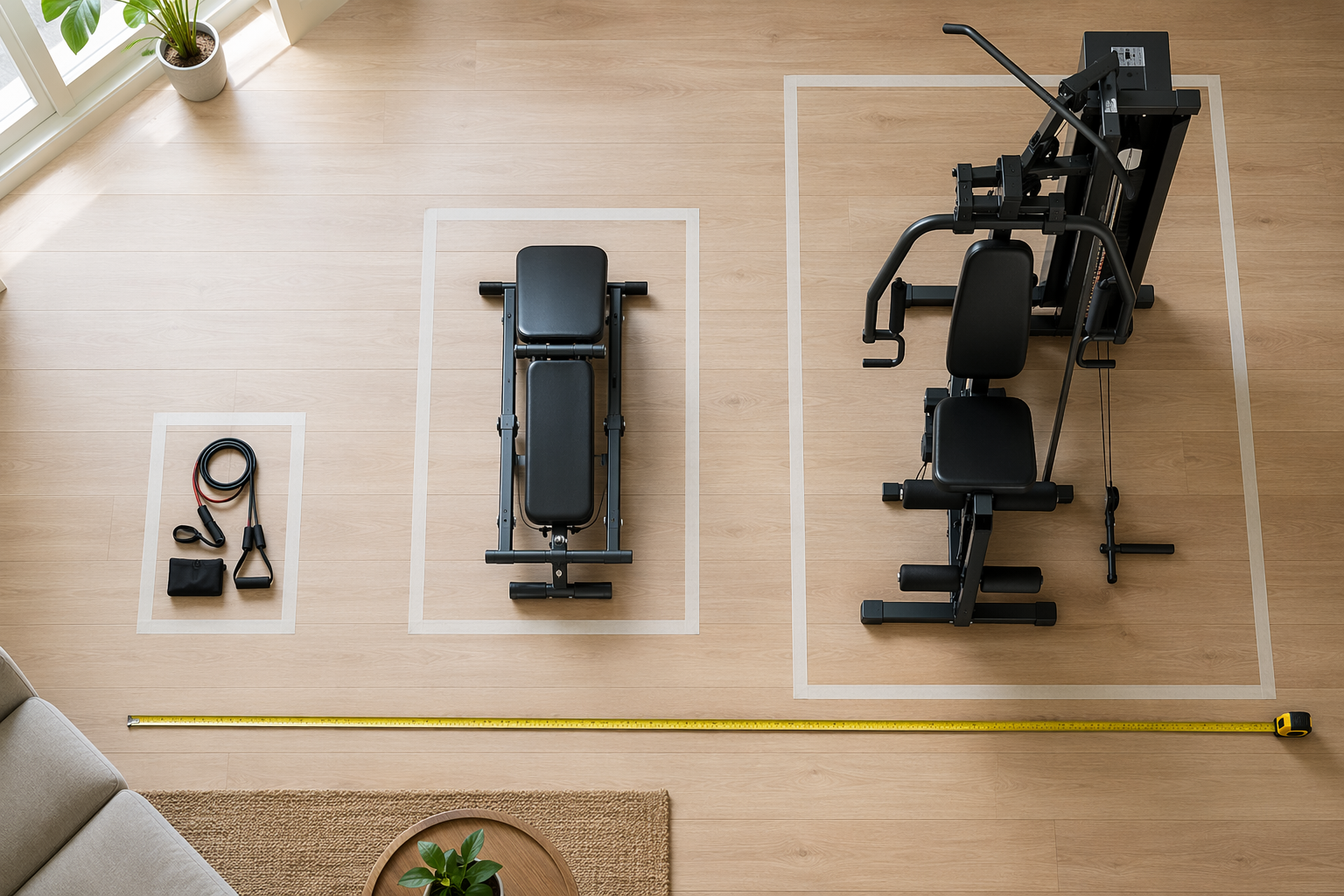
The cleanest way to compare these systems is by usable footprint tier: under 5 square feet, 5–15 square feet, and 15–30+ square feet. Price still matters, but it should come after the floor-plan question. A band-and-bar kit, a foldable smart gym, a wall-mounted rack, and a multi-station rack may all appear in “compact home gym” lists, yet they do not ask the same thing from your room.
The Speediance Gym Monster is the easiest example of why folded-only comparisons can mislead. It folds to 14.96 inches deep by 28.34 inches wide by 72.83 inches high, which sounds friendly to a wall. In use, its required depth is 49.21 inches, before you account for your own stance, arm path, or furniture nearby.[1]
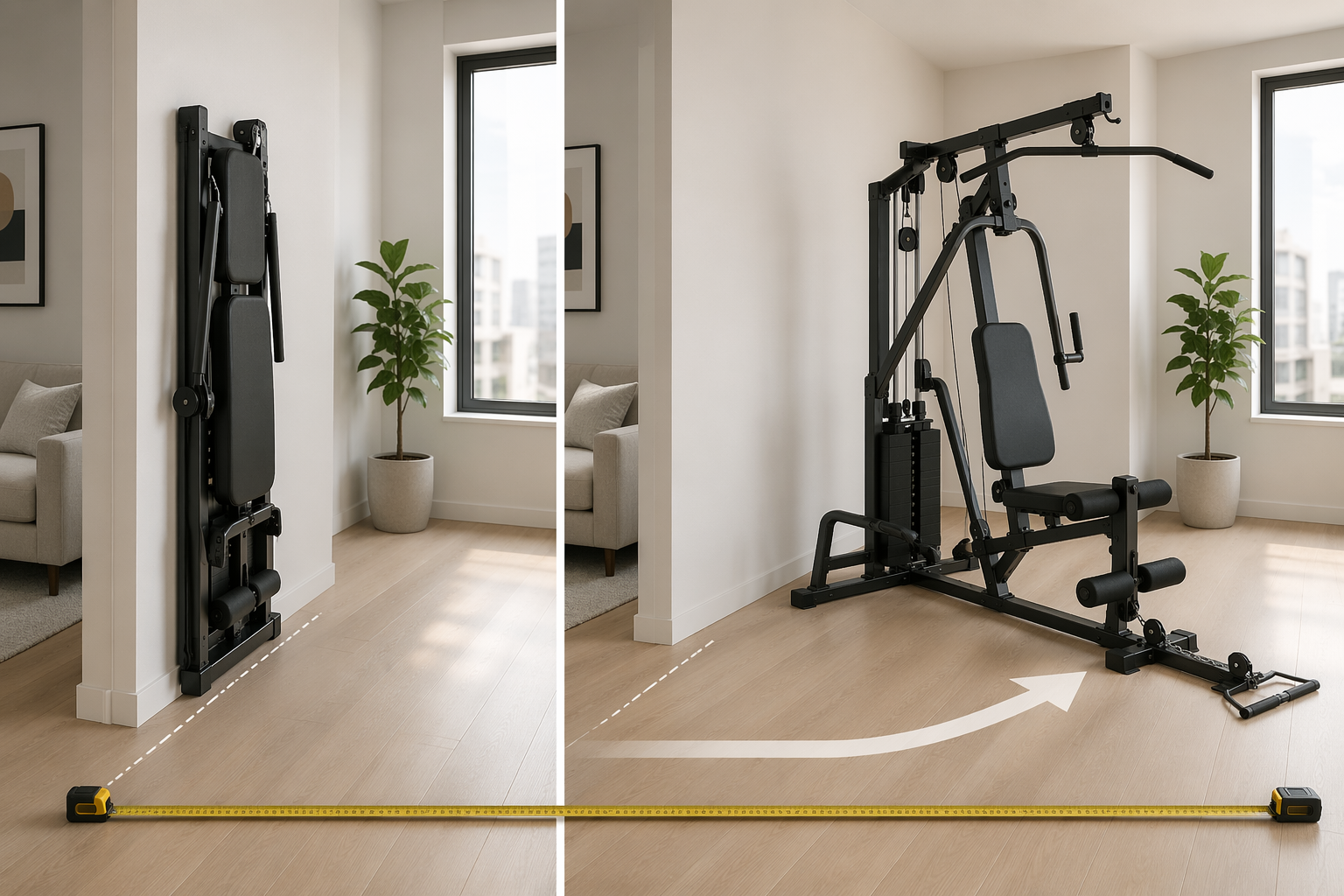
That does not make the Speediance a bad design. It means the stored footprint and the workout footprint are two different measurements. For small rooms, the second number is usually the one that decides whether the machine will be used or resented.
| Footprint tier | What usually fits | Best for | Watch before buying |
|---|---|---|---|
| Under 5 sq ft | Band systems, adjustable dumbbells, small modular kits, very compact cable towers when wall/corner placement works | Studios, bedrooms, shared living rooms, renters avoiding permanent installs | Resistance curve, max resistance, setup friction, whether the workout style matches your goals |
| 5–15 sq ft | Folding smart gyms, wall-mounted racks, narrow cable towers, compact rack-and-bench arrangements | Apartments and small homes with a dedicated workout corner | In-use depth, wall mounting, bench clearance, plate storage, subscriptions |
| 15–30+ sq ft | All-in-one racks, Smith/functional trainer combinations, larger multi-station systems | Garage bays, spare rooms, basements, larger multipurpose rooms | Whether the large footprint replaces enough separate stations to justify itself |
The broader home gym equipment market is large enough that buyers will keep seeing new “compact” claims: one market estimate places the category at $12.4 billion in 2025 and about $13 billion in 2026.[2] That figure covers home gym equipment broadly, not a separately measured compact segment, so it is useful as context rather than as proof that any one space-saving machine is better.
If you are still deciding what kind of machine architecture you want before measuring specific models, the comparison between all-in-one and modular home gyms is a useful detour. If you are newer to equipment selection altogether, start with the beginner decision framework by budget and space before building a shortlist.
How to measure before comparing machines
Measure the workout zone the way you would measure for a dining table, not the way a product page photographs a folded frame. You need the machine, the moving parts, your body, and any loaded accessories to fit at the same time.
- Mark the available rectangle with tape. Do not count space that a door swing, closet, hallway, or sofa already uses.
- Measure both stored depth and in-use depth. Folded depth is storage information, not a workout clearance guarantee.
- Add room for the bench if the system requires one. A rack or cable tower can look compact until a bench path cuts across the room.
- Account for plates, handles, bars, bands, and accessories. Plate-loaded systems often move the space problem from the machine to the floor beside it.
- Check ceiling height and mounting limits. Pull-up bars, folding racks, and wall-mounted units can fail the room even when the floor footprint works.
Renters should be especially careful with anything that depends on wall studs, ceiling clearance, or impact control. The renter’s guide to a compact home gym covers mounting and noise constraints in more detail, and the home gym flooring mistakes guide is worth reading before putting heavy or vibrating equipment over neighbors.
Tier 1: under 5 square feet
This is the real apartment-survival tier. Under 5 square feet usually means the equipment can live in a closet, under a bed, beside a desk, or in a corner without permanently changing how the room works. The trade-off is that the system probably will not feel like a traditional rack, cable station, or machine circuit.
The X3 Bar is the clearest example. Its storage footprint is listed at 10 inches by 19 inches by 1 inch, and it can generate up to 300 pounds of band resistance.[1][3] That is genuinely compact in a way many folding machines are not. You are not rearranging a room; you are pulling out a platform, bar, and bands.
The catch is training feel. Bands increase resistance as they stretch, so the hardest part of the movement is usually not the same as it would be with free weights. That can be productive, but it is not identical to loading a barbell or using a weight stack. If your goal is general strength training in a tiny apartment, this tier can work well. If your goal is to recreate a power rack or commercial cable machine, the footprint is probably telling you the truth: you are buying a different kind of tool.
| Example | Footprint or storage note | Resistance type | Practical fit judgment |
|---|---|---|---|
| X3 Bar | 10" × 19" × 1" storage footprint[1][3] | Band resistance, up to 300 lbs[1][3] | One of the few systems that deserves the ultra-compact label, but it asks you to accept band-style loading |
| Adjustable dumbbells | Usually small stored footprint, plus lifting clearance | Free weight | Good for simple strength work, but heavy sets still need floor control, storage discipline, and noise management |
| Modular bands, handles, anchors | Very small storage footprint | Band resistance | Best when portability and storage matter more than machine feel |
Adjustable dumbbells and small modular kits belong in the same tier only if the room can absorb the actual workout. A pair of dumbbells may store neatly, but lunges, floor presses, and bent-over rows still need space around your body. That is usually manageable in a bedroom or living room; it just should not be confused with zero-footprint training.
The under-5-square-foot tier is also where price comparisons get especially weird. A band system may cost less than a smart gym or an all-in-one rack, but the more important difference is not the receipt. It is the fact that the smallest systems avoid the room-planning problems larger machines create, while giving up some load feel, exercise variety, or progression style.
Tier 2: 5–15 square feet
This is where many small-home and apartment buyers should spend the most time. The machines look plausible: folding all-in-ones, narrow cable towers, and wall-mounted racks can all sit in a real room without turning it into a garage gym. They can also quietly demand a larger operating zone than the product photo suggests.
Speediance sits right in this tension. Folded, it has a shallow 14.96-inch depth; unfolded, it requires 49.21 inches of depth.[1] If your room has a clear wall and enough pull-out space, that may be a smart compromise. If that 49.21-inch depth lands in front of a bed, couch, desk chair, or doorway, the machine is not truly compact for that room.
Wall-mounted racks create a different trade. The PRx Profile PRO Squat Rack folds to a 9-inch depth and supports 1,000 pounds, with Garage Gym Reviews describing it as the smallest-footprint squat rack available.[1] That is a clever solution for a room where the wall is usable and the floor needs to come back after training. It is less clever if you cannot mount into appropriate structure, cannot tolerate drilling, or do not have ceiling and bar path clearance.
Narrow cable towers can also fit this tier, with the usual plate-storage footnote. The Bells of Steel Cable Tower has a 31-inch by 28.5-inch footprint, and the plate-loaded version is listed as starting at $434.99.[1] The tower itself is compact. The plates, however, still need a home. If those plates end up leaning against a baseboard or migrating under a desk, the real footprint has grown.
| Example | Key footprint fact | Resistance / loading | What to verify in your room |
|---|---|---|---|
| Speediance Gym Monster | 14.96" D folded; 49.21" D unfolded[1] | Smart all-in-one resistance system | Pull-out depth, stance clearance, screen/machine position, subscription or software dependence |
| PRx Profile PRO Squat Rack | 9" folded depth; supports 1,000 lbs[1] | Barbell and plates | Wall mounting, ceiling height, bar path, bench space, plate storage |
| Bells of Steel Cable Tower | 31" × 28.5" footprint; plate-loaded model starts at $434.99[1] | Plate-loaded cable resistance | Plate storage, cable travel, handle storage, whether a bench blocks the room |
The mid-compact choice is usually about what kind of inconvenience you can live with
A folding smart gym asks you to preserve pull-out space. A wall rack asks you to give up wall structure and accept barbell logistics. A cable tower asks you to manage plates or a weight stack and accessory clutter. None of those are dealbreakers by themselves. They are just different space debts.
For renters, the least obvious risk is buying the most impressive mid-tier machine on paper and then discovering that the landlord, wall studs, downstairs neighbor, or room layout removes half its appeal. For small homeowners, the risk is usually optimism: assuming that a folded rack or all-in-one will be put away every time, even when daily life starts stacking laundry baskets, office chairs, and storage bins in the same zone.
If you need a broader constraint model before choosing within this tier, use the guide on space, budget, and noise tolerance. If you already know you need apartment-specific product picks, the compact home gym equipment guide for apartments will be more directly useful.
Tier 3: 15–30+ square feet
This tier should not be sold as apartment compact unless the apartment has a very forgiving layout. But it can still be space-efficient. A machine that occupies a serious rectangle may be reasonable if it replaces a rack, cable station, Smith machine, pull-up setup, and storage sprawl that would otherwise consume even more room.
The Major Fitness B17 shows the upper edge of the category. Its listed dimensions are 68.1 inches deep by 78.7 inches wide, which works out to more than 37 square feet before user clearance. In exchange, it combines a Smith machine, functional trainer, power rack, and pull-up bar.[1] That is not a small-space apartment solution in any ordinary sense. It is a consolidation play for someone who has a spare room, basement, garage bay, or large dedicated corner.
The Bells of Steel All-in-One Home Gym is another example: its footprint is listed at 54.6 inches by 59 inches, with pricing from $1,299 and up.[1] It occupies major floor area, but it is not trying to solve the same problem as an X3 Bar. It is trying to pack several training stations into one frame.
| Example | Listed footprint | Why it may still be space-efficient | Who should skip it |
|---|---|---|---|
| Major Fitness B17 | 68.1" D × 78.7" W, more than 37 sq ft[1] | Combines Smith machine, functional trainer, power rack, and pull-up bar[1] | Apartment buyers trying to preserve a living room or bedroom walkway |
| Bells of Steel All-in-One Home Gym | 54.6" × 59"; $1,299+[1] | Replaces multiple machines or stations in one rack-style footprint | Anyone whose available rectangle is really a mid-compact 5–15 sq ft zone |
The useful question here is not “Can I squeeze it in?” It is “What happens to the rest of the room after it arrives?” A 30-plus-square-foot setup can be the right answer when it creates one organized training wall instead of a mess of separate pieces. It is the wrong answer when it turns a multipurpose room into a room that everyone walks around.
Why cross-tier price comparisons lead buyers off track
A low price on a larger machine does not make it a better compact home gym if the room cannot use it. A higher price on a smaller machine may be justifiable if it preserves the only open floor in the apartment. This is why rankings that place unlike systems next to each other by budget can feel helpful and still miss the buying constraint that matters most.
Compare prices inside a tier first. If you have under 5 square feet, compare band systems, adjustable dumbbells, and small modular options. If you have 5–15 square feet, compare folding smart gyms, wall racks, and narrow cable towers by in-use clearance. If you have a dedicated 15–30+ square feet, then all-in-one racks and multi-station systems become realistic candidates.
Pricing also moves. The product and pricing facts above are based on source pages available for this mid-2026 comparison, and several of those buying-guide pages include affiliate links. That does not automatically make the dimensional data unusable, but it is a reason to treat current checkout pricing, bundles, and discontinued configurations as items to verify before buying.[1][3]
A practical shortlist by available floor space
| Your real available workout space | Start with | Avoid making this mistake |
|---|---|---|
| Less than 5 sq ft stored, with only temporary open floor | X3 Bar, adjustable dumbbells, bands, very small modular equipment | Expecting a band or dumbbell setup to feel like a full rack or cable machine |
| 5–15 sq ft, with one clear wall or corner | Speediance-style folding systems, PRx-style wall racks, compact cable towers | Shopping by folded dimensions while ignoring pull-out depth, mounting, bench path, or plate storage |
| 15–30+ sq ft, preferably dedicated | All-in-one racks, Smith/functional trainer combinations, larger multi-station frames | Calling a 30+ sq ft machine apartment compact just because it replaces several stations |
For another way to inspect footprint assumptions, see the companion comparison of compact home gyms by real-world footprint. If the machine types themselves are still blurring together, the guide to all-in-one home gym types will make the footprint comparison easier to interpret.
Once your tier is clear, the shortlist usually gets much smaller. The right compact home gym is not the one that looks most complete across every category; it is the one whose stored size, in-use clearance, resistance system, accessories, and mounting demands all fit the room you actually have.
References
- Best Home Gyms 2026, Garage Gym Reviews.
- Home Gym Equipment Market, GM Insights.
- Best Compact Exercise Equipment 2026, Garage Gym Reviews.
This result comes from one real apartment under the stated conditions — it is a strong signal, not a guarantee your space will measure identically.
Builds this evidence supports
Cable Machine Alternatives That Save Space and Money
Compare the best cable machine alternatives for home gyms – from resistance bands and pulley systems to suspension trainers and compact digital units – and find the right option for your space and budget.
How to Choose a Compact Home Gym That Works for Your Space, Budget, and Noise Tolerance
This article provides a structured decision framework for apartment dwellers and small-space residents to match their specific floor footprint, noise sensitivity, and budget to the most suitable compact home gym strategy — whether that's an all-in-one machine, modular build, smart digital system, or band/bodyweight setup.
The Garage Gym Reality Check: What Equipment Actually Fits in a Single-Car Garage
Most garage gym guides assume a two-car space. This article uses real dimensions, real equipment footprints, and three layout templates to show what fits—and what doesn't—in a single-car garage (10x20 to 12x20 ft).
Spot something off?
If this result didn't match your own space, let us know — floor-damage and noise claims carry real deposit-risk consequences if we get them wrong.