
The Backward-Buying Problem: Why Most Cable Machine Purchases Lead to Buyer's Remorse
Walk into any home gym forum and you will find a recurring pattern: a user posts a photo of a brand-new standalone functional trainer taking up a quarter of their garage, only to realize they already own a power rack with a perfectly good pull-up bar and J-hooks. They bought the wrong format. They compared brands and price tags before asking the only question that matters — what format fits the equipment I already own?
This backward-buying approach is the single largest source of cable machine buyer's remorse among intermediate home gym owners. The average cable machine costs around $2,265 and occupies roughly 25.6 inches by 31.8 inches of floor space, according to data from Garage Gym Reviews. But those averages hide a brutal reality: a standalone functional trainer can demand 15 to 25 square feet of dedicated floor space, while a rack-mounted system adds zero additional footprint. Choosing the wrong format does not just waste money — it wastes the scarcest resource in any home gym: floor space.
The solution is a format-first decision tree. Before you look at a single price tag, before you compare pulley smoothness ratings or weight stack capacities, you answer one question: do you already own a power rack? That single branching point determines whether the optimal path is a rack-mounted attachment (space- and cost-optimal for rack owners), a standalone functional trainer (best for those without a rack who have the floor space), or a plate-loaded cable tower (the long-term value play for serious lifters who prioritize repairability).
The Three Cable Machine Formats Mapped
For the intermediate home gym owner who already owns a power rack, the cable machine market breaks into three distinct formats. Each serves a different space, budget, and upgrade-path profile. Understanding the differences in footprint, pulley ratio, weight stack type, and long-term cost is the foundation of any smart purchase.
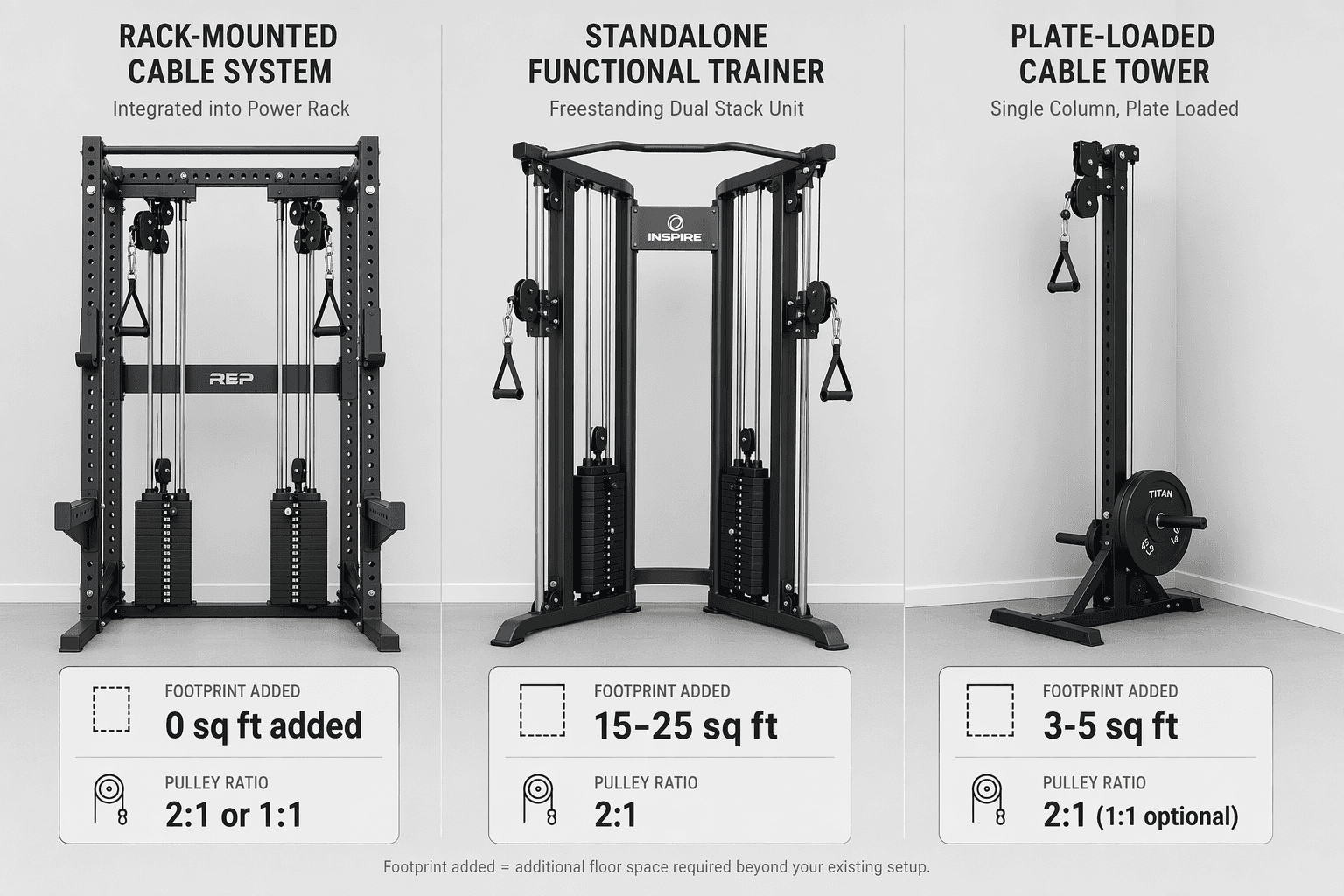
| Format | Footprint | Pulley Ratio | Price Anchor | Weight Stack Type | Key Trade-off |
|---|---|---|---|---|---|
| Rack-Mounted (e.g., REP Ares 2.0) | 0 sq ft added to rack | 2:1 (with 1:1 lat pulldown/low row) | $2,999.99 (Ares 2.0) | Dual 260 lb stacks (upgradeable to 310 lb) | Compatible only with specific rack models; reduces rack's open space for other uses |
| Standalone Functional Trainer (e.g., Titan Fitness FT) | 15–25+ sq ft | 2:1 | $2,999.99 (Titan FT) | Dual 200 lb stacks | Most convenient all-in-one; largest footprint; proprietary stacks |
| Plate-Loaded Cable Tower (e.g., Bells of Steel Cable Tower 2.0) | 3–6 sq ft | 2:1 (1:1 adapter available) | $587.99 (Bells of Steel attachment) | Plate-loaded (up to 250 lb capacity) | Most repairable and upgradable; requires separate plates; no weight stack convenience |
The footprint difference is the most immediately visible differentiator. Strong Home Gym puts it bluntly: "Standalone units eat 30-40 sq ft of floor. The Ares 2.0 adds zero." For anyone with a power rack already occupying a corner of their garage or spare room, that zero-added-footprint advantage is the single strongest argument for going rack-mounted.
The Decision Tree: Start With One Question
The entire cable machine buying process collapses to a single branching question: do you already own a power rack? If the answer is yes, the decision tree narrows sharply. If the answer is no, you are evaluating a different set of trade-offs entirely.
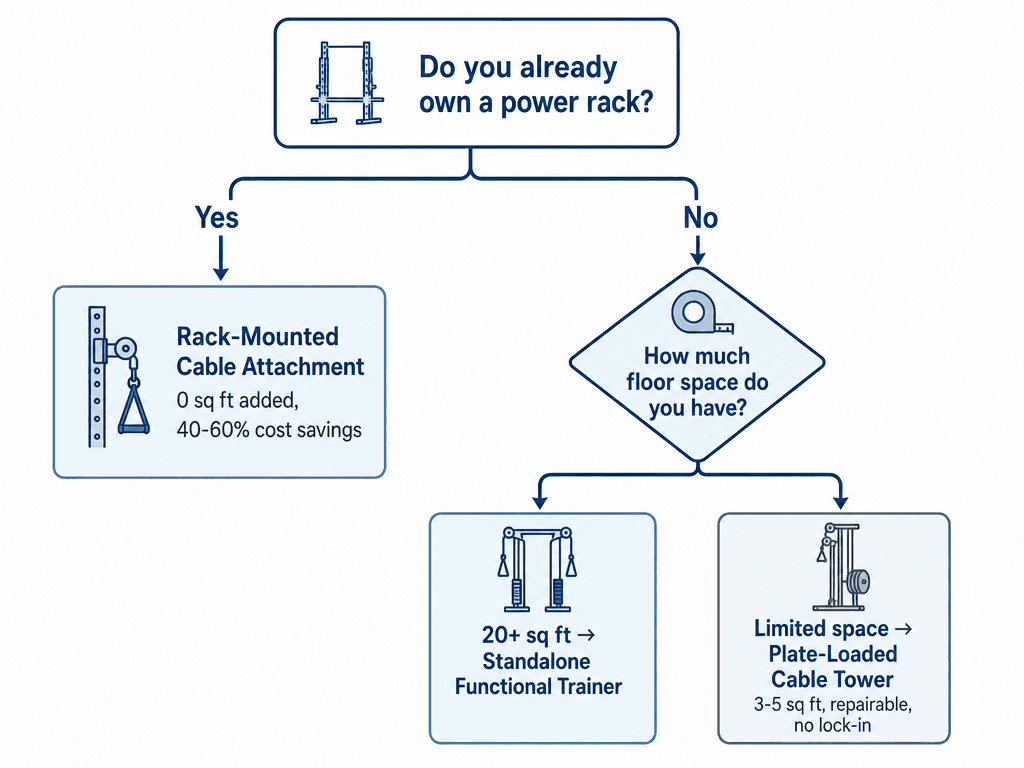
Branch 1: You Own a Power Rack → Rack-Mounted Cable Attachment
If you already own a power rack, a rack-mounted cable attachment is the space- and cost-optimal path. The savings are substantial: a rack-mounted system like the REP Ares 2.0 costs around $2,999.99 and adds zero floor footprint, while a comparable standalone functional trainer with similar pulley quality and weight stack capacity costs roughly the same but demands 15 to 25 square feet of additional floor space. That is a 40 to 60 percent effective savings when you account for the floor space you do not have to dedicate.
The catch is compatibility. The REP Ares 2.0, for example, only works with REP PR-4000 and PR-5000 series racks. If you own a different brand's rack, you will need to check whether a rack-mounted attachment exists for your specific model — or consider a plate-loaded tower instead.
Branch 2: You Do Not Own a Power Rack and Have 20+ Sq Ft → Standalone Functional Trainer
If you do not own a power rack and have at least 20 square feet of available floor space, a standalone functional trainer is the most convenient all-in-one option. Machines like the Titan Fitness FT (dual 200 lb stacks, 2:1 ratio, aluminum pulleys) or the REP Arcadia offer a complete cable solution with no compatibility concerns. You get dual weight stacks, multiple cable attachment points, and often a built-in pull-up bar — everything you need in one package.
The trade-off is that standalone trainers lock you into proprietary weight stacks. If the cable system fails or you want to upgrade the stack capacity, you are dependent on the manufacturer for replacement parts. This is not a concern for every buyer, but it matters for anyone who plans to keep their equipment for a decade or more.
Branch 3: You Want Maximum Upgradeability → Plate-Loaded Cable Tower
For serious lifters who prioritize long-term value and repairability over convenience, a plate-loaded cable tower is the better bet. The Bells of Steel Cable Tower 2.0, for example, occupies only 6 square feet of floor space, offers 33 cable positions, and has a 250 lb capacity. It uses a 2:1 pulley ratio with an available 1:1 adapter. At $587.99 for the rack-mounted version, it costs a fraction of a weight-stack standalone trainer.
Plate-loaded towers avoid proprietary lock-in entirely. If a cable snaps or a pulley wears out, you can replace it with standard hardware-store parts. If you want to increase resistance, you buy more plates — not a proprietary upgrade kit. This makes them the most future-proof option for anyone who plans to keep their equipment for the long haul.
The Pulley Ratio Trap: Why 2:1 vs 1:1 Changes Everything
Pulley ratio is the single most underappreciated spec in the cable machine market. It determines how the weight you load actually feels at the handle, and it fundamentally changes which exercises the machine excels at.
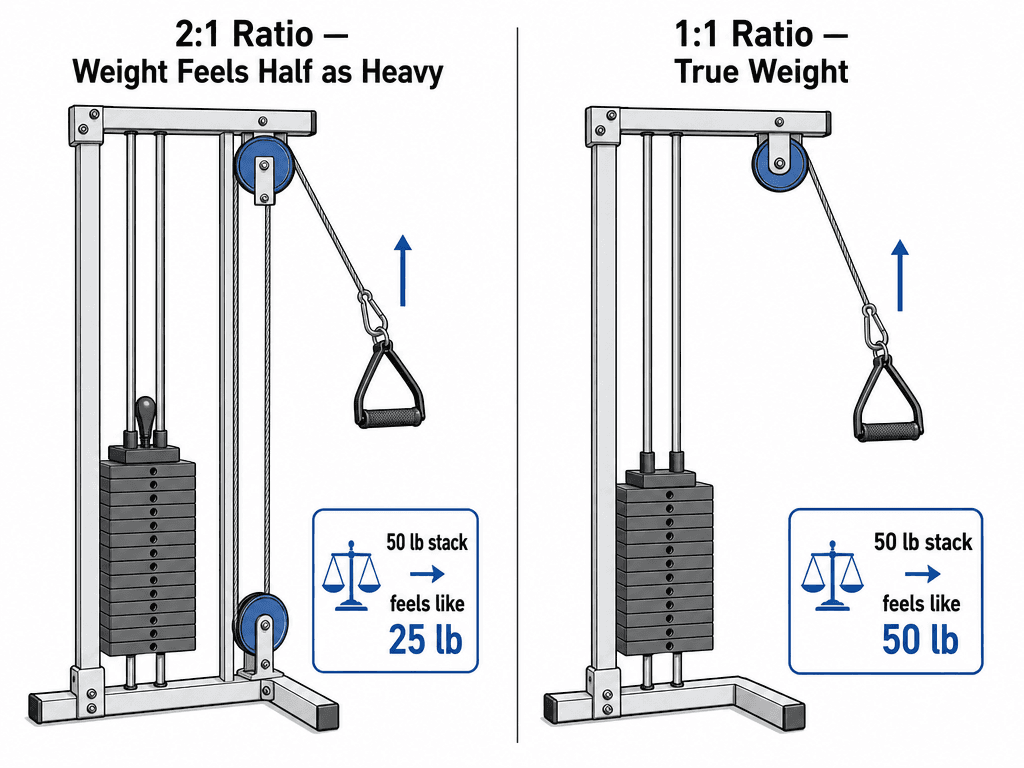
A 2:1 pulley ratio means the cable is routed through two pulleys before reaching the handle. The result: a 50-pound weight stack feels like 25 pounds at the handle. This is not a bug — it is a design choice that favors high-rep isolation work. Tricep pushdowns, cable crossovers, and face pulls feel smooth and controllable at 2:1 because the resistance is halved and the cable travel is doubled.
A 1:1 pulley ratio, by contrast, delivers the full stack weight at the handle. A 50-pound stack feels like 50 pounds. This is better for compound movements like lat pulldowns, seated rows, and low rows, where you want the full resistance without having to double the stack weight.
The trap is that many budget machines use a 2:1 ratio without clearly stating it. A buyer who expects a 200-pound stack to feel like 200 pounds will be disappointed when it feels like 100. The REP Ares 2.0 handles this well by offering a 2:1 ratio on the main columns with dedicated 1:1 lat pulldown and low row stations — giving you both ratios in one system. The Bells of Steel Cable Tower 2.0 offers a 1:1 adapter as an add-on. The Major Fitness B17 goes a step further with an interchangeable 1:1 or 2:1 pulley ratio, though its footprint is significantly larger.
Upgrade-Path Analysis: What Happens at Year 3, 5, and 10
A cable machine is not a one-time purchase — it is a long-term relationship with your home gym. The format you choose today determines whether you will be upgrading, repairing, or replacing in three, five, or ten years.
| Format | Year 3 | Year 5 | Year 10 | Upgrade Score |
|---|---|---|---|---|
| Rack-Mounted (e.g., REP Ares 2.0) | Aluminum pulleys still smooth; no wear on brass bushings. Weight stack upgrade available (260 lb → 310 lb). | Cables may need replacement if used daily. Stack upgrade still available from manufacturer. | Aluminum pulleys with brass bushings remain smooth. Proprietary parts may become harder to source. | 7/10 — Upgradable within manufacturer ecosystem; limited by rack compatibility. |
| Standalone Functional Trainer (e.g., Titan Fitness FT) | Aluminum pulleys still smooth. No stack upgrade path — you are locked into the original capacity. | Cable replacement possible but requires manufacturer parts. Stack capacity cannot be increased. | If nylon pulleys were used, glazing may have occurred by year 3. Full replacement may be needed if proprietary parts are discontinued. | 4/10 — Proprietary lock-in; no stack upgrade; full replacement likely if parts become unavailable. |
| Plate-Loaded Cable Tower (e.g., Bells of Steel Cable Tower 2.0) | Nylon pulleys may begin glazing if used heavily. Cable replacement is simple and uses standard parts. | Pulleys and cables easily replaced with off-the-shelf hardware. No stack to fail. | Infinitely repairable. No proprietary parts. Only limitation is the frame itself. | 9/10 — Fully repairable and upgradable; no proprietary lock-in; only format that can last indefinitely. |
The pulley longevity data is particularly instructive. According to Strong Home Gym's owner survey and Gray Matter Lifting's long-term use observations, aluminum pulleys with brass bushings stay smooth at year 10, while nylon pulleys glaze by year 3. This means a budget machine with nylon pulleys may need a full pulley replacement within three years of regular use — a cost that is rarely factored into the initial purchase price.
For budget buyers under $1,500, the upgrade-path analysis points decisively toward a plate-loaded tower. A low-end weight stack machine in this price range will almost certainly use nylon pulleys and a proprietary cable system. When the pulleys glaze or a cable snaps — and they will — you are looking at a full replacement, not a repair. A plate-loaded tower, by contrast, can be repaired indefinitely with standard hardware-store parts. The initial purchase may be less convenient (you have to load plates manually), but the total cost of ownership over a decade is significantly lower.
If you are still building out your home gym and wondering where a cable machine fits in the overall equipment priority list, our Garage Gym Equipment Tier System guide explains why the cable machine is typically the second purchase after the rack and bar are sorted.
Format-by-Format Q2 2026 Product Recommendations
The following recommendations are organized by format, not by rank. Each product is the best option within its format for a specific use case. Do not treat this as a simple ranked list — the right choice depends entirely on your existing equipment, available space, and long-term plans.
| Product | Format | Footprint | Pulley Ratio | Weight Stack | Price | Warranty | Best For |
|---|---|---|---|---|---|---|---|
| REP Ares 2.0 | Rack-Mounted | 0 sq ft added | 2:1 (1:1 lat pulldown/low row) | Dual 260 lb (upgradeable to 310 lb) | $2,999.99 | Lifetime frame | REP PR-4000/PR-5000 rack owners who want the best overall rack-mounted system |
| Bells of Steel Cable Crossover Power Rack Attachment | Rack-Mounted (Plate-Loaded) | 26"L x 40"W x 84.5"H per side | 2:1 | Plate-loaded, 160 lb per side | $587.99 | Limited lifetime | Budget-conscious rack owners who want a plate-loaded option |
| Bells of Steel Plate-Loaded Cable Tower 2.0 | Plate-Loaded Tower | 6 sq ft | 2:1 (1:1 adapter available) | Plate-loaded, 250 lb capacity | $587.99 (rack-mounted version) | Limited lifetime | Lifters who prioritize repairability, upgradability, and long-term value |
| Titan Fitness Functional Trainer | Standalone | 44"D x 64"W x 82"H | 2:1 | Dual 200 lb | $2,999.99 | Varies | Buyers without a power rack who want a complete all-in-one cable solution |
| Major Fitness B17 | Standalone | 68.1"L x 78.7"W x 88.1"H | Interchangeable 1:1 or 2:1 | Dual 130 lb (expandable to 260 lb) | $4,199.99 | Varies | Buyers who want the flexibility to switch between pulley ratios |
The REP Ares 2.0 earns the top overall rating (94/100 from Strong Home Gym, 4.5/5 from Garage Gym Reviews) because it combines zero added footprint, dual 260 lb stacks upgradeable to 310 lb, a 2:1 ratio with dedicated 1:1 stations, and aluminum pulleys with brass bushings. It is the gold standard for rack-mounted cable systems — but only if you own a compatible REP rack.
For those who do not own a REP rack or want to avoid proprietary lock-in entirely, the Bells of Steel Cable Tower 2.0 is the value champion. Strong Home Gym gives it a 96 out of 100 for value for money, and its 6-square-foot footprint makes it viable even in tight spaces. The trade-off is that you have to load plates manually and the 2:1 ratio may not suit heavy compound work without the 1:1 adapter.
Summary Decision Matrix
The following matrix distills the entire decision framework into a single scannable reference. Use it to compare the three formats across the dimensions that matter most to intermediate home gym owners.
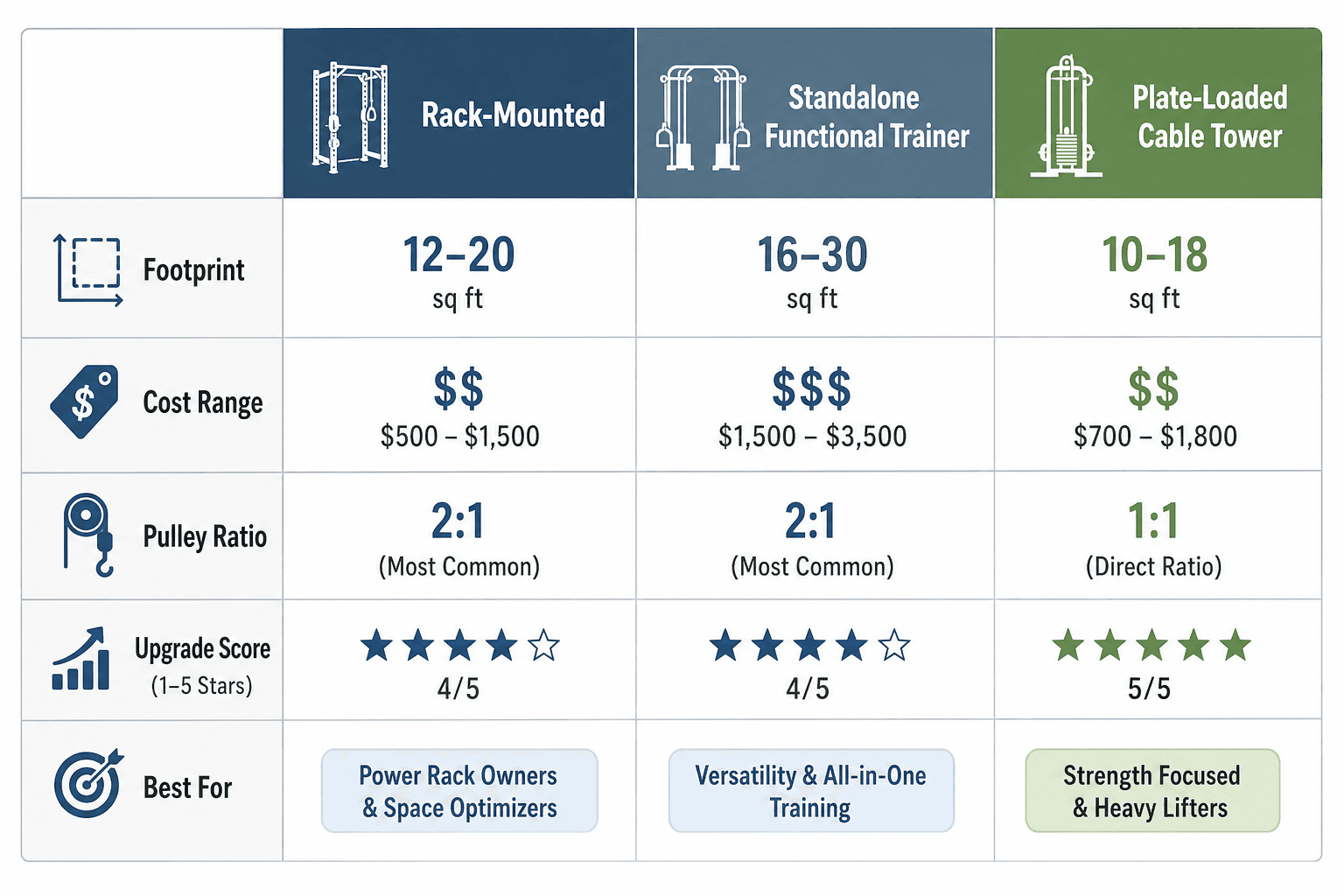
| Dimension | Rack-Mounted | Standalone Functional Trainer | Plate-Loaded Cable Tower |
|---|---|---|---|
| Footprint | 0 sq ft added | 15–25+ sq ft | 3–6 sq ft |
| Cost Range | $500–$3,000 | $2,000–$4,500+ | $500–$1,500 |
| Pulley Ratio | 2:1 (1:1 available on some models) | 2:1 (1:1 on premium models) | 2:1 (1:1 adapter available) |
| Upgrade Score | 7/10 — Manufacturer ecosystem | 4/10 — Proprietary lock-in | 9/10 — Fully repairable |
| Best For | Power rack owners who want zero added footprint | Buyers without a rack who have 20+ sq ft | Lifters who prioritize long-term value and repairability |
Before you make a final decision, take a moment to answer the eight questions in our compact home gym buyer's guide. They will help you confirm your space, budget, and equipment priorities before you commit to a format. And if you are still unsure how much space you can dedicate, our space-tier guide breaks down what you can build in 10, 30, 50, or 100 square feet.

Comments
Join the discussion with an anonymous comment.