
The Expanding At-Home Pilates Equipment Market
The global Pilates equipment market is projected to grow by USD 218.52 million at a compound annual growth rate of 14.2% from 2025 to 2030, according to a Technavio report. North America accounts for 37.7% of that growth. The Pilates machines segment alone was valued at USD 122.70 million in 2024. This expansion is driven by a surge in home fitness adoption and the proliferation of boutique studios, but it has also created a crowded market where buyers face a bewildering range of choices — from a $20 resistance band to a $10,000 commercial-grade reformer.
The central question for most home fitness buyers is not which reformer is best, but whether you need a reformer at all. The answer depends on three variables: how often you practice, how much floor space you can dedicate, and whether the unique resistance profile of a reformer is essential for your goals. This article breaks the at-home Pilates equipment landscape into three distinct tiers — mat-and-props kits, portable boards, and full-size reformers — and provides a decision framework to match each tier to your specific situation.
Tier 1: Mat + Props — The Under-$200 Starter Kit
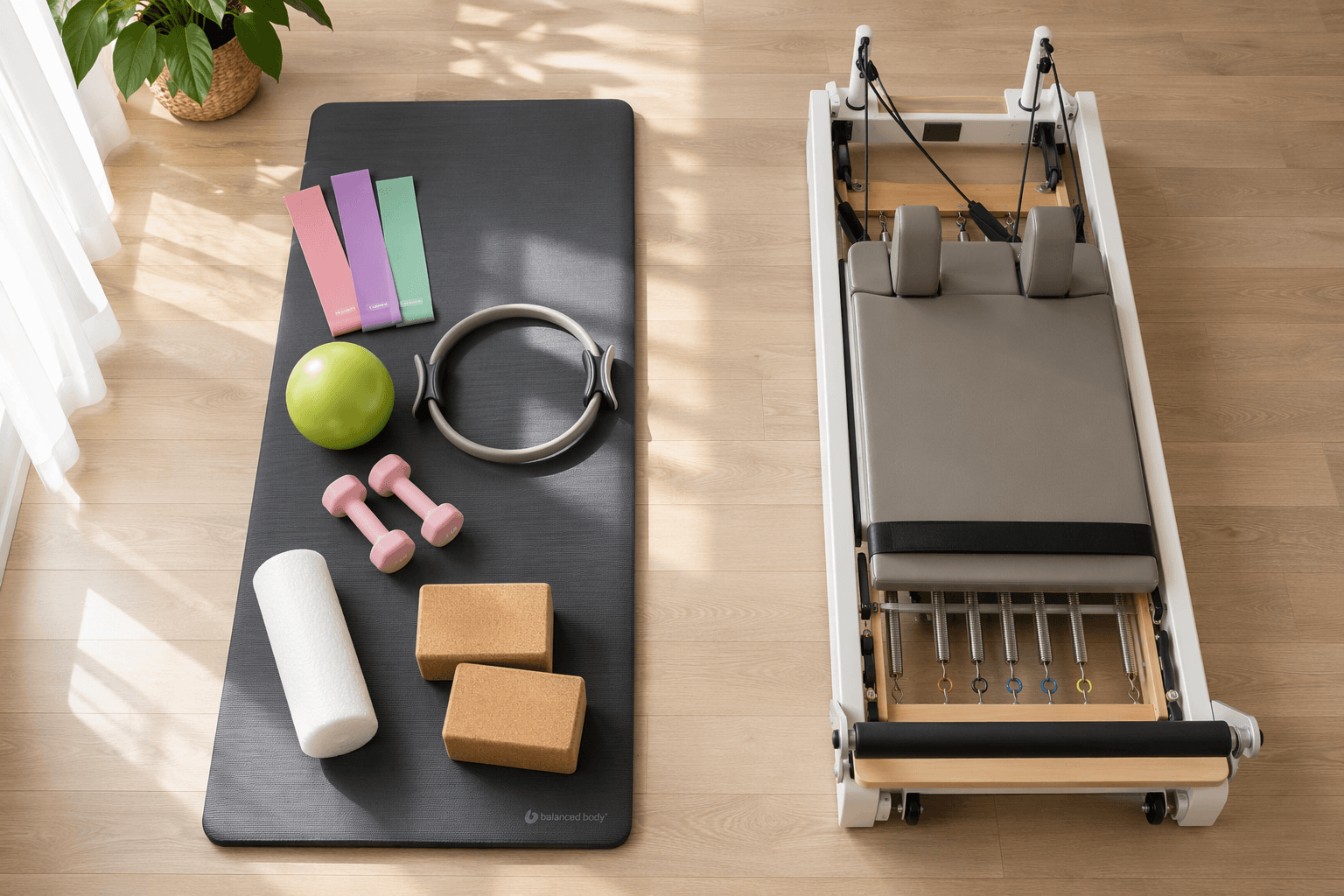
The most accessible entry point into at-home Pilates is a thick mat paired with a small collection of props. Certified Pilates instructor Alyssa, who has over 11 years of teaching experience, recommends seven core props for a complete home setup: a thick mat, resistance bands, a mini ball, sliders, hand weights, yoga blocks, and a foam roller. She states, "Having large workout equipment in our home isn't ideal for most, but you really don't need the big equipment — like Reformers & Cadillacs — to get a good workout. Using small props and your bodyweight can be just as effective."
The total cost for a quality mat-and-props kit comes in well under $200. Here is a breakdown of the essential components and what you should expect to pay for each:
| Prop | Recommended Spec | Example Product & Price | Primary Use |
|---|---|---|---|
| Pilates mat | 8–25mm thick, closed-cell foam | Airex Pilates 190 Mat ($108, 4.8/5 rating) | Spine support during rolling and supine exercises |
| Resistance bands | Long 78" band + mini/booty bands | STOTT Pilates Flex-Band (~$15) | Reformer-like resistance for arms, legs, and glutes |
| Mini ball | 9–12" diameter | Merrithew Mini Stability Ball (~$20) | Inner thigh activation, core stability, back support |
| Hand weights | 1–5 lb range | Bala weights 1 lb or 2 lb (~$45/pair) | Upper body and standing exercises |
| Sliders | Small plastic or felt discs | Generic sliders (~$10) | Replicate reformer gliding on wood or carpet |
| Yoga blocks | 4" standard | Cork or foam blocks (~$15/pair) | Support and proprioceptive feedback (e.g., between thighs) |
| Foam roller | 36" medium density | Generic medium-density roller (~$25) | Myofascial release and active recovery exercises |
Comments
Join the discussion with an anonymous comment.