
Introduction: Why the Upfront Price Isn't the Real Cost
When you see a commercial treadmill priced at $4,299 or a power rack built from 11-gauge steel, the natural reaction is sticker shock. A consumer-grade treadmill at $1,200 looks like the sensible choice — until you run the math on what each option actually costs you per year of use.
This article is not a general "is it worth it?" analysis — we've already covered that elsewhere. Instead, this is a cost-per-year model built for the home fitness enthusiast who trains 4–6 days per week and is considering an upgrade. The question is not "Can I afford the commercial price?" but "Which option costs less per year over the next decade?"
The answer, backed by replacement-cycle data and total-cost-of-ownership figures, is often counterintuitive: a commercial-grade machine at 2–3 times the upfront price can deliver a lower annual cost than a consumer model that needs replacing every few years. But that math only works for certain training profiles. This article will help you determine whether yours fits.
The Engineering Difference: What Makes Commercial Equipment Last Longer
The lifespan gap between consumer and commercial equipment isn't a marketing claim — it's a direct result of how each category is engineered. Commercial equipment is built to withstand 12–18 hours of daily use in a facility. Consumer equipment is designed for 1–2 hours per day. Those design targets produce fundamentally different machines.
The table below summarizes the core engineering differences across the categories that matter most for home gym buyers.
| Specification | Consumer Grade | Commercial Grade |
|---|---|---|
| Steel gauge (frame) | 14–18 gauge | 10–14 gauge |
| Weight capacity | 250–350 lbs | 400–1,500+ lbs |
| Motor rating (treadmills) | 2.0–3.5 HP (peak) | 3.0–7.0 CHP (continuous) |
| Designed daily use | 1–2 hours | 8–14+ hours |
| Running deck (treadmills) | 18–20" x 50–55" | 22" x 60"+ |
| Typical lifespan | 3–7 years | 10–20 years |
| Warranty (frame) | 1–5 years (limited) | 10 years to lifetime |
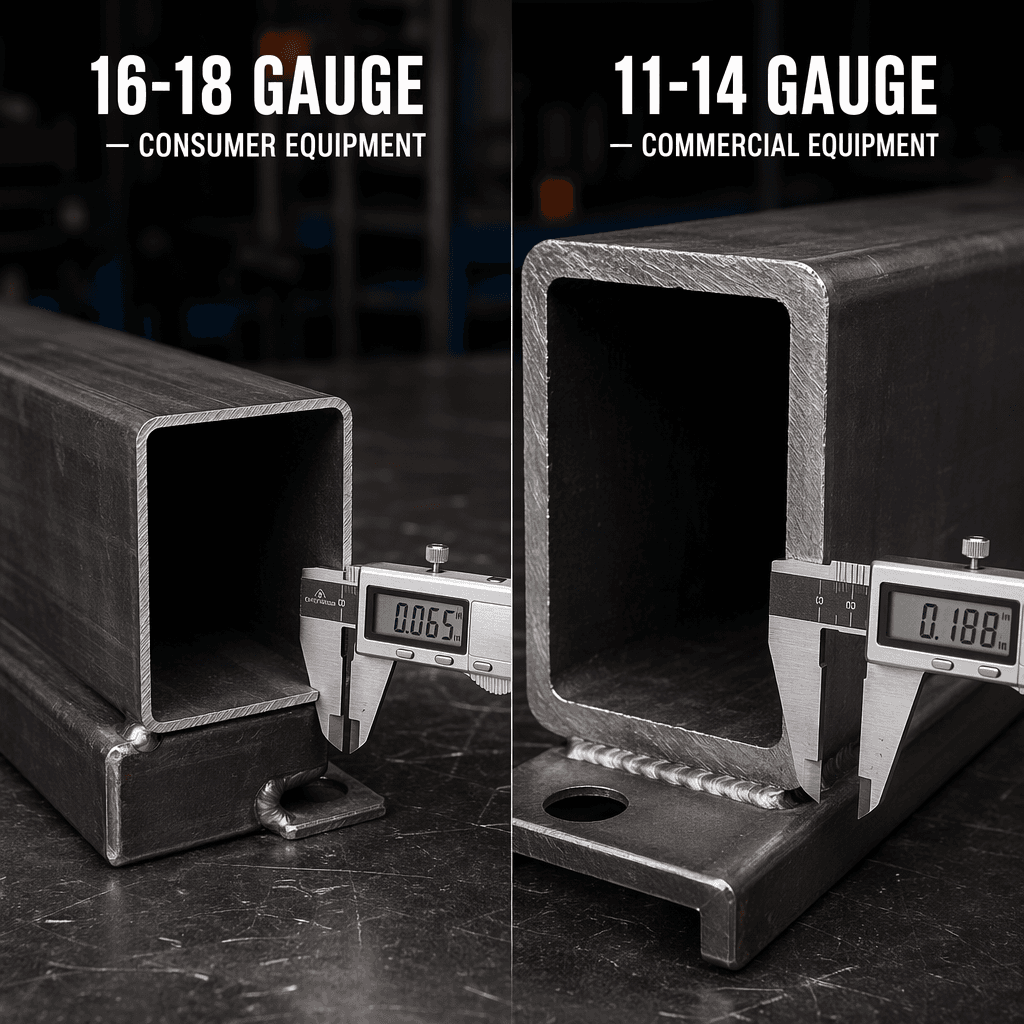
The steel gauge difference is particularly important for strength equipment. Commercial frames use 11–14 gauge steel at critical stress points, while consumer frames typically use 16–18 gauge. That translates to weight capacities of 800–1,500+ lbs for commercial power racks versus 300–700 lbs for consumer models. For a lifter doing heavy squats or deadlifts multiple times per week, that margin is not theoretical — it's the difference between a rack that feels solid under 400 lbs and one that wobbles.
Motor ratings follow a similar pattern. Commercial treadmills use continuous-duty motors rated 3.0–7.0 CHP, meaning they can sustain that output for hours. Consumer treadmills use peak horsepower ratings of 2.0–3.5 HP, which represent short bursts rather than sustained output. A runner training 5–6 days per week at moderate intensity will push a consumer motor past its design limits within a few years.
The Cost-Per-Year Model: Consumer vs. Commercial Over 5 and 10 Years
The most concrete way to compare these two categories is to calculate cost per year of usable life. This method accounts for the full replacement cycle — not just the initial purchase, but what happens when a consumer-grade machine fails and needs to be replaced.
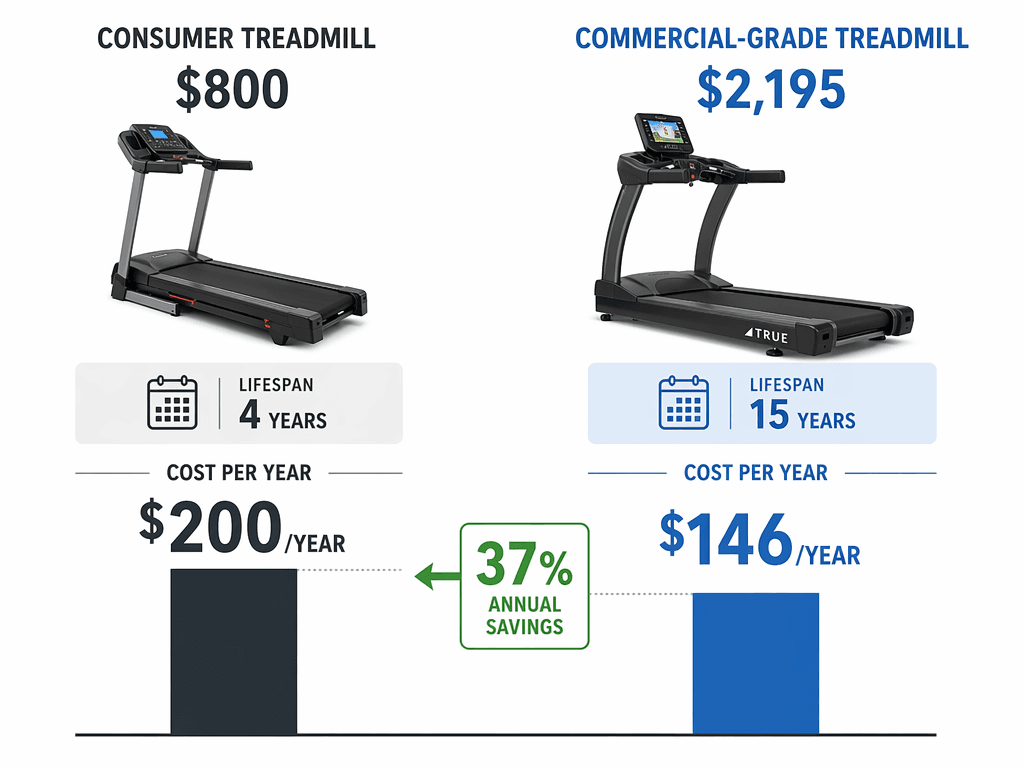
Consider a specific example cited by CTX Home Gyms: a consumer treadmill priced at $800 with a 4-year lifespan costs $200 per year. A remanufactured commercial treadmill at $2,195 with a 15-year lifespan costs $146 per year. That's a 37% annual savings for the commercial option, despite a nearly 3x higher upfront price.
| Scenario | Upfront Cost | Lifespan | Cost Per Year | 5-Year Total | 10-Year Total |
|---|---|---|---|---|---|
| Consumer treadmill | $800 | 4 years | $200 | $1,600 (2 units) | $2,400 (3 units) |
| Remanufactured commercial treadmill | $2,195 | 15 years | $146 | $730 | $1,460 |
| Consumer cardio machine (typical range) | $1,200–$1,800 | 3–5 years | $240–$600 | $1,200–$3,000 | $2,400–$6,000 |
| Commercial cardio machine (typical range) | $3,000–$4,500 | 10–15 years | $200–$450 | $1,000–$2,250 | $2,000–$4,500 |
The pattern holds across price ranges. A $3,000–$4,500 commercial unit over 5 years costs the same or less than replacing a $1,200–$1,800 consumer unit once, according to GearForFit. An entry-level home unit at $1,200–$1,800 that gets replaced after 2–4 years brings the 5-year total to $2,500–$3,500 or more — comparable to a single commercial purchase that is still running strong at year 5.
Hidden Benefits: Stability, Resale Value, and the Performance Edge
Beyond the per-year cost math, commercial equipment offers three advantages that don't show up on a price tag but affect both your wallet and your training experience.
Stability Under Heavy Loads
A commercial power rack with 11-gauge steel and a 1,000+ lb weight capacity does not flex when you rerack a heavy squat. A consumer rack with 16-gauge steel and a 500 lb capacity may wobble or shift over time. For anyone training near their max, that stability is a safety feature as much as a performance one. The same applies to benches: the REP FB-5000 Competition Flat Bench, tested by Garage Gym Reviews, carries a 1,000-lb weight capacity with a 10-year warranty for $245 — a commercial-grade piece at a price that undercuts many consumer benches.
Resale Value Retention
Commercial equipment holds 40–50% of its original value after 5 years, according to CTX Home Gyms. Consumer equipment retains only 10–20% over the same period. That difference matters if you ever sell or upgrade. A commercial treadmill purchased for $4,000 might sell for $1,600–$2,000 after half a decade. A consumer treadmill bought for $1,500 might fetch $150–$300. The resale value gap further widens the total-cost-of-ownership advantage for commercial gear.
The Psychological Performance Impact
Training on equipment that feels solid, responsive, and built to last changes how you approach your workout. A commercial-grade running deck that absorbs up to 40% of joint impact (per Harison Fitness) allows longer, more comfortable runs. A competition barbell with 236,000 PSI tensile strength (like the Eleiko IWF bar tested by Garage Gym Reviews) provides consistent whip and spin that makes heavy lifts feel more controlled. These are not luxuries — for the 4–6 day per week trainee, they are factors that influence consistency, recovery, and long-term progress.
Decision Framework: Is Commercial Equipment Right for You?
The cost-per-year model only works in your favor if your training profile matches the commercial equipment's design. The table below helps you self-assess based on the three factors that matter most.
| Factor | Stick with Consumer | Consider Commercial |
|---|---|---|
| Training frequency | 1–3 days per week | 4–7 days per week |
| Users in household | Single user | 2+ users or shared gym |
| Training style | General fitness, walking, light weights | Heavy lifting, running, high-intensity intervals |
| Commitment horizon | Unsure if you'll still train in 2 years | Certain you'll train 5+ years |
| Budget flexibility | Hard cap under $2,000 per piece | Can invest $3,000–$5,000 per core piece |
| Space | Need folding or compact equipment | Have dedicated garage or basement space |
The most important variable is training frequency. Consumer equipment is designed for 1–2 hours of daily use. If you train 5–6 days per week for 45–60 minutes per session, you are using a consumer machine at or near its design limit. That accelerates wear and shortens lifespan, which is exactly why the replacement-cycle math flips in favor of commercial equipment for high-frequency users.
User count is the second critical factor. A household with two people training 5 days per week is effectively putting 10 sessions per week on a single machine. That level of use will push a consumer treadmill past its design life in 2–3 years, while a commercial treadmill designed for 8–14 hours of daily use handles it without issue.
Debunking the Space Myth: Commercial Equipment in a Home Gym Footprint
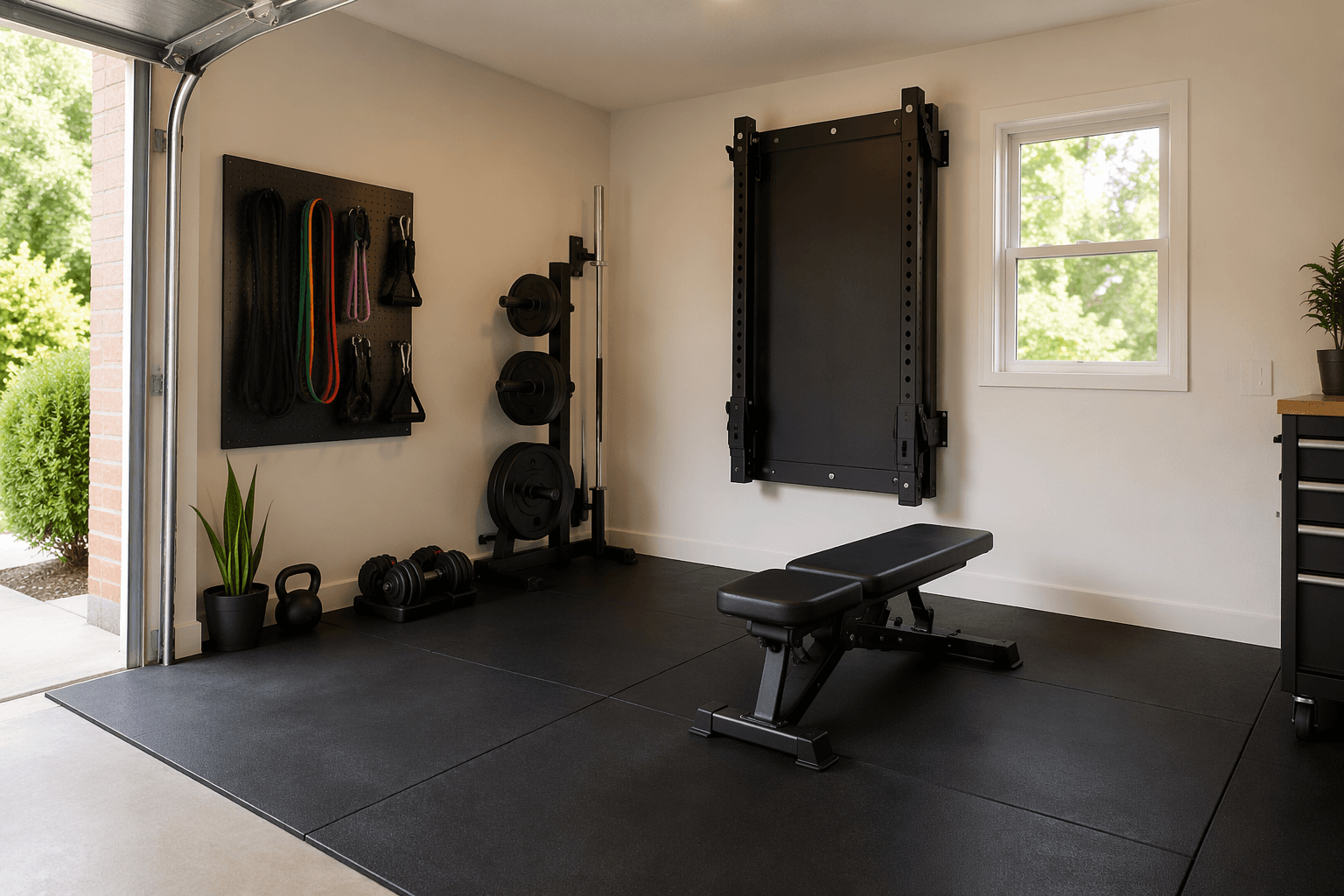
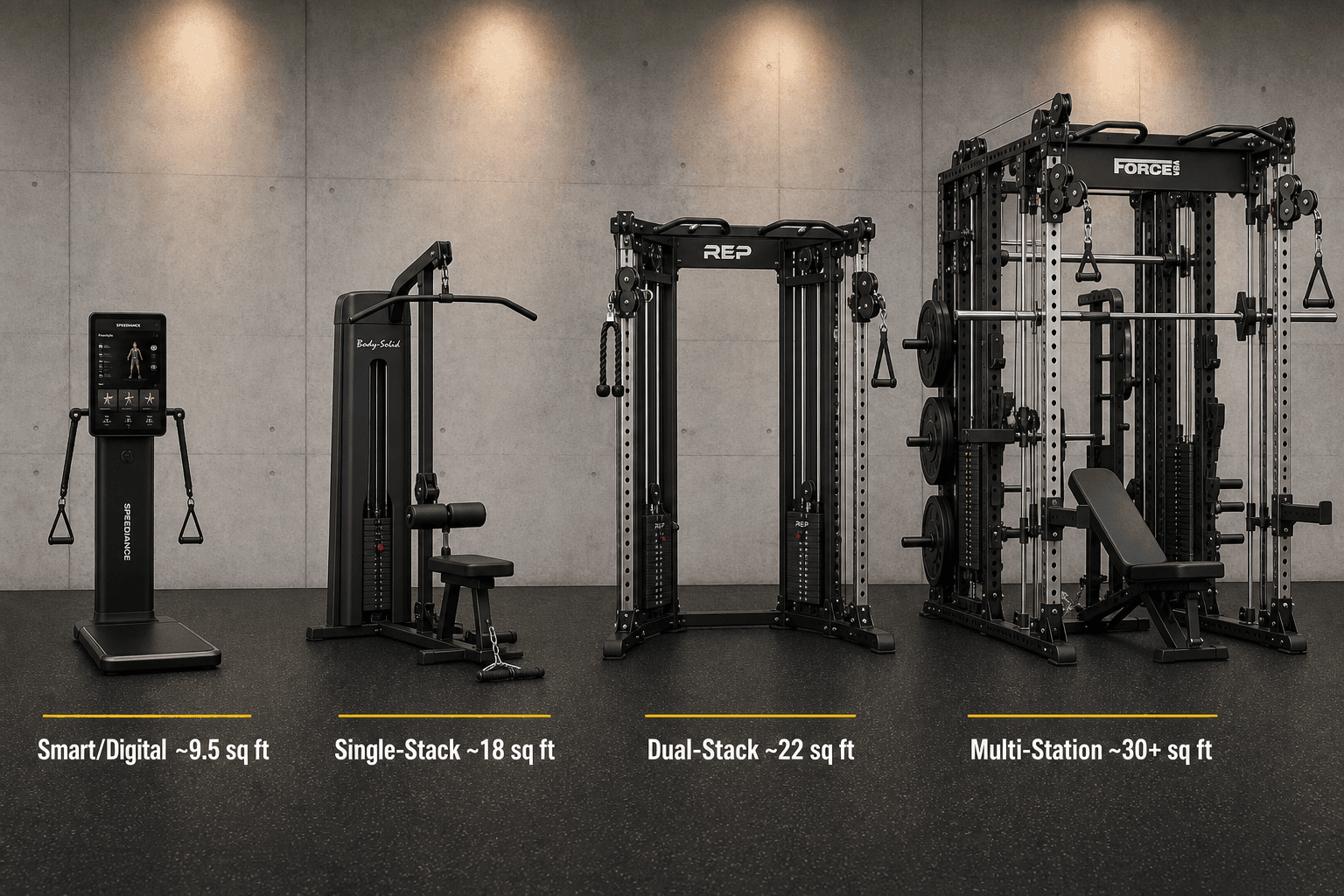
A common objection to commercial equipment is that it won't fit in a home gym. The reality is more nuanced. Modern commercial equipment — especially all-in-one systems, functional trainers, and compact power racks — is designed with home gym footprints in mind.
- A commercial treadmill requires roughly 80" L x 35" W plus clearance on all sides, according to Harison Fitness. That's about 20 square feet of floor space — comparable to many consumer models, though commercial units rarely fold.
- Modern all-in-one systems combine a Smith machine, power rack, functional trainer, lat pulldown, and low row in a compact footprint designed specifically for basements and garage gyms, per GearForFit.
- The Titan Fitness Functional Trainer, tested by Garage Gym Reviews at $2,999.99, has dual 200-lb weight stacks and fits in a footprint comparable to many consumer cable machines.
- The Rogue R-3 Power Rack ($870) uses 11-gauge steel with a 1,000+ lb capacity and a footprint of roughly 48" x 48" — smaller than many consumer racks with lower weight ratings.
The real space constraint is not the equipment footprint but the clearance required for safe use. A power rack needs enough room to load plates and rerack the bar. A treadmill needs rear clearance in case of a fall. These requirements apply to consumer and commercial equipment alike.
Best Commercial Equipment Categories for Home Use
Not every commercial equipment category translates well to a home gym. The following categories offer the best value for home users because they deliver the most meaningful durability and performance advantages without requiring facility-level space or power.
| Category | Why It Translates Well | Example (from Garage Gym Reviews testing) | Key Specs |
|---|---|---|---|
| Commercial treadmills | Continuous-duty motors, larger decks, better cushioning | NordicTrack X24 ($4,299) | 60" x 22" belt, 400-lb capacity, lifetime motor warranty |
| Power racks | Thicker steel, higher weight capacity, better safety features | Rogue R-3 ($870) | 11-gauge steel, 1,000+ lb capacity, lifetime warranty |
| Competition benches | Higher weight capacity, wider base, more stable | REP FB-5000 ($245) | 1,000-lb capacity, 10-year warranty |
| Functional trainers | Smooth cable action, dual stacks, compact footprint | Titan Fitness Functional Trainer ($2,999.99) | Dual 200-lb stacks |
| Rowing machines | Proven durability, low maintenance, compact storage | Concept2 RowErg ($990) | 500-lb capacity, 5-year frame warranty |
Commercial treadmills and power racks are the two categories where the durability difference matters most for home users. A commercial treadmill's continuous-duty motor and larger running deck directly impact training quality and longevity. A commercial power rack's thicker steel and higher weight capacity provide safety margins that consumer racks cannot match.
For a broader set of tiered recommendations across budget levels, see our Best Home Gym Equipment guide, which includes picks at consumer, light commercial, and full commercial price points.
Conclusion: Making the Call Based on Your Numbers
The decision between consumer and commercial exercise equipment is a math problem, not a brand preference. The key variables are your training frequency, the number of users in your household, and your commitment horizon.
If you train 4–6 days per week, have multiple users, or plan to train for 5+ years, the cost-per-year model consistently favors commercial equipment. A $3,000–$4,500 commercial treadmill that lasts 10–15 years will almost certainly cost you less per year than a $1,200–$1,800 consumer treadmill that needs replacing every 3–5 years. The 37% annual savings from the remanufactured commercial treadmill example is not an outlier — it reflects a structural advantage that applies across categories.
If you train 1–3 days per week, are the sole user, or are uncertain about your long-term commitment, consumer equipment remains the financially rational choice. The lower upfront cost minimizes your risk, and the shorter lifespan is less relevant when the machine sees light use.
The equipment you buy today will shape your training experience for the next 5–15 years. Run the numbers for your specific situation, and let the math — not the sticker price — make the decision.

Comments
Join the discussion with an anonymous comment.