
Commercial Exercise Equipment: A Three-Tier Decision Framework for Home Gym Buyers
This article helps high-consideration home gym buyers decide between Residential, Light Commercial, and Full Commercial equipment using a structured decision matrix based on usage frequency, number of users, space permanence, and workout intensity.
Introduction: The Real Question Isn't 'Commercial vs. Home'
If you've been researching home gym equipment for any length of time, you've encountered the standard binary: buy consumer-grade gear for a few hundred dollars, or spend thousands on commercial machines built for 24-hour fitness chains. That framing misses the real decision most serious home buyers face. The market has three distinct tiers — Residential, Light Commercial, and Full Commercial — and choosing between them requires matching equipment construction to your actual usage patterns, not just your budget.
This article introduces a three-tier decision framework that goes beyond the oversimplified commercial-versus-home comparison. Instead of asking "Should I buy commercial equipment?" you'll learn to ask "Which tier matches my training frequency, number of users, space situation, and workout intensity?" We'll walk through the construction differences that define each tier, model the 10-year cost of ownership, and apply a scenario-based decision matrix that produces clear recommendations for your specific situation.
If you prefer a simpler binary cost-benefit analysis before diving into this three-tier framework, our complete 2026 cost-benefit analysis on commercial-grade equipment covers the upfront-versus-long-term tradeoffs in a more direct format.
The Three Equipment Tiers: What Each Level Actually Means
Understanding the physical construction differences between tiers is the foundation of any smart purchase decision. The materials, engineering, and intended use-case vary substantially across the three levels, and those differences directly affect lifespan, maintenance costs, and resale value.
Residential (Consumer-Grade)
Residential equipment is designed for intermittent use by one or two people. Frames typically use 16- to 18-gauge steel, with weight capacities in the 250- to 350-pound range. Treadmill motors are rated at 2.5 to 3.5 HP peak duty, meaning they are not built for sustained operation. Expected lifespan is 3 to 7 years with normal use. Brands like Bowflex and most models from NordicTrack and Sole's entry-level line fall into this category. Price range: roughly $400 to $2,800.
Light Commercial
Light commercial equipment occupies the middle ground. According to The Fitness Outlet, it is designed for moderate daily use in settings like boutique studios, hotel fitness rooms, and apartment gyms — environments where equipment sees regular but not continuous traffic. Construction is heavier than residential: thicker steel frames, industrial-grade bearings, and reinforced welds. Weight capacities typically reach 350 to 400 pounds. Treadmill motors are 3.0 to 4.0 HP continuous duty. Expected lifespan is 8 to 12 years. Brands such as Sole, Spirit, and TRUE Fitness's residential line are often positioned here. Price range: roughly $1,500 to $4,500.
Full Commercial
Full commercial equipment is engineered for continuous, high-traffic environments — think 8 to 14 hours of daily use in facilities like Gold's Gym, OrangeTheory, or Anytime Fitness. Frames use 11- to 14-gauge steel, with weight capacities of 400 to 500+ pounds. Treadmill motors are 3.0 to 5.0 HP continuous duty. Cables, pulleys, and bearings are all industrial-grade. Expected lifespan is 15 to 20 years with proper maintenance. Brands like Life Fitness, Precor, Matrix, and Hammer Strength dominate this tier. Price range: $2,000 to $10,000+.
| Specification | Residential | Light Commercial | Full Commercial |
|---|---|---|---|
| Steel gauge | 16–18 gauge | 14–16 gauge | 11–14 gauge |
| Weight capacity | 250–350 lbs | 350–400 lbs | 400–500+ lbs |
| Treadmill motor | 2.5–3.5 HP peak | 3.0–4.0 HP continuous | 3.0–5.0 HP continuous |
| Expected lifespan | 3–7 years | 8–12 years | 15–20 years |
| Typical price range | $400–$2,800 | $1,500–$4,500 | $2,000–$10,000+ |
| Example brands | Bowflex, entry-level NordicTrack | Sole, Spirit, TRUE residential | Life Fitness, Precor, Matrix |
Total Cost of Ownership: A 10-Year Comparison Across Tiers
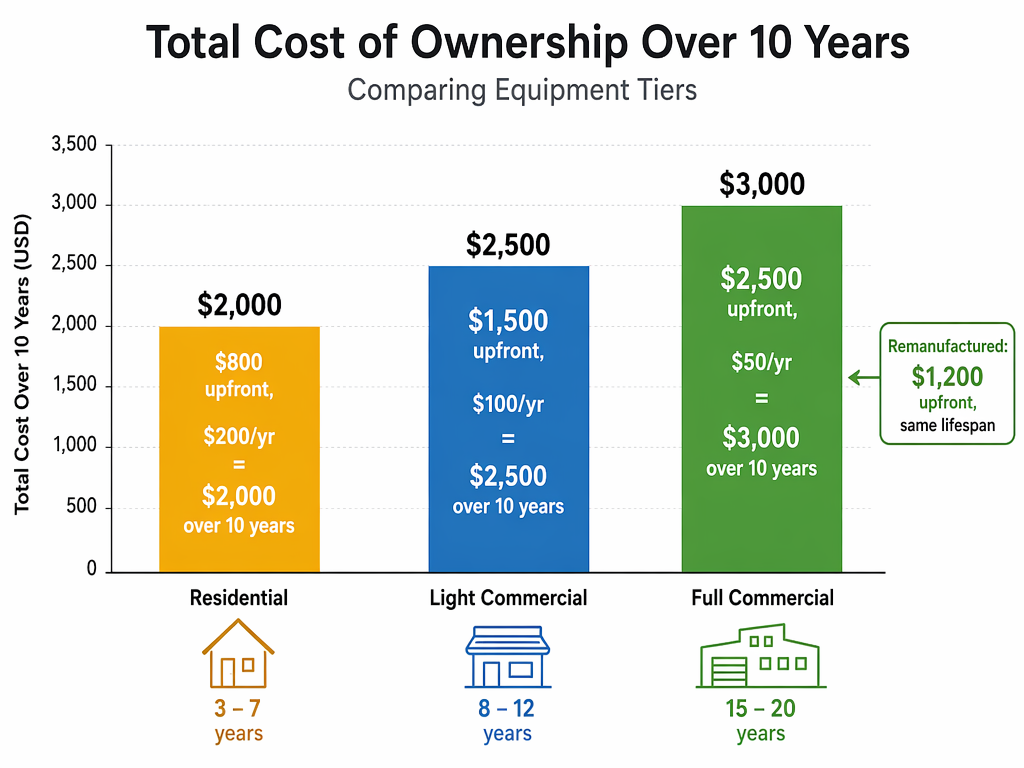
Upfront price is only one part of the equation. A more honest comparison looks at cost per year of usable life, factoring in resale value and the likelihood of replacement. The figures below are drawn from multiple sources, including a remanufactured equipment seller's analysis, so we present them with appropriate caveats.
| Cost Factor | Residential | Light Commercial | Full Commercial (New) | Full Commercial (Remanufactured) |
|---|---|---|---|---|
| Upfront price (example) | $800 | $2,000 | $4,000 | $2,195 |
| Expected lifespan | 4 years | 10 years | 15 years | 15 years |
| Cost per year | $200/year | $200/year | $267/year | $146/year |
| Resale value after 5 years | 10–20% of original | 25–35% of original | 40–50% of original | 40–50% of original |
| 10-year total cost (est.) | $2,000+ | $2,000 | $2,670 | $1,460 |
The remanufactured commercial treadmill at $2,195 works out to roughly $146 per year over 15 years, compared to $200 per year for an $800 consumer treadmill that lasts 4 years — a 37% annual savings. Commercial equipment also retains 40-50% of its original value after 5 years, versus 10-20% for consumer models. That resale strength matters if you upgrade or move.
The Decision Matrix: Matching Equipment Tier to Your Situation
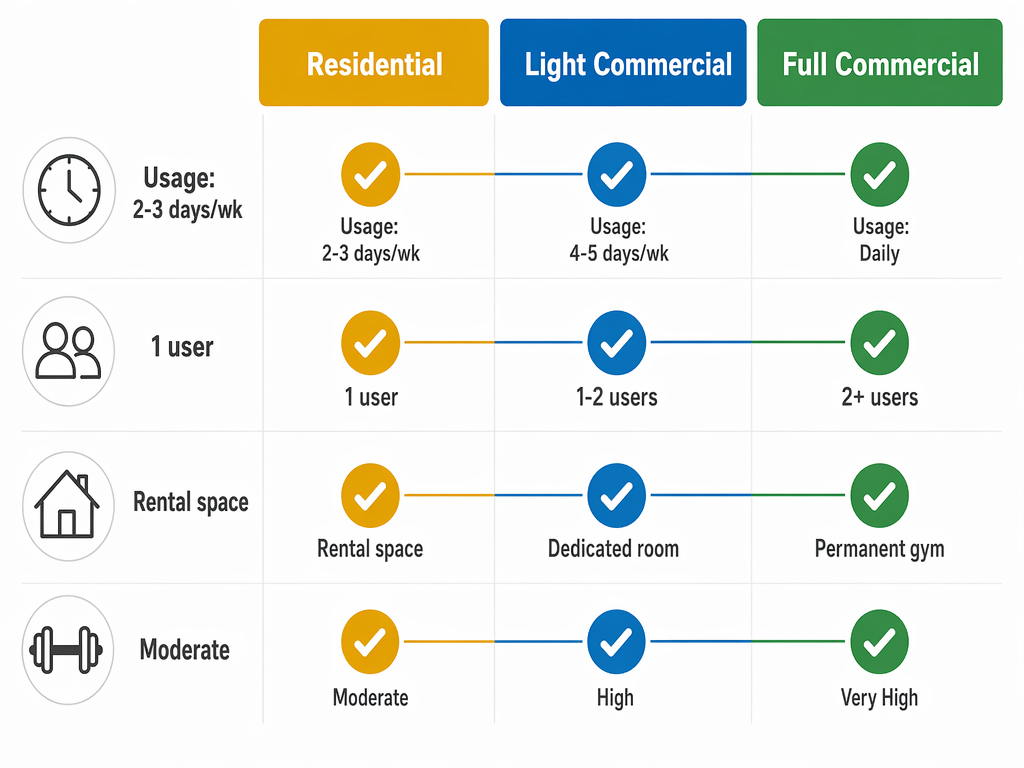
Rather than applying a single rule like "buy commercial if you train 4+ days per week," a more useful approach considers four dimensions simultaneously: usage frequency, number of users, space permanence, and workout intensity. Each dimension shifts the recommendation toward a different tier.
| Decision Criteria | Residential | Light Commercial | Full Commercial |
|---|---|---|---|
| Usage frequency | 1–3 days/week | 3–5 days/week | 5–7 days/week or daily |
| Number of users | 1 person | 1–2 people | 2+ people or family |
| Space permanence | Rental, temporary setup | Own home, semi-permanent | Permanent gym room or garage |
| Workout intensity | Moderate (walking, light weights) | Moderate to high | High to very high (heavy lifting, HIIT) |
To use the matrix: assess where you fall on each of the four criteria. If you land in the Residential column for all four, consumer-grade equipment is likely sufficient. If you hit Light Commercial on three or more criteria, that tier is your sweet spot. If you hit Full Commercial on three or more — especially if you have multiple users or very high intensity — the long-term economics favor commercial-grade gear despite the higher upfront cost.
Real-World Scenarios: Applying the Framework
Theory is useful, but concrete examples make the framework actionable. Below are two common home gym buyer profiles and how the decision matrix guides their choice.
Scenario A: Heavy Use, Multiple Users, Permanent Space
Profile: A couple in their own home, both training 5-6 days per week. One does heavy strength training (squats, deadlifts), the other does HIIT and treadmill running. They have a dedicated garage gym that will not change for at least 10 years.
- Usage frequency: 5-6 days/week → Full Commercial
- Number of users: 2 people → Full Commercial
- Space permanence: Permanent garage → Full Commercial
- Workout intensity: High to very high → Full Commercial
Recommendation: Full Commercial. The upfront investment is higher, but the equipment will last 15-20 years, retain strong resale value, and handle daily use by two people without premature wear. A remanufactured commercial treadmill or a new light commercial rack paired with a commercial cardio machine would be a cost-effective combination.
Scenario B: Occasional Use, Single User, Rental Space
Profile: A single renter in an apartment, training 3 days per week with bodyweight exercises and a set of adjustable dumbbells. They may move in 2-3 years and have limited floor space.
- Usage frequency: 3 days/week → Residential or Light Commercial
- Number of users: 1 person → Residential
- Space permanence: Rental → Residential
- Workout intensity: Moderate → Residential
Recommendation: Residential or Light Commercial. A quality residential setup will meet this user's needs without over-investing. If the user plans to keep the equipment for 8+ years and values higher resale, a light commercial piece like a Sole treadmill or a Spirit elliptical would be a reasonable upgrade. For budget-conscious buyers, our compact home gym budget builds guide offers complete setups at $500, $1,500, and $3,000.
The Remanufactured Middle Path: Commercial Quality at 40-60% Off
For buyers who want full commercial durability but cannot justify $4,000+ for a single treadmill or $6,000+ for a functional trainer, remanufactured equipment offers a compelling alternative. Remanufactured commercial machines are fully disassembled, inspected, repaired with OEM parts, and reassembled to like-new condition. According to CTX Home Gyms, they cost 40-60% less than new commercial equipment while retaining the same lifespan and performance characteristics.
The key advantage is access to the full commercial tier's construction — 11- to 14-gauge steel, industrial-grade motors, and heavy-duty components — at a price point closer to light commercial. A remanufactured Life Fitness treadmill might cost $2,195 instead of $4,299 new, with the same 15- to 20-year expected lifespan.
Quick-Reference Spec Comparison Across Tiers
The table below summarizes the key differences across all three tiers at a glance. Use it as a quick reference when comparing specific models.
| Attribute | Residential | Light Commercial | Full Commercial |
|---|---|---|---|
| Steel gauge | 16–18 gauge | 14–16 gauge | 11–14 gauge |
| Weight capacity | 250–350 lbs | 350–400 lbs | 400–500+ lbs |
| Motor (treadmill) | 2.5–3.5 HP peak | 3.0–4.0 HP continuous | 3.0–5.0 HP continuous |
| Frame warranty | 10–15 years (lifetime on some) | 15 years – lifetime | Lifetime |
| Parts warranty | 1–3 years | 3–5 years | 5–10 years |
| Labor warranty | 1 year | 1–2 years | 2–3 years |
| Expected lifespan | 3–7 years | 8–12 years | 15–20 years |
| Typical price range | $400–$2,800 | $1,500–$4,500 | $2,000–$10,000+ |
| Resale value (5 yr) | 10–20% | 25–35% | 40–50% |
| Example brands | Bowflex, entry NordicTrack | Sole, Spirit, TRUE residential | Life Fitness, Precor, Matrix |
Final Verdict: Which Tier Should You Choose?
The three-tier framework replaces a vague "commercial or not" question with a structured decision process. Here is the summary recommendation based on the decision matrix:
- Choose Residential if you train 1-3 days per week alone, have a moderate workout intensity, and are in a temporary living situation. You will get adequate performance for 3-7 years at the lowest upfront cost.
- Choose Light Commercial if you train 3-5 days per week, have 1-2 users, and plan to keep the equipment for 8-12 years. This is the value sweet spot for most serious home gym owners.
- Choose Full Commercial if you train 5-7 days per week, have multiple users, high workout intensity, and a permanent gym space. The higher upfront cost is offset by 15-20 year lifespan, lower annual cost, and strong resale value.
- Consider Remanufactured Commercial if you want full commercial quality but need to stay within a light commercial budget. Verify warranty and return policies carefully.
For specific product recommendations within each tier, see our tiered picks for best home gym equipment, which covers budget, space, and training goal scenarios. If you are still weighing the binary commercial-versus-home question, the 2026 cost-benefit analysis provides a complementary perspective.
This result comes from one real apartment under the stated conditions — it is a strong signal, not a guarantee your space will measure identically.
Builds this evidence supports
Small Treadmill Buying Guide: 7 Critical Specs to Check Before You Buy
A cross-category spec primer for apartment and small-space dwellers comparing walking pads, ultra-compact folding treadmills, and full-size folding treadmills. Learn the concrete thresholds for motor HP, deck length, noise, warranty, and subscription lock-in so you can compare apples to apples.
Where to Spend vs. Save on Affordable Home Gym Equipment: A Quality Tradeoff Guide
A practical guide for budget-conscious buyers (under $1,000) that reveals which equipment categories demand a higher investment for safety and durability, and where cutting costs is a smart move.
Spot something off?
If this result didn't match your own space, let us know — floor-damage and noise claims carry real deposit-risk consequences if we get them wrong.