
I have watched too many people drop thousands on equipment that does not fit their space, budget, or ability. The average home gym cost you see in roundups—$1,855—is worthless. It flattens a $254.34 Sunny Health bike and a $4,295 Tonal 2 into the same sentence. That range tells you nothing about what you should spend.
What the average also hides: subscription costs. Tonal 2 charges $59.95 per month. Over five years that $4,295 machine becomes $7,892. The Speediance Gym Monster costs $3,199 with no mandatory subscription. Two products that seem to compete in the same price tier end up with very different lifetime bills. Generic lists almost never show that.
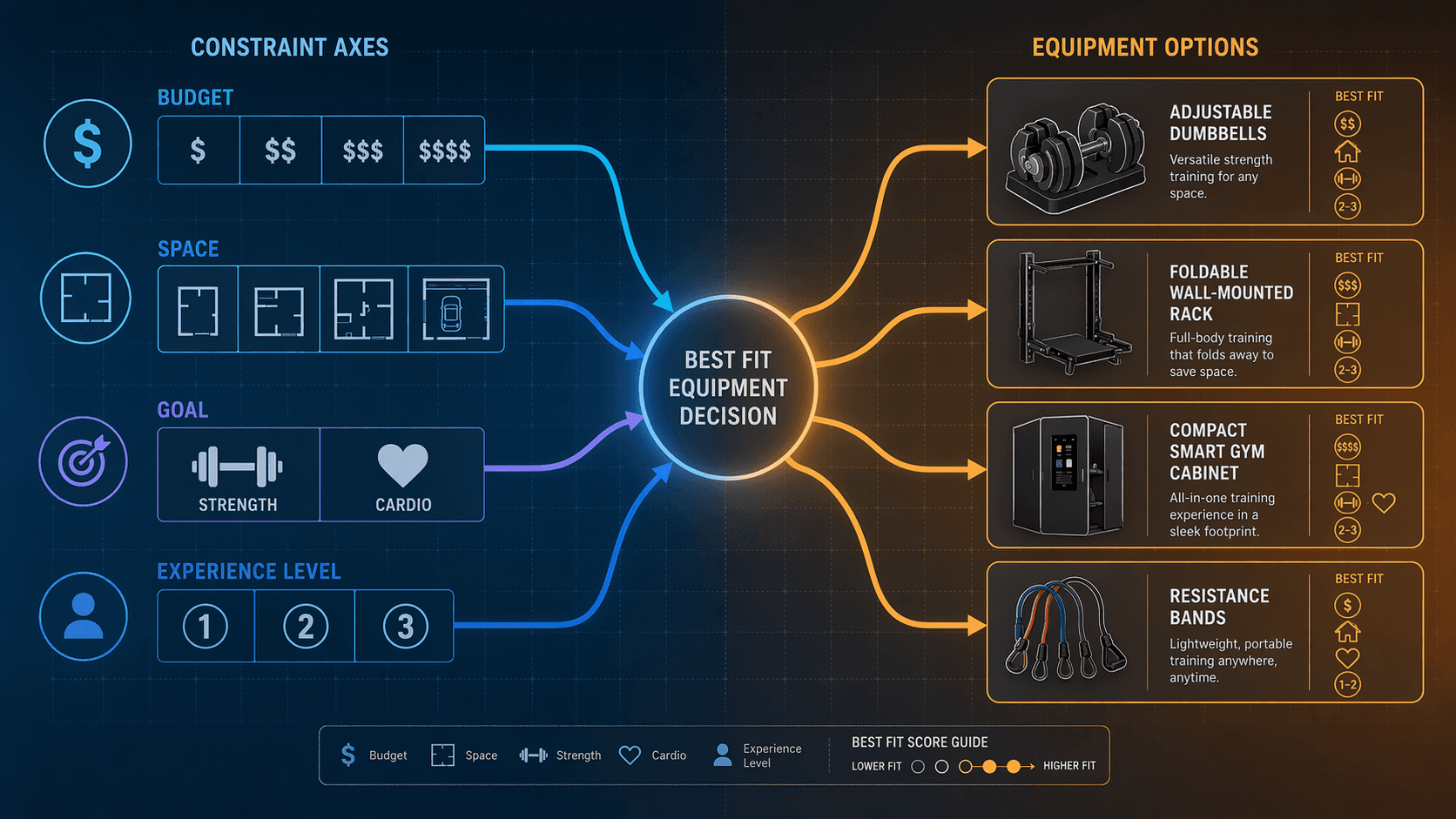
Sticker price is not the full picture. Before you read another “best overall” roundup, get four numbers straight: your budget, your available floor space, your primary fitness goal, and your experience level. This article builds a decision matrix around those four axes.
Four Numbers, Not One Average
Every home gym buyer filters by constraints, whether they say it or not. I have found four that separate a smart purchase from a regret:
- Budget tier – Under $500, $500–$1,500, $1,500–$3,000, $3,000+
- Space type – Apartment/small room, dedicated room, garage
- Primary goal – Strength, cardio, hybrid
- Experience level – Beginner, intermediate, advanced
Experience level is the most ignored. A beginner does not need a 1,000‑lb power rack or $200+ band set. The matrix below defaults toward simpler, safer, cheaper gear for beginners and only escalates for intermediate and advanced lifters. Goal alone is not enough—a person training for strength in a studio apartment has completely different options than someone with a garage. The four axes must work together.
For a deeper dive on how training style affects equipment choice, see the Home Gym Decision Guide: Which Type of Gym Machine Actually Fits Your Training Style?. That article narrows the goal dimension; here we keep the full matrix.
The Decision Matrix
The table below maps the most common constraint intersections to equipment categories. Each recommendation is justified by at least two axes. The same product can be “best” for one profile and wrong for another.
| Budget | Space | Goal | Experience | Recommended Equipment Category | Example Products |
|---|---|---|---|---|---|
| Under $500 | Apartment / small room | Strength | Beginner | Adjustable dumbbells + resistance bands + mat | REP QuickDraw 30‑lb set $335.99, Living.Fit bands $128.94 |
| $500–$1,500 | Apartment / small room | Strength | Intermediate | Adjustable dumbbells + adjustable bench | REP QuickDraw 60‑lb set ~$450, Ironmaster Super Bench Pro V2 $499 |
| $500–$1,500 | Dedicated room or garage | Strength | Beginner | Budget power rack + Olympic barbell + plates | REP PR‑1100 rack $380, Synergee barbell $179.95, Fringe Sport plates ~$2.20/lb |
| $1,500–$3,000 | Garage | Strength | Intermediate | Folding power rack + flat bench + plates | PRx Profile PRO rack $1,099.99, REP FB‑5000 bench $245, Fringe Sport plates 300 lb ~$660 |
| $1,500–$3,000 | Apartment | Cardio | Any | Compact cardio machine | Concept2 RowErg $990 (vertical storage), NordicTrack RW900 $1,499 + iFIT |
| $3,000+ | Apartment | Hybrid | Advanced | Smart gym + rower | Speediance Gym Monster $3,199, Concept2 RowErg $990 |
| $3,000+ | Dedicated room or garage | Hybrid | Intermediate | Cable tower or all‑in‑one | Bells of Steel Cable Tower $434.99 + rack, Major Fitness B17 $4,199.99 |
Notice how often the same product category moves from “best pick” to “avoid” when the constraint axis changes. The PRx Profile PRO Squat Rack ($1,099.99) is a great choice for an intermediate lifter in a garage who needs it to fold into 9–12" depth. For a beginner in a studio apartment, it is too heavy and too advanced—bands and dumbbells will serve better. That is the point. No single “best” exists.
For a deeper comparison of smart gym vs. traditional weights—relevant for the “Strength” goal and intermediate/advanced levels—read Smart Home Gym vs. Traditional Weights.
Real Profiles
Applying the matrix to realistic scenarios makes it concrete. Here are three common profiles, each with a clear trade‑off.
Beginner, Apartment, Strength, Under $500
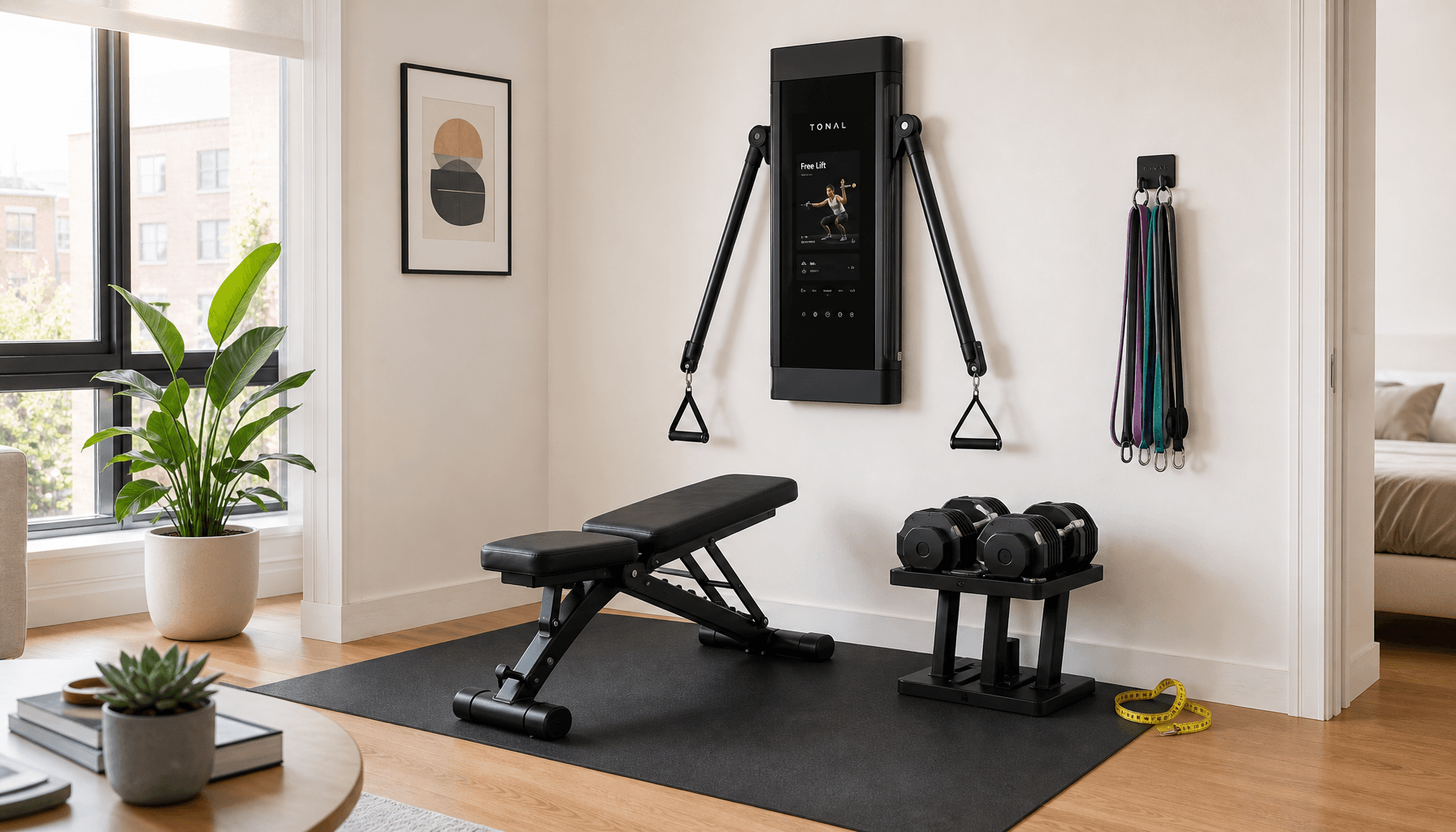
I would start with resistance bands and adjustable dumbbells. The Living.Fit set ($128.94) and REP QuickDraw 30‑lb pair ($335.99) total $464.93, no subscription, stores in a closet. This covers all major muscle groups and grows with you—the QuickDraw handles up to 60 lb per dumbbell. Far smarter than dropping $4,000 on a smart gym you cannot fully use.
Intermediate, Garage, Strength, $1,500–$3,000
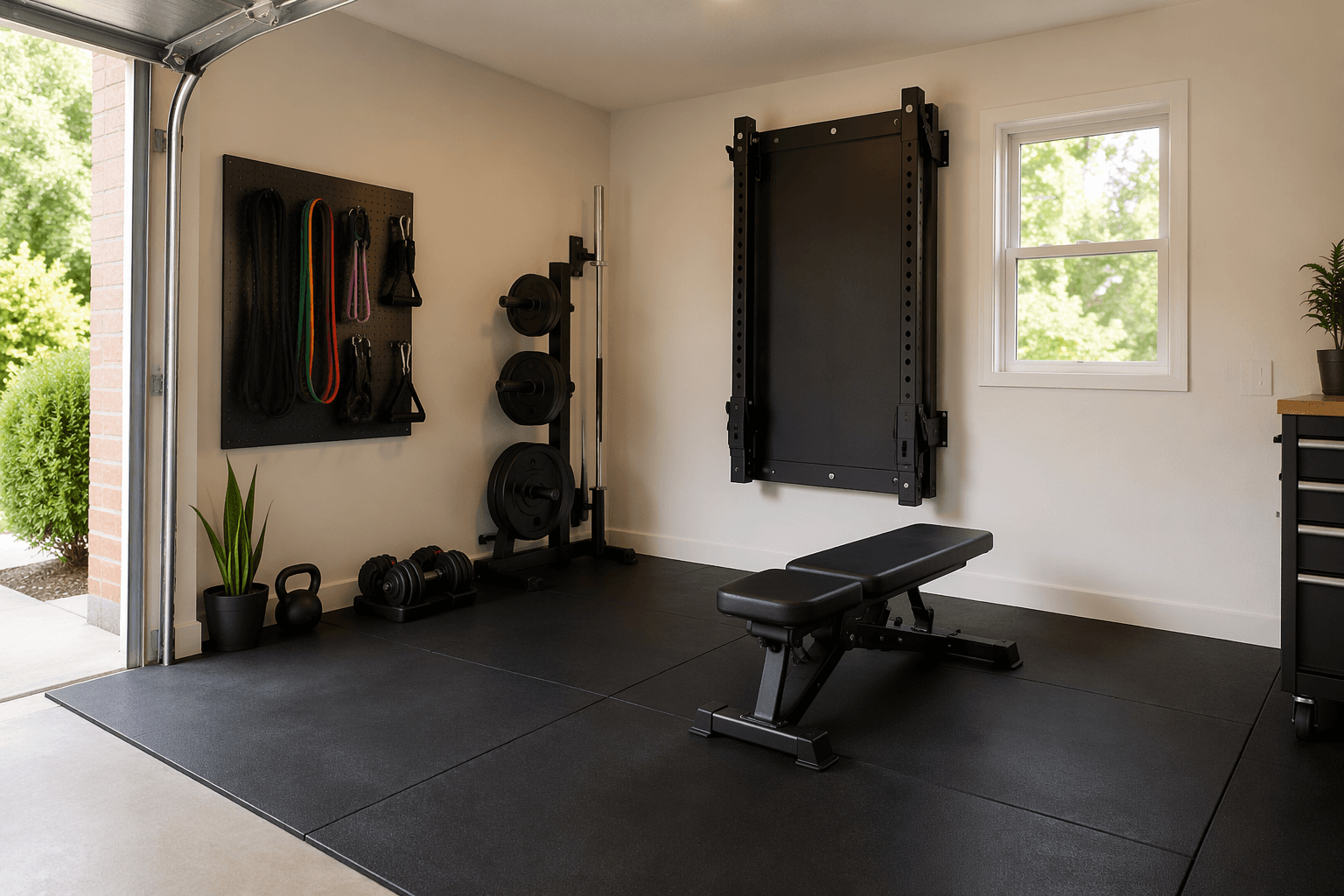
A folding rack like the PRx Profile PRO ($1,099.99) gives you a 1,000‑lb capacity that folds to 12" depth. Pair it with a REP FB‑5000 bench ($245), Synergee barbell ($179.95), and 300 lb of Fringe Sport bumpers ($660). Total ~$2,224, no subscription. Real barbell training that reclaims garage space. If the budget stretches, add a Bells of Steel Cable Tower ($434.99) for accessory work.
Advanced, Dedicated Room, Hybrid, $3,000+
The trade‑off here is subscription vs. simplicity. The Speediance Gym Monster ($3,199) folds to 15" depth with no mandatory subscription and 220 lb resistance. Tonal 2 ($4,295) requires $59.95/mo ($7,892 over five years) and a 7'×7' operating area. Add a Concept2 RowErg ($990) that stores vertically. For an advanced user who wants variety, this combo is flexible and space‑efficient. For a beginner, it is overkill.
Phase Your Purchases
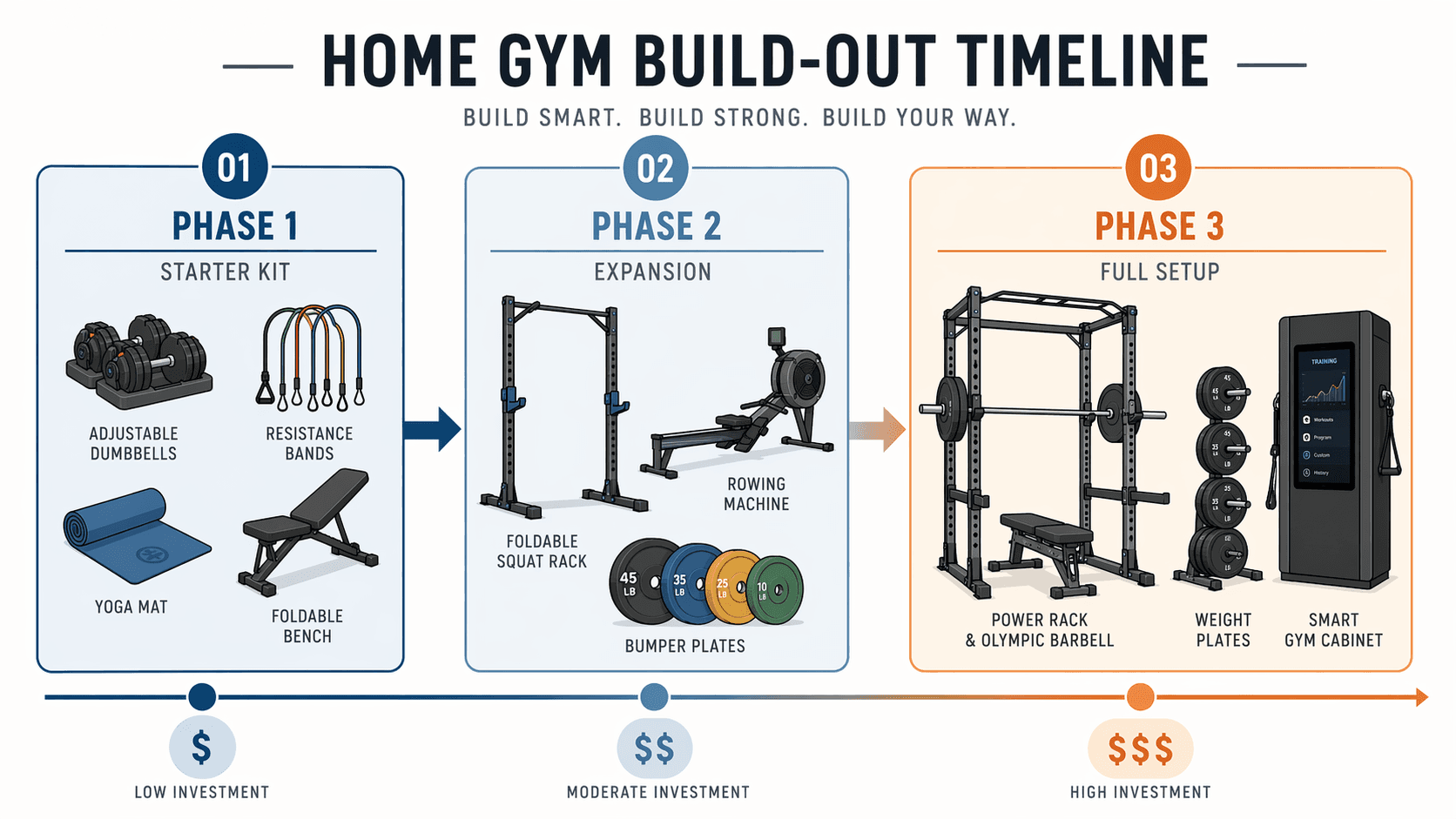
Few people buy a complete home gym in one go. A phased approach reduces upfront cost and lets you learn what you actually need before committing to the big pieces. Here is a progression that works:
- Starter kit: resistance bands ($128.94 for a full set), a quality mat, and adjustable dumbbells ($335.99 for 30‑lb pair). Total under $500. Full‑body workouts with just these.
- Expansion: add an adjustable bench ($499 for the Ironmaster Super Bench Pro V2) and, if you have the space, a folding rack ($1,099.99 PRx). Opens bench press, rows, rack pulls.
- Full setup: add an Olympic barbell, bumper plates, and a cardio machine of your choice. Now you have a complete gym built incrementally, matching your growing experience and budget.
This approach also defers the expensive decision—smart gym or traditional—until you have a clearer sense of your training style and space tolerance. The Home Gym System Buyer's Guide helps with that final choice once you are ready to upgrade.
Red Flags
Even a well‑matched setup can fail if you miss these common pitfalls.
- Ignoring operating footprint: The Tonal 2 is 5.25" deep on the wall, but the manufacturer recommends 7'×7' of clear space to use it safely. Measure the room you have, not just the product depth.
- Underestimating subscription costs: A $4,295 Tonal with five years of $59.95/mo totals $7,892. A $3,199 Speediance with no subscription is $3,199. Always run the 5‑year total before comparing price tags.
- Warranty gaps: The Bowflex Xtreme 2 SE has a 7‑year machine warranty but only 5‑year rods. The Beyond Power Voltra I has a 1‑year warranty. Budget equipment with short warranties may cost more in the long run if something fails.
- Buying more than you can use: A beginner does not need a 1,000‑lb power rack. Simpler, cheaper gear produces better results early on because you can actually do the exercises correctly.
Cost: Home Gym vs. Membership
A quick reference: the average gym membership in the U.S. runs about $65 per month (2024 U.S. Health & Fitness Consumer Report). A $1,500 home gym setup breaks even in roughly 23 months—assuming you would have paid that membership. This is a rough estimate: it ignores resale value, maintenance, and the fact that memberships can go unused. Treat it as a directional reference, not a precise TCO analysis.
For a detailed, multi‑year cost breakdown between a smart gym system, traditional equipment, and a commercial membership, see the Smart Home Gym Total Cost of Ownership: 5‑Year Breakdown vs. Gym Membership vs. Traditional Equipment. This article stays focused on the decision matrix.
The next time you see a “best home exercise equipment” roundup, ask yourself: What is my budget? How much floor space do I actually have? What do I want to achieve? How experienced am I? Then ignore the list and apply the matrix.
Generic recommendations are misleading. A decision based on your personal constraints is the only one that will hold up after the return window closes.
Comments
Join the discussion with an anonymous comment.