
You already know you want a home gym — the question is which kind
The question is not whether to buy one. It is which kind — and most people skip the architecture decision and go straight to brand comparisons. They ask "Should I get a Bowflex or a Tonal?" before they have asked themselves whether they belong in the all-in-one camp, the power-rack camp, or the smart-gym camp. That order costs money.
I have assembled enough machines to know that the category you pick determines far more about long-term cost, space use, and training experience than any brand-level spec sheet. An all-in-one machine and a smart gym both occupy roughly the same floor area, but one will quietly bill you sixty dollars a month for the life of the ownership while the other will not. A power rack starts at $1,099, but the buyer who thinks they are done at that number has never priced barbell, plates, bench, and flooring.
That $1,855 average hides a $3,000 spread
According to Garage Gym Reviews, the average price across all tested home gym machines is $1,855. That figure looks neat until you pull it apart. The low end is a Bells of Steel all-in-one at $1,299. The high end is the Major Fitness Heritage Series B17 Flying Fortress at $4,199. A single average hides a spread of nearly $3,000, and the spread matters because the machines at the two ends serve different buyers.
The all-in-one category itself has a wide range, but the bigger gap is between categories. A PRx Profile PRO folding rack lists at $1,099. A Tonal 2 lists at $4,295. A Speediance Gym Monster lists at $3,199. These are not versions of the same product; they are three distinct architectures with different resistance types, different subscription requirements, and drastically different total-cost-of-ownership curves.
The sticker price is just the beginning
Every category has costs that do not appear on the manufacturer's page. HomeGuide puts flooring at $400–$3,400, delivery at $100–$300, and assembly at $75–$300 per piece. An all-in-one machine that costs $1,499 on paper can easily require $200 in shipping and $200 in assembly before you touch the first handle. A power rack needs the same flooring and delivery, plus a barbell ($200–$500), weight plates ($300–$800), a bench ($150–$400), and usually a mat or platform. The PRx rack at $1,099 becomes a realistic $2,000–$2,500 before you can do a squat.
| Cost item | All-in-one (Bowflex Xtreme 2 SE) | Power rack (PRx PRO + build-out) | Smart gym (Tonal 2) | Smart gym (Speediance) |
|---|---|---|---|---|
| Equipment | $1,499 | $1,099 + $1,000 (bar, plates, bench, flooring) | $4,295 | $3,199 |
| Subscription (5 yr) | $0 | $0 | $3,597 ($59.95×60) | $0 |
| Delivery + assembly | $200–$500 | $200–$500 | $200–$500 | $200–$500 |
| Flooring | $400–$3,400 | $400–$3,400 | $400–$3,400 | $400–$3,400 |
| Realistic 5-year total | ~$2,100–$5,400 | ~$2,700–$5,000 | ~$8,500–$12,000 | ~$3,800–$7,100 |
Then there is the subscription factor. Smart gyms are the obvious offenders: Tonal requires $59.95/month, Peloton's All-Access membership runs $49.99/month. Over five years, a Tonal 2 costs $4,295 plus ($59.95 × 60) = $7,892 total. The Speediance Gym Monster, at $3,199 with no subscription, looks cheap by comparison — but it lacks the guided programming and AI-based coaching that makes the subscription feel valuable in the first place. You are not just comparing $0 vs $60/month; you are comparing a manual experience with a coached one.
The conventional breakeven math also deserves scrutiny. Gray Matter Lifting calculates a $3,243 new home gym (Rogue rack, bench, bar, plates, flooring) breaks even against a $50/month membership in about two years. That analysis uses $50/month; the average gym membership today is closer to $65/month. If you plug in $65/month, the breakeven shortens to roughly 1.5 years. But neither number accounts for equipment replacement, maintenance, or the fact that a $50/month membership usually includes classes and equipment variety that a single home gym cannot replicate. I would not treat the two-year figure as a guarantee — it is a directional heuristic.
How each category feels to train on
Cost is only one axis. The experience of lifting on an all-in-one machine, a power rack, and a smart gym is fundamentally different, and that difference matters more than a few hundred dollars over five years.
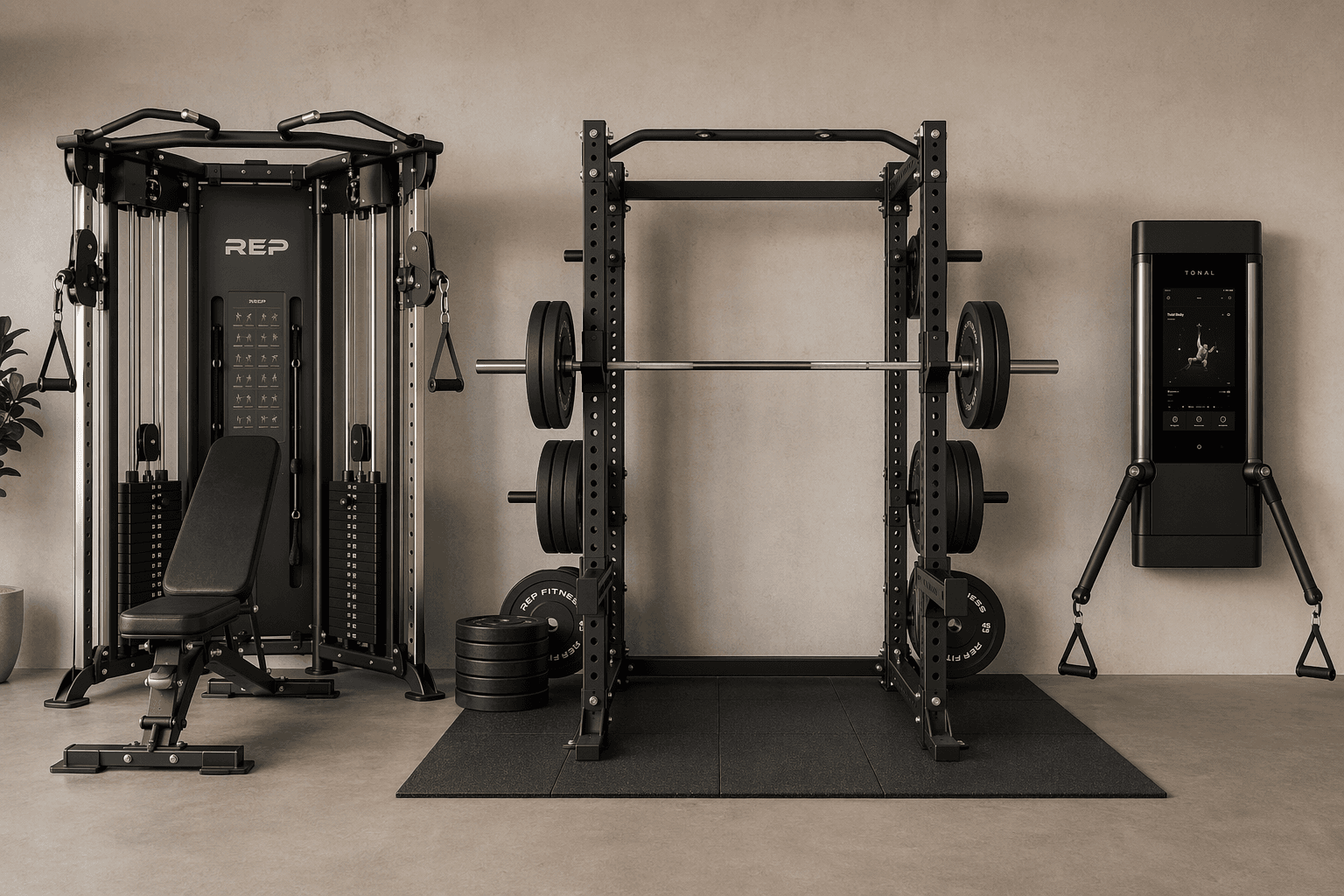
- All-in-one machines use cables and weight stacks. The resistance is smooth, the changes are fast, and you can go from a chest press to a lat pulldown without leaving the bench. But max resistance is limited: the Bowflex Xtreme 2 SE starts at 210 lbs (upgradable to 410 lbs), and the Major Fitness B17 has dual stacks expandable to 260 lbs each. If you are an experienced lifter who squats or deadlifts over 315 lbs, these machines will not satisfy you.
- Power racks with free weights offer unlimited progressive overload. The PRx PRO has a 1,000-lb rack capacity — the limit is not the rack, it is the plates you buy. But you have to know what to do. No guided programming, no automatic adjustments. You load the bar, you do the lift, you record the reps. For someone who loves the raw feel of iron, it is perfect. For someone who wants a trainer in the room, it is not.
- Smart gyms use digital resistance. Tonal 2 goes up to 250 lbs, Speediance to 220 lbs. The weight is smooth, the eccentric mode can be harder than the concentric, and the AI tracks every rep. But 250 lbs is a hard ceiling. A strong male lifter may outgrow it within a year. The subscription provides the coaching, the variety, and the engagement — without it, the machine is a digital stack with a screen.
The market data reinforces the appeal of connected equipment: Speediance reports that 63% of users prefer smart connected devices and 48% use AI-based tracking. That does not mean smart gyms are better — it means the desire for guided, tech-driven workouts is real. If you are in the 37%, a power rack or all-in-one may be a better fit.
The decision matrix
Here is the comparison that matters. Read the columns that reflect your situation.
| Dimension | All-in-one (cable/weight stack) | Power rack + free weights | Smart gym (digital resistance) |
|---|---|---|---|
| Price range (equipment only) | $1,000 – $5,000 | $700 – $1,500 (rack); build-out $2,000 – $2,500 | $3,000 – $4,300 |
| Subscription | None | None | $40 – $60 / month |
| Floor footprint | 30 – 60″ wide, ~40 – 80 sq ft | 48 – 60″ wide, ~60 – 100 sq ft | Wall-mounted, ~5″ depth |
| Max resistance | 210 – 410 lbs (upgradable) | Unlimited (plates) | 220 – 250 lbs |
| Best training style | General strength, cable work | Heavy compounds: squat, bench, deadlift | Guided / AI-coached, variety |
| Long-term cost | Moderate – no subscription, but may need upgrades | Low after build-out – replacement plates rarely needed | High – subscription can double the total over 5 years |
| Resale value | Moderate – depreciates | High – free weights hold value | Low – technology becomes outdated |
I want to underline the subscription row again. The difference between a $0 subscription and a $60 subscription compounds. Over five years, it can mean the difference between spending $3,000 and $7,000 for the same physical device. If you are not certain you will use the guided programming, avoid the subscription trap. If you know you will, the cost per month is reasonable compared to a personal trainer.
Three questions that will point you to your category
Enough analysis. Here is how to apply it.
- What is your primary training goal? If it is heavy compound lifts (squat, bench, deadlift) and you want to get stronger over years, you belong in the power rack category. If it is general fitness, variety, and cable work, all-in-one is a strong choice. If you value guided programming and do not plan to lift over 200 lbs, smart gym is worth the subscription.
- What is your hard budget? Under $2,000 total (including hidden costs) points toward a power rack or a used all-in-one. At $3,000–$4,500 you can afford a new all-in-one or a smart gym. Over $5,000 you can consider any category, but the cost-conscious choice is still the rack.
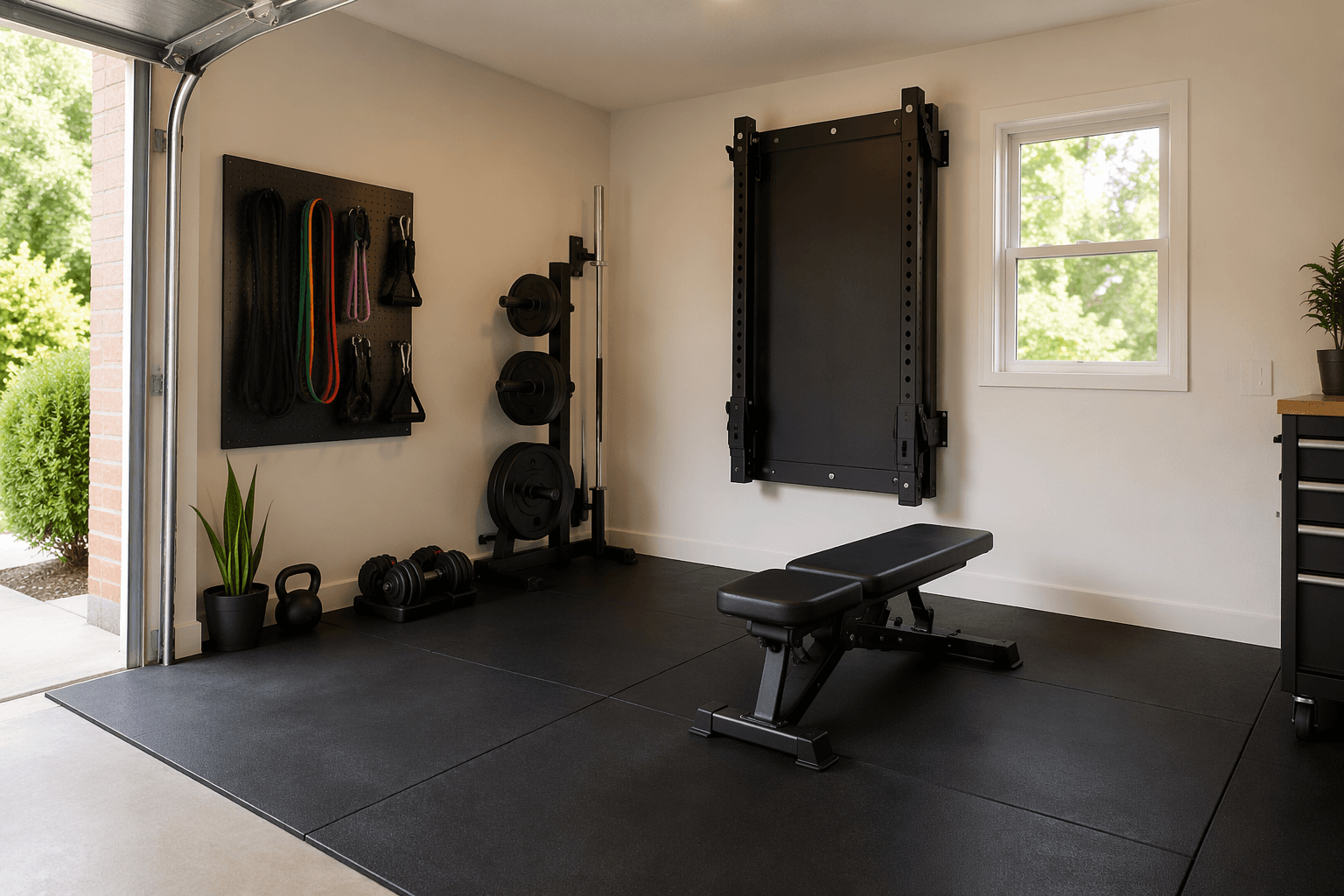
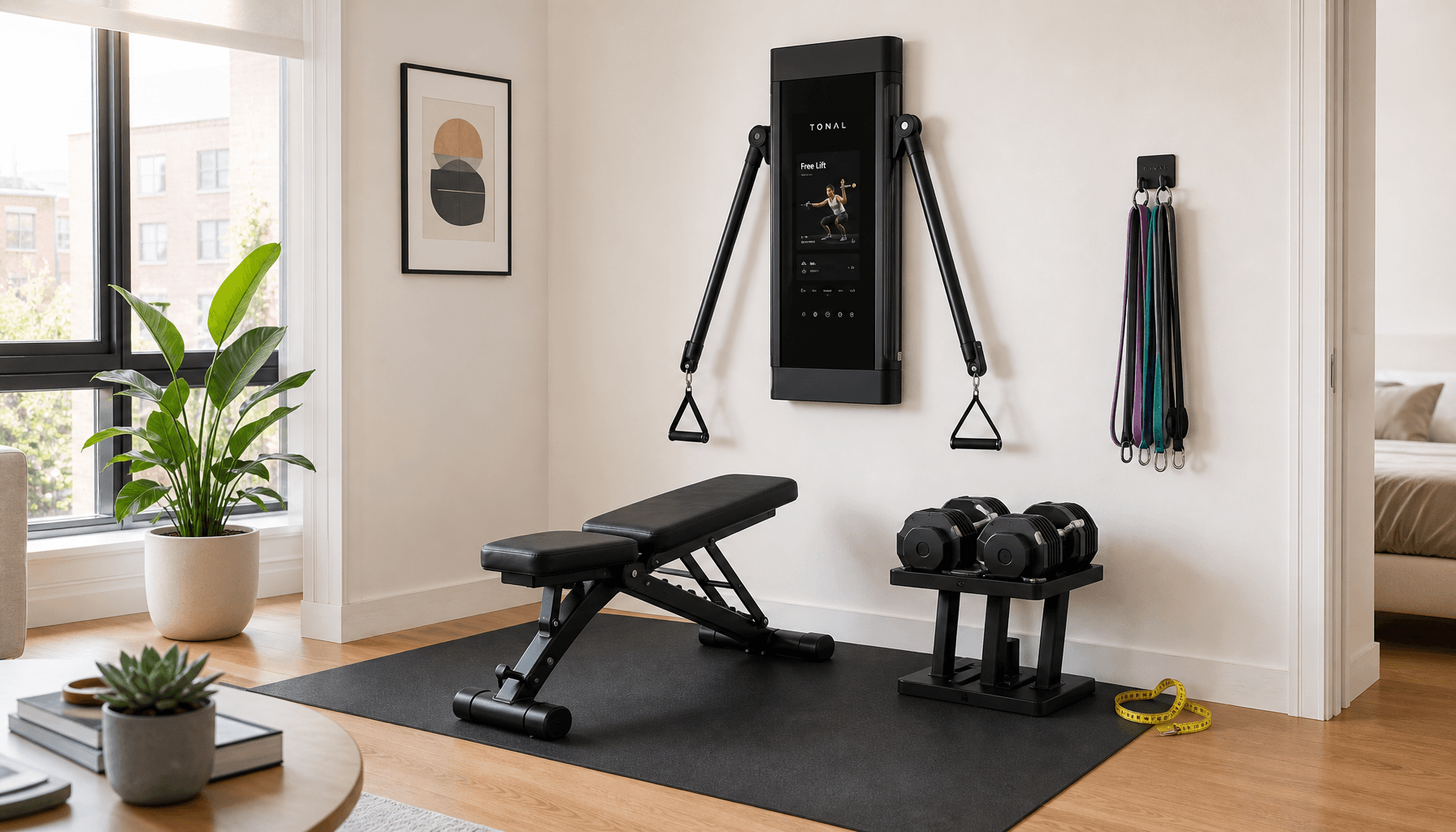
- How much space do you have, and can you wall-mount? A power rack needs a dedicated 6′ × 6′ area with overhead clearance. An all-in-one fits in a similar footprint but often cannot be folded away. A smart gym like Tonal or Speediance needs only a wall stud and about 5″ of depth — ideal for apartments or shared rooms.
If you want a deeper walkthrough of the trade-offs between an all-in-one machine and buying separate components, read our All-in-One Home Gym vs. Separate Components comparison. It covers the cost, footprint, and training tradeoffs in more detail.
Common questions that trip up category decisions
Can I build a power rack setup gradually?
Yes. Many people start with the rack, bar, and a set of plates, then add a bench, a second bar, or a cable attachment over time. The main risk is that the initial cost of the rack alone ($1,099 for the PRx) looks cheap, but you will spend another $1,000+ before you have a usable gym. Plan for the full build-out, not just the rack.
Is a no-subscription smart gym worth it?
The Speediance Gym Monster has no monthly fee, but it also lacks the guided coaching and AI features that make smart gyms engaging. You get a digital weight stack with an app for tracking. If you do not need a trainer and simply want the clean, compact form factor, it is competitive with an all-in-one machine. If you want the coaching, the subscription is what buys it.
Which category holds resale value best?
Free weights (bars, plates) retain the most value — they rarely break, and the market is always there. Power racks also hold value reasonably well. All-in-one machines depreciate faster because of moving parts and proprietary cables. Smart gyms depreciate the fastest; once new technology arrives, last year's model loses appeal. If resale matters, choose the rack.
Do I need professional assembly?
All-in-one machines often require two people and a few hours to assemble; many buyers pay $150–$300 for assembly. Power racks are usually DIY-friendly if you have basic tools. Smart gyms like Tonal require wall-mounting into studs — you can DIY if you are handy, but many buyers hire a handyman. Budget for assembly if you are not confident in your ability to lift heavy parts and align bolts.
Now you know your category
Once you have settled on all-in-one, power rack, or smart gym, the real brand research can begin. For a deeper dive into how the subscription costs of smart gyms can double your bill, read The Hidden Cost of Smart Home Gyms. If you are still unsure which training style fits you best, our Home Gym Decision Guide will help. And if you are considering a compact setup for a small space, Modular vs. All-in-One vs. Smart Gym: Which Compact Home Gym Approach Is Right for You? covers the space-specific tradeoffs this guide does not.
The right home gym system is the one that matches your training style, your space, and your tolerance for recurring payments. There is no universal best — only the best for you.

Comments
Join the discussion with an anonymous comment.