
All-in-One Home Gym vs. Separate Components: Cost, Footprint, and Training Tradeoffs
Considering whether to buy an all-in-one home gym or piece together separate equipment? This comparison breaks down the real cost, footprint, and training tradeoffs using tested models, so you can decide which setup fits your space, budget, and lifting goals.
The Assumption I Started With
You figure you can pick the best rack, the smoothest cable machine, a bench that actually fits your frame, and upgrade each piece later. Separate components feel like the honest, adult choice. An all-in-one machine sounds like a compromise: one box to do everything, probably doing none of it well. That is the default judgment I carried into this, and I suspect you carry it too.
Then I Did the Math
Then I looked at the actual prices and footprints, and the assumption started to fray.
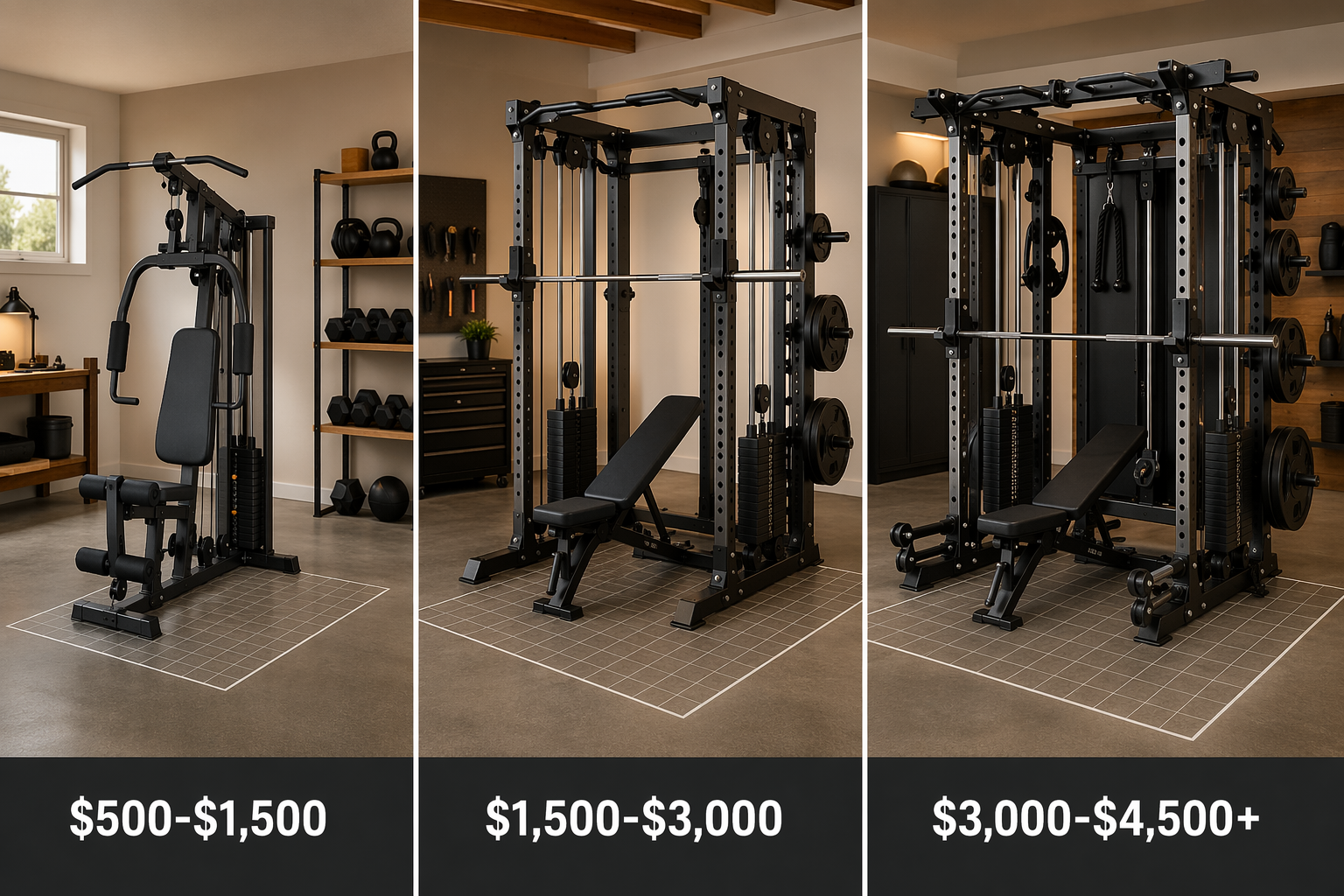
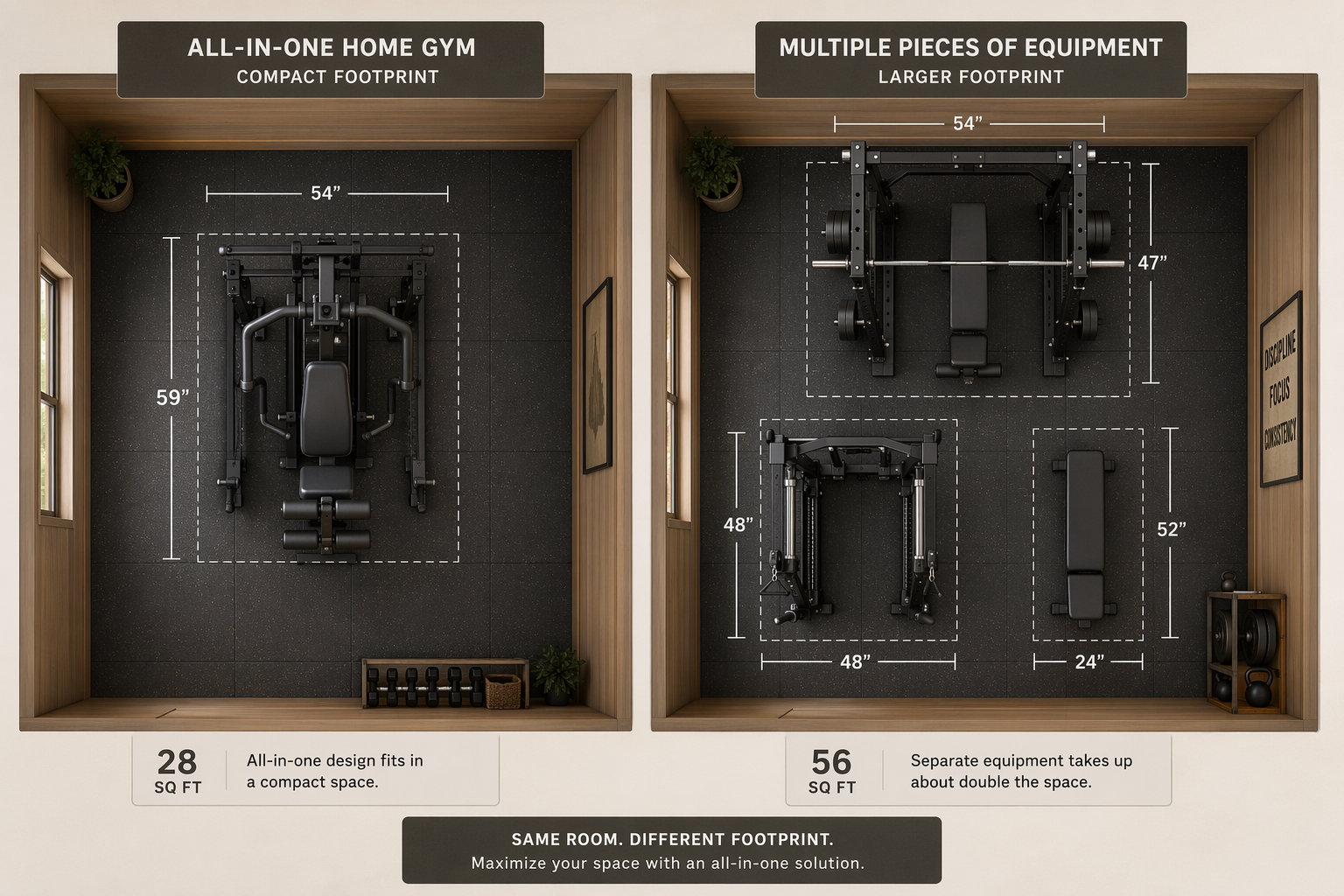
Take the Bells of Steel All-in-One Home Gym. The plate-loaded version starts at $1,299.99; the weight stack version runs about $1,900. Its footprint is 54.6 inches deep by 59 inches wide by 81 inches high. Now compare that to buying a standalone power rack like the REP PR-4000 (around $700) plus a standalone functional trainer like the Titan Fitness Functional Trainer ($2,999). The Titan alone is 44" D x 64" W x 82" H. Stack the rack and trainer side by side and you are looking at roughly double the floor area and a combined cost north of $3,700 — before you add a bench.
RitFit's own analysis says a well-built all-in-one replaces a power rack, Smith machine, functional trainer, and cable station in under 20 square feet, and that buying those machines separately usually costs more and takes more floor space. That is a manufacturer's claim, not an independent audit, but it matches what the GGR numbers show.
So the first counterintuitive finding stands: an all-in-one can genuinely cost less and take less floor space than an equivalent set of separate components. If that were the whole story, the decision would be easy. It is not the whole story.
The One Detail That Changes Everything
Here is where my skepticism kicked in. The Bells of Steel unit uses proprietary 2.3" x 2.3" uprights. That means you cannot attach standard 3" x 3" accessories from Rogue, REP, or Titan. No monolifts, no strap safeties, no dip bars from the aftermarket. If you want to upgrade your safeties or add a landmine attachment later, you are limited to whatever Bells of Steel offers — if they offer it at all.
A standard 3" x 3" rack accepts accessories from REP, Rogue, Titan, and a dozen smaller brands. You can swap safeties, add a dip attachment, mount a landmine, or convert to a cable system later. That flexibility has a value, and it is not reflected in the comparison above.
Cable Smoothness Isn't One Number
GGR rates the Bells of Steel All-in-One 4.2 out of 5 for cable smoothness. The Titan Functional Trainer gets 4.1. The REP Ares 2.0 gets 4.5. Those numbers are useful, but they need context. "Smoothness" is not one thing. It is pulley bearing quality, cable routing geometry, resistance curve linearity, and noise. A short, direct cable path — like the one on the Bells of Steel — can feel fine for lat pulldowns and rows. For flyes and triceps pushdowns where you want a constant, quiet glide, a standalone trainer with larger pulleys and a longer cable run usually feels better.
The difference between 4.1 and 4.5 is not a gulf. But if you intend to do a lot of cable work, the REP Ares will feel noticeably better than the Bells of Steel over time. I would not let a 0.3-point gap drive the decision alone, but I would let the mechanism behind it matter.
The Third Path: Attach an All-in-One to a Standard Rack
The simple binary — all-in-one vs. separate — does not capture the whole market. The REP Ares 2.0 is an all-in-one that attaches to a standard rack. It costs $2,999 and gives you dual 260-lb weight stacks (expandable to 310) with GGR's highest smoothness rating. But you need to own the rack. If you already have a REP PR-4000 or PR-5000, the Ares turns it into a setup that rivals standalone cable towers. If you do not, you are paying for both the rack and the Ares, which pushes the total well above the Bells of Steel.
This path costs more upfront, but you keep standard 3" x 3" uprights. You retain full access to third-party attachments. You can sell the rack separately later, or move the Ares to a different rack. That flexibility is the opposite of the proprietary trap.
Which One Belongs in Your Room
The decision comes down to how you answer three questions: How much floor space do you have? How committed are you to future upgrades? How much cable work do you plan to do?
| User profile | Recommendation | Rationale |
|---|---|---|
| Budget-conscious, limited space | Bells of Steel weight-stack version | Lowest total cost, smallest footprint, good enough cable feel for general training. Accept the proprietary uprights as a future constraint you may never hit. |
| Space-limited, wants future upgrade path | REP Ares on a PR-4000 | Keeps standard uprights, allows attachment expansion later. Higher upfront cost but preserves flexibility. |
| Committed lifter planning long-term use | Separate rack + standalone functional trainer (e.g., REP PR-4000 + Titan Functional Trainer) | Maximum cable smoothness, full attachment ecosystem, upgradable piece by piece. Higher total cost and larger footprint, but the investment pays back over years. |
| Apartment dweller, strict footprint limit | Bells of Steel (plate-loaded) or similar compact all-in-one | Smallest possible setup. See the apartment dweller setup guide for noise and flooring details. |
If you fall into the first row, do not let my worry about proprietary uprights scare you off. The Bells of Steel is a legitimately good machine at a fair price. But if you already know you will want to add a dip bar or upgrade to strap safeties in two years, skip it.
For readers still unsure where to start, the beginner's budget guide offers a phased approach, and the garage gym blueprint walks through space planning for any equipment choice.
The Hard Conclusion
An all-in-one machine can be a smart choice for the buyer with tight space or a strict budget. The numbers prove it: lower cost, smaller footprint, fewer purchase decisions. But the tradeoffs are real. The proprietary uprights on a machine like the Bells of Steel are not a marketing footnote; they are a long-term constraint. The cable feel on a standalone trainer is genuinely better for dedicated cable work.
If you are the kind of person who buys a tool and keeps it for a decade, the extra cost of a modular setup — a standard rack plus a standalone functional trainer, or the REP Ares hybrid — is worth it. You preserve the ability to upgrade, repair, and resell. That is the kind of long-term value no spec table captures.
For a deeper look at whether building a home gym at all makes financial sense, see the home gym vs. gym membership cost comparison. And for those already committed to an all-in-one, the full buyer's guide on our site covers the full range of models.
This result comes from one real apartment under the stated conditions — it is a strong signal, not a guarantee your space will measure identically.
Builds this evidence supports
Cable Machine Alternatives That Save Space and Money
Compare the best cable machine alternatives for home gyms – from resistance bands and pulley systems to suspension trainers and compact digital units – and find the right option for your space and budget.
How to Choose a Compact Home Gym That Works for Your Space, Budget, and Noise Tolerance
This article provides a structured decision framework for apartment dwellers and small-space residents to match their specific floor footprint, noise sensitivity, and budget to the most suitable compact home gym strategy — whether that's an all-in-one machine, modular build, smart digital system, or band/bodyweight setup.
The Garage Gym Reality Check: What Equipment Actually Fits in a Single-Car Garage
Most garage gym guides assume a two-car space. This article uses real dimensions, real equipment footprints, and three layout templates to show what fits—and what doesn't—in a single-car garage (10x20 to 12x20 ft).
Spot something off?
If this result didn't match your own space, let us know — floor-damage and noise claims carry real deposit-risk consequences if we get them wrong.