
The Core Question: Can Cables Replace Free Weights for Muscle Growth?
Walk into any home gym setup discussion and you'll hear the same tension: free weights are the gold standard for building muscle, but cable machines are safer, more versatile, and easier on aging joints. If you're a beginner who finds a barbell intimidating, an intermediate lifter nursing a cranky shoulder, or someone trying to fit a full strength setup into a spare bedroom, the question isn't academic — it's practical. Can you park the dumbbells and build real muscle with just a cable machine?
The short answer, backed by a growing body of research, is yes — but with an important nuance. Cables and free weights can produce equivalent muscle growth, but they create different training stimuli. Understanding those differences is the key to making the right choice for your goals, your joints, and your floor plan.
What the Research Actually Says: The 2023 Meta-Analysis on Free Weights vs. Machines
The most definitive answer to the cables-versus-free-weights debate comes from a 2023 systematic review and meta-analysis published in BMC Sports Science & Medicine Rehabilitation. Haugen and colleagues pooled data from 18 studies comparing free-weight and machine-based resistance training. Their headline finding: there was little to no difference in muscle hypertrophy between the two modalities.
This is not a small or niche result. The 18 studies covered a range of populations, training histories, and exercise protocols. Across the board, when total training volume was matched, muscles grew at similar rates whether the resistance came from a barbell, a dumbbell, or a stack of plates on a cable pulley.
Why Cables Can Build Muscle: Constant Tension, Time Under Tension, and Safer Range of Motion
If the meta-analysis tells us that cables work, the mechanistic studies explain why. Three specific advantages make cable machines uniquely suited for muscle growth.
Constant Tension Through the Full Range of Motion
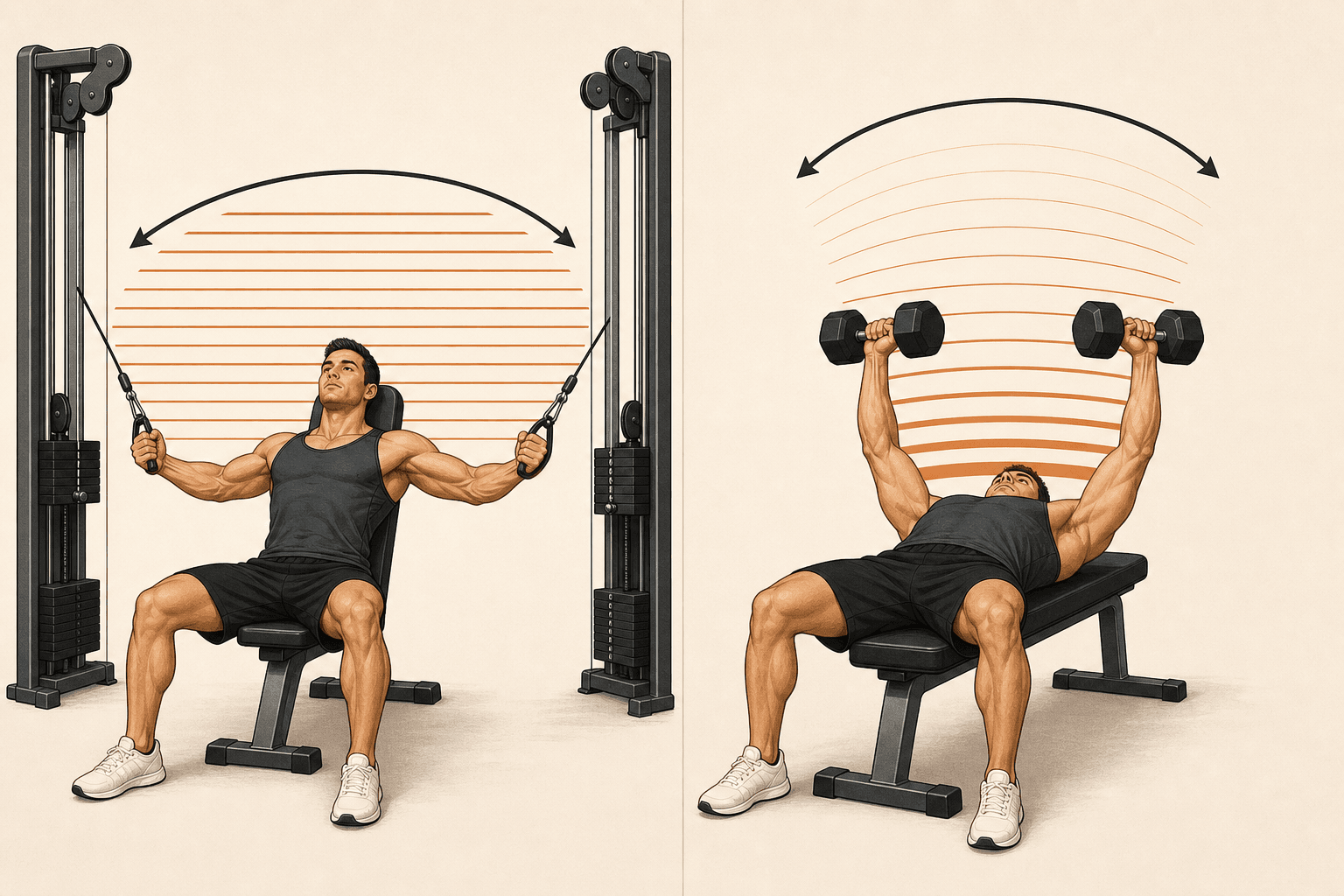
Free weights are hardest at their midpoint and easiest at the top and bottom of a movement. A dumbbell press, for example, offers peak resistance when your arms are perpendicular to the floor, but nearly zero resistance at the top of the rep when the weights are stacked over your chest. Cables, by contrast, pull at a consistent angle throughout the entire arc of the movement. The muscle is under tension from the first inch of the rep to the last.
This matters because time under tension is a primary driver of hypertrophy. A 2012 study by Burd et al. in The Journal of Physiology demonstrated this directly: when subjects performed a leg press with a slow, 6-second eccentric phase, muscle protein synthesis remained elevated for up to 24 hours post-workout. Cable machines naturally encourage this kind of controlled, tension-heavy movement because the resistance doesn't disappear at any point in the rep.
Better Joint Angles and Greater Range of Motion
A 2017 study in the Journal of Strength and Conditioning Research by Signorile et al. compared muscle activation and kinematics between cable-based exercises and traditional selectorized machines. The researchers found that cable-based movements allowed for better starting and ending joint angles and a greater overall range of motion. This is because cables don't lock you into a fixed movement path — you can adjust your stance, angle, and hand position to find the groove that works best for your anatomy.
For home gym users, this flexibility is a major practical advantage. A single cable station can replace a dozen selectorized machines, and it can do so while offering a more natural, joint-friendly movement pattern.
Measurably Safer for Joints and Beginners
Safety is often cited as a reason to choose cables, and the data backs it up. A 2010 study by Kerr et al. on weight-training injuries found that most free-weight injuries involved dropped weights — not the exercise itself. Cables eliminate that risk entirely. The weight stack is guided, the cables absorb shock, and there's no barbell to bail out of on a failed rep.
For beginners, this means they can push closer to failure without fear. For intermediate lifters with joint concerns, it means they can train heavy isolation work — like cable lateral raises or tricep pushdowns — without the grinding discomfort that often accompanies free-weight equivalents.
Where Free Weights Still Have the Edge: Neural Activation, Stabilizers, and Functional Transfer
Acknowledging the strengths of cables doesn't mean dismissing free weights. For certain training outcomes, free weights remain superior — and understanding why helps you decide when to use each tool.
- Greater neural activation. Free weights require your nervous system to stabilize the load in three dimensions. A barbell squat, for instance, demands coordination from your core, spinal erectors, and hip stabilizers just to keep the bar balanced. This neural demand drives strength gains that transfer broadly across movements.
- Stabilizer muscle recruitment. Because free weights are unstable, smaller stabilizer muscles must work throughout each rep. Cables, with their guided path, largely bypass these muscles. Over time, exclusive cable training can lead to underdeveloped stabilizers, which may increase injury risk when you do pick up a barbell.
- Functional transfer to sports and daily life. Free-weight movements like deadlifts, cleans, and overhead presses more closely mimic the force production patterns required in athletics and real-world lifting. If your goal is performance — not just appearance — free weights have a clear edge.
- Higher peak force production. For maximal strength and power, free weights allow you to load the bar to near-maximal levels in a way that most cable stacks cannot match. A powerlifting bar has a 1,500-pound capacity; most home cable stacks top out at 150–250 pounds.
Cables vs. Free Weights: A Side-by-Side Comparison for Home Gym Decisions
The table below summarizes the key differences across the dimensions that matter most to home gym owners. Use it to match your priorities to the right modality.
| Dimension | Cable Machines | Free Weights |
|---|---|---|
| Hypertrophy potential | Equivalent to free weights per 2023 meta-analysis (18 studies) | Equivalent to cables per same meta-analysis |
| Maximal strength gains | Good, but limited by stack weight (typically 150–250 lbs) | Superior — allows near-maximal loading and neural adaptation |
| Joint safety | Better — guided motion, no dropped weights, lower impact on joints | Higher risk — dropped weights account for most free-weight injuries (Kerr et al. 2010) |
| Stabilizer recruitment | Minimal — cables guide the movement path | High — requires three-dimensional stabilization |
| Range of motion | Better — allows adjustable joint angles and greater ROM (Signorile et al. 2017) | Good, but fixed by gravity and bar path |
| Space requirements | Compact options exist (wall-mounted: ~5" deep, functional trainers: ~44" deep) | Barbell + rack requires ~8 ft x 8 ft minimum; dumbbells less |
| Learning curve | Low — guided motion reduces form errors | Moderate to high — requires coaching for compound lifts |
| Cost | Average $2,265 (GGR testing of 30+ machines); budget options under $500 | Dumbbells: $200–$800; barbell + plates + rack: $500–$2,000+ |
Practical Conclusion: How to Combine Both Modalities for Optimal Results
The evidence is clear: you can build muscle with just a cable machine. But for most lifters, the best approach is to use both. Cables excel at isolation work, constant-tension exercises, and unilateral training to fix muscle imbalances. Free weights excel at compound movements that build foundational strength and neural coordination.
Here's a sample weekly split that integrates both modalities. It follows the loading recommendations from Schoenfeld et al. (2021): 8–12 reps per set for hypertrophy, 60–90 seconds rest between sets.
| Day | Focus | Free-Weight Exercises | Cable Exercises |
|---|---|---|---|
| Monday | Push (chest, shoulders, triceps) | Barbell bench press 4x8, Overhead press 3x10 | Cable chest fly 3x12, Tricep pushdown 3x12 |
| Tuesday | Pull (back, biceps) | Barbell row 4x8, Pull-ups 3xAMRAP | Lat pulldown 3x10, Cable bicep curl 3x12 |
| Wednesday | Rest or active recovery | — | — |
| Thursday | Legs | Barbell squat 4x8, Romanian deadlift 3x10 | Cable hamstring curl 3x12, Glute kickback 3x12 |
| Friday | Full-body accessories + unilateral | Dumbbell lunges 3x10/leg, Dumbbell rows 3x10/arm | Cable woodchopper 3x10/side, Pallof press 3x10/side |
| Saturday | Conditioning or light pump | — | Full-body cable circuit: 3 rounds, 12 reps each, 30s rest |
| Sunday | Rest | — | — |
If you don't have free weights at all, you can still run an effective hypertrophy program using only cables. The key is to prioritize exercises that hit each major muscle group from multiple angles — high pulley, mid pulley, and low pulley — and to push each set close to failure within the 8–15 rep range. For a practical example of programming with a home gym cable stack, see our full-body workout plans for the Marcy 150lb stack home gym.
Frequently Asked Questions About Cable-Only Training
- Can you get strong with just cables? Yes, up to the limit of the weight stack. For most home cable machines (150–250 lbs), you can build significant strength for upper-body and moderate lower-body exercises. For maximal lower-body strength, free-weight squats and deadlifts remain superior because they allow much heavier loading.
- Are cables better for beginners? Generally, yes. Cables guide the movement path, reduce injury risk, and allow beginners to focus on feeling the target muscle work rather than worrying about balance or form. The EōS Fitness beginner's guide recommends starting with 2–3 sets of 10–15 reps on cable exercises, training full-body 2–3 times per week.
- Do cables build functional strength? They build strength that transfers to many real-world movements, especially pulling and rotational patterns. However, free weights are generally considered superior for functional transfer because they require three-dimensional stabilization that mimics real-world force production.
- How much weight do you need on a cable stack for hypertrophy? For most upper-body exercises, a 150 lb stack is sufficient for the majority of lifters to reach failure within the 8–15 rep range. For lower-body exercises like squats or deadlifts performed on a cable, 200+ lbs may be needed. If you're consistently maxing out the stack on isolation exercises, you can add resistance bands or switch to single-arm variations to increase the challenge.
- Can cables replace all free-weight exercises? For hypertrophy, yes — the research shows equivalent muscle growth. For maximal strength and power, no — free weights have an edge in neural recruitment and allow heavier loading. The optimal home gym includes both.
Comments
Join the discussion with an anonymous comment.