
Home Gym Decision Guide: Which Type of Gym Machine Actually Fits Your Training Style?
Overwhelmed by all-in-one machines, power racks, functional trainers, and smart gyms? This decision guide maps your primary lifting goal to the right equipment category, so you don't waste money on a system that doesn't match how you actually train.
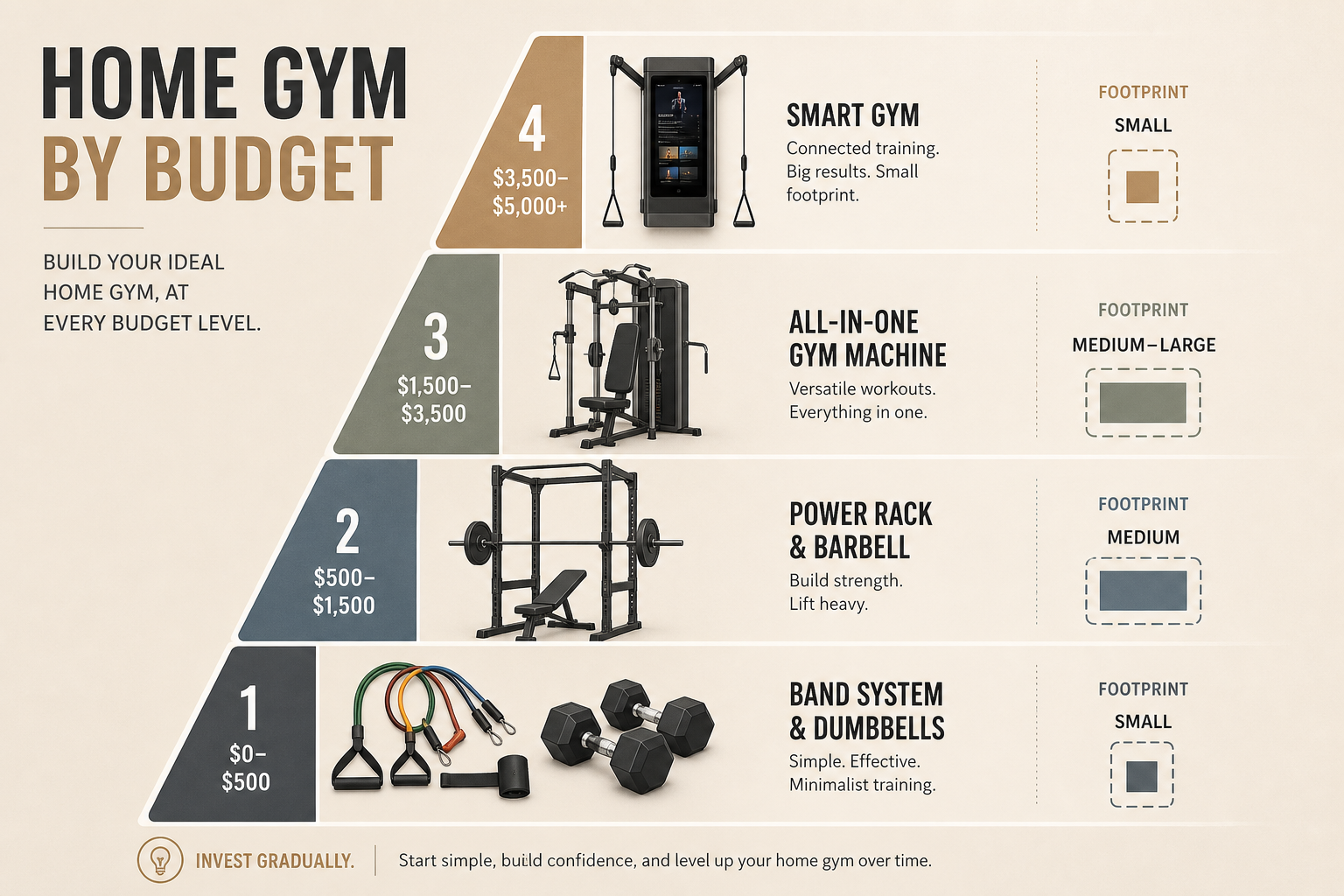
Why Choosing the Wrong Home Gym Category Wastes Your Money
The home gym market in 2026 is more fragmented than ever. Walk into any equipment showroom or scroll through a single search results page, and you will encounter five fundamentally different machine categories: all-in-one systems, power racks with a barbell, functional trainers, smart gyms with digital resistance, and band-based portable rigs. Each category was engineered for a different training philosophy. Each one demands a different budget, a different floor footprint, and a different long-term commitment to subscriptions or plate loading.
The problem is that most buyers pick a machine based on price, brand recognition, or a single feature like "it folds flat." They do not ask the only question that matters: What do I actually want to train for? A power rack is a terrible choice for someone who wants to do cable flyes and lat pulldowns. A functional trainer is a frustrating tool for a powerlifter who needs to squat 400 pounds. A smart gym with 250 pounds of digital resistance will leave an advanced strength athlete stalled within months. These mismatches are not equipment failures — they are category failures.
This guide does not rank machines. It does not start with a budget tier or a space constraint. It starts with your training ambition. By the end of the decision tree below, you will know which equipment category matches how you actually train — not how a marketing page says you should train.
The Five Home Gym Categories in 2026: A Quick Orientation
Before the decision tree makes sense, you need a clear picture of what each category actually is. These are not brand-specific reviews — they are category definitions with representative examples so you can recognize the type when you see it.
| Category | Representative Example | Primary Strength | Footprint | Max Resistance | Cost Range |
|---|---|---|---|---|---|
| All-in-One Machine | Major Fitness B17 Flying Fortress | Most exercise variety per square foot; multiple stations in one frame | 37+ sq ft (68" D x 79" W) | Dual weight stacks, expandable to 260 lbs each | $1,300 – $4,200 |
| Power Rack + Barbell | REP PR-1100 / Titan T-3 | Best for compound lifts (squat, bench, deadlift); highest weight capacity | ~15–25 sq ft (rack only) | 700–1,000+ lbs (rack capacity) | $380 – $1,100 (rack alone) |
| Functional Trainer | REP Ares 2.0 | Excellent for cable isolation work, pulley exercises, and unilateral training | ~20–30 sq ft | Dual 260-lb stacks (2:1 pulley ratio halves working weight) | $2,000 – $3,000 |
| Smart Gym (Digital Resistance) | Tonal 2 | Smallest footprint; AI coaching and digital weight adjustment; no plates needed | Wall-mounted, 5.25" deep | 250 lbs total (125 lbs per arm) | $3,545 – $4,295 + $59.95/month |
| Band / Portable System | X3 Bar + Living.Fit bands | Fits in a closet; under $600; no assembly | Negligible (stored in bag) | Up to 300 lbs (band resistance) | $129 – $549 |
A few important details on each category:
- All-in-one machines like the Major Fitness B17 and the Bells of Steel All-in-One (starting at $1,300) combine a squat station, cable crossover, leg press, and often a pull-up bar into a single welded frame. They trade raw weight capacity for convenience. The Bells of Steel unit measures 54.6" D x 59" W x 81" H with a 300-lb cable capacity.
- Power rack + barbell setups are the gold standard for strength training. The REP PR-1100 costs $380 and holds 700 lbs. The Titan T-3 uses 2x3" 11-gauge steel and supports 1,000 lbs. You add a barbell (Rogue Bar 2.0, under $300), weight plates (REP Iron Plates at $0.89/lb), and a bench (REP FB-5000 at $245) to complete the setup.
- Functional trainers like the REP Ares 2.0 ($2,999) use a 2:1 pulley ratio, meaning the weight you feel is half of what is loaded on the stack. This is not a flaw — it allows smoother cable movement and finer resistance increments — but it means a 260-lb stack delivers about 130 lbs of working resistance per arm.
- Smart gyms such as the Tonal 2 ($4,295 plus $59.95/month) and the Speediance Gym Monster ($3,199) use electromagnetic digital resistance. The Tonal 2 provides up to 250 lbs total (125 lbs per arm) and measures only 5.25 inches deep. The Speediance unfolds to 49" D x 28" W x 73" H and folds to 15 inches deep. Both require a subscription for full functionality.
- Band-based systems like the X3 Bar ($549) and Living.Fit resistance bands ($129 per set, lifetime warranty) generate resistance through elastic tension. The X3 Bar claims up to 300 lbs of resistance in a 17-lb package. These systems store in a closet but do not replicate the feel of free weights or cable machines.
For a deeper look at how all-in-one resistance types compare (weight stack vs. plate-loaded vs. digital vs. power rod), see our all-in-one home gym resistance type comparison. For a full spec-level clash of smart gym systems, read our smart home gym comparison 2026.
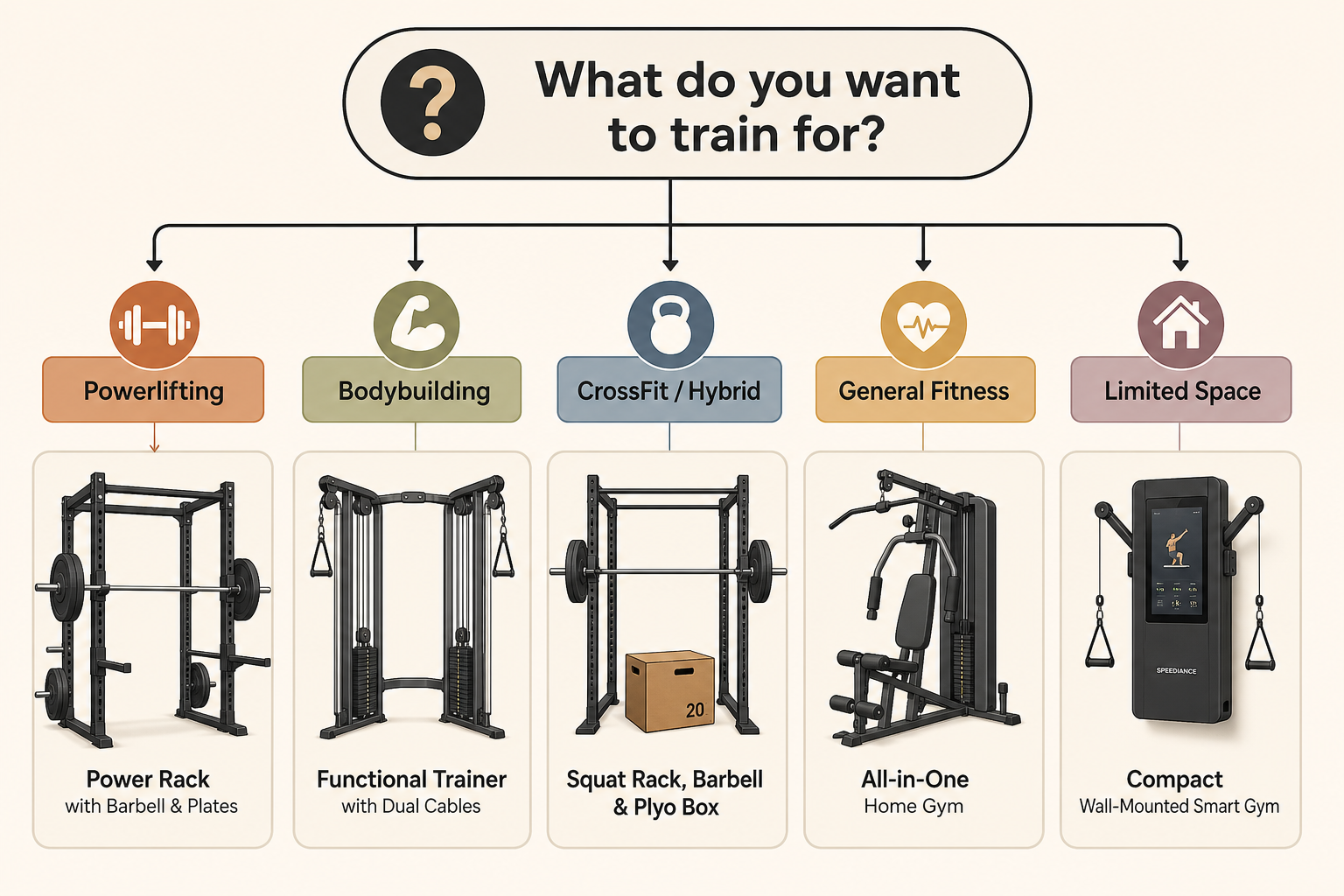
Decision Tree: What Do You Want to Train For?
This is the core of the guide. Stop comparing specs. Start with your answer to one question: What is your primary training goal? Follow the branch that fits.
Branch 1: Powerlifting / Max Strength
If your primary goal is to increase your squat, bench press, and deadlift — or to train with heavy compound movements in general — the only category that makes sense is a power rack + barbell setup.
Why: Power racks are built to handle heavy loads safely. The REP PR-1100 holds 700 lbs. The Titan T-3 holds 1,000 lbs. You can squat inside the rack with spotter arms, bench with safety catches, and deadlift on the floor in front of it. No all-in-one machine or functional trainer comes close to this weight capacity. No smart gym can deliver the progressive overload you need beyond 250 lbs total.
Trade-offs: You need to buy a barbell, plates, and a bench separately. The setup takes more floor space than a smart gym. You will not get cable crossover movements or lat pulldowns without adding a separate pulley attachment. But for raw strength, nothing else competes.
Branch 2: Bodybuilding / Muscle Hypertrophy
If your goal is to build muscle through isolation work, cable exercises, and high-volume training, a functional trainer is your best match.
Why: Functional trainers excel at the exercises bodybuilders rely on — cable flyes, triceps pushdowns, face pulls, lateral raises, single-arm rows, and leg extensions with ankle cuffs. The dual weight stacks allow unilateral training, which is critical for addressing muscle imbalances. The REP Ares 2.0, for example, uses a 2:1 pulley ratio that provides smooth, constant tension through the full range of motion.
Trade-offs: Functional trainers are weak for heavy compound lifts. The 2:1 ratio means a 260-lb stack delivers only about 130 lbs of working resistance per arm — insufficient for heavy rows or pulldowns if you are an advanced lifter. You will still need a barbell or dumbbells for squats, deadlifts, and heavy pressing.
Branch 3: CrossFit / Hybrid Training
If your training blends Olympic lifting, gymnastics, metabolic conditioning, and plyometrics, you need a squat rack + barbell + plyo box setup — essentially a power rack with enough open floor space for dynamic movements.
Why: CrossFit workouts require the ability to clean and jerk, snatch, do pull-ups, box jumps, and burpees in rapid succession. A power rack with a pull-up bar and a barbell gives you the foundation. You need open floor space for the dynamic lifts — a functional trainer or all-in-one machine gets in the way. Add a plyo box and a rower (like the Concept2 RowErg at $990, which stores vertically) and you have a complete hybrid gym.
Trade-offs: This setup requires the most floor space — at least 100 sq ft for the rack, barbell, and movement area. You will not have a cable station built in. You will need bumper plates for Olympic lifts.
Branch 4: General Fitness / Variety Training
If you want to do a bit of everything — some strength, some cardio, some cable work, some bodyweight — and you value convenience over specialization, choose an all-in-one machine or a smart gym.
Why: All-in-one machines like the Major Fitness B17 ($4,200) pack a squat station, cable crossover, leg press, and often a lat pulldown into a single footprint. You can switch between exercises quickly without moving to different stations. Smart gyms like the Tonal 2 ($4,295) take this further by eliminating weight plates entirely — digital resistance adjusts in one-pound increments, and the AI coaching guides you through workouts. The Tonal 2 measures only 5.25 inches deep, making it the smallest footprint option in this branch.
Trade-offs: All-in-one machines are expensive and heavy. The B17 requires over 37 sq ft. Smart gyms require a subscription — Tonal 2 costs $59.95/month — and their digital resistance caps at 250 lbs total, which will limit advanced lifters. For a detailed breakdown of what makes a home gym "smart" in 2026, see our buyer's guide to AI coaching and digital resistance.
Branch 5: Limited Space / Portable Training
If you live in a studio apartment, rent a room, or need a gym that fits in a closet, your options are band/portable systems or wall-mounted smart gyms.
Why: Band-based systems like the X3 Bar ($549) and Living.Fit bands ($129 per set) take up virtually no space. The X3 Bar weighs 17 lbs and generates up to 300 lbs of resistance. Living.Fit bands offer resistance from 6 to 250 lbs and come with a lifetime warranty. Wall-mounted smart gyms like the Tonal 2 (5.25" deep) and the Speediance Gym Monster (folds to 15" deep) mount to the wall and leave the floor clear. The PRx Profile PRO squat rack folds to 9 inches deep against the wall, costs $1,099, and supports 1,000 lbs — a viable option if you have a wall stud and want real barbell training in a small space.
Trade-offs: Band-based systems do not replicate the feel of free weights or cables. The resistance curve of elastic bands is nonlinear — hardest at the top of the movement, easiest at the bottom — which is the opposite of how muscles naturally produce force. Smart gyms require a subscription and have resistance caps. For a deeper dive into compact approaches, read our comparison of modular, all-in-one, and smart gym compact setups.
Side-by-Side Comparison: Footprint, Resistance, Variety, Subscription, and Cost
Once the decision tree has narrowed your options to one or two categories, use this comparison table to evaluate them across the dimensions that actually matter for a purchase decision. All figures are drawn from independently verified product specs.
| Dimension | All-in-One Machine | Power Rack + Barbell | Functional Trainer | Smart Gym | Band / Portable |
|---|---|---|---|---|---|
| Floor Footprint | 37+ sq ft | 15–25 sq ft (rack only) | 20–30 sq ft | Wall-mounted; 5–15" deep | Negligible (stored) |
| Max Resistance | 260 lbs per stack (expandable) | 700–1,000+ lbs (rack capacity) | 260 lbs per stack (2:1 ratio = ~130 lbs working) | 220–250 lbs total (digital) | Up to 300 lbs (band tension) |
| Exercise Variety | High (multiple stations) | Moderate (compound-focused; add-ons needed for cables) | High (cable isolation, unilateral) | Moderate (guided programs; limited by resistance cap) | Low to moderate (compound pulls, no push exercises) |
| Subscription Required | No | No | No | Yes ($40–$60/month) | No |
| Total Cost Range | $1,300 – $4,200 | $380 – $1,100 (rack); $800 – $1,500 (full setup with bar, plates, bench) | $2,000 – $3,000 | $3,199 – $4,295 + monthly subscription | $129 – $549 |
Sample Setups for Each Training Style at Different Price Points
These case studies show what a complete setup looks like for each training style at a realistic budget. Each one includes the equipment you need and the trade-off you accept.
Powerlifting Starter: ~$1,000
- REP PR-1100 Power Rack ($380) — 700-lb capacity, 14-gauge steel
- Rogue Bar 2.0 (under $300) — the most recommended starter barbell in the industry
- REP Iron Plates ($0.89/lb) — start with 255 lbs total for ~$227
- REP FB-5000 Weight Bench ($245) — adjustable, sturdy, and widely tested
- Total: ~$1,152
What you get: A complete squat, bench, and deadlift setup that will serve you for years. What you sacrifice: No cable work, no lat pulldown, no leg extension. You will need to add a pulley attachment or resistance bands for isolation exercises.
Bodybuilding / Hypertrophy Setup: ~$2,500
- REP Ares 2.0 Functional Trainer ($2,999) — dual 260-lb stacks, 2:1 pulley ratio
- REP QuickDraw Adjustable Dumbbells (starting at $336 for 30-lb pair) — drop-tested, replaces 12 pairs of dumbbells
- Total: ~$3,335
What you get: A cable-based training environment ideal for isolation, unilateral work, and high-volume hypertrophy. The adjustable dumbbells cover free-weight pressing and rows. What you sacrifice: No heavy squat or deadlift capability. You will need a separate barbell and rack if you want to train those movements.
General Fitness / Smart Gym: ~$4,500
- Tonal 2 ($4,295) — 250 lbs digital resistance, 5.25" deep, wall-mounted
- Concept2 RowErg ($990) — 57 lbs, stores vertically, gold-standard cardio
- Subscription: $59.95/month for Tonal 2
- Total: ~$5,285 + ongoing subscription
What you get: A tiny-footprint strength system with AI coaching, plus a rower for cardio. The Tonal 2's Aero feature adds HIIT capability. What you sacrifice: The 250-lb resistance cap will limit advanced lifters. The subscription is a permanent cost. For a full reality check on the Tonal 2, read our unvarnished Tonal home gym review.
Portable / Limited Space: ~$550
- X3 Bar ($549) — band-based, up to 300 lbs resistance, 17 lbs
- Living.Fit Resistance Bands ($129) — 6 to 250 lbs, lifetime warranty
- Total: ~$678
What you get: A gym that fits in a duffel bag. You can do deadlifts, rows, squats, and overhead presses with band resistance. What you sacrifice: No push exercises (bench press, overhead press) without a separate bar. The band resistance curve is nonlinear — hardest at lockout, easiest at the bottom — which does not match how your muscles naturally produce force. This is a compromise, not a substitute for free weights.
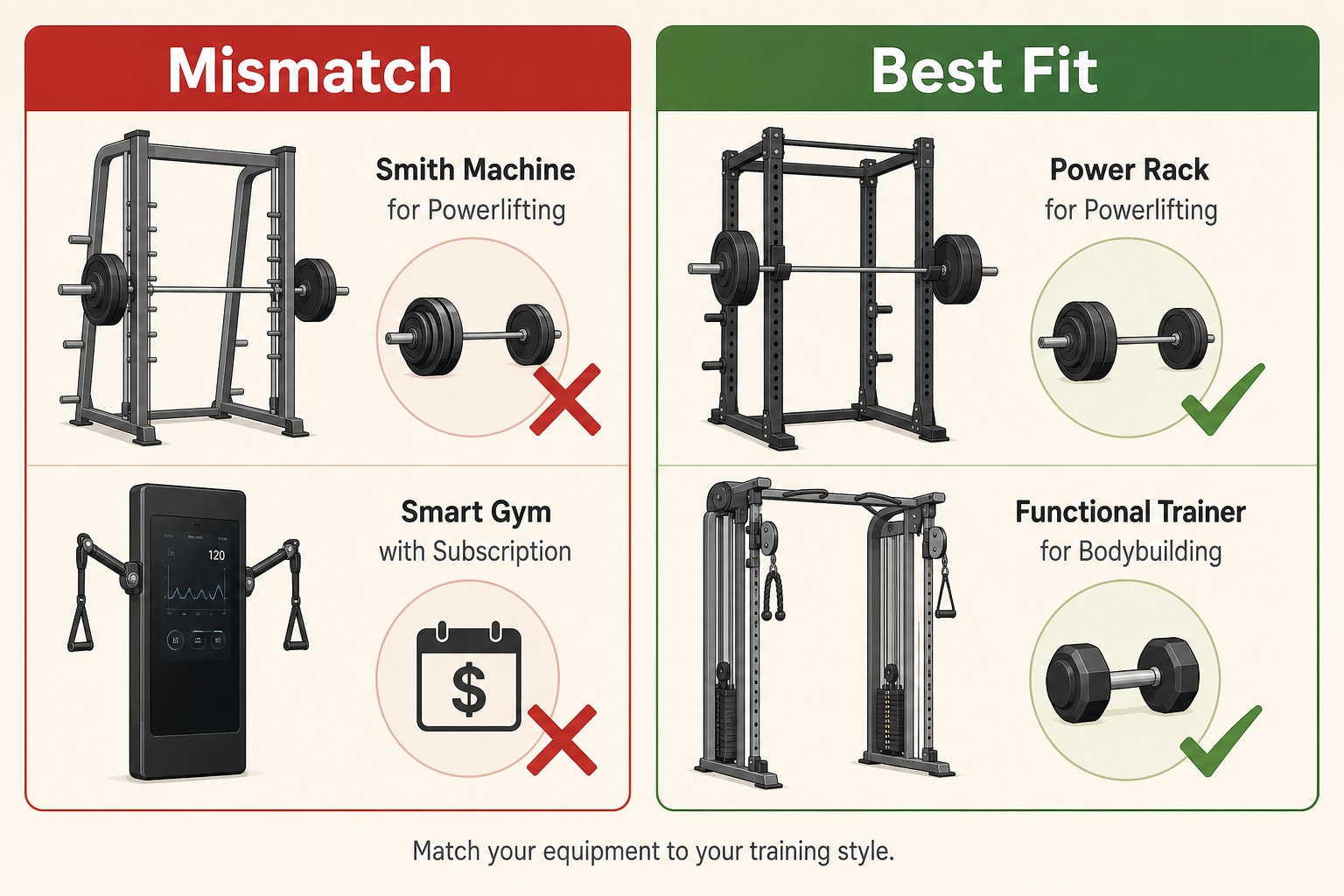
Common Mistakes: Matching Equipment to the Wrong Training Style
The decision tree prevents the most expensive mistakes in home gym buying. Here are the four most common mismatches and why they happen.
Mistake 1: Buying a Smith Machine When You Want Free-Weight Compound Lifts
Smith machines look like a power rack but constrain the barbell to a fixed vertical path. This removes the stabilization work that makes squats and bench presses effective. If your goal is strength, a Smith machine will not develop the same neuromuscular coordination as a free barbell. Buy a power rack instead — the REP PR-1100 at $380 costs less than most Smith machines and gives you real barbell training.
Mistake 2: Choosing a Smart Gym When You Do Not Want a Subscription
Smart gyms like the Tonal 2 ($4,295) and Speediance Gym Monster ($3,199) require ongoing subscriptions — $59.95/month for Tonal, $40/month for Speediance. Over five years, that adds $2,400 to $3,600 to the purchase price. If you do not want a recurring cost, choose an all-in-one machine or a power rack. Both have no subscription and no feature degradation if you stop paying.
Mistake 3: Buying a Functional Trainer When Your Primary Goal Is Powerlifting
Functional trainers excel at cable isolation work, but they are weak for heavy compound lifts. The 2:1 pulley ratio means a 260-lb stack delivers only about 130 lbs of working resistance per arm. If your primary goal is increasing your squat and deadlift, a functional trainer will not get you there. Buy a power rack and barbell first, then add a functional trainer later if you want cable work.
Mistake 4: Selecting an All-in-One Machine Without Measuring Your Floor Space
All-in-one machines like the Major Fitness B17 require over 37 sq ft. The Bells of Steel All-in-One measures 54.6" D x 59" W x 81" H. Buyers often underestimate the footprint because they see the machine's base dimensions but forget the space needed for movement — swinging a barbell, stepping back for cable rows, or lying flat on a bench. Measure your actual floor space before buying. If you have less than 30 sq ft, consider a wall-mounted smart gym or a band-based system instead.
Your Next Step: From Decision to Purchase
By now, you should have identified the equipment category that matches your training style. The decision tree is your filter: powerlifting → power rack, bodybuilding → functional trainer, CrossFit → squat rack + barbell, general fitness → all-in-one or smart gym, limited space → compact/portable.
Your next action depends on which category you chose:
- If you chose an all-in-one machine, read our all-in-one resistance type comparison to understand weight stack vs. plate-loaded vs. digital vs. power rod systems.
- If you chose a smart gym, dive into our smart home gym spec clash 2026 for a head-to-head comparison of Tonal 2, Speediance, and others.
- If you chose a power rack, our full-body workout machine types comparison can help you understand how it stacks up against other categories.
- If you are still evaluating the Tonal 2, read our Tonal reality check for the unvarnished pros and cons.
The right home gym is not the one with the most features, the lowest price, or the smallest footprint. It is the one that matches how you actually train. Start with your goal, not the gear.
This result comes from one real apartment under the stated conditions — it is a strong signal, not a guarantee your space will measure identically.
Builds this evidence supports
Where to Spend vs. Save on Affordable Home Gym Equipment: A Quality Tradeoff Guide
A practical guide for budget-conscious buyers (under $1,000) that reveals which equipment categories demand a higher investment for safety and durability, and where cutting costs is a smart move.
Garage Gym Equipment Tier System: What to Buy First, Second, and Third Based on Your Training Goals
A practical guide for beginners and intermediate home gym builders that uses a community-backed tier system (must-have, should-have, nice-to-have, avoid) to help you buy equipment in the right order—so every purchase serves a real training need and nothing is wasted.
Spot something off?
If this result didn't match your own space, let us know — floor-damage and noise claims carry real deposit-risk consequences if we get them wrong.