
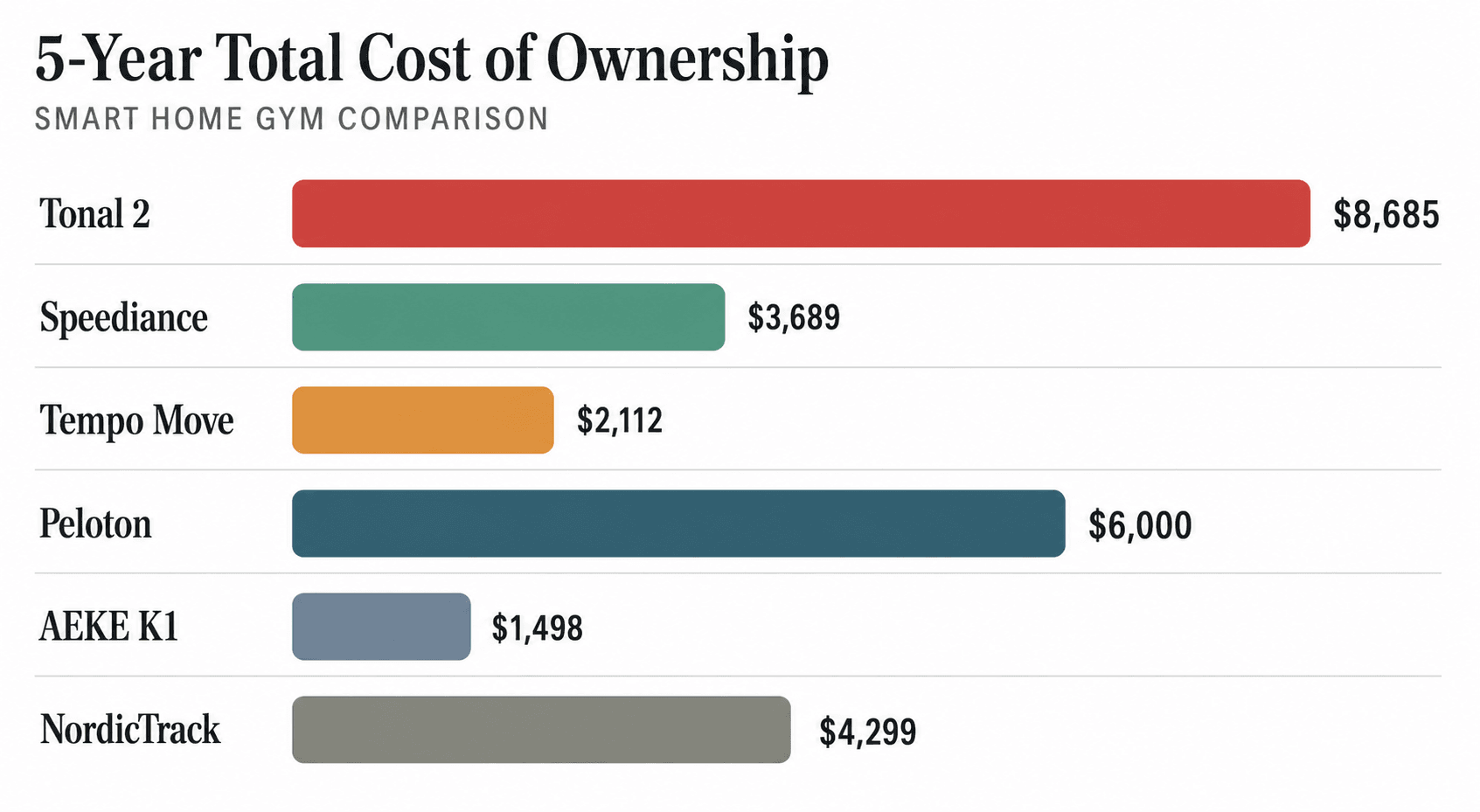
A $4,295 Gym That Costs $8,685
The product page says $4,295. You see that and think, “That’s the price.” Then you catch a sale and feel smart. But the real cost over a reasonable ownership period is a different number. Tonal 2 costs $8,685 over five years — machine, mandatory membership, required accessories, and shipping. That is more than double the sticker. The gap: $4,390. Almost entirely subscription fees.
A Garage Gym Reviews analysis puts the average smart home gym upfront price at $1,930 and the average monthly subscription at $22.81. But that average includes systems with no subscription at all. For subscription-locked systems like Tonal 2, the monthly fee is $59.95 with a 12-month commitment — mandatory for core functionality. Over five years, that fee alone is $3,597. The machine is $4,295. The math is not hard: the subscription costs nearly as much as the equipment.
The Monthly Fee Is the Real Price
If you are used to buying dumbbells once and owning them forever, the smart gym subscription model feels like a second purchase every year. A $60 monthly charge is $720 annually. Over five years, $3,600. That is not a trivial add-on — it is the dominant cost. And it is non-negotiable. Without the Tonal membership, the screen shows nothing. The system becomes a very expensive mirror.
Not all smart gyms work this way. Speediance offers a lifetime free membership on its current GM2 and GM2S models. No monthly fee. The same digital resistance, same workout tracking, same app. The upfront price is $3,474 to $3,689, and that is the total you pay. No ongoing obligation.
The average $22.81 monthly fee that roundups cite includes machines like Speediance and AEKE K1 (both free). It blurs the real picture. For a true comparison, separate the two tiers: subscription-locked and subscription-free. The difference in five-year cost is not hundreds of dollars — it is thousands.
5-Year Total Cost: All Major Systems
The table below includes all costs that hit your wallet: upfront machine price, mandatory monthly subscription fees over 5 years, required accessories (without which the system does not function fully), and professional installation where applicable. I have excluded optional items like extra premium content tiers or extended warranties. These are the minimum totals.
| System | Upfront Price | Monthly Fee | Required Accessories | Installation | 5-Year Total |
|---|---|---|---|---|---|
| Tonal 2 | $4,295 | $59.95 | $495 | $295 | $8,685 |
| Speediance GM2 Works Plus | $3,689 | $0 | $0 | $0 | $3,689 |
| Tempo Move Starter Bundle | $504 (first year $972) | $39 after year 1 | $0 | $0 | ~$2,112 |
| AEKE K1 (subscription-free) | ~$1,300 | $0 | Included | $0 | $3,200–$5,500 |
| AEKE K1 (if subscription-locked) | ~$1,300 | $39.99 | Included | $0 | $6,100–$9,600 |
The Tempo Move row requires explanation. The first 12 months are $81/month because that payment bundles the equipment cost. After the machine is paid off, the subscription drops to $39/month. Over five years the total is approximately $2,112 — the lowest among subscription-based systems — but you still pay $39/month indefinitely after year one. That is still a recurring cost.
The AEKE K1 range for the subscription-free version comes from the manufacturer's own content. Independent verification is thin, so treat it as directional. The gap between the two AEKE totals ($3,200–$5,500 vs. $6,100–$9,600) is exactly the subscription cost over five years — roughly $2,900 to $4,100 extra.
Hidden costs not in the table: Tonal 2 requires an Essential Accessories Bundle priced at $495 (or $595 for the Ultimate). Without it you cannot do most exercises. Speediance includes basic accessories in the upfront price. Installation for Tonal 2 is $295 and is mandatory for safety. Some systems charge for premium content tiers beyond the base subscription, but that varies by usage.
What You Lose If You Stop Paying
The biggest risk of a subscription-locked system is what happens when you cancel. Tonal 2 does not work without the membership. The screen goes blank. The digital resistance ceases. You cannot even track workouts manually. The $4,295 machine becomes a wall ornament.
Speediance and AEKE K1 keep all functionality active without a subscription. You lose access to guided classes or curated programs, but the core digital resistance and manual workout logging remain. That matters if your budget changes or if you decide the content is not worth the fee after a year.
Warranty risk compounds the subscription risk. Tonal 2 carries a 2-year warranty. The average across the smart gym category is 4.27 years. If the machine fails in year three, you pay for repairs out of pocket while still paying the subscription. Speediance also has a 2-year warranty. That is an additional cost contingency that many buyers ignore.
The $81 Illusion
Tempo Move's financing plan is designed to look like a low monthly payment. $81 per month. No large upfront cost. But that $81 is not the subscription fee — it pays off the machine in the first year. The actual subscription is $39 per month, and it starts after year one. The label "as low as $81/mo" masks the breakdown. Consumers see a single number and assume it is the total cost. It is not.
Over five years, the Tempo Move costs around $2,112. That is still much less than Tonal 2, but the point is this: financing plans separate the equipment cost from the subscription cost in a way that is not obvious unless you look at the fine print. Read the terms. Calculate the out-the-door total after the financing period ends. Do not rely on the monthly payment alone.
Compared to a Real Gym Membership
A premium gym membership runs $6,000 to $12,000 over five years. That is higher than most smart gym totals, but the comparison is not fair in one direction. A gym membership includes no equipment depreciation, no repair risk, and no space commitment. You do not pay for maintenance. You do not need to store a machine. You can cancel at any time with no sunk cost. Smart gyms, especially subscription-locked ones, leave you with a depreciated machine when you stop paying.
If you factor in the resale value (or lack thereof) and the potential repair costs after warranty, the total cost of a smart home gym can easily match or exceed a mid-tier gym membership. The convenience of working out at home is real, but it comes with financial obligations that a gym membership does not.
Pick Your Lock or Pass
The numbers are clear: subscription-free systems cost $3,200 to $5,500 over five years. Subscription-locked systems cost $6,100 to $9,600. The difference is $2,900 to $4,100 — exactly the amount spent on monthly fees. For anyone keeping the equipment longer than three years, the subscription-free option is far cheaper.
That is not to say subscription-locked systems have no place. If you value polished coaching content and will use the programming daily, Tonal 2 may still justify its $8,685 total. But you need to budget that full number, not the sticker price. Plan to keep it for at least five years to amortize the upfront cost. Be comfortable with the fact that you cannot cancel the subscription without losing the machine entirely.
I would recommend Speediance GM2 or AEKE K1 to anyone who wants the convenience of a smart gym without the recurring obligation. The $5,000 savings over Tonal over five years is real money. You can spend it on a good barbell set. Or keep it.

Comments
Join the discussion with an anonymous comment.