
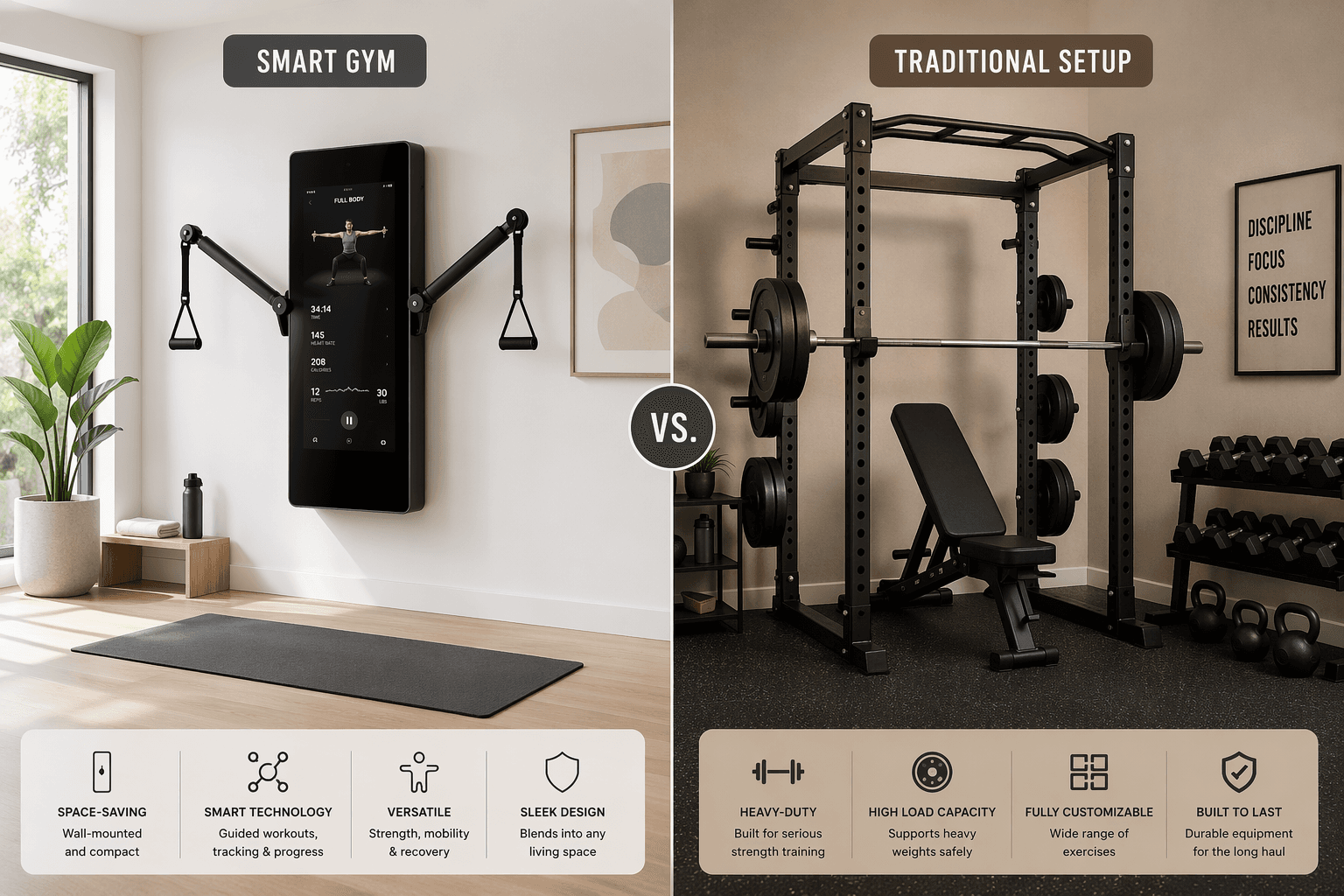
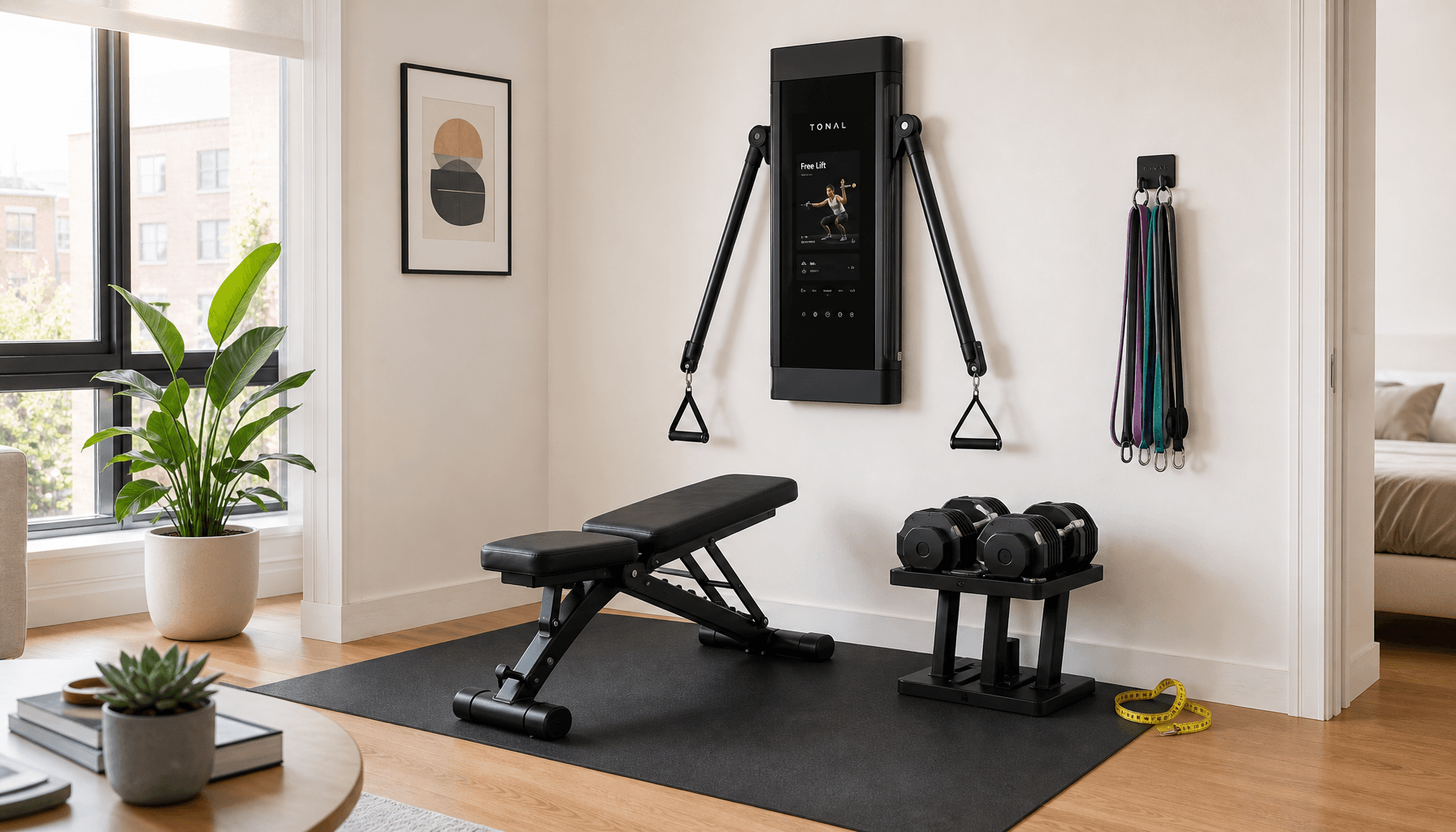
I hear this question every week. A $4,295 Tonal 2 hangs on one side of the comparison; a $380 power rack with a barbell and a few plates sits on the other. They look like two ways to do the same thing—build strength at home—but they are not interchangeable. The decision is less about which machine wins and more about what kind of owner you are going to be.
What actually moves the weight?
Electromagnetic resistance is not a trick that replicates gravity. A smart gym like the Tonal 2 uses a motor to create controlled tension through cables. It delivers up to 250 pounds of total digital resistance (125 pounds per arm). That number is not a suggestion—it is a hard ceiling. You cannot add a plate the way you can on a barbell. A traditional setup, by contrast, is limited only by the rack and the plates you buy. The REP PR-1100 power rack costs $380 and handles up to 700 pounds. With a $180 barbell and a set of bumper plates at roughly $2.20 per pound, you can load past 500 pounds for under $1,500—and there is no motor to cap it. If you can deadlift or squat more than 250 pounds, the smart gym simply cannot serve you for those movements.
| Smart Gym (Tonal 2) | Traditional (Barbell + Rack) | |
|---|---|---|
| Resistance type | Electromagnetic (digital) | Gravitational (plates) |
| Max resistance | 250 lbs total (125 lbs per arm) | 700+ lbs (rack capacity) |
| Max resistance cost | $4,295 (includes screen, arms, cables) | $1,360 (rack + barbell + 260 lbs of plates) |
| Upgrade path | None – ceiling is fixed | Add more plates indefinitely |
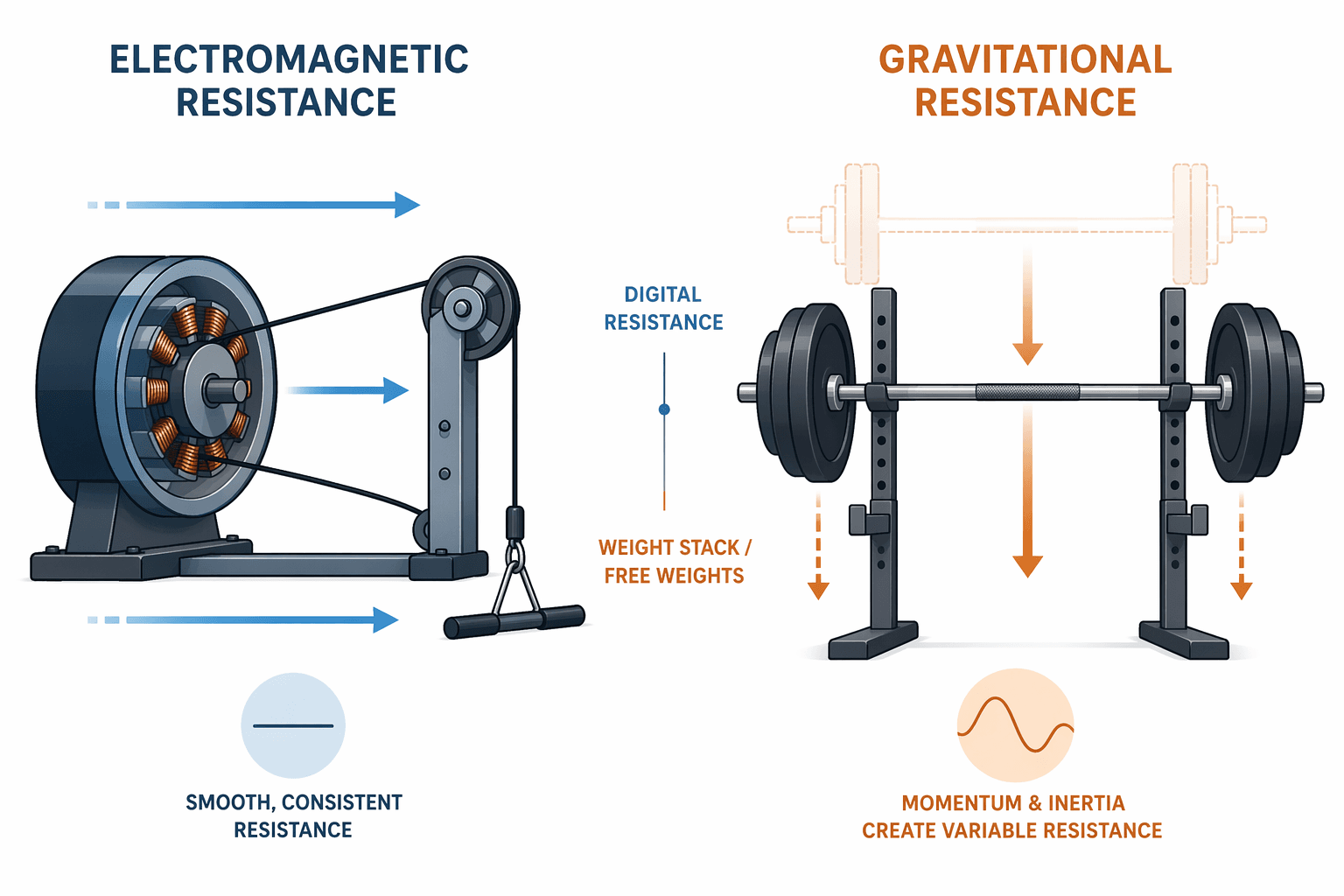
Digital resistance feels smooth and constant—like a good cable machine. That is not the same as a free-weight lift. A barbell deadlift starts with a heavy eccentric, requires you to accelerate through the mid-range, and finishes with a lockout that demands full-body tension. The motor inside a smart gym cannot replicate that momentum or the sudden shift in load when you accelerate. It provides a controlled, cable-like pull that feels consistent but lacks the dynamic overload that drives the most strength adaptation. This matters most for compound lifts. If your primary goal is to squat, deadlift, or bench press heavy weight, a smart gym's 250-pound ceiling and uniform resistance curve will leave you underloaded. The Tonal 2 might be fine for accessory isolation work—rows, curls, tricep pushdowns—but for the main barbell movements, it is a constraint, not a replacement.
The market reflects this fundamental split. The conventional equipment segment still holds 73.3% of the global home gym equipment market, according to GM Insights. Smart gyms are the fastest-growing slice, but growth from a small base does not mean they are ready to replace the barbell for everyone.
Guidance vs. self-reliance
The smart gym's strongest selling point is the coaching. It auto-adjusts weight, counts reps, and guides you through workouts with on-screen demonstrations. For someone who does not want to plan their own training, that is a real benefit—provided they keep paying for it.
Tonal's subscription runs $59.95 per month. That is not optional—the machine's core features require it. Without the subscription, you cannot access the guided workouts, the auto-spotting, or the progressive programming that make the machine useful. You end up with a very expensive digital cable tower.
Traditional equipment owners can use free apps, write their own programs, or follow written routines from this very site—for zero recurring cost. The trade-off is that you have to plan your own progression. If you are the kind of person who would let a gym membership lapse after a year, the smart gym's guided programming might keep you training. But if you already know how to run Starting Strength or a simple linear progression, the subscription is a cost with no benefit.
The arithmetic is brutal over time. The Tonal 2 costs $4,295 upfront. Add $59.95 per month for 60 months and the total is $7,892. A traditional setup with a high-quality rack, barbell, plates, and bench can be assembled for around $1,360—a one-time purchase. Even if you upgrade to premium brands, the total rarely passes $3,000 before plates. The average home gym machine tested by Garage Gym Reviews costs $1,855—but that is a sample average of 50+ machines, not a market-wide figure. Even with that context, the gap is stark.
| Cost category | Smart Gym (Tonal 2) | Traditional (REP PR-1100 + Synergee barbell + plates + bench) |
|---|---|---|
| Upfront | $4,295 | $1,360 |
| Monthly subscription | $59.95/mo | $0 |
| Total after 5 years | $7,892 | $1,360 |
| Total after 10 years | $11,489 | $1,360 |
| Resale value after 5 years | ~$0 (anecdotal) | 60–80% of original (anecdotal) |
For a deeper breakdown of equipment costs across budget tiers, see our full cost breakdown article. And for more on the subscription trap, read the hidden cost analysis.
The warranty gap: 2 years vs. a lifetime
Warranty length is not marketing fluff. It is the manufacturer's estimate of how long the machine will last before something fails. Compare the coverage on these two paths:
| Equipment | Warranty | What is covered |
|---|---|---|
| Tonal 2 | 2 years parts and labor | Screen, arms, cables, motor; 1 year on accessories |
| REP PR-1100 Power Rack | Limited lifetime on frame | Welds and steel structure; no corrosion wear |
| Fringe Sport Black Bumper Plates | Lifetime | Cracking, chipping, delamination |
| Synergee Games Cerakote Barbell | Lifetime | Shaft bending, sleeve spin failure |
A rack with a lifetime warranty on its frame is expected to outlive its owner. A smart gym with a 2-year warranty is expected to last until the fourth year at most—after which repairs are out of pocket. The Tonal 2 costs $4,295; a screen replacement or motor repair could easily run several hundred dollars, and the machine is not designed for user serviceability. Traditional gear, by contrast, is repairable with basic tools. Bent barbell? Buy a new one for $180. Cracked plate? Replace it for $2.20 per pound. The warranty gap signals a fundamentally different design philosophy: planned obsolescence versus generational equipment.
Where does the resale value go?
Traditional steel equipment holds its value remarkably well. Community observation in home gym forums and online marketplaces suggests that a used power rack retains 60–80% of its purchase price, and barbells with light use sell for close to retail. The reasons are simple: no proprietary electronics, no subscription lock, and easy inspection of wear. A buyer can look at a rack and see if it is straight. They cannot evaluate a three-year-old smart gym's motor or screen without turning it on—and even then, hidden cable wear is invisible.
Smart gyms suffer the opposite fate. The screen, cables, and motor degrade; the proprietary parts cannot be swapped cheaply; and the first buyer's subscription lapses, making the machine less appealing to a second owner. A five-year-old Tonal is not worth much—if it still works. This near-zero resale value transforms the initial investment into a sunk cost the moment you swipe your credit card.
Who should buy what
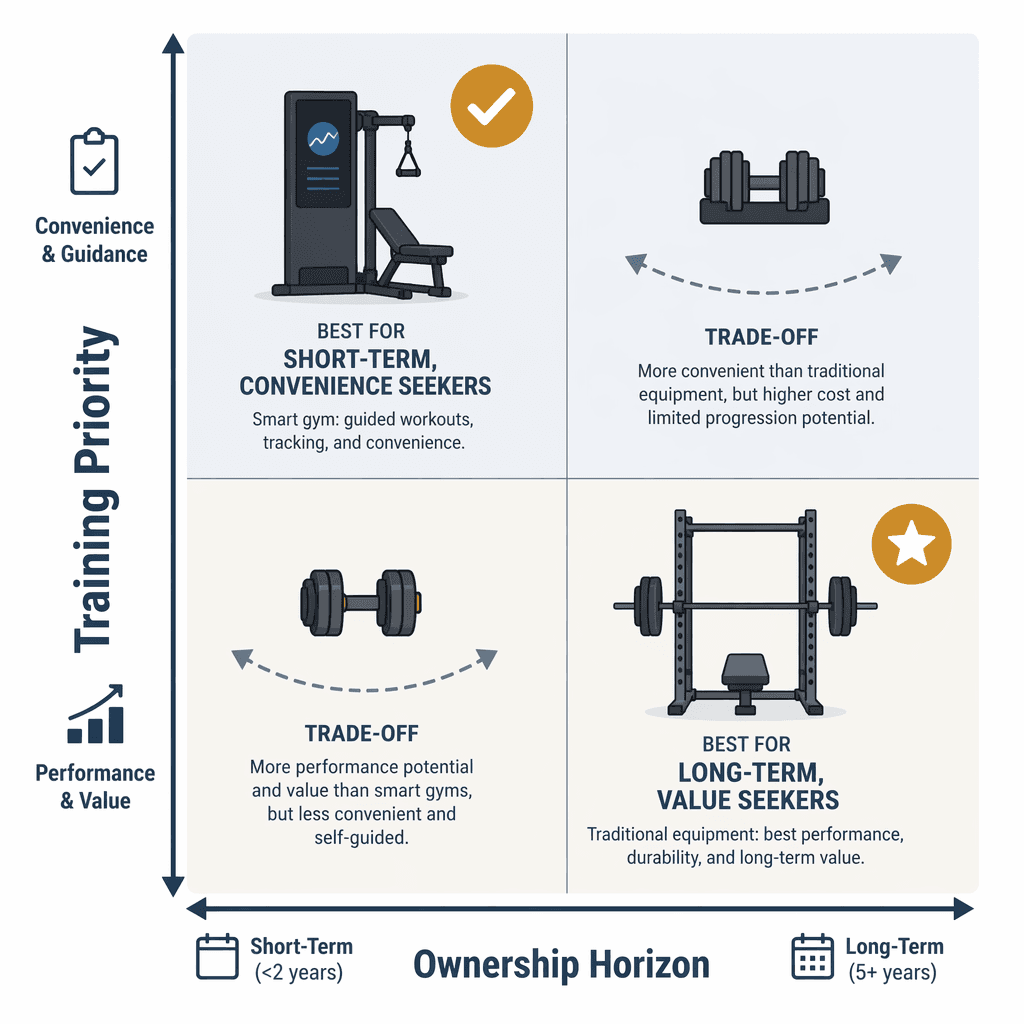
The matrix above sums it up. The only scenario where a smart gym makes rational sense is the top-left quadrant: short-term, convenience-driven. You value guided workouts, need the compact wall mount, and you know you would let a gym membership lapse inside 18 months. The subscription and limited resale are acceptable because you are paying for engagement, not lifetime equipment.
If you are in any other quadrant, traditional equipment wins. The long-term performance seeker gets lifetime warranty, no subscription, infinite resistance ceiling, and strong resale. The long-term convenience seeker is better off with a traditional setup and a free programming app—otherwise the subscription costs will double the machine price inside five years. And even the short-term performance seeker should lean traditional unless space is truly impossible, because a 250-pound ceiling will cap progress quickly.
For a broader framework that includes other equipment types and training styles, see our home gym decision guide.
Verdict: two different tools for two different jobs
The asymmetry is plain: a $1,360 traditional setup outlasts a $7,892 subscription-locked smart gym, lifts heavier, retains resale value, and costs nothing to run after purchase. If you train consistently past two years, do not trade a lifetime-rated rack for a screen that stops working the month the subscription expires.
That said, I will defend the narrow scenario where a smart gym makes sense. If you have the money, the wall space, and the self-awareness that you drop gym memberships inside a year, the guided programming might actually keep you lifting. A smart gym is not a bad purchase—it is a bad purchase for the wrong person.
But for the reader asking the question, the data points are clear. The warranty, the subscription, the resistance ceiling, and the resale value all point in one direction. The smart gym promises convenience. The barbell promises permanence.

Comments
Join the discussion with an anonymous comment.