
The Space vs. Performance Trade-Off: Why Most Compact Treadmills Fail Runners
If you live in an apartment or a small home and you run, you have likely encountered a frustrating paradox. Walk into any big-box fitness store or browse online, and you will find dozens of treadmills marketed as "compact," "space-saving," or "apartment-friendly." Open the spec sheet, and the pattern is consistent: a 49-inch deck, a 2.0 CHP motor, and a top speed of 8 mph. These machines are not designed for running. They are walking pads with handrails, dressed up to look like something they are not.
The root of the problem is a genuine engineering trade-off. To make a treadmill small enough to slide under a bed or stand upright in a closet, manufacturers have historically shortened the deck, downgraded the motor, and capped the speed. For a runner who needs a full stride, a motor that can sustain a 6-minute-mile pace, and a belt that does not overheat after 30 minutes, those compromises are deal-breakers.
That trade-off is no longer mandatory. A new generation of folding and flat-storage treadmills now delivers true running specifications — 60-inch decks, 12 mph top speeds, and 3.0+ CHP motors — in packages slim enough for closets, under beds, and apartment corners. The key is knowing which specs to look for and which storage type fits your specific space. This guide applies runner-specific thresholds to identify the models that actually deliver a real running experience in a compact footprint, and it organizes recommendations by how they store — flat-fold, vertical-fold, or under-bed — so you can match the machine to your room, not the other way around.
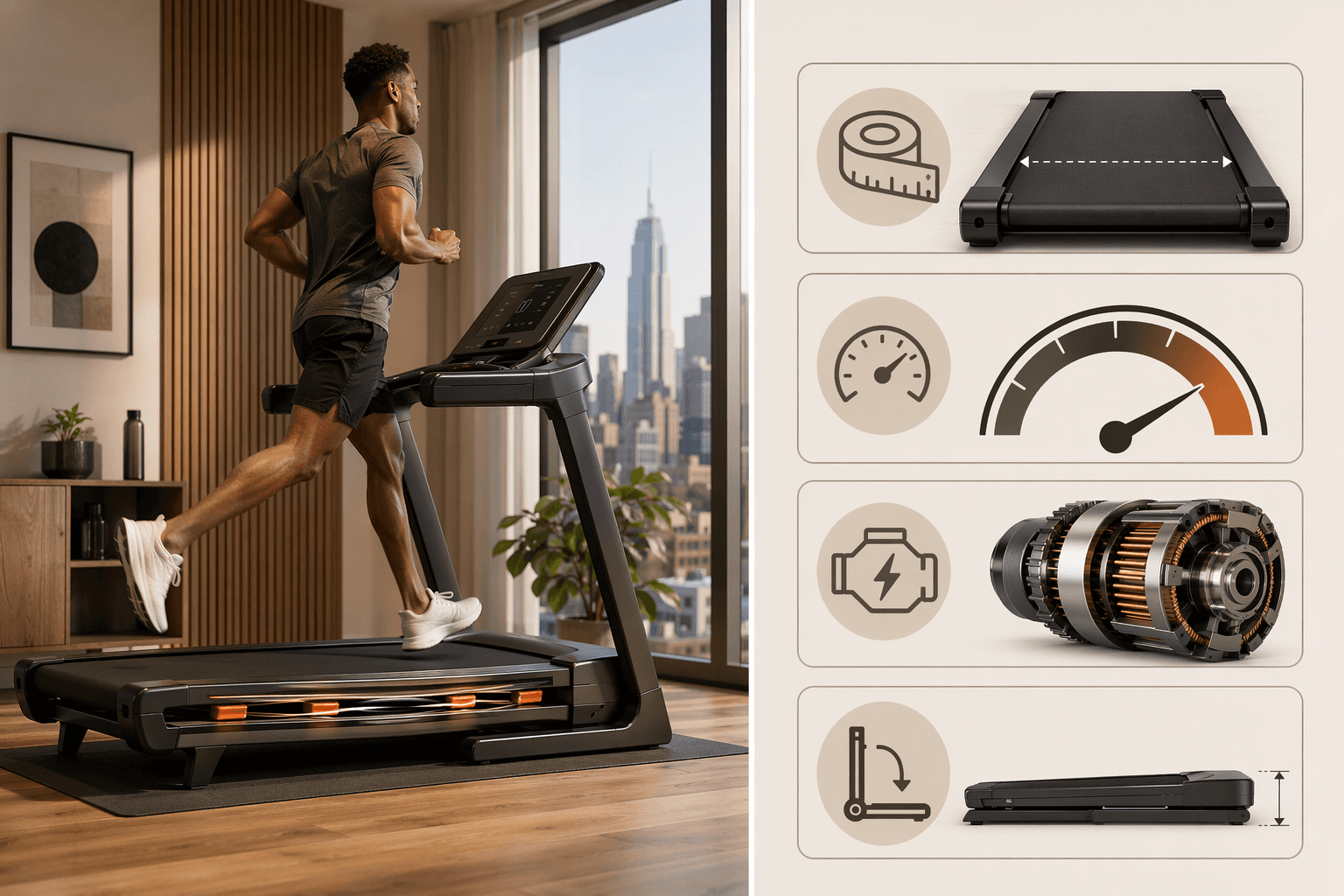
Minimum Running-Spec Thresholds for a Small-Space Treadmill
Before looking at specific models, it is essential to establish the baseline specifications that separate a running machine from a glorified walking pad. These thresholds are not arbitrary — they are derived from the biomechanics of running and the mechanical demands of sustained high-speed use.
The Non-Negotiables
- Deck length: Minimum 55 inches, preferably 60 inches. A 55-inch deck accommodates a stride length of roughly 5 feet 6 inches, which fits most runners up to about 6 feet tall. Runners over 6 feet or those with longer strides need a full 60-inch deck to avoid stepping on the motor hood at the end of each stride.
- Motor power: Minimum 3.0 CHP (continuous horsepower). CHP measures sustained output, not peak power. A 3.0 CHP motor can maintain a 6- to 7-minute-mile pace indefinitely without overheating. Motors below this threshold are adequate for walking and light jogging but will struggle or fail under the thermal load of a 30-minute run at 8+ mph.
- Top speed: Minimum 10 mph, ideally 12 mph. A 10 mph top speed equates to a 6-minute mile, which covers the vast majority of recreational runners. If you do speed work, intervals, or have any ambition of running sub-6-minute miles, look for 12 mph or higher.
- Folding or storable design: The entire point of this guide. The treadmill must fold flat, fold vertically, or slide under a bed. If it does not store away, it does not belong in a small-space discussion.
| Spec | Walking Pad | Minimum for Running | Ideal for Runners |
|---|---|---|---|
| Deck length | Under 50 in | 55 in | 60 in |
| Motor (CHP) | 1.5 – 2.5 CHP | 3.0 CHP | 3.5+ CHP |
| Top speed | 6 – 8 mph | 10 mph | 12+ mph |
| Folded depth | Varies | Must fold or store | Under 12 in flat |
Best Flat-Fold Running Treadmills: Store Under a Bed or in a Closet
Flat-fold treadmills are the most space-efficient option for runners. They fold down to a pancake-flat profile — typically 10 to 12 inches thick — allowing them to slide completely under a standard bed frame, stand vertically against a wall, or tuck into a shallow closet. The trade-off has historically been a shorter deck or weaker motor, but that is no longer the case.
Echelon Stride 6: The Best Flat-Fold Running Treadmill
The Echelon Stride 6 is the current benchmark for flat-fold running treadmills. It folds to just 10 inches deep — thin enough to slide under a bed frame with standard 12-inch clearance — yet it delivers a full-size 60.5-by-20.5-inch running deck and a top speed of 12.4 mph. Runner's World named it "Best Folding Treadmill," highlighting its fold-flat design that "makes it very convenient to store under a bed or stand vertically." The motor is a 3.0 CHP brushless unit, which meets the minimum running threshold and runs efficiently without the maintenance of a brushed motor.
Noise is a critical factor for apartment dwellers, and the Stride 6 performs well here too. OutdoorGearLab measured it at just 60 dB during use — quieter than most home treadmills, which typically range from 65 to 75 dB. At 60 dB, it is roughly the volume of a normal conversation, making it unlikely to disturb neighbors in adjacent units.
Horizon T101: The Budget-Friendly Flat-Fold Alternative
If the Echelon Stride 6 stretches your budget, the Horizon T101 is a viable entry-level running machine at a significantly lower price point — often available for around $600. Runner's World lists it as "Best Value" with a 20-by-55-inch deck and an easy hydraulic folding mechanism. The deck is 55 inches, which meets the minimum running threshold for most runners under 6 feet. The motor is a 2.5 CHP unit, which is below the 3.0 CHP ideal but adequate for moderate-paced running (8–10 mph) for sessions under 45 minutes.
The T101 weighs only 180 pounds, making it one of the lightest full-size treadmills on the market. That is a genuine advantage in a small space — you can move it in and out of storage without a second person or a dolly. The trade-off is that the 55-inch deck and 2.5 CHP motor place it at the edge of the running threshold, so it is best suited for runners who prioritize portability and price over maximum performance.
| Model | Folded Depth | Deck Size | Motor (CHP) | Top Speed | Price (Approx.) |
|---|---|---|---|---|---|
| Echelon Stride 6 | 10 in | 60.5 x 20.5 in | 3.0 CHP | 12.4 mph | $1,200 – $1,500 |
| Horizon T101 | ~12 in | 55 x 20 in | 2.5 CHP | 10 mph | $600 – $700 |
Best Vertical-Folding Running Treadmills: Upright Storage for Apartments
Vertical-folding treadmills use a hinge mechanism that lifts the deck to a near-upright position, reducing the floor footprint to roughly the size of the console and base. They do not slide under a bed, but they occupy a much smaller footprint than a non-folding treadmill and can be stored against a wall or in a corner. The trade-off is that they are heavier and require more effort to fold and unfold — though some models include assist mechanisms.
NordicTrack Commercial 1750: The Premium Vertical-Fold Option
The NordicTrack Commercial 1750 is the most capable vertical-folding treadmill for runners who need a full-size deck and a powerful motor. It features a 22-by-60-inch deck — the widest and longest in this comparison — and a 4.25 CHP motor, which exceeds the ideal running threshold by a wide margin. Runner's World names it "Best Premium" folding treadmill, noting its EasyLift assist mechanism that makes the vertical fold manageable for one person.
When folded, the Commercial 1750 occupies approximately 38 inches by 52 inches of floor space — roughly the footprint of a large armchair. That is small enough to fit in most apartment living rooms or spare bedrooms. The trade-off is weight: at over 300 pounds, it is not something you will move in and out of storage daily. It is best suited for a dedicated corner where it can remain set up most of the time, with the vertical fold used for occasional space recovery.
Sole F63: A Reliable Mid-Range Vertical Fold
The Sole F63 is a solid mid-range alternative for runners who want a vertical fold without the premium price tag. It offers a 20-by-60-inch deck and a 3.0 CHP motor, meeting the ideal running threshold for deck length and the minimum for motor power. The folding mechanism is a standard hydraulic fold without assist, so it requires more effort than the NordicTrack 1750, but it is manageable for most adults. The F63 is often priced around $1,000, making it one of the more affordable full-size vertical-folding options.
| Model | Folded Footprint | Deck Size | Motor (CHP) | Top Speed | Folding Assist |
|---|---|---|---|---|---|
| NordicTrack 1750 | 38 x 52 in | 22 x 60 in | 4.25 CHP | 12 mph | EasyLift assist |
| Sole F63 | ~36 x 50 in | 20 x 60 in | 3.0 CHP | 12 mph | Standard hydraulic |
Under-Bed Storage Options: The Slimmest Running Treadmills
Under-bed storage is the holy grail for small-space runners. A treadmill that slides completely under a standard bed frame (which typically has 10 to 14 inches of clearance) effectively disappears when not in use, reclaiming the entire floor for other purposes. The challenge is finding a model that is thin enough to fit under a bed while still meeting running-spec thresholds.
The Echelon Stride 6, covered in the flat-fold section above, is the clear leader in this category. At 10 inches folded depth, it slides under virtually any standard bed frame. The 60.5-inch deck and 12.4 mph top speed mean you are not sacrificing running performance for storage. The only caveat is weight: at roughly 130 pounds, it is manageable to slide in and out from under a bed, but it is not something you will want to move multiple times per day.
For runners who need an even thinner profile, the Horizon T101 folds to approximately 12 inches, which fits under most bed frames with standard 14-inch clearance. The 55-inch deck and 2.5 CHP motor place it at the minimum running threshold, but the lighter weight (180 lbs) makes it easier to slide in and out of storage than the Echelon Stride 6.
| Model | Folded Height | Fits Under Standard Bed? | Deck Size | Motor (CHP) | Weight |
|---|---|---|---|---|---|
| Echelon Stride 6 | 10 in | Yes (12+ in clearance) | 60.5 x 20.5 in | 3.0 CHP | ~130 lbs |
| Horizon T101 | ~12 in | Yes (14+ in clearance) | 55 x 20 in | 2.5 CHP | 180 lbs |
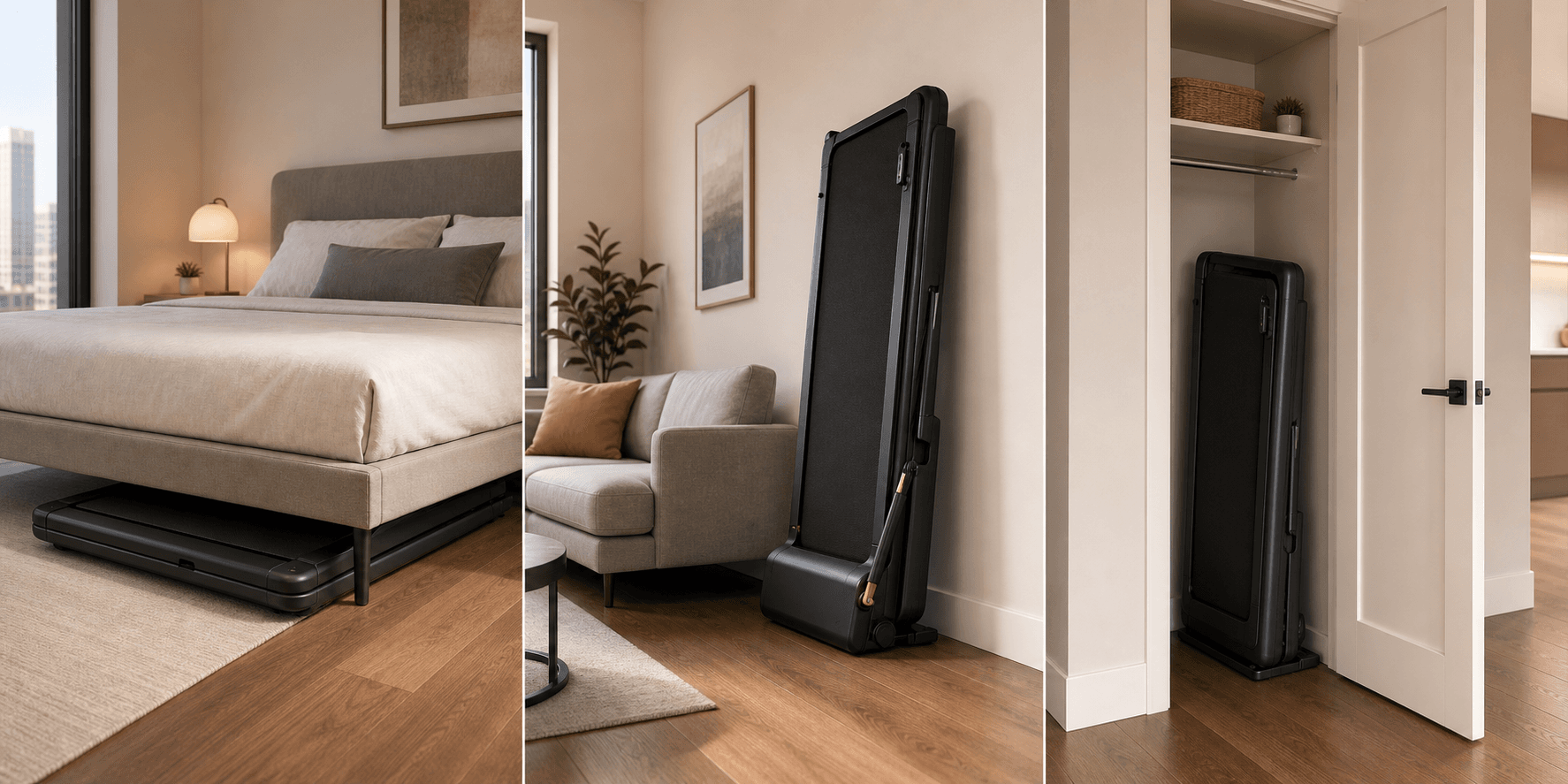
Space Planning Guide: Ceiling Height, Room Dimensions, and Outlet Requirements
Even the most compact treadmill will not work in a space that is too small or has inadequate ceiling height. Before you buy, measure your space against these minimum requirements.
Ceiling Height
Running on a treadmill requires more vertical clearance than walking because your body rises and falls with each stride. A minimum ceiling height of 7 feet (84 inches) is adequate for most runners under 6 feet tall. If you are 6 feet or taller, or if you have a high knee drive, aim for at least 7 feet 6 inches (90 inches). To check your personal clearance: stand on the treadmill deck, raise your arms overhead, and ensure you have at least 6 inches of clearance above your fingertips.
Room Dimensions for Safe Use
A treadmill needs clearance on all sides for safe entry, exit, and emergency dismount. The minimum recommended room dimensions are:
- Width: At least 4 feet (48 inches) wider than the treadmill deck. For a 20-inch-wide deck, that means a minimum room width of 5 feet 8 inches (68 inches).
- Length: At least 6 feet (72 inches) longer than the treadmill deck. For a 60-inch deck, that means a minimum room length of 11 feet (132 inches).
- Behind the treadmill: At least 3 feet (36 inches) of clear space behind the belt for emergency dismount.
- Storage clearance: For flat-fold models, ensure the storage location (under a bed, in a closet) has at least 2 inches of clearance above the folded height.
Electrical Requirements
Most home treadmills require a dedicated 15-amp or 20-amp circuit. Plugging a treadmill into a circuit shared with other high-draw appliances (refrigerator, microwave, air conditioner) can trip the breaker mid-run. Check the owner's manual for the specific amperage requirement, and if possible, use a surge protector rated for treadmill use.
Noise Comparison: Which Treadmills Keep the Neighbors Happy?
Noise is a first-class concern for apartment dwellers. A treadmill that sounds like a jet engine at 8 mph will generate complaints from neighbors below and beside you. The good news is that measured noise levels vary significantly between models, and quieter options exist.
OutdoorGearLab conducted controlled noise measurements on several popular treadmills. The Echelon Stride 6 registered at just 60 dB during use — quieter than most home treadmills, which typically fall in the 65–75 dB range. To put that in context: 60 dB is roughly the volume of a normal conversation, while 70 dB is closer to a vacuum cleaner. A difference of 10 dB represents a tenfold reduction in acoustic energy.
| Model | Measured dB | Comparable To | Apartment Suitability |
|---|---|---|---|
| Echelon Stride 6 | 60 dB | Normal conversation | Excellent — unlikely to disturb neighbors |
| Typical home treadmill | 65–75 dB | Vacuum cleaner | Moderate — may be audible in adjacent units |
| NordicTrack 1750 | ~68 dB (est.) | Loud conversation | Good — use on a rubber mat to reduce floor vibration |
| Horizon T101 | ~65 dB (est.) | Moderate conversation | Good — quieter than average for its class |
Beyond the treadmill itself, floor vibration transmits noise to units below. A high-quality rubber treadmill mat (at least 1/4 inch thick) can significantly reduce structure-borne noise. For apartments with wood-frame construction, consider a mat with a closed-cell foam layer to absorb impact vibration.
Decision Matrix: Which Storage Type Fits Your Space?
The right treadmill for your small space depends on how you plan to store it. Use this decision matrix to match your storage constraint to the best category and model.
| Storage Type | Best For | Top Pick | Key Advantage | Key Trade-Off |
|---|---|---|---|---|
| Flat-fold (under-bed) | Runners who need the treadmill to disappear completely when not in use | Echelon Stride 6 | Folds to 10 in; full 60-in deck; 12.4 mph; quiet (60 dB) | Higher price point; not ideal for daily folding/unfolding |
| Flat-fold (budget) | Runners on a tight budget who need under-bed storage | Horizon T101 | Lightweight (180 lbs); easy hydraulic fold; under $700 | 55-in deck; 2.5 CHP motor — at minimum running threshold |
| Vertical-fold | Runners who can dedicate a corner or wall space for storage | NordicTrack 1750 | 22 x 60 in deck; 4.25 CHP motor; EasyLift assist | Heavy (300+ lbs); not portable; requires iFit subscription for full features |
| Vertical-fold (mid-range) | Runners who want a vertical fold without premium pricing | Sole F63 | 60-in deck; 3.0 CHP; lifetime frame warranty | No folding assist; heavier than flat-fold models |
If you are still unsure which storage type fits your space, start by measuring your available storage location. If you have a bed with at least 12 inches of clearance, the flat-fold category (Echelon Stride 6 or Horizon T101) will give you the most flexibility. If you have a corner or wall where the treadmill can remain upright, the vertical-fold category (NordicTrack 1750 or Sole F63) offers more powerful motors and wider decks. For a broader look at how a treadmill fits into a complete apartment gym setup, see our Compact Home Gym Equipment Guide for Apartments.
For more detailed guidance on choosing between folding mechanisms and evaluating total cost of ownership, read our Folding Treadmill Buyer's Decision Framework.
Comments
Join the discussion with an anonymous comment.