
All-in-One vs. Modular Home Gym: Comparing Cost, Space, and Upgrade Flexibility
This article compares two strategies for building a compact home gym—buying a single all-in-one machine versus assembling a modular system over time—by analyzing total cost of ownership, space requirements at each investment tier, upgrade paths, and subscription lock-in, to help you decide which approach fits your constraints.
- Space type
- apartment
Items included: —
The fork in the road usually shows up after the first round of shopping: spend several thousand dollars on one compact home gym machine now, or start with adjustable dumbbells, bands, a mat, and a bench, then add pieces as training demands grow. If you need the broader philosophy first, the modular vs. all-in-one vs. smart gym overview is the better starting point. This comparison assumes you already know the trade-off exists and are trying to avoid the expensive version of “I’ll figure out the rest later.”
The sticker price is the loudest number, but it is rarely the deciding one. Garage Gym Reviews lists smart and all-in-one machines across a wide span, including Tonal 2 at $4,295, Speediance at $3,199, a PRx foldable rack around $1,100, a Bells of Steel cable tower around $435, and the X3 Bar at $550.[1] Those prices do not live in the same kind of room, require the same future purchases, or create the same exit problem if your training changes.
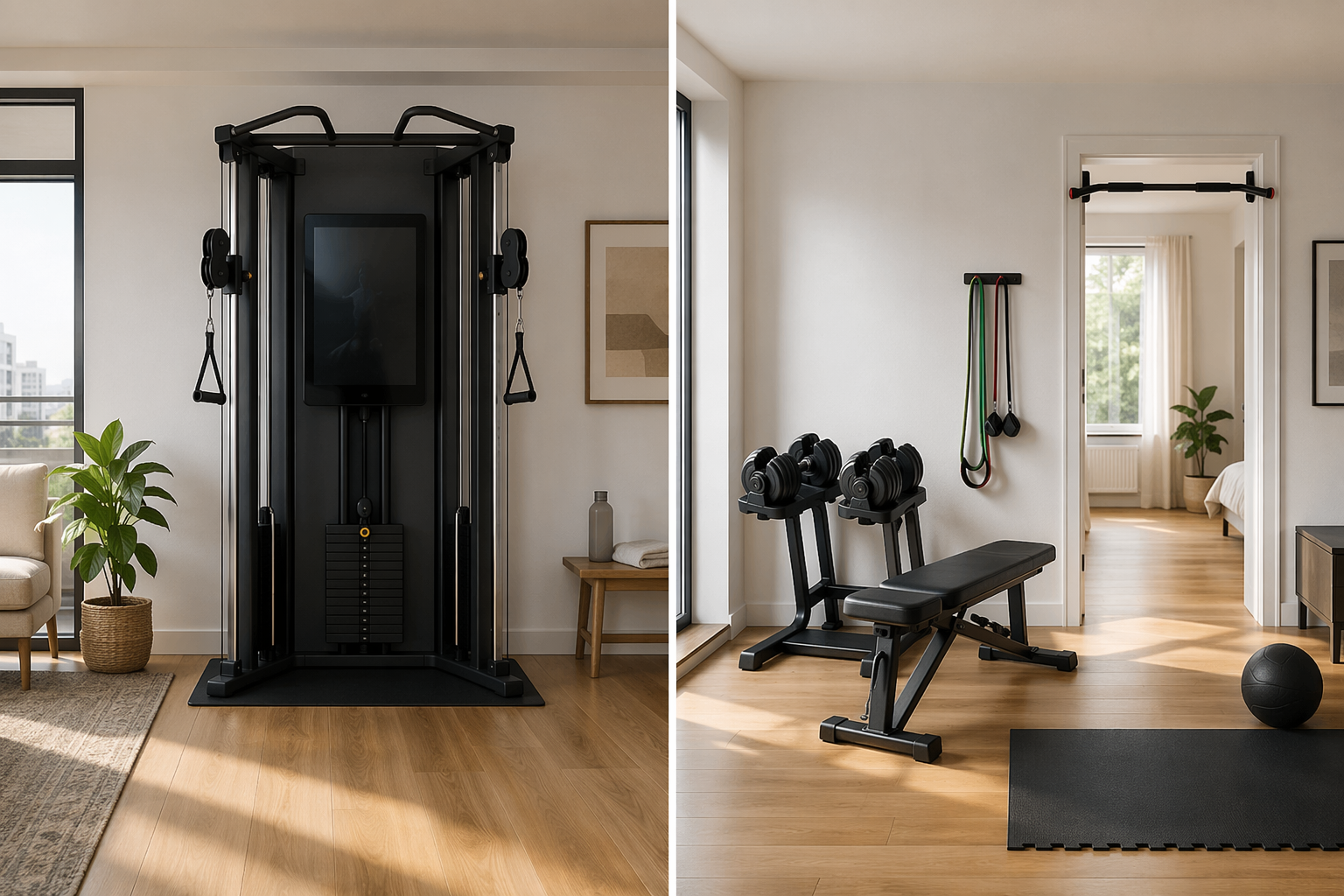
The Useful Comparison Is Total Ownership, Not Machine Price
A compact home gym has three costs. The first is the obvious purchase price. The second is the setup cost: flooring, bench, mat, attachments, storage, delivery, and sometimes wall clearance or installation. The third is the future cost of outgrowing the first decision.
That is why the cheapest modular start can be a genuinely good move and still not be the universal recommendation. A minimalist setup built from adjustable dumbbells, resistance bands, a mat or floor tiles, and a doorway pull-up bar can come in under $900 using the source figures here: about $595 for adjustable dumbbells, $192 for resistance bands, $40 for a doorway pull-up bar, and $25 for floor tiles. WIRED’s PT-recommended minimalist approach supports the idea that a true low-equipment training setup can be legitimate rather than just a compromise.[2]
But that setup does not quietly become a cable machine. It does not solve heavy lower-body loading for every lifter. It also asks you to keep making good compatibility decisions: which bench height, which rack footprint, which plates, which cable tower, which storage plan. The modular path protects you from one large mistake, but it can create five smaller ones if every purchase is treated as a standalone bargain.
All-in-one systems reverse the problem. They concentrate the decision into one package. That can be expensive, and in some cases it adds a subscription. It can also be the reason the equipment actually gets used: one footprint, one interface, one resistance system, one set of accessories, fewer loose parts competing for floor space.
| Decision Area | Modular Build | All-in-One Machine |
|---|---|---|
| Entry cost | Can start under $900 with dumbbells, bands, mat or floor tiles, and a pull-up bar using the figures above.[2] | Usually starts much higher for smart systems; Tonal 2 and Speediance are listed at $4,295 and $3,199 respectively.[1] |
| Space behavior | Starts small but spreads as bench, rack, plates, tower, and storage enter the room. | Often cleaner as one zone, but folded depth or wall profile can hide the movement space you still need. |
| Upgrade flexibility | High if you plan the end state; messy if rack, bench, tower, and storage are chosen independently. | Lower component flexibility, but the training ecosystem is coherent from day one. |
| Subscription exposure | Usually none unless you add apps or connected equipment. | Varies sharply: some smart gyms depend heavily on subscriptions, while mechanical machines may have none. |
| Exit or resale | Individual parts can be sold separately, but mismatched pieces may be harder to move as one package. | Complete systems may be easier for a second buyer to understand, though resale differences are not supported by systematic data here. |
Space: Folded Footprint Is Not the Room You Train In
A machine can look compact against a wall and still require an honest training zone around it. Healthline’s home-gym space guidance uses a 6- to 8-foot square as a minimum anchor for free movement.[3] That does not mean every setup needs the same square; it means the product footprint is only the parked position. Your body, bench angle, cable path, dumbbell swing, mat, and walking clearance are part of the gym.
This matters most in apartments, shared garages, and multipurpose rooms. Garage Gym Reviews’ apartment equipment guide cites the National Apartment Association figure of 39 million American apartment dwellers, which is a useful reminder that “just wall-mount it” is not advice many people can use.[4] Renters may be unable to bolt a folding rack into studs, may need to preserve a living room path, or may have neighbors below them who make heavy barbell training a flooring and noise question before it is a strength question.
For a more granular layout view, the compact home gym by space tier guide is the right companion piece. The short version here is that both strategies can be compact, but they become compact in different ways.
| Budget Tier | Modular Space Reality | All-in-One Space Reality | Main Decision |
|---|---|---|---|
| Entry: under about $900 | Dumbbells, bands, mat or tiles, and a pull-up bar can live in a corner or closet, but workouts still need open floor space.[2][3] | Most full smart all-in-one systems are outside this tier based on listed prices.[1] | Modular is the realistic route if the hard ceiling is under $900. |
| Intermediate: about $1,500–$2,500 | A bench, heavier dumbbells, a foldable rack, or cable tower can enter the plan; storage and clearance start becoming the real footprint. | Some non-premium all-in-one or mechanical systems may fit here, depending on model and accessories. | Compare the final room layout, not just the next purchase. |
| Advanced: $4,000+ | A rack, barbell, plates, cable tower, bench, storage, and flooring can be stronger and more adaptable but less visually compact. | Premium smart systems are squarely in this tier; Tonal 2 is listed at $4,295 before accessory and subscription considerations.[1] | The choice shifts from affordability to control, coherence, and lock-in. |
Flooring belongs in this calculation earlier than most people put it. A mat under dumbbells is not the same as a protected lifting area for a rack and plates. If your plan includes iron, adjustable dumbbells, or a cable tower on hard flooring, add the flooring line before deciding which setup is cheaper; the home gym flooring cost guide is where that number should be worked out.
How the Modular Path Actually Evolves
The best modular compact home gym is not a pile of clever purchases. It is a staged version of a finished gym. The first stage buys training coverage. The second stage buys better loading. The third stage buys the movement patterns the first two stages could not cover well.
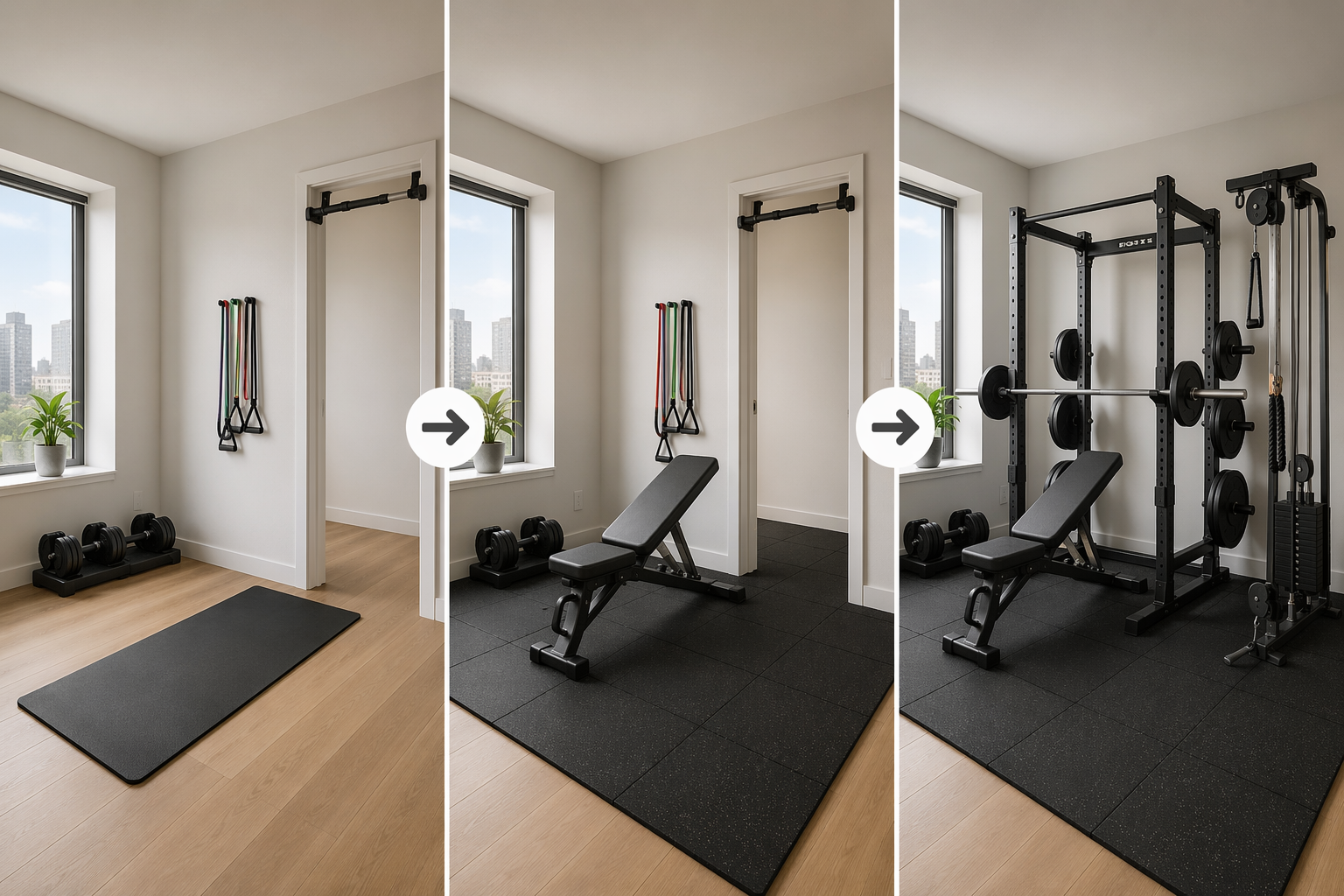
A sensible first stage is adjustable dumbbells, resistance bands, a mat or tiles, and maybe a doorway pull-up bar. It covers pressing, rows, split squats, hinges, curls, raises, band pulldowns, assisted mobility work, and general conditioning. It also keeps the room livable. For someone testing consistency, this is the least painful way to learn what they actually do at home.
The second stage is usually a bench and heavier loading. This is where many people discover that “small-space equipment” is not just small equipment. Bench length, bench height, dumbbell shape, and where the unused pair sits between sets all affect whether the setup feels tidy or constantly in the way. Readers choosing specific pieces can continue into the best home gym equipment for small spaces once the strategy is clear.
The third stage is where the modular path either becomes excellent or starts looking like a storage problem. A foldable rack around the PRx price point of $1,100 and a cable tower around the Bells of Steel price point of $435 can add barbell work and cable patterns without jumping straight to a premium smart system.[1] But those pieces need a plan: rack depth, ceiling height, bench fit inside the rack, plate storage, cable tower placement, and whether the rack can be mounted at all.
In a garage, that phased approach can work especially well because the room can absorb a little awkwardness while the setup matures. The single-car garage phased build guide follows that logic more closely. In an apartment, the same path needs stricter rules. If the rack cannot be wall-mounted, if plates cannot be stored without blocking a walkway, or if cable work would require moving furniture every session, the modular plan may be flexible on paper and annoying in real life.
What the All-in-One Path Gets Right
The all-in-one case is strongest when the buyer values coherence. A smart gym or integrated cable machine can remove a surprising amount of friction: no separate rack search, no plate math, no bench compatibility rabbit hole, no cable tower squeezed beside a dresser, and fewer pieces to explain if the system is sold later.
That does not make it automatically space-saving. A wall-mounted smart system may have a shallow parked footprint, but it still needs working clearance for arms, cables, lunges, hinges, and a bench. A freestanding all-in-one may keep attachments organized but occupy a fixed zone that cannot be repurposed as easily as a mat-and-dumbbell corner. The honest question is not “does it fold?” It is “can I train without rearranging the room every time?”
The higher price can also be rational if it prevents a long sequence of partial purchases. A person who already knows they want cable movements, guided programming, compact storage, and a clean interface may spend less emotional energy buying once than trying to assemble the same experience from separate parts. This is especially true for someone who does not enjoy equipment research and has no interest in turning a spare room into a continuing project.
Resale is the one area where the all-in-one path probably has an advantage, but the claim should stay modest. A complete system with its accessories intact is easier for a new buyer to understand than a mixed set of bench, tower, bands, dumbbells, and storage pieces. No systematic resale-market analysis is cited here, so this is a practical expectation rather than a measured resale premium.
Subscription Lock-In Is Real, but It Is Not the Same for Every Machine
Subscription risk gets exaggerated when every all-in-one machine is treated as a smart gym. Tonal-style systems, Speediance-style ecosystems, and Bowflex-style mechanical machines do not create the same dependency.
The smart-gym concern is straightforward: if the screen, coaching, resistance modes, tracking, or workout library are central to the product, the subscription is part of the ownership cost, not an optional entertainment add-on. The source figures include smart gym subscription ecosystems in the $39 to $49 per month range, along with proprietary accessories such as Tonal’s $495 smart accessories package.[1]
That is different from a mechanical all-in-one machine with cables, rods, pulleys, or weight stacks. If the resistance still works without an app, the lock-in risk is lower. You may still be limited by the machine’s maximum resistance, movement path, and accessory ecosystem, but you are not deciding whether the gym loses major value when a monthly payment stops.
Speediance’s own 2026 ROI article says a roughly $3,000 all-in-one setup can break even against an $80-per-month gym membership in about three years.[5] That is useful as a manufacturer-provided datapoint, not as proof that every smart gym pays for itself. It depends on the membership you would actually cancel, the subscription you would actually keep, delivery and accessory costs, and whether the machine still fits your training two years from now.
The cleaner comparison is to calculate the monthly ownership cost you can live with. A $3,199 machine plus a recurring subscription behaves very differently from a $900 modular start with no required monthly fee. But a modular setup that grows into a rack, bench, plates, cable tower, flooring, and storage can also pass the original budget quietly. The subscription is not the only way a compact gym becomes more expensive over time.
The Break-Even Math Changes by Tier
At the entry tier, modular wins on cost because the all-in-one alternative often is not really in the same budget conversation. Using the under-$900 modular setup described earlier, a person replacing a $50-per-month gym membership reaches a simple purchase-price break-even in about 18 months. That does not prove they should cancel a gym; it only shows the purchase price can be recovered quickly if the home setup truly replaces the paid membership.
At the intermediate tier, the math gets less tidy. A bench, heavier adjustable dumbbells, more floor protection, storage, or a first cable option can make the modular route much more capable. It can also erase the feeling of having spent “only” a few hundred dollars. This is where the buyer should price the next two purchases, not just the current one.
At the advanced tier, the modular route is no longer mainly about being cheap. It is about owning the components: a rack you can keep, a barbell you can replace, plates that work with different setups, a cable tower that can be upgraded or sold separately. The all-in-one route at this tier is about buying a finished training experience. The right answer depends on whether you want control over the system or relief from designing it.
| Tier | Modular Advantage | All-in-One Advantage | Watch-Out |
|---|---|---|---|
| Entry | Lowest realistic starting cost; easy to store; no required subscription. | Limited unless considering simpler non-smart machines or used equipment. | No cable work and limited heavy lower-body loading. |
| Intermediate | Can add the missing capability one piece at a time. | May provide a neater full-body setup if the model fits the room. | Modular clutter starts here if storage and compatibility are ignored. |
| Advanced | Best control over rack, bar, plates, bench, cables, and future replacements. | Most coherent package; potentially easier to adopt and resell intact. | Smart systems may add recurring fees and closed accessories. |
Upgrade Flexibility Is the Real Divider
A modular compact home gym is best when the first purchase already knows the third purchase. If you may eventually want a rack, buy a bench that works inside one. If you may eventually want cable work, leave wall or corner space for it. If you may eventually use a barbell, do not fill the only lifting zone with furniture-like storage that cannot move.
The all-in-one path is best when you accept the ceiling before buying. Digital resistance, integrated cables, guided workouts, and compact storage can be excellent, but they are not infinitely expandable. If your training is likely to move toward heavy barbell squats, specialty bars, competition-style benching, or highly specific accessory work, the closed system may become the thing you work around instead of the thing you grow into.
For readers still deciding between smart resistance and traditional weights, the smart home gym vs. traditional weights guide is the more focused next read. That question sits underneath this one: some people are choosing a buying strategy, but others are really choosing what kind of resistance they want to train with for the next several years.
A Practical Way to Choose
Start by drawing the training zone, not the equipment footprint. Mark the open floor space you can keep available, the door swing, the path through the room, and any wall you cannot drill into. Then price the setup as it will be used: machine or components, bench, mat or flooring, accessories, storage, delivery, and subscription if the system depends on one. The complete small-space home gym decision guide can help if you are still sorting room constraints from equipment preferences.
- Choose modular if your budget is tight now, you want to phase purchases, and you are willing to plan the end state before buying the first pieces.
- Choose modular if you expect your training to change toward barbell work, heavier loading, or component upgrades.
- Choose all-in-one if you value a complete package, a cleaner setup, fewer compatibility decisions, and a system that feels coherent from the first workout.
- Choose all-in-one only after you understand the subscription, accessory, resistance ceiling, and what the machine can still do if you stop paying.
There is no universal winner here. The modular route is usually the safer first move when preserving cash and flexibility matters most. The all-in-one route earns its price when simplicity, compact coherence, and lower planning burden matter more than component control. The expensive mistake is not choosing one path over the other; it is buying as if the first footprint, first price, or first month of enthusiasm tells the whole story.
References
- Best Home Gym Machines in 2026 — Garage Gym Reviews
- PT-recommended minimalist setup — WIRED
- Home gym space dimensions — Healthline
- Apartment equipment guide — Garage Gym Reviews
- 2026 Home Gym Review: Pros, Cons & ROI — Speediance
Some links on this page are affiliate links — they may earn us a commission at no extra cost to you. Our tier and tests are decided before we ever check which links pay; see our full affiliate disclosure.
Spot something off?
Noise and floor-damage claims carry real deposit-risk consequences if we get them wrong — tell us if your experience with this build didn't match what's above.