
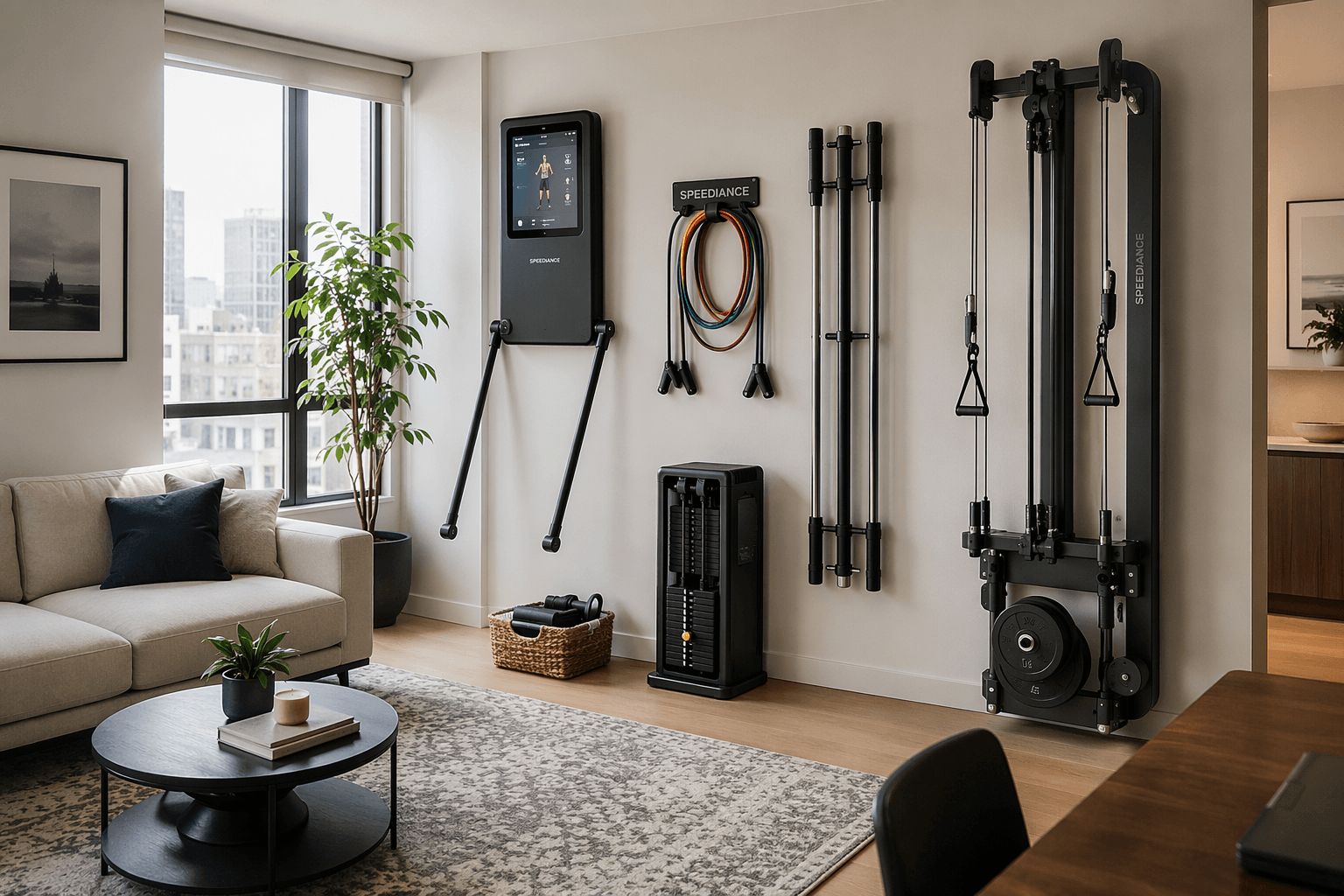
A machine can look compact on a product page and still be awkward in a real apartment once you count plate storage, cable travel, ceiling height, floor vibration, and the bench you still need to move before dinner. In a compact home gym, the wrong resistance system is not just a weaker training choice; it is a room-management problem that you live with every day.
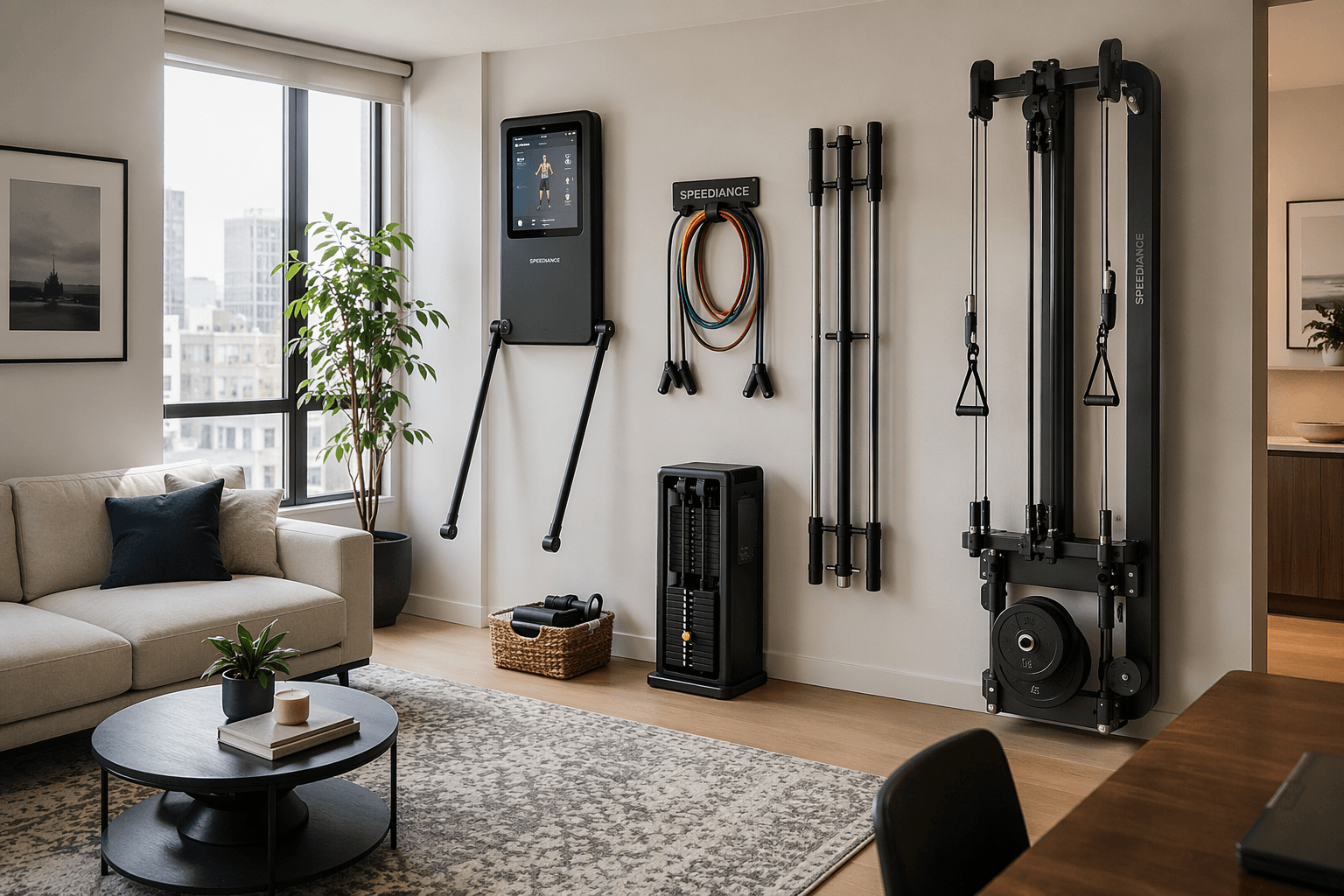
A compact home gym comparison at a glance
The matrix below uses the testing numbers and product specifics in the research brief so you can compare the five resistance types on the same terms instead of getting pulled in by one big resistance number or one narrow footprint figure.[1]
| Resistance type | Footprint reality | Noise | Max resistance / capacity | Feel | Subscription cost | Upgrade path | Apartment suitability |
|---|---|---|---|---|---|---|---|
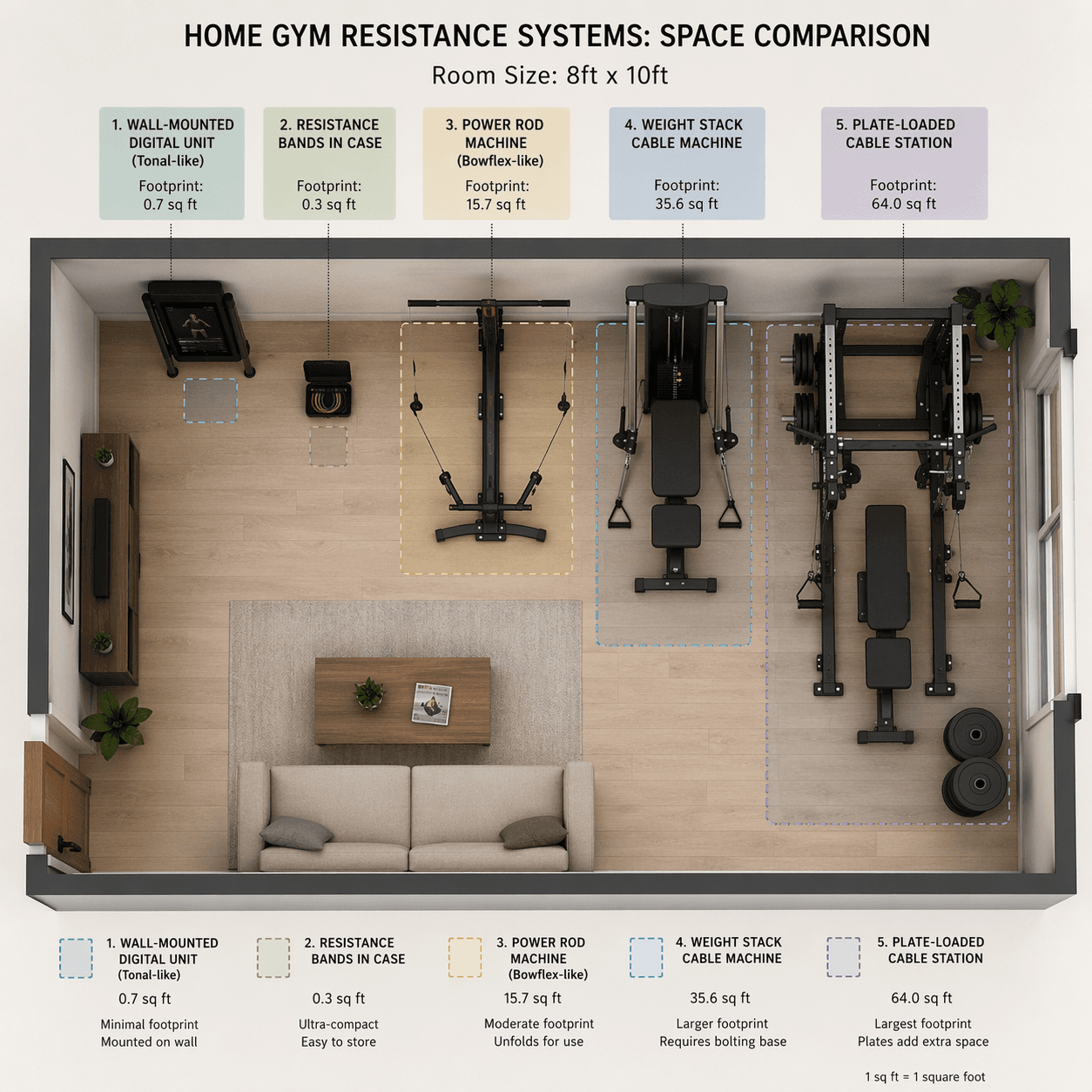
| Weight stack | Larger than digital and band systems; often needs bolting and real clearance | Moderate | About 200-260 lbs per side at a 2:1 ratio | Most traditional cable feel | No subscription | Good, but not the most expandable | Works if you can give up more room and accept some noise |
| Digital / electromagnetic | Tonal at 5.25"D x 21.5"W; Speediance at 28.34"W x 49.21"D unfolded | Quietest | 250 lbs on Tonal; 220 lbs on Speediance | Smooth and precise, but machine-specific | Tonal requires $49/month; Speediance has no subscription | Software and ecosystem driven, not plate-driven | Best fit when silence and small footprint matter most |
| Resistance bands | X3 Bar at 10" x 19" x 1" | Near-silent | Up to 300-600 lbs of force | Distinct from free weights | Zero subscription | Bands wear and need replacement | Very strong fit for tiny rooms and portable use |
| Power rods | Bowflex Xtreme 2 SE at 63"L x 49"W x 83.25"H | Quieter than stack and plate-loaded systems | 210-410 lbs upgradable resistance | Unique variable resistance curve | No subscription | Moderate; lighter than plate-loaded systems | Useful if you accept a different feel for a lighter machine |
| Plate-loaded cables | Largest footprint of the five; requires separate plates and more room around the station | Loudest | Highest potential resistance | Closest to heavy cable work | No subscription | Most upgradeable | Usually the hardest fit in apartments, especially upstairs |
Listed dimensions are only the starting point. The real room cost includes wall depth, plate storage, the space needed to stand and press without hitting furniture, bolting requirements, and whether the ceiling still leaves you enough usable range of motion. That last point matters more than many reviews admit, especially for taller users and for compact smart machines with less-documented fit limits.
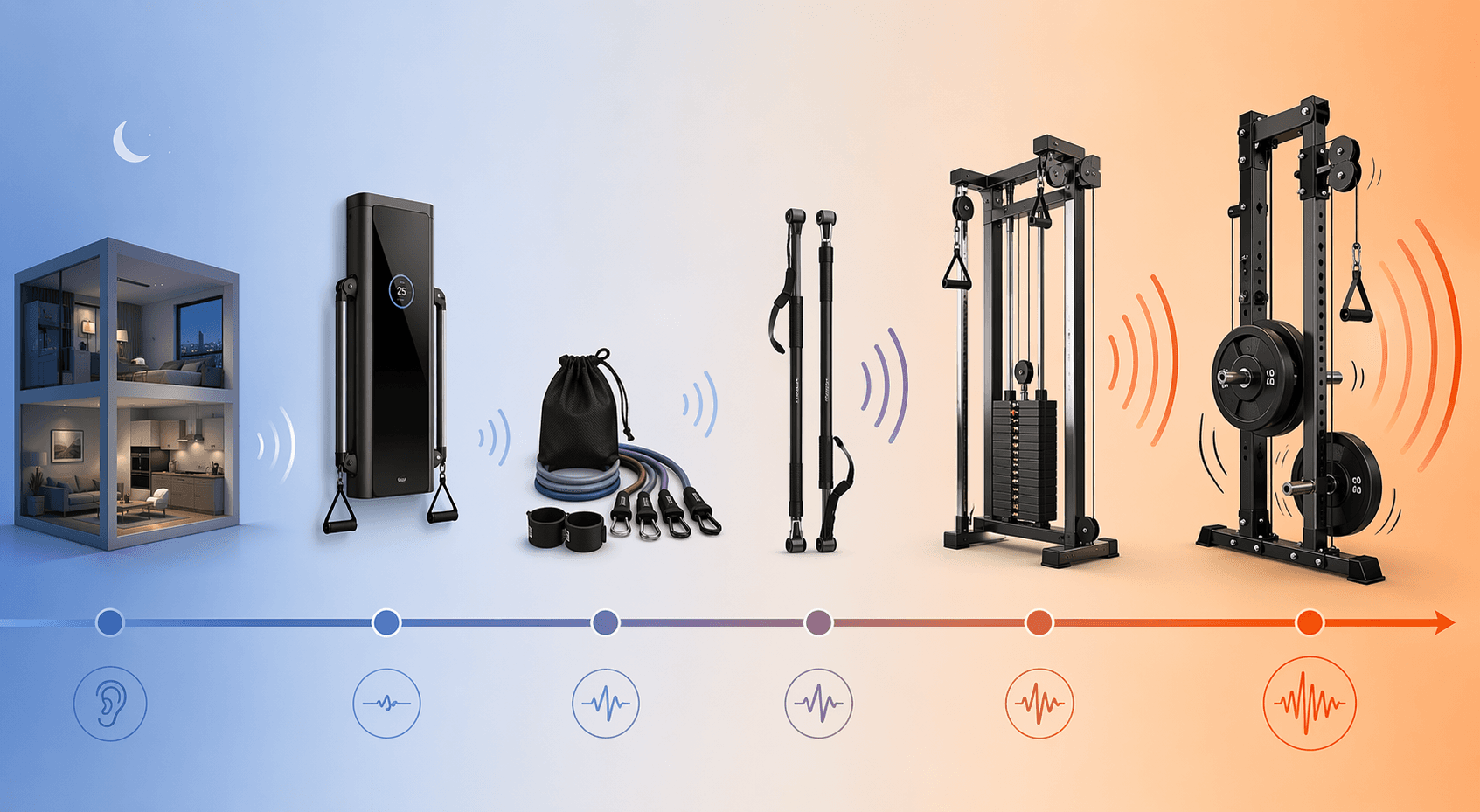
Noise and footprint decide more than most specs
For apartment use, the clearest hierarchy is magnetic or digital resistance first, then bands, then power rods, then weight stacks, with plate-loaded systems that involve iron drops at the loud end.[1] That order is not about gym romance; it is about what your neighbors hear, what the floor feels like, and how often you have to think about the machine after the workout is over.
How each resistance type behaves in a small room
Digital resistance
Digital systems make the strongest case when you are trying to keep a compact home gym quiet and physically small. Tonal’s footprint is extremely slim, Speediance folds into a still-manageable wall of hardware, and both avoid the clatter that makes apartment training harder to live beside.[1] The catch is that the clean setup comes with a ceiling: Tonal tops out at 250 pounds and requires a $49 monthly subscription, while Speediance reaches 220 pounds without a subscription.[1] If your room is small, your schedule is early, and your tolerance for floor vibration is low, that trade can make a lot of sense. If you are chasing more headroom for long-term strength progression, the resistance limit becomes the conversation.
Resistance bands
Bands are the quiet wildcard. The X3 Bar is tiny, near-silent, and easy to store, and the reported force range reaches 300 to 600 pounds without any subscription at all.[1] That combination solves a lot of apartment problems better than a heavier-looking machine can. The downside is not subtle: the feel is different from free weights, and the bands themselves wear out, so the system asks for periodic replacement rather than permanent indifference.[1] For a renter, that may still be the cleaner compromise because the whole setup disappears when the room has to become a living room again.
Weight stacks
Weight stacks are the most familiar answer if what you want is cable training that still feels like cable training. They come with no subscription, they usually land in the 200 to 260 pound per-side range at a 2:1 ratio, and they sit in a middle band for noise rather than a silent one.[1] That makes them easier to justify in a house or garage than in a second-floor apartment. They also tend to require bolting, which is not a moral issue but a living-situation issue. If the machine has to stay put, and if your building does not love vibration or anchor points, the appeal drops fast. For a deeper look at the economics of this category, see the <a href="/is-a-home-gym-cable-machine-worth-it" rel="internal">cable-machine cost-benefit analysis</a>.
Power rods
Power rods sit between the familiar and the unusual. Bowflex’s Xtreme 2 SE is lighter than a plate-loaded tower, avoids a subscription, and gives you an upgradable 210 to 410 pounds of resistance in a package that is still compact enough to count as space-conscious rather than sprawling.[1] The compromise is the resistance curve. It is not the same as weights on a cable stack, and the feel is a little too specific to be called universal. GGR’s testing also gave the Xtreme 2 SE a durability score of 3/5, which is a reminder not to smooth away early wear concerns just because the machine is lighter on the floor.[1]
Plate-loaded cables
Plate-loaded cable systems earn respect for one reason: they scale. If you want the highest resistance ceiling and the most upgrade room, they are the clear edge case winner.[1] They are also the largest footprint of the five, the loudest when plates move or drop, and the category most likely to turn a compact home gym into a storage problem instead of a training solution.[1] In a garage, that can be fine. In an upstairs apartment, the same setup can become the machine you end up avoiding because you do not want to think about every rep as a noise event.
Match the resistance type to the constraint that actually matters
If you are still sorting the bigger room-planning questions before you commit to a resistance system, the broader <a href="/the-complete-compact-home-gym-decision-framework" rel="internal">compact home gym decision framework</a> is the better next stop.
- Choose digital resistance if quiet footprint matters most and the resistance cap and monthly cost still fit your plan.
- Choose bands if portability and silence matter more than a free-weight feel.
- Choose weight stacks if you want familiar cable training and can live with more space, some noise, and a more fixed installation.
- Choose power rods if you accept a distinct feel in exchange for a lighter no-subscription machine.
- Choose plate-loaded cables if upgradeability and high resistance matter more than apartment friendliness.
References
- Garage Gym Reviews testing data on compact home gym resistance systems — Garage Gym Reviews — garagegymreviews.com
Comments
Join the discussion with an anonymous comment.