
Garage Workout Equipment for Small Spaces: Wall-Mounted Racks, All-in-One Machines, and Layout Strategies for a Shared Garage
This guide helps suburban homeowners with a single-car or shared two-car garage choose equipment that coexists with parking and storage. It covers wall-mounted foldable racks, multi-function machines, space-saving weights, and layout strategies for a gym that fits a half-garage without sacrificing training quality.
- Budget tier
- $1,500–$4,000
- Space type
- garage
Items included: —
Why a Shared Garage Changes Your Equipment Choices
Most garage gym guides operate on a generous assumption: you own the entire space. They picture a two-car garage emptied of vehicles, lined with stall mats wall-to-wall, and filled with a power rack, a barbell, a bench, a dumbbell set, and maybe a rower or a fan bike. That vision works if you have a dedicated garage or a three-car bay. But for the majority of suburban homeowners — those with a single-car garage or a shared two-car garage — that advice is not just unhelpful; it is actively misleading.
When your garage must also fit a car, lawn equipment, holiday decorations, or a workbench, the equipment-selection logic flips. The primary constraint is no longer budget or training style — it is footprint. Every piece of gear must earn its square footage, and the best purchase is often the one that disappears when you are done using it. This article is written for that specific scenario: a garage where the gym coexists with everything else.
Wall-Mounted and Foldable Racks: The Foundation of a Shared-Space Gym
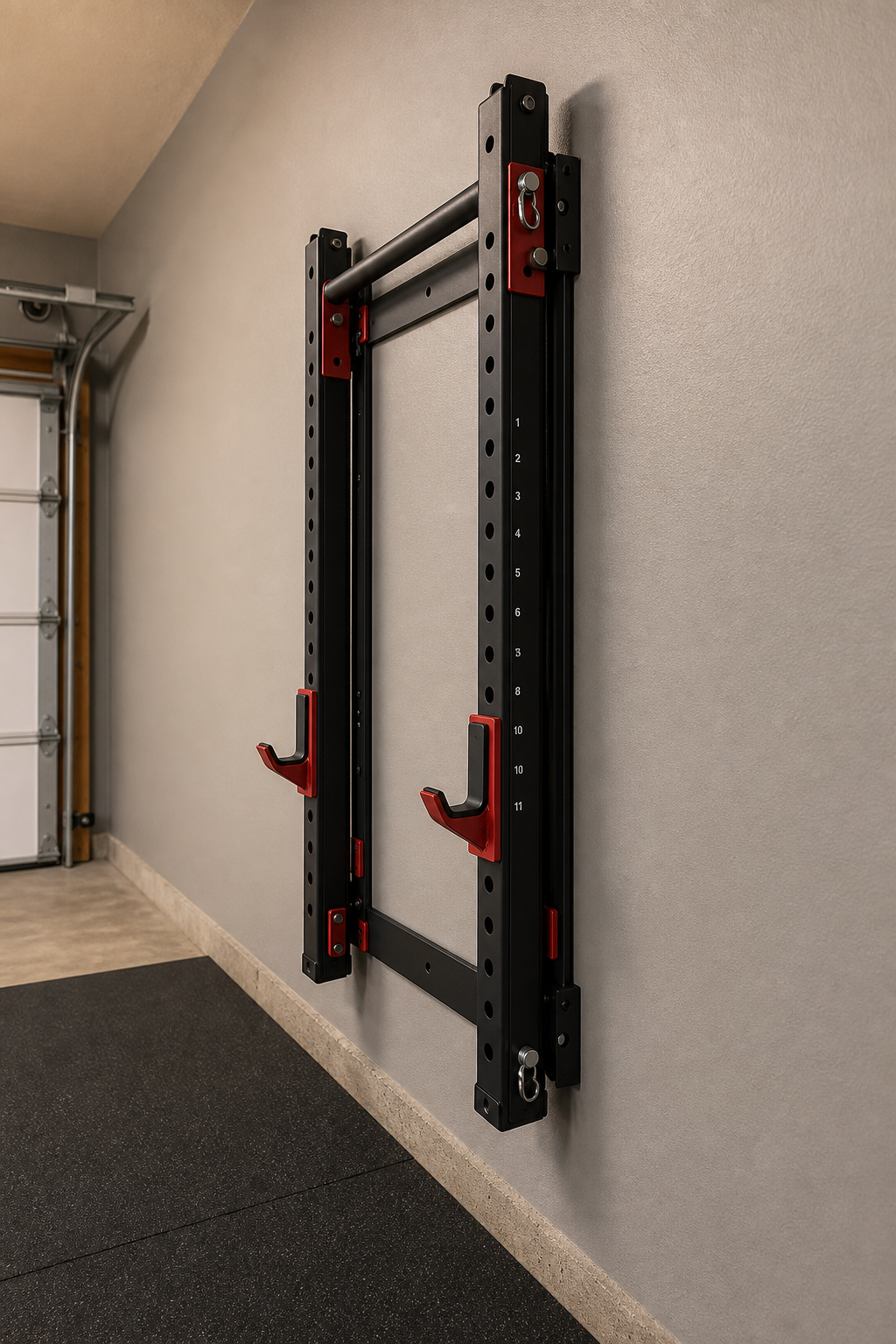
If you can buy only one piece of space-saving equipment for a shared garage, make it a wall-mounted foldable rack. A full-size power rack with a 48-inch depth occupies roughly 20 square feet of floor space permanently. A foldable rack, by contrast, lives on the wall and extends only when you need it. When folded, it protrudes just inches into the room — enough to park a car or walk past without obstruction.
The current benchmark in this category is the PRx Profile PRO Squat Rack. According to Garage Gym Reviews' testing, it folds to just 9 inches from the wall — the shallowest folded depth among commercially available wall-mounted racks. Unfolded, it measures 53 inches wide by 29.25 inches deep by 89 inches tall, with a stated capacity of 1,000 pounds. At $1,099.99, it is not cheap, but it is the closest thing to a disappearing rack on the market. The trade-off is that it requires bolting into studs, and the installation must be precise — the pull-up bar and J-hooks are fixed to the uprights, so ceiling height and wall space need to be measured carefully before purchase.
Several alternatives exist at lower price points. The Rogue RML-3WC is a wall-mounted foldable rack with a slightly deeper folded profile (around 12 inches) but a wider stance and compatibility with Rogue's full line of Monolith attachments. REP Fitness offers the Wall Mounted PR-5000, which can be paired with REP's wall-mounted Athena cable system or the ARES 2.0 for a combined rack-and-cable setup — a compelling option for those who want both squat and cable work in a single wall footprint.
| Rack | Folded Depth | Unfolded Footprint (W x D x H) | Weight Capacity | Price (June 2026) |
|---|---|---|---|---|
| PRx Profile PRO | 9" | 53" x 29.25" x 89" | 1,000 lbs | $1,099.99 |
| Rogue RML-3WC | ~12" | 49" x 30" x 90" | 1,000 lbs | $795 |
| REP Wall Mounted PR-5000 | ~12" | 49" x 30" x 90" | 1,000+ lbs | $649+ |
| Titan T-3 Series Wall Mount | ~14" | 48" x 30" x 87" | 1,100 lbs | $465-$689 |
All-in-One Machines That Combine Rack and Cable in a Compact Footprint
For some users, a wall-mounted rack is not enough. If your training relies heavily on cable work — lat pulldowns, rows, face pulls, tricep pushdowns — you may be tempted to buy a separate functional trainer. In a shared garage, that is a luxury most cannot afford. A functional trainer typically occupies 20 to 30 square feet of floor space, and adding one alongside a rack can consume half the garage.
The solution is an all-in-one machine that integrates a squat rack and a cable system into a single footprint. These machines are not new, but recent models have shrunk their dimensions significantly while maintaining usable cable weight.
The Bells of Steel All-in-One Home Gym is a strong contender for small garages. According to Garage Gym Reviews, its footprint is 54.6 inches deep by 59 inches wide by 81 inches tall — roughly 22 square feet. It starts at $1,299.99 and offers a 300-pound cable capacity, which is sufficient for most intermediate lifters. The trade-off is that the cable system uses a single weight stack with a selectorized pin, so you cannot do bilateral cable work (like cable crossovers) without an adapter.
The Major Fitness B17 is larger — 68.1 inches deep by 78.7 inches wide by 88.1 inches tall — but it features dual weight stacks that can be expanded to 260 pounds each. This allows for true bilateral cable work. The B17 is better suited to a two-car garage where the gym occupies one bay and the car the other, rather than a single-car garage where every inch matters.
For those willing to trade steel plates for digital resistance, the Speediance Gym Monster offers a radically different form factor. Unfolded, it measures 49.21 inches long by 28.34 inches wide by 72.83 inches tall. Folded, it compresses to just 14.96 inches deep — smaller than a standard mattress. It provides up to 220 pounds of digital resistance and includes a built-in screen with guided workouts. The catch is the price (around $2,500) and the fact that digital resistance feels different from steel plates — some lifters find it less satisfying for heavy compound lifts.
| Machine | Footprint (D x W x H) | Cable / Resistance | Price (June 2026) | Best For |
|---|---|---|---|---|
| Bells of Steel All-in-One | 54.6" x 59" x 81" | 300 lbs (single stack) | $1,299.99+ | Single-car garage, budget-conscious, unilateral cable work |
| Major Fitness B17 | 68.1" x 78.7" x 88.1" | 260 lbs per side (dual stacks) | $1,899+ | Two-car garage bay, bilateral cable work, taller users |
| Speediance Gym Monster | 14.96" folded x 28.34" x 72.83" | 220 lbs digital resistance | ~$2,500 | Ultra-compact spaces, guided workouts, digital resistance fans |
Space-Saving Weights: Adjustable Dumbbells and Kettlebells
A full set of fixed dumbbells from 5 to 50 pounds requires a dedicated rack that spans 6 to 8 feet of wall space and occupies roughly 10 to 15 square feet of floor area. In a shared garage, that is a non-starter. Adjustable dumbbells solve this problem by replacing 12 to 15 pairs of fixed dumbbells with a single unit that sits on a small cart or a shelf.
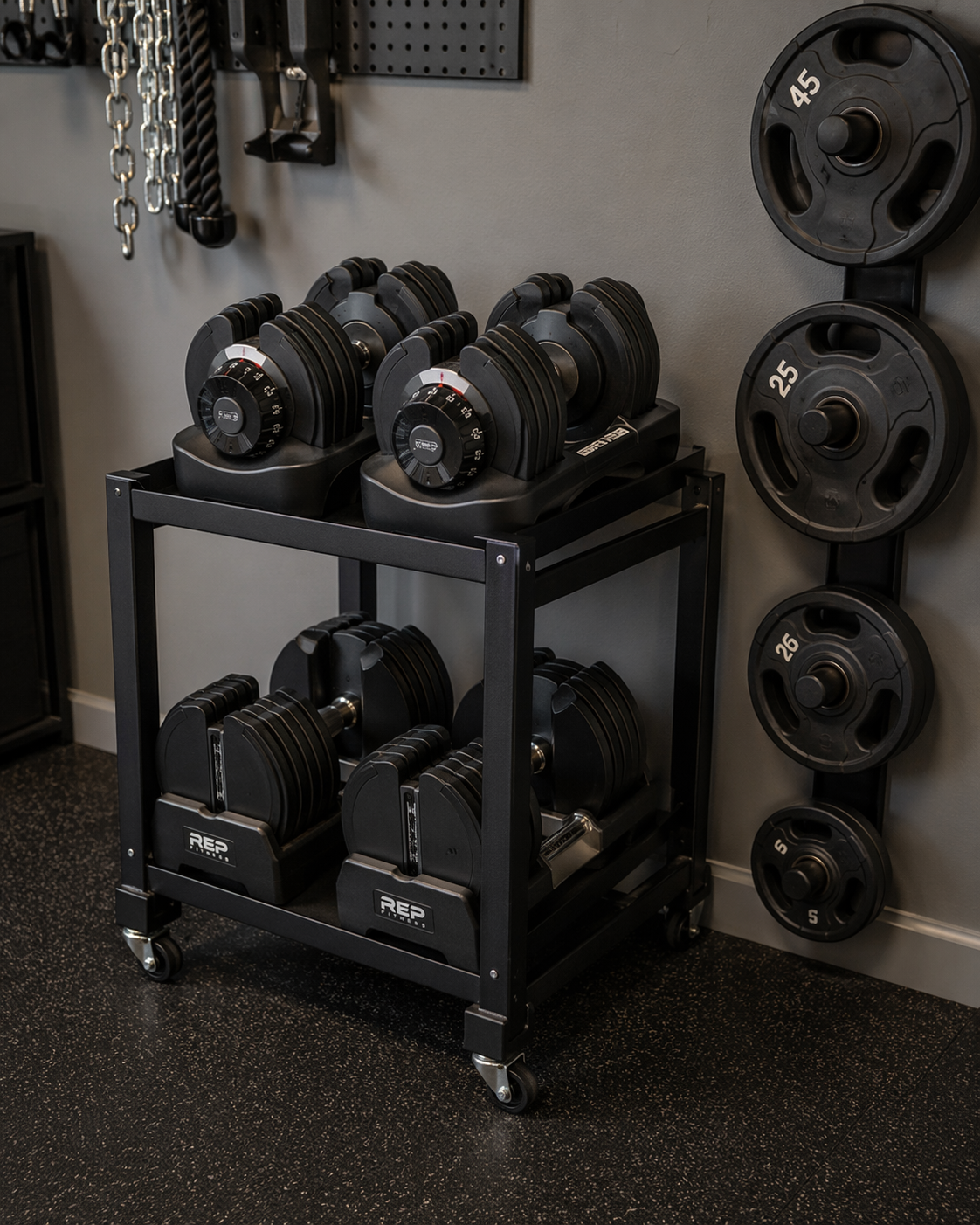
The REP Fitness QuickDraw Adjustable Dumbbell is one of the most space-efficient options available. It ranges from $335.99 for the 30-pound pair to $575.99 for the 60-pound pair, with 5-pound increments and a 32-millimeter handle with volcano-style knurling. The QuickDraw uses a dial system that lets you change weight in seconds, and it comes with a lifetime warranty. According to Garage Gym Reviews, it replaces up to 12 pairs of dumbbells, which is a significant space savings in any garage.
For heavier work, the Snode AD80 Adjustable Dumbbells go from 10 to 80 pounds in 10-pound increments. At $795, they are more expensive than the QuickDraw, but they offer a wider weight range and a drop-proof warranty from up to 32 inches — a useful feature if you tend to drop dumbbells at the end of a set. The Snode AD80 uses a plate-stacking mechanism rather than a dial, which is slightly slower to adjust but more durable over the long term.
Adjustable kettlebells are a less common but equally space-efficient option. The PowerBlock Adjustable Kettlebell comes in two ranges (18-35 lbs or 35-62 lbs) and uses a magnetic pin system to change weight. It replaces up to four individual kettlebells, which is useful if your training includes swings, goblet squats, and Turkish get-ups.
| Product | Weight Range | Increments | Price (June 2026) | Space Saved vs. Fixed Set |
|---|---|---|---|---|
| REP QuickDraw (30-lb pair) | 5-30 lbs | 5 lbs | $335.99 | Replaces ~8 pairs |
| REP QuickDraw (60-lb pair) | 5-60 lbs | 5 lbs | $575.99 | Replaces ~12 pairs |
| Snode AD80 | 10-80 lbs | 10 lbs | $795 | Replaces ~15 pairs |
| PowerBlock Adjustable Kettlebell | 18-35 or 35-62 lbs | N/A (magnetic pin) | $149-$199 | Replaces 4 kettlebells |
Layout Strategies for a Half-Garage Gym
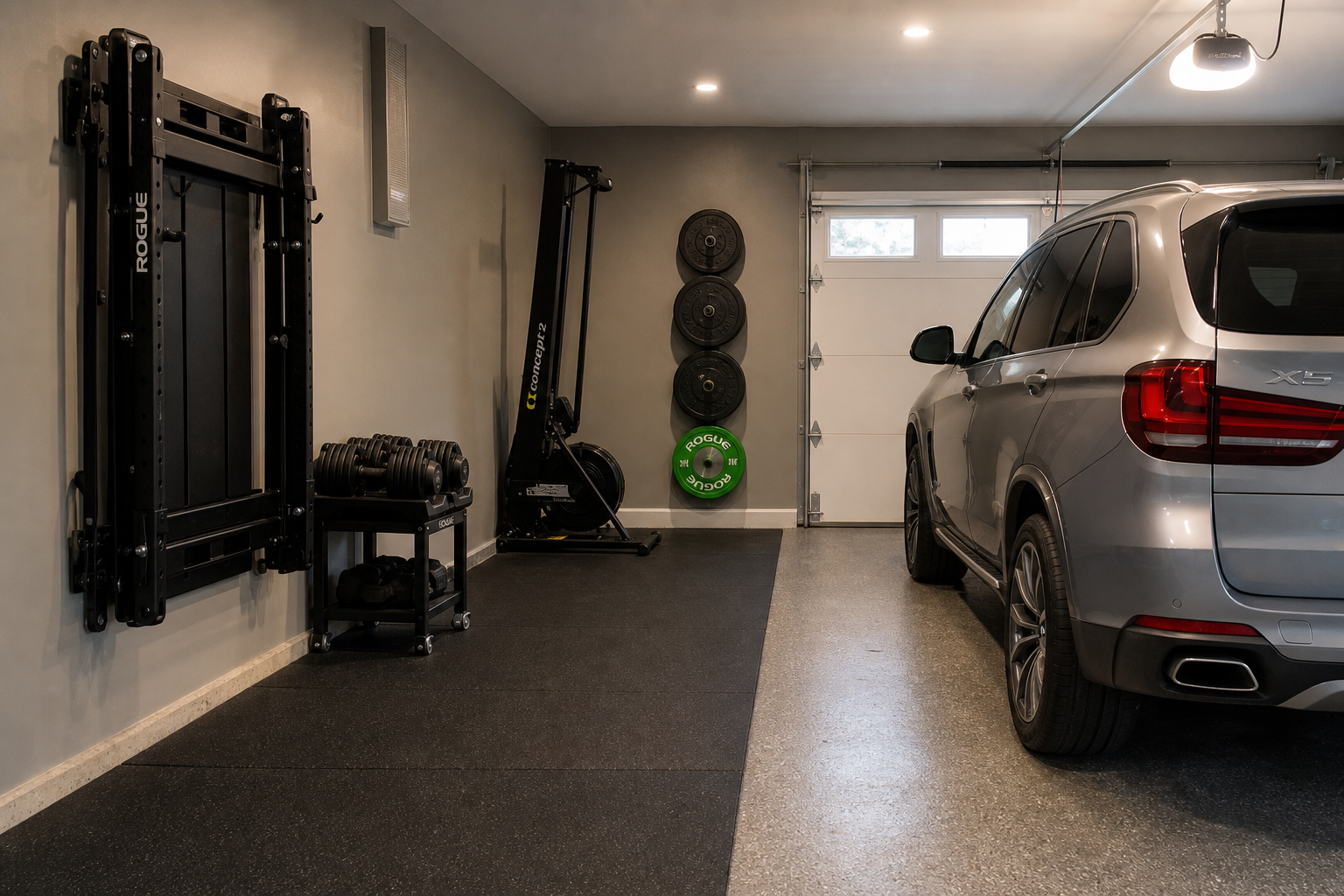
Once you have selected space-saving equipment, the next challenge is arranging it so the gym and the car coexist without daily friction. The most common mistake is placing the rack in the center of the garage, which blocks parking and forces you to move the car every time you want to train. A better approach is zone planning.
In a typical single-car garage (roughly 12 feet wide by 20 feet deep), the parking zone occupies the center 8 feet of width. That leaves roughly 2 feet on each side — not enough for a rack, but enough for wall-mounted storage and a foldable rack. The optimal layout places the foldable rack on the wall opposite the driver's side of the car. This way, you can park, open the driver's door, and step directly into the workout zone without squeezing past the equipment.
- Place the foldable rack on the wall opposite the car's parking side. This keeps the rack accessible when the car is parked and avoids door-swing conflicts.
- Use the back wall for vertical plate storage and wall-mounted barbell racks. This keeps plates off the floor and within arm's reach of the rack.
- Keep a clear 8-foot by 8-foot working space in front of the rack. This is the minimum area needed to safely perform barbell exercises, according to Graymatterlifting's home gym guide.
- Store adjustable dumbbells and kettlebells on a compact cart that can be rolled out of the way when not in use. A cart with locking casters is ideal.
- If you have a two-car garage and are dedicating one bay to the gym, treat the gym bay as a self-contained zone. Install the rack against the shared wall, use partial flooring (not wall-to-wall), and keep the other bay clear for parking and storage.
Ceiling height is another critical factor. Most foldable racks require at least 90 inches of ceiling clearance when unfolded. If your garage has a standard 8-foot ceiling (96 inches), you have enough room. But if your garage has a low ceiling (7 feet or less), you may need to consider a shorter rack or a non-foldable alternative. Measure your ceiling height before purchasing any rack.
Flooring, Storage, and Climate Considerations
Garage gyms have different flooring requirements than apartment or basement setups. The concrete subfloor is durable but hard on dropped weights and unforgiving on joints. The solution is partial-flooring with rubber mats — specifically, horse stall mats from Tractor Supply.
According to Garage Gym Reviews' testing, Tractor Supply's 3/4-inch rubber stall mats cost $2.38 per square foot and come in 4-foot by 6-foot sheets weighing 100 pounds each. They are made from recycled rubber and rated 5 out of 5 for both durability and value. The key advantage for a shared garage is that you do not need to cover the entire floor. You can lay mats only in the workout zone — typically a 6-foot by 8-foot area in front of the rack — and leave the parking area bare concrete. This saves money and makes it easier to sweep or hose down the garage.
For a deeper comparison of flooring materials, see our Rubber vs. Foam Gym Flooring guide, which explains why rubber mats are superior to foam for partial-coverage garage floors. For thickness and budget considerations, our Home Gym Flooring Decision Guide covers the full range of options.
Storage in a shared garage should prioritize vertical space. Wall-mounted plate storage racks hold weight plates stacked vertically, keeping them off the floor and within easy reach. Wall-mounted barbell racks store bars horizontally along the wall, preventing them from rolling around or taking up floor space. A simple 2x4-and-pipe barbell rack costs under $50 to build and holds up to four bars.
Climate control is often overlooked in garage gym guides, but it matters. Garages experience temperature extremes — freezing in winter, sweltering in summer. If you train year-round, consider installing a ceiling fan for air circulation, a space heater for winter workouts, and a portable air conditioner or mini-split for summer. Insulating the garage door and walls helps stabilize temperature and reduces noise for neighbors.
| Consideration | Garage-Specific Requirement | Recommended Solution |
|---|---|---|
| Flooring | Partial coverage, not wall-to-wall | Tractor Supply 3/4" stall mats ($2.38/sq ft) in workout zone only |
| Plate storage | Must not take floor space | Wall-mounted vertical plate tree or rack |
| Barbell storage | Must not roll or take floor space | Wall-mounted horizontal barbell rack (DIY or commercial) |
| Temperature | Extreme cold and heat | Ceiling fan, space heater, portable AC or mini-split |
| Humidity | Can cause rust on steel equipment | Dehumidifier, silica gel packs in storage bins |
Sample Builds at $1,500, $2,500, and $4,000
The following sample builds are designed for a shared single-car garage where the gym must coexist with parking. Each build prioritizes space efficiency first, then training quality, then budget. Prices reflect June 2026 and may shift with seasonal sales.
| Item | $1,500 Build | $2,500 Build | $4,000 Build |
|---|---|---|---|
| Rack | Titan T-3 Wall Mount ($465) | PRx Profile PRO ($1,099) | PRx Profile PRO ($1,099) |
| Barbell | CAP Barbell 7-ft Olympic Bar ($150) | Rogue Ohio Bar ($295) | Rogue Ohio Bar ($295) |
| Weight Plates | CAP 300-lb Olympic Set ($350) | Rogue Echo Bumper Plates 260-lb ($495) | Rogue Echo Bumper Plates 260-lb ($495) |
| Adjustable Dumbbells | REP QuickDraw 30-lb ($336) | REP QuickDraw 60-lb ($576) | Snode AD80 ($795) |
| Bench | REP FB-3000 Flat Bench ($150) | REP AB-3100 Adjustable Bench ($299) | REP BlackWing Adjustable Bench ($599) |
| Flooring | 2x Tractor Supply Stall Mats ($115) | 3x Tractor Supply Stall Mats ($172) | 4x Tractor Supply Stall Mats ($230) |
| Storage | Wall-mounted plate tree ($50) | Wall-mounted plate tree + barbell rack ($100) | Wall-mounted plate tree + barbell rack + dumbbell cart ($200) |
| Total (approx.) | $1,566 | $3,036 | $3,713 |
For more detailed sample builds at different price points, see our Compact Home Gym Budget Builds guide, which covers complete setups at $500, $1,500, and $3,000.
Common Mistakes to Avoid When Building a Shared-Garage Gym
Building a gym in a shared garage is a balancing act. The following mistakes are easy to make and hard to undo.
- Buying oversized equipment first. A full-size power rack with a 48-inch depth may seem like a good investment, but in a shared garage, it permanently blocks parking. Start with a wall-mounted foldable rack and add equipment only after you have confirmed the layout works with your car.
- Ignoring ceiling height for folding racks. Many foldable racks require 90+ inches of clearance when unfolded. If your garage has a low ceiling, the rack may not fit in the unfolded position. Measure ceiling height before purchasing.
- Using wall-to-wall flooring when partial coverage works better. Full-floor rubber mats are expensive, heavy, and unnecessary in a shared garage. Partial coverage in the workout zone saves money and makes the garage easier to clean.
- Failing to plan for vehicle coexistence. If you cannot park your car with the rack in the folded position, the gym will become a daily frustration. Test the layout with your car before committing to a rack placement.
- Neglecting climate control. Steel equipment rusts in humid garages. Concrete floors are cold in winter. A dehumidifier, a space heater, and a fan are not luxuries — they are necessities for year-round training.
Some links on this page are affiliate links — they may earn us a commission at no extra cost to you. Our tier and tests are decided before we ever check which links pay; see our full affiliate disclosure.
Spot something off?
Noise and floor-damage claims carry real deposit-risk consequences if we get them wrong — tell us if your experience with this build didn't match what's above.