
Tonal Home Gym Problems and Reliability: What Real Long-Term Users Say Before You Buy
Before spending $5,000+ on a Tonal, read this breakdown of the real-world problems long-term owners report: mandatory subscription lock-in, hardware reliability concerns like arm drooping and cable wear, and limited lower-body resistance for advanced lifters.
Why This Article Exists: The Side of Tonal the Marketing Doesn't Show
Tonal's marketing is polished. The product shots show a sleek, wall-mounted unit in a sunlit room. The workout videos feature athletes moving through cable exercises with perfect form. The tagline — "Intelligent strength training" — promises a future where a machine spots you, adjusts weight automatically, and tracks every rep. And in many ways, Tonal delivers on that promise. That's why it has earned the nickname "the iPhone of fitness" and why you'll find glowing reviews across most major tech and fitness publications.
But this article is not one of those reviews.
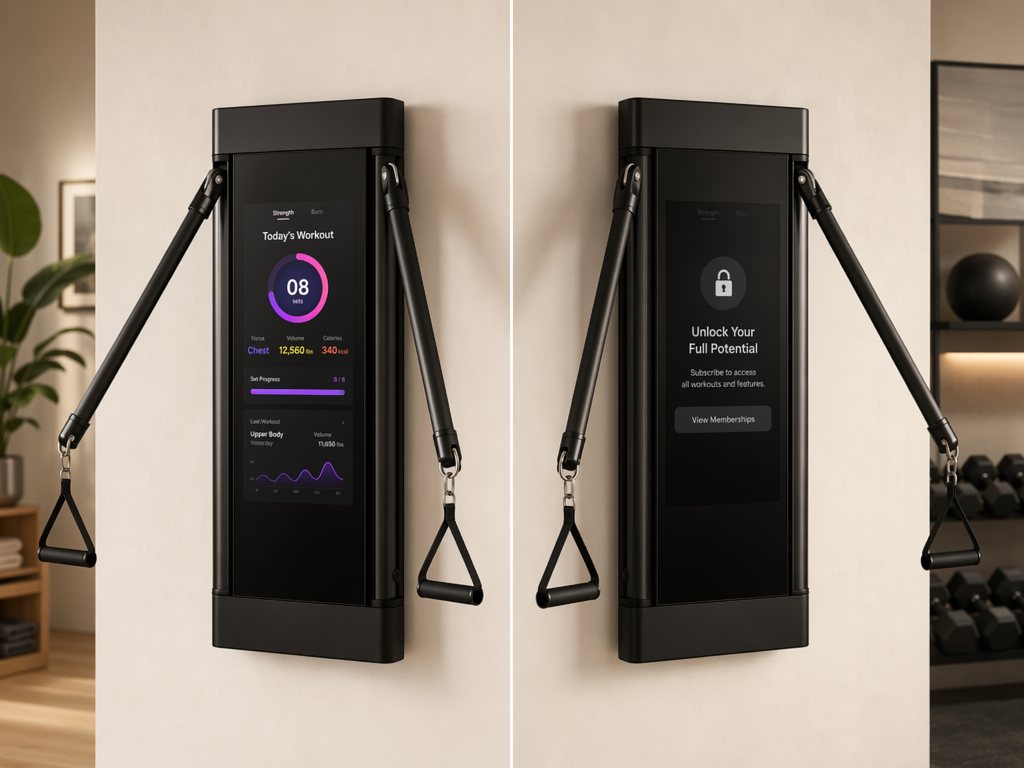
If you are considering a Tonal — and spending over $4,000 on the unit plus a mandatory $60 monthly membership — you have likely already read the positive coverage. What is harder to find is a clear, consolidated picture of the problems that surface after the first few months of ownership. The arm drooping that requires a replacement unit. The cables that wear out and cost hundreds to replace. The subscription that, if paused, turns your $4,000 smart gym into a very expensive wall decoration.
This article focuses exclusively on those downsides. It draws on long-term user reports from Reddit, independent blogs, and detailed reviews to give you the full picture before you commit. If you want a balanced overview or a spec-by-spec breakdown, our Tonal 2 review covers that ground. Here, we are looking at the problems — because a $5,000+ purchase deserves to be made with eyes wide open.
The Subscription Trap: What You Actually Lose Without the $60/Month Membership
Tonal requires a 12-month initial membership commitment. The current rate is $59.95 per month. You cannot buy the machine and use it without paying for at least one year of subscription. After that first year, you can cancel, but the question is: what are you left with?
The answer, according to multiple sources, is not much. Without an active subscription, Tonal loses the following features:
- Spotter mode — the feature that automatically reduces weight if you fail a rep
- Dynamic weight modes (eccentric, chains, burnout, spots)
- Form feedback and real-time coaching
- Most workout tracking and progress metrics
- Access to the workout library and program content
As one long-term user on Ian's blog put it: "Without a subscription, Tonal loses spotter mode, dynamic weight modes, form feedback, and most tracking." The machine still functions as a basic cable resistance system, but the intelligence that justifies the premium price tag is gone.
This creates a particularly concerning scenario around safety. Innerbody noted that "Tonal's spotter mode goes away (along with most other features) if you suspend your membership for any reason. That could put users in a dangerous situation, and there's no reason that Tonal couldn't leave that minimum functionality in place to protect its users who aren't active members." If you are lifting near your max and fail a rep without spotter mode active, you are relying entirely on the cable's catch mechanism — which is not designed for that scenario.
For a detailed breakdown of how the subscription cost adds up over 2, 5, and 10 years, see our Tonal Home Gym Total Cost of Ownership analysis. The short version: a Tonal 2 with a 2-year membership costs over $6,500, and after 10 years, that figure exceeds $12,000.
Hardware Reliability: Arm Drooping, Cable Wear, and Creaking Plastics
Tonal's hardware is a mix of a large touchscreen display, two articulating arms, and a cable pulley system that provides electromagnetic resistance. It is mechanically complex, and complexity brings failure points.
The Arm Drooping Problem
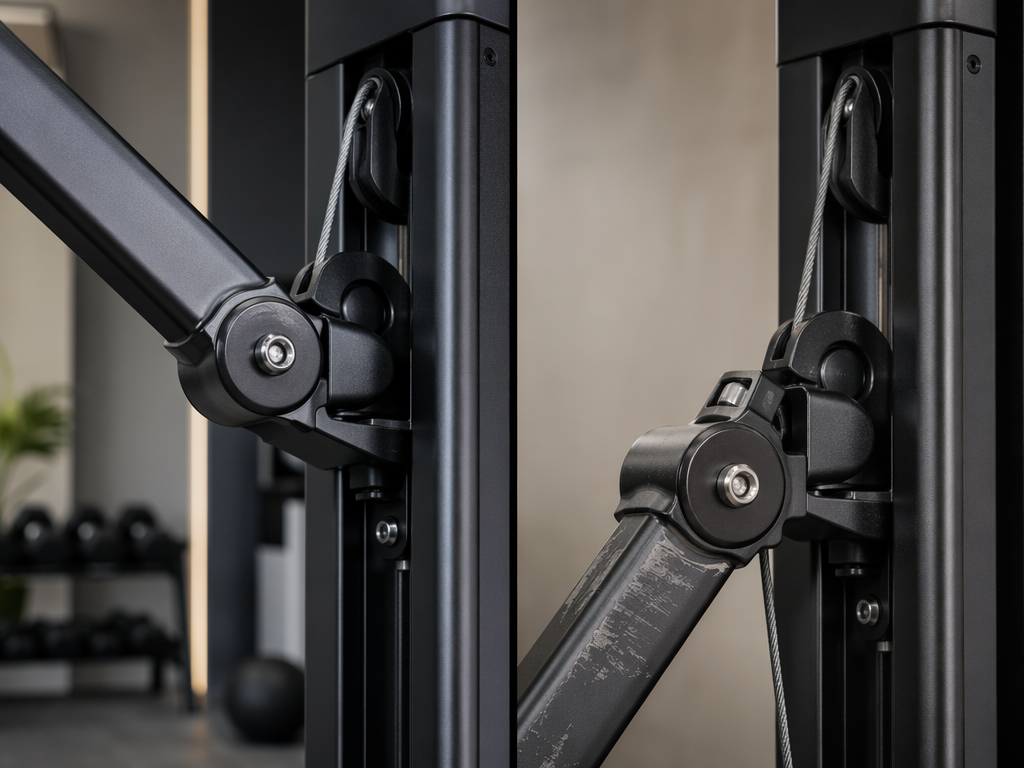
The most commonly reported hardware issue among long-term users is arm drooping. The two articulating arms that extend from the main unit are designed to hold position at various angles. Over time, some users report that the arms begin to sag or droop, failing to stay at their set position.
One detailed account comes from Ian's blog, a long-term owner who documented his experience: "After coming back from a weekend vacation, I noticed the ends of the arms drooping a few inches. I called support, they opened an email ticket, and I was promptly told to prepare for a replacement unit." Tonal scheduled installers to bring a new unit and take the old one, and the process took about two weeks.
While Tonal handled this particular case under warranty, the fact that arm drooping requires a full unit replacement — not a simple repair — is concerning. It suggests a design or manufacturing issue that cannot be fixed in the field.
Cables Are Consumable Parts
Tonal uses cables routed through pulleys to deliver resistance. Like any cable-based system, these cables wear over time. Fraying, kinking, and eventual breakage are normal outcomes of regular use. The same blog post notes: "Cables are consumable – they never last forever – so factor that into your price considerations."
The problem is that Tonal's cable system is not user-serviceable. You cannot simply order a replacement cable and thread it through the pulleys yourself. When cables wear out, you are looking at a service call — and an out-of-warranty repair that, according to Reddit reports cited in the same blog, costs "a few hundred bucks minimum."
Creaking Plastics and Build Quality
Multiple user reports mention creaking or popping sounds from the plastic housing and arm joints during use. While this is not necessarily a functional failure, it is a quality-of-life issue for a machine that costs over $4,000. Users in online forums describe the noise as distracting and note that it tends to worsen over time.
Installation and Relocation: The Hidden Constraints
Tonal is not a plug-and-play device. It must be professionally installed on a wall that meets specific structural requirements. These constraints are more restrictive than many buyers realize.
Wall Requirements
According to CNET's review, Tonal "fits best in a 7-by-7-foot space with 7-foot, 10-inch ceilings. It's easiest to install if your walls are made of wood or metal with stud widths from 16 to 24 inches." If your wall is made of concrete, plaster, or stucco, it must be 1.25 inches or less in thickness. If your wall does not meet these requirements, you may need a custom build-out — an additional expense that can run into the hundreds or thousands of dollars.
Installation and Relocation Costs
Professional installation is required and comes at an additional cost that varies by location. If you move, Tonal charges a relocation fee to disassemble and reinstall the unit. CNET notes that "if you move, there's also an additional relocation charge (subject to moving details) to cover the cost of disassembling and reinstalling your Tonal."
More critically, attempting to move the unit yourself voids the warranty. Garage Gym Reviews states that the warranty "is voided if you use Tonal for commercial purposes or install it improperly yourself (like if you try to move it)." This means every relocation — whether across town or across the country — requires a paid professional service call.
The 250 lb Resistance Ceiling: When Tonal Isn't Enough for Advanced Lifters
Tonal's electromagnetic resistance system provides up to 100 pounds per arm on the original model (200 pounds total) and up to 250 pounds total on the Tonal 2. For many users doing HIIT workouts or moderate strength training, this is sufficient. But for anyone who trains with heavy compound lifts, it is a hard ceiling.
The problem is most acute on lower-body exercises. Garage Gym Reviews notes: "As someone who enjoys heavy-weight workouts, however, I found that the resistance didn't always cut it, especially for lower body movements. Movements like squats or deadlifts aren't as satisfying as using the real thing for obvious reasons."
The Gray Matter Lifting article puts it bluntly: "The entire system can handle 100lbs per arm, or 200lbs combined. That 200lbs might not be enough for larger exercises like squats and deadlifts. My wife deadlifts over 200lbs and rarely trains the deadlift. If you are an adult male you will likely exceed this weight limitation rather quickly."
| Exercise | Typical Intermediate Male 1RM | Tonal 2 Max Resistance | Sufficient? |
|---|---|---|---|
| Deadlift | 275–315 lbs | 250 lbs | No for most intermediate lifters |
| Barbell Squat | 225–275 lbs | 250 lbs | Borderline for intermediate lifters |
| Bench Press | 185–225 lbs | 250 lbs | Yes for most intermediate lifters |
| Overhead Press | 115–155 lbs | 250 lbs | Yes for nearly all lifters |
| Barbell Row | 155–185 lbs | 250 lbs | Yes for most lifters |
If you are an intermediate or advanced lifter who squats or deadlifts over 200 pounds, Tonal will not be your primary leg training tool. You will need to supplement with free weights or a separate barbell setup. For a broader look at systems that offer higher resistance, see our Best Home Gym Systems Compared guide.
Customer Service and Warranty: What Happens When Things Go Wrong
Tonal's warranty coverage is surprisingly short for a machine in this price bracket. The original Tonal comes with a one-year warranty. The Tonal 2 extends that to two years. For comparison, many power racks and cable machines from Rogue, REP, and Titan Fitness carry 5-year to lifetime warranties on frames.
When things go wrong outside of that warranty window, the costs add up quickly. According to Ian's blog, "According to Reddit, repairs to Tonal devices out of warranty are a few hundred bucks minimum." Given that cables are consumable and the arms are prone to drooping, most owners will face at least one out-of-warranty repair during the machine's lifetime.
Beyond repair costs, there are two additional customer service pain points worth noting:
- Shipping delays — Multiple user reports mention significant delays between ordering and delivery, sometimes stretching several weeks beyond the initial estimate.
- No data export — Tonal does not offer a public API or any way to export your workout data. As Ian's blog notes, "There is no public API and no data export. Your data is locked in forever." If you decide to switch platforms, your entire workout history stays on Tonal's servers.
The Trade-Offs: What Tonal Still Does Better Than Anyone Else
A critical article that ignores Tonal's genuine strengths would be incomplete. The company's software is widely considered the best in the connected fitness space. As Ian's blog puts it: "Tonal's software is ahead of everyone else in the industry by a mile."
Here is what Tonal does exceptionally well:
- AI coaching and dynamic weight adjustment — The ability to automatically add or remove weight between sets, and to apply eccentric overload or chains modes, is genuinely innovative and effective.
- Program structure — Tonal's workout programs are well-designed, with clear progression logic and professional coaching. The home screen shows your next planned workout if you are enrolled in a program.
- Space efficiency — The wall-mounted design takes up minimal floor space, making it one of the most space-efficient strength training solutions available.
- Build quality (when it works) — When the arms are not drooping and the cables are not fraying, the machine feels solid and the electromagnetic resistance is smooth and quiet.
These strengths are real, and they explain why Tonal has a loyal user base despite the problems outlined in this article. For a full, balanced review that covers both the positives and negatives, read our Tonal 2 Home Gym Review.
Mitigation Strategies: How to Protect Your Investment
If after reading this you still want a Tonal — and many people do, for good reason — here are practical steps to protect your investment:
- Verify wall compatibility before purchasing. Measure your stud spacing and check your wall material. If you have concrete, plaster, or stucco walls, get a professional assessment before you order.
- Budget for cable replacement. Assume you will need at least one out-of-warranty repair during the machine's lifetime. Set aside $300–$500 for this eventuality.
- Consider an extended warranty or protection plan. Given the short standard warranty and the cost of repairs, a third-party protection plan may pay for itself.
- Understand the subscription commitment. You are locked in for 12 months at $60/month. After that, decide whether the ongoing cost is worth the features you actually use.
- Plan for relocation. If you move frequently, factor in the cost of professional disassembly and reinstallation each time. Attempting to move the unit yourself voids the warranty.
- Set realistic resistance expectations. If you are an intermediate or advanced lifter, plan to supplement Tonal with free weights for lower-body compound lifts.
This result comes from one real apartment under the stated conditions — it is a strong signal, not a guarantee your space will measure identically.
Builds this evidence supports
Cable Machine Alternatives That Save Space and Money
Compare the best cable machine alternatives for home gyms – from resistance bands and pulley systems to suspension trainers and compact digital units – and find the right option for your space and budget.
How to Choose a Compact Home Gym That Works for Your Space, Budget, and Noise Tolerance
This article provides a structured decision framework for apartment dwellers and small-space residents to match their specific floor footprint, noise sensitivity, and budget to the most suitable compact home gym strategy — whether that's an all-in-one machine, modular build, smart digital system, or band/bodyweight setup.
The Garage Gym Reality Check: What Equipment Actually Fits in a Single-Car Garage
Most garage gym guides assume a two-car space. This article uses real dimensions, real equipment footprints, and three layout templates to show what fits—and what doesn't—in a single-car garage (10x20 to 12x20 ft).
Spot something off?
If this result didn't match your own space, let us know — floor-damage and noise claims carry real deposit-risk consequences if we get them wrong.