
What Smart Home Gym Systems Actually Cost Over 5 Years
This breakdown calculates the true 5-year cost of major smart home gym systems, including hardware, subscriptions, installation, and accessories, so you can compare budget-friendly options against subscription-locked models without being misled by the sticker price.
The sticker price is the weakest number in a smart home gym system comparison. A machine that looks like a $2,000–$4,000 purchase can become a very different five-year commitment once the subscription, required accessories, installation, and content lock-in are counted. Using June 2026 pricing, the six systems below range from about $2,000 for a subscription-free newer entrant with limited independent testing, to about $8,600 for Tonal 2 when its listed hardware, accessories, installation, and $59.95 monthly membership are all included. Speediance lands around $3,199 without its optional subscription and about $4,939 with it.
That spread changes the buying conversation. It is no longer “Which wall trainer looks best?” or “Which connected machine has the lowest starting price?” It is: what does this system cost to keep using the way you expect to use it for three to five years?
The five-year cost table
The table uses the same ownership rule for every product: hardware price, required accessories where specified, installation where specified, and subscription fees over 36 and 60 months. It excludes financing interest, taxes, shipping, promotions, warranty extensions, and replacement accessories. That matters because financing can make a low monthly payment feel smaller while quietly increasing the actual cost if interest applies.
Garage Gym Reviews’ 2026 smart-gym testing benchmark puts the average smart home gym at $1,930 upfront with a $22.81 monthly subscription, based on roughly 30 models; that is useful as a category reference, not as a promise that every product clusters near the average.[1]
| System | Type | Upfront cost counted here | Subscription status | Estimated 3-year cost | Estimated 5-year cost | What the sticker price misses |
|---|---|---|---|---|---|---|
| Tonal 2 | Wall-mounted digital strength trainer | $4,295 hardware + $495 accessories + about $250 installation | Mandatory, about $59.95/month | About $7,198 | About $8,637 using listed components; GGR also cites about $7,892 under its pricing assumptions | The hardware price leaves out accessories, installation, and the largest recurring fee in this group |
| Speediance Gym Monster 2 | Freestanding digital strength trainer | $3,199 hardware | Optional, about $0–$29/month | $3,199 without subscription; about $4,243 with subscription | $3,199 without subscription; about $4,939 with subscription | The ownership cost depends heavily on whether you value the optional content layer |
| Tempo Move | Small-space connected strength system | From $504+ hardware for Starter bundle with 50 lb noted in available pricing context | Required for connected experience, about $39/month | About $2,844 in the cited cost scenario | About $3,840 in the cited cost scenario | The entry hardware price does not fully explain the long-term subscription commitment |
| AEKE K1 | Compact smart strength system | About $2,000 estimated from AEKE-published buying guidance | $0 subscription in available materials | About $2,000 | About $2,000 | Lowest recurring-cost profile here, but the pricing and specs rely more on manufacturer-published material |
| Peloton Bike+ | Connected cardio bike | $2,695 hardware | All-Access membership, about $50/month | About $4,495 | About $5,695 | The machine is only part of the purchase; the class library is the economic center |
| NordicTrack 1750 | Connected treadmill | $1,999 hardware | iFIT, about $39/month | About $3,403 | About $4,339 | The treadmill price looks moderate until five years of iFIT are added |
This is also why it is unfair to throw all of these products into one bucket without explaining what they are. Tonal, Speediance, Tempo Move, and AEKE K1 are primarily strength systems. Peloton Bike+ and NordicTrack 1750 are connected cardio machines. They can all sit under the broad “smart home gym” label, but they do not replace the same workouts, depend on paid content to the same degree, or create the same ownership risk if you stop paying.
How the calculation works
For a fair comparison, the purchase has to be treated as a small ownership ledger rather than a checkout cart. The core formula is simple:
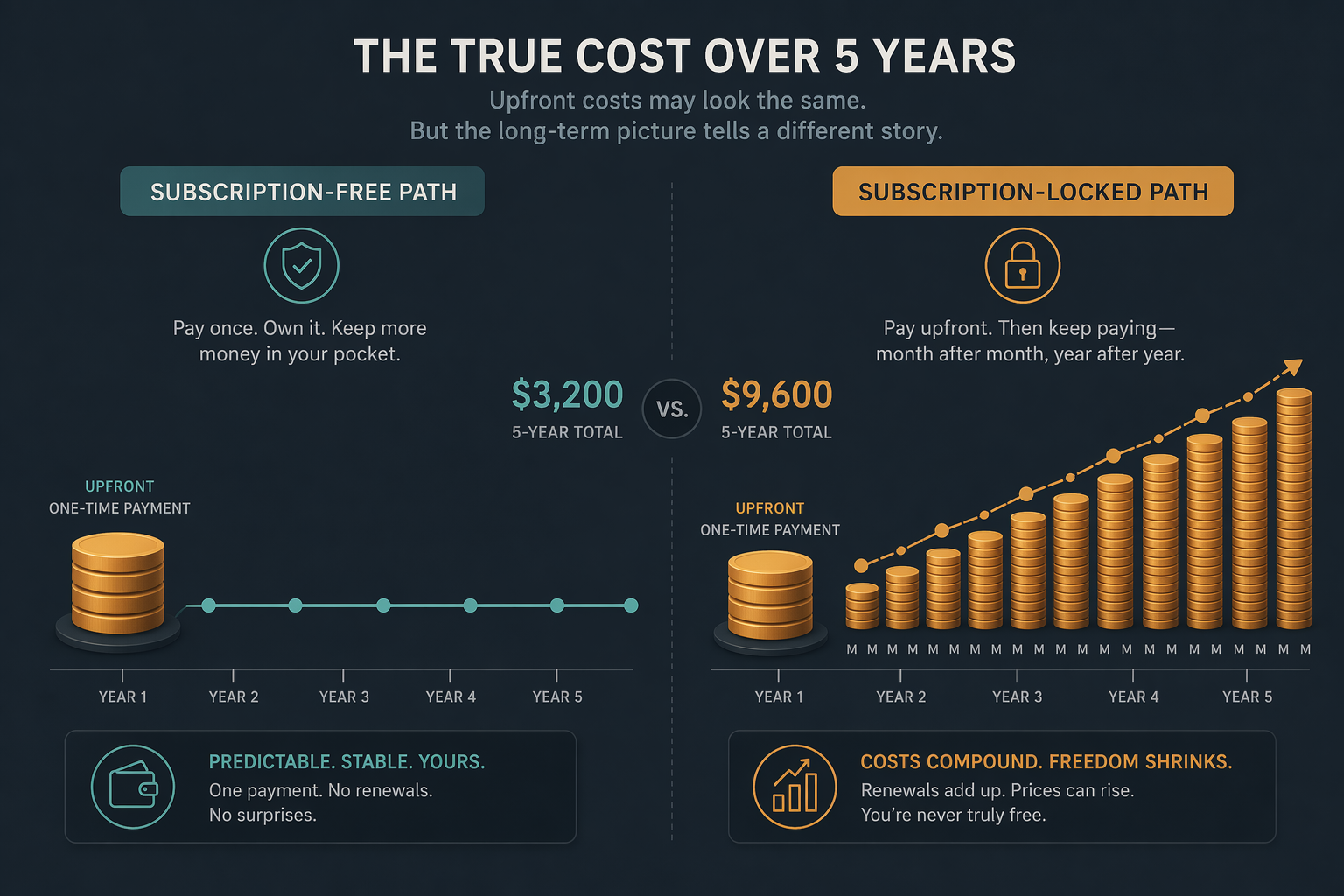
Five-year ownership cost = hardware + required accessories + installation + (monthly subscription × 60)The three-year version uses the same formula with 36 months. The distinction is useful because some buyers reassess after three years, while others expect a major home gym purchase to last at least five. The systems with no required subscription stay flat after the initial purchase. The systems with mandatory memberships keep climbing every month.
A mandatory subscription is counted when the product’s expected experience depends on it. An optional subscription is shown as a range. That is especially important for Speediance, where the same hardware can sit at $3,199 over five years without a subscription or rise to about $4,939 if the buyer pays about $29 per month for five years.[2]
This calculation does not try to price motivation, coaching quality, resale value, household sharing, or the value of not commuting to a gym. Those can be real benefits. They are just not substitutes for knowing the bill.
Tonal 2: the clearest case of sticker-price distortion
Tonal 2 is the product that most clearly shows why the hardware price cannot stand alone. The listed hardware price is $4,295. The accessories add $495. Installation is about $250. Before the first monthly membership is counted, the purchase is already around $5,040.[1]
Then the subscription becomes the long tail. At about $59.95 per month, the membership adds roughly $2,158 over three years and roughly $3,597 over five years. That puts the five-year total at about $8,637 using the component prices above. The research materials also note a GGR five-year Tonal 2 estimate of about $7,892, which likely reflects different pricing assumptions or timing; either way, the ownership cost is far above the hardware number alone.[1]
That does not make Tonal unserious. It is one of the most polished mainstream digital strength systems, and it has much more independent coverage than many newer competitors. But its economic model is clear: the premium experience is tied to a premium recurring fee. Garage Gym Reviews’ Coop Mitchell gave Tonal 2’s monthly fee a 2-out-of-5 rating, writing, “At about $60 per month, we could only give the Tonal 2 a 2-out-of-5 rating for its monthly fee.”[1]
That rating is useful because it separates product quality from cost pressure. A system can be excellent and still be expensive to keep unlocked. Buyers considering Tonal should read the membership terms as carefully as the resistance specs, especially if they are trying to replace a gym membership rather than add another monthly bill. For a narrower Tonal-only breakdown, see the full Tonal home gym total cost of ownership guide.
Speediance Gym Monster 2: the math changes when the subscription is optional
Speediance Gym Monster 2 starts from a different bargain with the buyer. The hardware is listed at $3,199, and the subscription is optional at roughly $0–$29 per month in the available pricing materials.[2] That creates two realistic ownership paths instead of one.
- No subscription: about $3,199 over three years and five years, before taxes, shipping, financing, or add-ons.
- With subscription: about $4,243 over three years and about $4,939 over five years.
That optionality is not a minor detail. It means a buyer can choose the hardware for guided resistance and compact setup without automatically accepting a five-year content bill. If the paid layer is useful, it can be added. If the buyer mostly wants the machine and their own programming, the long-term cost stays much closer to the sticker price.
This is where subscription-free or subscription-light systems become financially compelling. Compared with a subscription-locked model, the savings can run into the low thousands over a five-year period. The trade-off is that buyers should be more careful about the exact feature set they get without paying, because “optional” does not always mean “irrelevant.” If you are specifically comparing what disappears when a membership ends, the deeper issue is covered in the smart home gym subscription costs breakdown.
AEKE K1: attractive cost control, thinner independent evidence
AEKE K1 is the cleanest cost-control story in the group, with an estimated price around $2,000 and no subscription listed in the available materials. AEKE’s own 2026 buying guide also describes the K1 as having a 3.2-square-foot folded footprint, more than 300 exercises, and 9 user profiles.[3]
Those numbers are appealing, especially for a buyer trying to avoid a luxury-membership replacement disguised as equipment. But the source matters. The AEKE K1 information available here relies more heavily on manufacturer-published material than the Tonal or Speediance discussion, where independent comparison coverage is broader. That does not make the claims false; it means the confidence level is different.
For a cautious buyer, AEKE’s subscription-free model is worth attention, but the next layer of due diligence should be practical: warranty terms, return policy, app behavior without payment, service availability, resistance feel, and whether independent reviewers have tested the production unit. A low five-year cost is only useful if the system remains usable and supported for those five years.
Tempo Move: lower hardware does not erase the membership math
Tempo Move is the current Tempo product to pay attention to; older Tempo Studio references can confuse the comparison because the Studio has been discontinued. In the available 2026 pricing context, Tempo Move is listed from $504+ for a Starter bundle with 50 pounds, with a $39 monthly subscription. BarBend’s smart home gym coverage puts the cost scenario at about $2,844 over three years and about $3,840 over five years.[2]
Tempo’s appeal is different from Tonal’s. It is a smaller-space, lower-entry-price route into connected strength training. But the recurring fee still does much of the long-term work. A buyer who focuses only on the hardware number may underestimate how quickly a $39 monthly fee becomes the larger part of the ownership story.
Peloton Bike+ and NordicTrack 1750: connected cardio has the same subscription problem
Peloton Bike+ and NordicTrack 1750 are not strength trainers, so they should not be treated as direct substitutes for Tonal, Speediance, Tempo Move, or AEKE K1. They belong in this comparison because many buyers use “smart home gym system” broadly to mean connected equipment with guided workouts, performance tracking, and a paid content ecosystem.
Peloton Bike+ is listed at $2,695, with an All-Access membership around $50 per month. That puts the five-year cost around $5,695 before taxes, financing, accessories, or other add-ons. NordicTrack 1750 is listed at $1,999, with iFIT around $39 per month, for about $4,339 over five years.[1]
The lesson is the same, even though the workouts are different. Connected cardio hardware can look much cheaper than a premium wall-mounted strength system at checkout. Over five years, the gap narrows because the membership keeps billing after the excitement of delivery day is gone.
The gym membership comparison buyers actually need
A smart home gym can beat a premium gym membership on five-year cost. Garage Gym Reviews’ home gym versus gym membership cost discussion puts premium memberships in the Equinox-style range at about $150–$250 per month, or $9,000–$15,000 over five years.[4] Against that baseline, even a high-cost smart system can look financially defensible, especially if multiple people in the household use it.
That is not the same as saying smart gyms are the cheapest way to train. A Planet Fitness-style budget membership around $10 per month is about $600 over five years.[4] On pure cost, almost every connected machine in this article loses badly to that number.
The honest comparison depends on what the buyer is replacing. Replacing a premium boutique or luxury gym membership is one calculation. Replacing a low-cost gym membership is another. Replacing nothing, because the machine is meant to remove commute friction and make workouts happen at home, is another again. If you want to run your own numbers against a membership, use the home gym vs gym membership calculator.
The cost categories that should not be blended together
The biggest mistake in smart-gym shopping is comparing products by brand polish instead of economic structure. These systems fall into different cost patterns:
| Cost pattern | Examples from this comparison | Buyer consequence |
|---|---|---|
| Mandatory subscription strength system | Tonal 2 | Best considered only if the coaching, tracking, and guided content are worth paying for every month |
| Optional-subscription strength system | Speediance Gym Monster 2 | Gives the buyer more control over long-term cost, but the paid layer still needs scrutiny |
| Subscription-free or no-subscription-listed strength system | AEKE K1 | Strongest recurring-cost profile, with more caution needed around independent verification |
| Lower-entry connected strength system | Tempo Move | Hardware may look inexpensive, but the membership drives the multi-year total |
| Connected cardio ecosystem | Peloton Bike+, NordicTrack 1750 | Not direct strength-system substitutes; subscription value depends on how much the household uses classes and coaching |
If you are still deciding which category you are even shopping in, start with a broader smart home gym comparison guide before comparing final prices. A wall-mounted digital strength trainer, a compact camera-based system, a smart treadmill, and a connected bike solve different problems.
A practical decision framework
The cleanest way to choose is to decide which cost you are willing to make permanent.
- Choose subscription-free or optional-subscription systems if long-term cost control matters most and you are comfortable judging the hardware experience more directly.
- Choose a subscription-locked system only if the guided coaching, progression, classes, tracking, or household engagement are features you will actually use month after month.
- Treat low hardware prices with suspicion when the membership is mandatory or functionally central to the experience.
- Compare five-year ownership cost before comparing screens, leaderboards, exercise counts, or celebrity instructors.
- If space, installation, or household constraints are the real bottleneck, price the room as well as the machine; a professionally installed wall trainer and a freestanding compact system create different obligations.
For a wider view of what else the same money can buy, the broader home gym cost breakdown from $500 to $5,000 is the useful next comparison. A smart home gym system is not just competing with another smart screen. It is competing with adjustable dumbbells, racks, benches, cable systems, budget gyms, premium gyms, and the very real value of having fewer excuses between you and the workout.
References
- Best Smart Home Gym Equipment (2026) — Garage Gym Reviews
- The 7 Best Smart Home Gyms of 2026 — BarBend
- 7 Ways to Choose a Smart Home Gym in 2026 — AEKE
- Home Gym vs. Gym Membership — Garage Gym Reviews
This result comes from one real apartment under the stated conditions — it is a strong signal, not a guarantee your space will measure identically.
Builds this evidence supports
Cable Machine Alternatives That Save Space and Money
Compare the best cable machine alternatives for home gyms – from resistance bands and pulley systems to suspension trainers and compact digital units – and find the right option for your space and budget.
How to Choose a Compact Home Gym That Works for Your Space, Budget, and Noise Tolerance
This article provides a structured decision framework for apartment dwellers and small-space residents to match their specific floor footprint, noise sensitivity, and budget to the most suitable compact home gym strategy — whether that's an all-in-one machine, modular build, smart digital system, or band/bodyweight setup.
The Garage Gym Reality Check: What Equipment Actually Fits in a Single-Car Garage
Most garage gym guides assume a two-car space. This article uses real dimensions, real equipment footprints, and three layout templates to show what fits—and what doesn't—in a single-car garage (10x20 to 12x20 ft).
Spot something off?
If this result didn't match your own space, let us know — floor-damage and noise claims carry real deposit-risk consequences if we get them wrong.