
Home Gym vs. Gym Membership: The Complete Cost-Breakdown Calculator for 2026
Most cost comparisons skip the hidden costs of commuting, multi-user savings, and equipment resale value. This article builds a transparent, scenario-based calculator so you can determine your real break-even point.
What your membership really costs — it’s not $65/month
The average monthly gym dues in the U.S. rose 9% in 2023 to $65, according to the Health & Fitness Association 2024 report. That’s the number most articles use to argue a home gym pays for itself in 12 to 18 months. I don’t buy that headline alone.
The same report says nearly 67% of members paid less than $50 per month. If your actual dues are $40 or $45, the break-even math shifts. And the $65 average doesn’t include initiation fees, annual maintenance fees, or the occasional price hike — dues rose 9% in one year, after all.
The 10-minute drive that costs $1,620 a year
A $50 monthly membership with a 10-minute drive each way, three times per week, 45 weeks per year doesn’t cost $600 annually. According to a detailed 2026 cost breakdown from Gray Matter Lifting, it totals roughly $1,620 per year when you include mileage at the IRS rate of 65.5 cents per mile and opportunity cost of time valued at $7.25 per hour.
I want to pause on the $7.25 figure. That’s the federal minimum wage, and it’s the floor. Most readers’ opportunity cost of time is higher. If you value your time at $20 per hour — closer to the median wage — that same commute costs $1,620 in time alone before adding mileage. The real hidden cost of a gym membership is likely even larger than the $1,620 figure suggests.
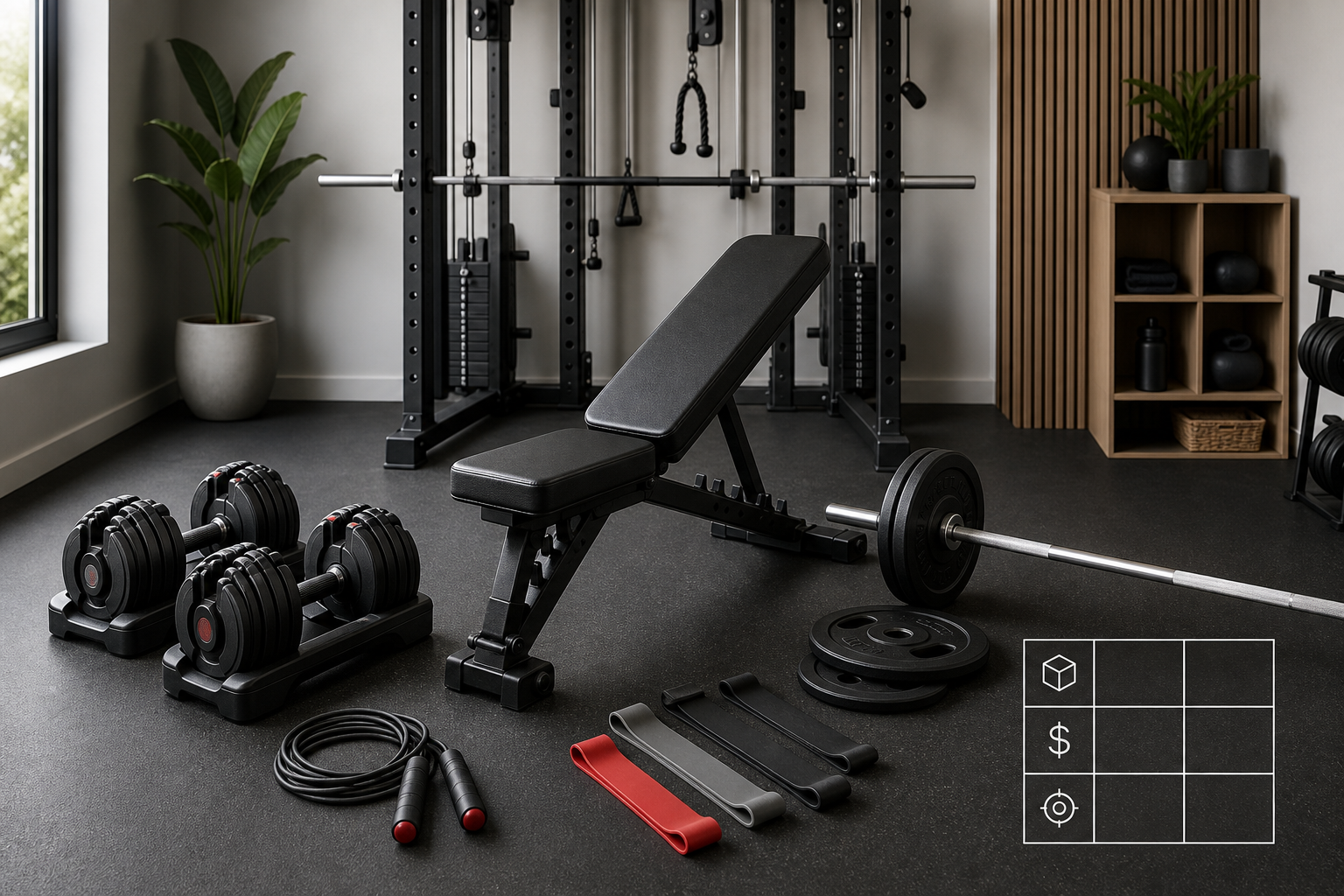
Three home gym budgets — and what they actually cost after resale
Equipment costs vary wildly, but the key is to choose a tier that matches your budget and training style. Here are three data-backed scenarios:
| Scenario | Cost range | Includes | Example build |
|---|---|---|---|
| Budget build | $500–$1,500 | Adjustable dumbbells, bench, resistance bands, mat, pull-up bar | Used or entry-level gear; fits 80 sq ft |
| Mid-range build | $1,500–$3,500 | Power rack, barbell, 255–500 lb plates, bench, flooring | New Rogue starter build ($3,243 shipped, per Gray Matter Lifting) or Bells of Steel (under $3,000) |
| Premium build | $3,500+ | Commercial-grade rack, premium cable machine, multiple barbells, specialty bars, dumbbells up to 150 lb | Lasts 10–20 years (Fitness Outlet); may include smart gym features |
Note that space requirements also matter: a functional single-machine home gym fits in about 80 square feet, while a more complete arrangement with both cardio and strength equipment needs 120 to 150 square feet. If you are planning a garage gym, see the Garage Workout Equipment: A Phased Build Guide for a phased approach.
One important factor: high-quality equipment holds its value. Rogue Fitness equipment typically retains close to 90% of its value on the secondary market, according to community consensus cited by Gray Matter Lifting. I will treat this as a market observation rather than a guarantee — the actual range is likely 70–90% depending on condition and demand. Home-use equipment also depreciates more slowly than commercial gear because it sees far less wear.
Smart gym subscriptions: the new monthly dues
If you choose a smart gym like Tonal, Peloton, or an iFIT-enabled machine, the equipment price is not the only recurring cost. These platforms charge ongoing subscriptions: Tonal $49/month, Peloton $24–$44/month, iFIT $15–$39/month. That adds $180 to $588 per year — ongoing costs parallel to gym dues.
Traditional equipment — a power rack, barbell, and plates — has no subscription. If you are choosing between a smart gym and traditional kit, the subscription changes the break-even calculus substantially. Do not treat it as part of the equipment price; treat it as your new monthly dues.
- Tonal: $49/month ($588/year)
- Peloton All-Access: $44/month ($528/year)
- iFIT Family: $39/month ($468/year)
- iFIT Individual: $15/month ($180/year)
- Traditional rack + barbell: $0/month
So when does the home gym pay for itself?
Now we have all the pieces. Let us build the break-even table across multiple scenarios. I will use two membership cost scenarios: $50/month (the typical cost for 67% of members) and $65/month (the 2023 average). For each, I add the commute cost from earlier ($1,620/year for a $50 membership, an extra $180 for higher mileage if your drive is longer). On the home gym side, I use the three builds above, assume a resale recovery of 70% (conservative), and subtract that from the effective cost for a fair comparison.
| Scenario | 1 year | 3 years | 5 years | 10 years |
|---|---|---|---|---|
| $50 gym dues + commute ($2,220/yr total) | -$2,220 | -$6,660 | -$11,100 | -$22,200 |
| $65 gym dues + commute ($2,400/yr total) | -$2,400 | -$7,200 | -$12,000 | -$24,000 |
| Budget home gym ($1,000 net after 70% resale recovery) | +$1,000 (cost) | +$1,000 (cost) | +$1,000 (cost) | +$1,000 (cost) |
| Mid-range home gym ($3,243 → $973 net after 70% recovery) | +$3,243 (cost) | +$973 (cost) | +$973 (cost) | +$973 (cost) |
| Premium home gym ($5,000 → $1,500 net after 70% recovery) | +$5,000 (cost) | +$1,500 (cost) | +$1,500 (cost) | +$1,500 (cost) |
| Two-person $50 gym + 2 commutes ($4,440/yr) | -$4,440 | -$13,320 | -$22,200 | -$44,400 |
| Two-person $65 gym + 2 commutes ($4,800/yr) | -$4,800 | -$14,400 | -$24,000 | -$48,000 |
For most households — a single person paying $50/month with a 10-minute drive — the mid-range home gym pays for itself sometime in the second year. For two people sharing the equipment, it’s under one year. If you can use the gear sequentially without buying duplicates, the savings accelerate. But the answer depends on three numbers: your actual dues, your commute, and whether you’ll actually use it. Run your own numbers — I’ve given you the formula.
This result comes from one real apartment under the stated conditions — it is a strong signal, not a guarantee your space will measure identically.
Builds this evidence supports
Cable Machine Alternatives That Save Space and Money
Compare the best cable machine alternatives for home gyms – from resistance bands and pulley systems to suspension trainers and compact digital units – and find the right option for your space and budget.
How to Choose a Compact Home Gym That Works for Your Space, Budget, and Noise Tolerance
This article provides a structured decision framework for apartment dwellers and small-space residents to match their specific floor footprint, noise sensitivity, and budget to the most suitable compact home gym strategy — whether that's an all-in-one machine, modular build, smart digital system, or band/bodyweight setup.
The Garage Gym Reality Check: What Equipment Actually Fits in a Single-Car Garage
Most garage gym guides assume a two-car space. This article uses real dimensions, real equipment footprints, and three layout templates to show what fits—and what doesn't—in a single-car garage (10x20 to 12x20 ft).
Spot something off?
If this result didn't match your own space, let us know — floor-damage and noise claims carry real deposit-risk consequences if we get them wrong.