
Home Gym Cost Breakdown: What $500 to $5,000+ Actually Buys You in 2026
Unsure how much to spend on a home gym? This tiered total-cost-of-ownership breakdown shows exactly what $500 to $5,000+ buys in 2026, including hidden subscription fees and five-year ownership estimates.
The average foundational home gym costs $2,530. That figure comes from Fitness Avenue. It includes a bench, a set of weights, and one machine. It does not include flooring. It does not include shipping. It does not include the app subscription you will be asked to buy six months in. The real number is higher.
Most home gym coverage hides these costs. An article says a machine costs $1,499. It does not tell you that the optional accessory package is $495, or that the mat under it is another $100, or that the monthly membership turns that $1,499 into $3,000 over five years. I have been burned by this myself. Now I run the five-year total for every piece of equipment I write about.
The table below is not about the sticker price. It is about what you actually pay to own and use a home gym for five years. Four budget tiers, from $500 to $5,000 and beyond. Each one includes the equipment, the flooring, the shipping where it matters, and the subscriptions. Against that, I have laid the alternative: an average $828 per year gym membership. The math is simple. The catch is whether you actually use what you buy.
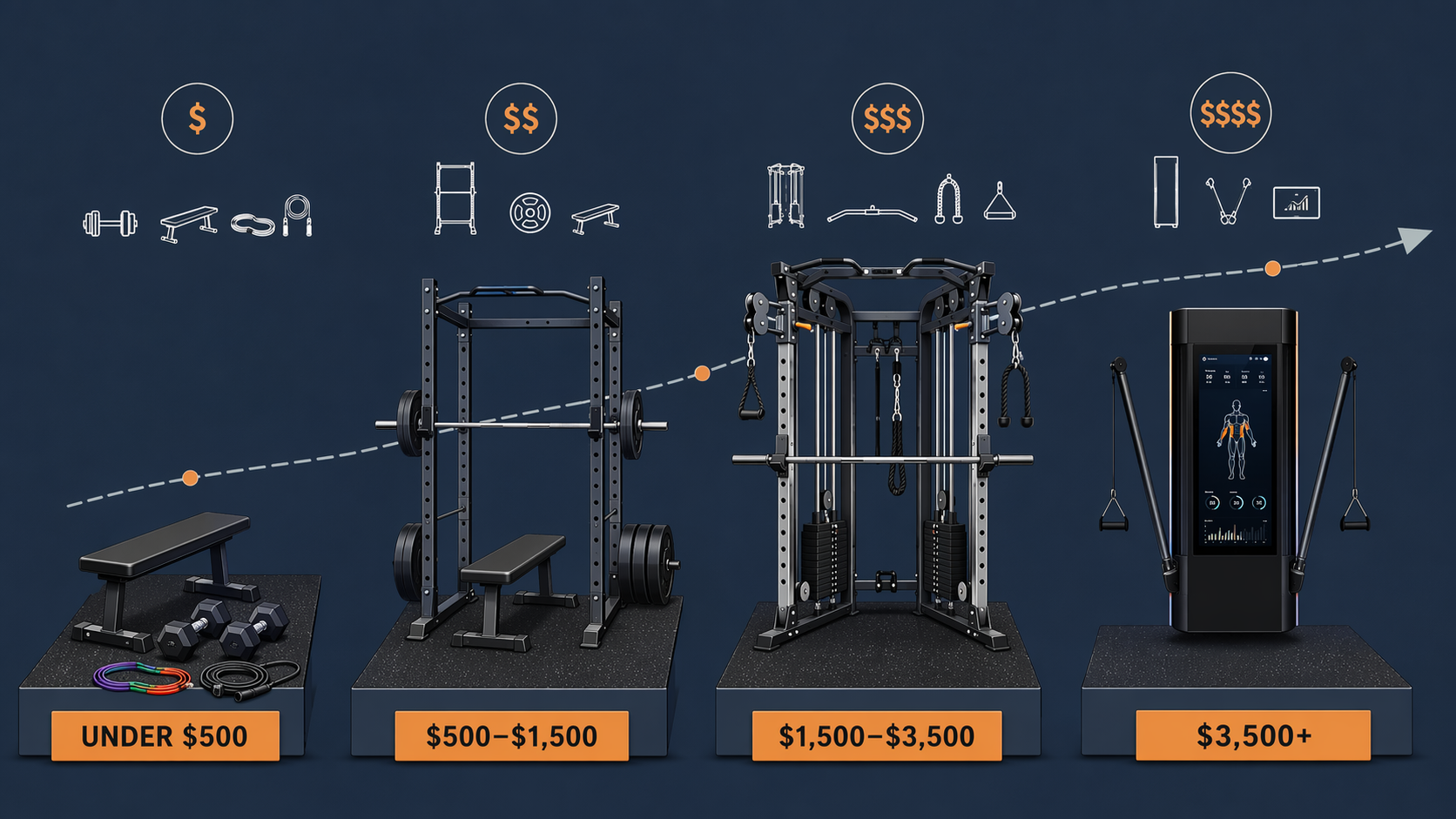
Under $500: The Minimalist Actually Wins
A minimalist setup — dumbbells, a pull-up bar, a mat — comes in under $400. That is the number from Fitness Avenue, and it is honest because there is nothing else to buy. No subscription. No flooring upgrade beyond the mat. No shipping on a mat. Total cost of ownership after five years: about $400, plus maybe a replacement jump rope.
| Item | Price | Notes |
|---|---|---|
| Adjustable dumbbells (e.g., REP QuickDraw 30 lb pair) | $336 | Replaces 12 pairs of fixed dumbbells |
| WOD Nation Speed Rope | $19 | Includes replacement cable |
| Exercise mat (basic 6x4 ft) | $30 | Floor protection, no shipping if bought locally |
| Resistance bands (set of 3) | $25 | Adds variety without space |
| Total | ~$410 | No subscription, no ongoing cost |
Against a $69 monthly gym membership, this setup pays for itself in about six months. The trade-off is limited versatility. You cannot squat heavy. You cannot do cable flyes. But if your goal is general fitness — bodyweight strength, light resistance, some cardio — this tier works, and it carries zero subscription risk. The 63% of 18- to 29-year-olds who plan to buy home fitness equipment should start here.
$500–$1,500: The No-Subscription Sweet Spot
At this tier, you have a real choice. You can build a traditional rack-and-barbell setup for around $1,000, or you can buy an all-in-one machine like the Bowflex Xtreme 2 SE for $1,499. Both have zero subscription costs. The difference is how you train.
| Setup | Upfront cost | 5-year TCO | Best for |
|---|---|---|---|
| Traditional: REP PR-1100 rack ($380) + Synergee barbell ($180) + 255 lb plates (~$220) + adjustable bench ($220) + flooring ($100) | ~$1,100 | ~$1,100 | Serious strength training, progressive overload |
| Bowflex Xtreme 2 SE + flooring ($100) | $1,599 | $1,599 | 70+ exercises, compact, no barbell needed |
| RitFit M1 PRO Smith machine + functional trainer | $1,300 | $1,300 | All-in-one with cable crossover, 68-inch depth |
The Bowflex is a known quantity: power rod resistance, 210 lbs upgradable to 410, no subscription. The RitFit M1 PRO ($1,299.99) combines a Smith machine, plate-loaded functional trainer, and squat rack in a single footprint. Neither charges a monthly fee. Compare that to the smart gyms in Tier 4, where a $60 monthly subscription can add thousands to the five-year cost.
$1,500–$3,500: The Value Peak
This is where the best value lives. The $1,500–$3,500 range supports a premium functional trainer or a high-end rack build. A functional trainer is the single most versatile piece of strength equipment. And many of the best options in this tier require no subscription.
| Machine | Price | 5-year TCO | Space | Subscription |
|---|---|---|---|---|
| Bells of Steel All-in-One | $1,300 base (~$1,900 with shipping + cables) | $1,900 | 31" x 28.5" x 80.75" | None |
| REP Fitness Ares 2.0 (requires PR-4000/5000 rack) | $3,000 (attachment only) | $3,000 + $400 rack = $3,400 | Varies by rack size | None |
| Titan Fitness Functional Trainer | $3,000 | $3,000 | ~48" x 48" | None |
| Beyond Power Voltra I (portable cable trainer) | $2,199 | $2,199 | 12.8 lbs, no floor space | None |
The Bells of Steel All-in-One is the standout. I have been recommending it to anyone who asks. It combines a squat rack and functional trainer with a 300 lb cable capacity. No subscription. At roughly $1,900 delivered with accessories, it undercuts the smart gyms by half and gives you more usable weight. The REP Fitness Ares 2.0 is a premium add-on for those who already own a REP rack, but the total cost pushes toward $3,400. Still no subscription.
$3,500+: Smart Gyms and Commercial Grade
Above $3,500, the equipment is commercial-grade: built for daily heavy use with 10- to 20-year warranties. Multi-station machines like the Body-Solid G9B or Major Fitness Heritage Series B17 fall here. They cost more upfront, but they do not ask for a monthly check. The smart gyms in this tier — Tonal, Speediance — are different. They are expensive, and they want your credit card every month.
| Machine | Upfront | Subscription | 5-year TCO | 10-year TCO |
|---|---|---|---|---|
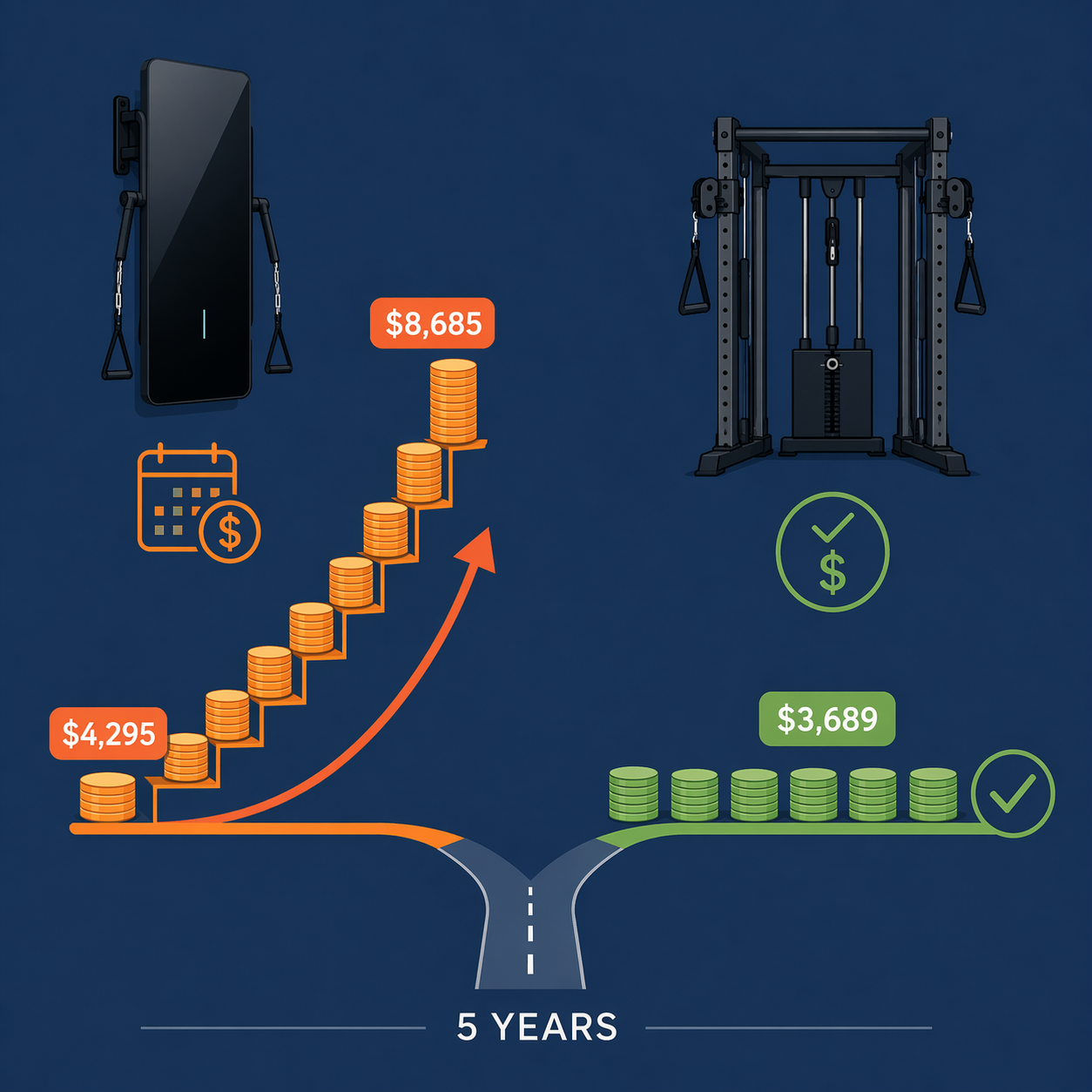
| Tonal 2 + shipping | $4,295 + $295 | $60/month | $8,685 | $12,285 |
| Speediance Gym Monster 2 Works Plus | $3,689 | None (free lifetime) | $3,689 | $3,689 |
| Major Fitness Heritage B17 (dual weight stacks) | $4,200 | None | $4,200 | $4,200 |
| Body-Solid G9B (dual 210 lb stacks) | ~$3,500 | None | ~$3,500 | ~$3,500 |
Speediance offers a 'free lifetime membership' — but that is a recent change from their prior $25/month model. I would not bet the savings on a policy staying free forever. The hardware itself is solid: 220 lbs of digital resistance, compact footprint, built-in screen. But the real counterexample to Tonal is not Speediance. It is the Bells of Steel All-in-One from the previous tier. Same capability, no subscription, half the price.
The Subscription Trap: A $5,000 Difference You Cannot Ignore
Tonal 2 costs $4,295. The membership is $60 a month. Shipping is $295. After five years, that is $8,685. After ten years, $12,285. Speediance Gym Monster 2 costs $3,689 flat. The difference over five years is $4,996. Over ten years, $8,596. That is not a rounding error. That is a whole additional home gym.
I used Innerbody's comparison to run these numbers. They are current as of mid-2026. The math is simple: if you train for five years, every $60 Tonal membership dollar goes to the subscription company. Not to better equipment. Not to more weights. To the privilege of accessing the machine you already bought.
The subscription trap is not limited to Tonal. Many smart gyms — Mirror, Peloton, NordicTrack iFit — add $20 to $60 per month. The equipment becomes a liability if you stop paying. A traditional cable machine or a barbell setup never asks for another dollar. The 22% of U.S. households that own smart home gym equipment are betting that the coaching and convenience are worth the monthly bleed. For many, they are. But the five-year number should be part of the decision, not a surprise after the first year.
What to Buy First: The Priority Pyramid
After running the numbers across every tier, one pattern is clear: the money you spend on hardware gives you lasting value. The money you spend on subscriptions gives you access until you cancel. That does not mean subscriptions are evil — coaching, programming, and community have real value. But the hierarchy matters.
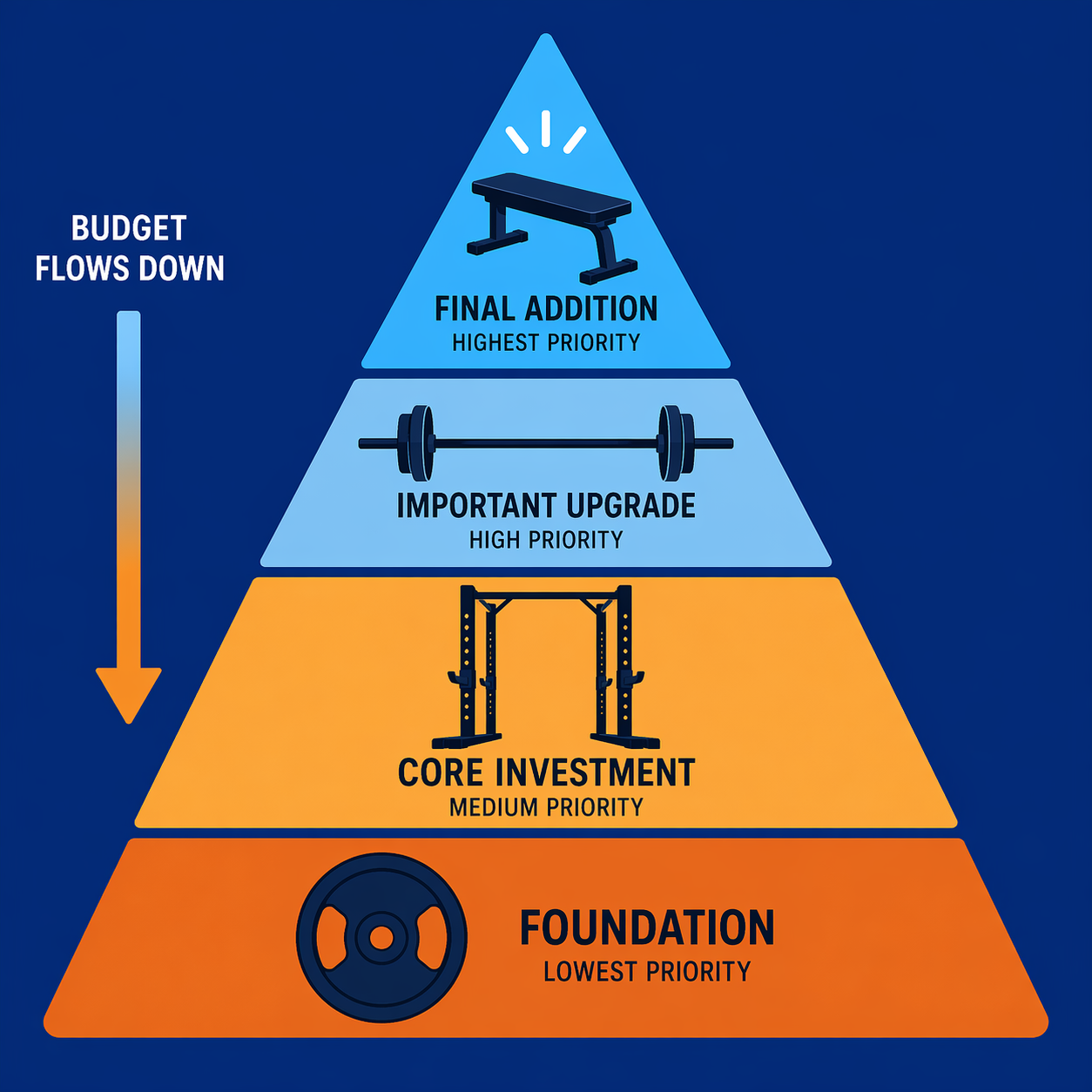
- Spend on a good adjustable bench first. Every upper-body press and row needs it.
- Then a barbell and plates. Used plates are fine. Cast iron does not go bad.
- A power rack or squat stand comes third. Safety matters when you go heavy.
- Accessories — cables, bands, specialty bars — come last. They add variety, not necessity.
A $1,500 no-subscription setup following this hierarchy outperforms a $3,500 smart gym over five years in training value per dollar. The smart gym gives you coaching and convenience. The traditional setup gives you progressive overload and no ongoing cost. Choose based on your five-year budget, not the sticker price.
The $2,530 foundational home gym pays for itself in about three and a half years for a single user. After that, every workout is free. The same math applies at every tier. The question is not how much you spend today. It is how much you will have spent by the time you stop using it.
This result comes from one real apartment under the stated conditions — it is a strong signal, not a guarantee your space will measure identically.
Builds this evidence supports
Small Treadmill Buying Guide: 7 Critical Specs to Check Before You Buy
A cross-category spec primer for apartment and small-space dwellers comparing walking pads, ultra-compact folding treadmills, and full-size folding treadmills. Learn the concrete thresholds for motor HP, deck length, noise, warranty, and subscription lock-in so you can compare apples to apples.
Where to Spend vs. Save on Affordable Home Gym Equipment: A Quality Tradeoff Guide
A practical guide for budget-conscious buyers (under $1,000) that reveals which equipment categories demand a higher investment for safety and durability, and where cutting costs is a smart move.
Spot something off?
If this result didn't match your own space, let us know — floor-damage and noise claims carry real deposit-risk consequences if we get them wrong.