
Smart Home Gym Comparison Guide (2026) — Which Type Is Right for You?
Not sure which smart home gym is right for you? This guide breaks down the four main categories—wall-mounted digital resistance, freestanding cable systems, app-based free-weight trainers, and cardio-first smart machines—so you can choose based on your space, training style, and budget before comparing specific models.
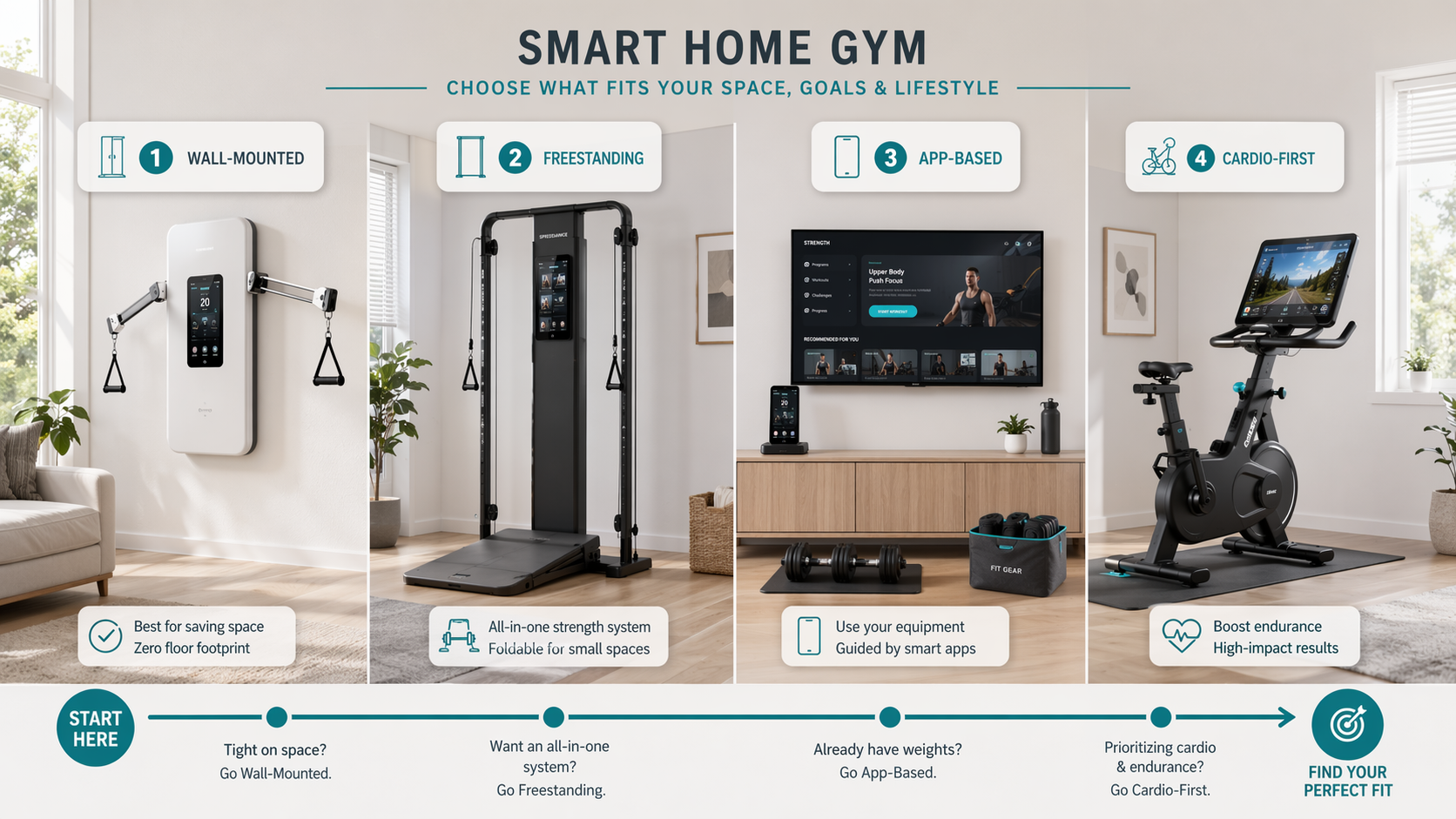
Skip the Brands, Start with the Category
Most buyers start the same way: they search "best smart home gym" and land on a listicle comparing Tonal, Peloton, Tempo, and Speediance as if they were interchangeable. Then they read reviews, watch videos, and try to pick a winner. A few weeks later they either drill holes in a rented wall, discover the "beginner" bundle maxes out at 50 pounds, or realize the subscription costs as much as the machine within two years.
I would not start by comparing brands. I would start by asking which category you actually need.
The smart home gym market in 2026 splits into four distinct categories: wall-mounted digital resistance, freestanding cable systems, app-based free-weight trainers, and cardio-first smart machines. These are not marketing labels — they reflect real differences in space requirements, strength potential, subscription dependency, and the kind of training the hardware actually supports. Pick a category first. Then compare models within it.
Three things actually matter: the floor space you can spare, the kind of training you actually do (strength, cardio, or both), and whether you are willing to pay $30–$60 every month for the foreseeable future. Everything else — brand name, screen size, "AI coaching" — is a detail you can sort out after the category is set.
For a primer on the three tiers of smart features and how much they actually change the workout, see What Makes a Home Gym 'Smart' in 2026?. But first, let's walk through each category.
Wall-Mounted: No Floor Space, Heavy Commitment
These systems — Tonal 2 at $4,295 and the Speediance Gym Monster 2 at $3,199 — attach directly to a wall stud and deliver digital resistance via a cable mechanism. Their biggest practical advantage: zero floor footprint. In use, the machine occupies only the space your body moves through, about 10 to 50 square feet depending on the exercise. That is dramatically less than a traditional rack-and-iron setup, which can require 80 to 150 square feet.
The trade-offs are equally real. Tonal 2 requires professional assembly — you are not mounting this yourself in a rental apartment. It also asks for a $59.95 monthly subscription and a minimum 12-month commitment, plus $495 for the accessories bundle (smart handles, bar, rope, bench, mat). Over five years, that works out to about $8,400 total. The Speediance GM2 is slightly cheaper and its AI coaching subscription is optional at $24.90 per month, but it still needs a sturdy wall mount.
The AI in these systems tracks your rep speed and suggests weight adjustments. It does not replace a real coach. One honest line from a tester: "It suggests weight adjustments and tracks reps, but it doesn't tell you if your squat form is wrong." The coaching is a convenience, not a transformation.
Who this category is for: homeowners with a dedicated wall, at least $3,200 upfront, and no objection to a monthly subscription. Who it is not for: renters who cannot drill, anyone on a tight monthly budget, or people who want a machine that still works if the company goes under or they cancel the subscription. Tonal 2's core functions lock without a membership.
If space is your main constraint, you might also want to read the Apartment-Friendly Smart Home Gym Guide — but be honest about whether you can drill.
Freestanding: No Drilling, No Commitment to a Wall
Freestanding systems like the Speediance Gym Monster 2 (when used with its floor platform) and the AMP Fitness Device ($2,495) solve the installation problem. They sit on the floor, often fold, and can be wheeled into a closet or corner. The Speediance platform folds to under 4 square feet for storage. You still need 10 to 20 square feet of clear space during a workout, but you do not need a drill or permission from a landlord.
Resistance is similar to the wall-mounted category: the GM2 delivers 220 pounds (the GM2S variant goes to 260), and the AMP peaks at 100. The Speediance's AI subscription is optional — core functions (manually selecting weight and reps) work without paying anything. That makes the five-year cost $3,199 for the hardware alone, or $4,693 if you keep the $24.90/month AI sub. Compare that to Tonal's forced $60/month.
The practical take on AI here: "The AI coaching is optional; you can use the machine as a dumb cable tower." That is a genuine advantage for buyers who want the hardware but not the monthly tie-in.
These machines are still heavy — the Speediance unit is around 100 pounds — so "portable" means you can move it across the room, not carry it up stairs. But for renters and apartment dwellers who do not want to commit to a wall, this category is the most practical option.
See also: The Apartment-Friendly Smart Home Gym Guide for more on folding designs and storage.
App-Based Free-Weight: Low Entry, Low Ceiling
The Tempo Move starter bundle at $504 is the lowest entry price in the smart gym market — less than a quarter of the category average of $1,930. You buy a phone mount, a heart rate strap, a mat, and 50 pounds of weight plates. The app uses your iPhone camera to track your movements and count reps. No screen, no wall mount, no professional install.
The catch: you need an iPhone XR or later. Android is not supported. And the weight ceiling is real — the starter bundle maxes at 50 pounds, and even if you buy additional plates, the system is designed for moderate loads, not heavy lifting. The Tempo Studio, which had a more robust frame, has been discontinued.
At $39 per month, the subscription adds up. Over five years the total cost is $504 + ($39 × 60) = $2,844. That is still cheaper than any other smart gym with a subscription, but it is not trivial. The AI form coaching uses the phone camera — it watches your reps and gives feedback based on body tracking. It will not spot you on a heavy set.
This category works best for beginners who are not sure they will stick with a routine and do not want to spend thousands upfront. It also suits people whose strength goals will not outgrow 50–100 pounds. If you are already comfortable benching 135, you will hit the ceiling fast.
For a simpler starter recommendation, see our Best Home Workout Machine for Beginners guide.
Cardio-First: Great for Heart, Not for Muscles
Peloton, NordicTrack, and Aviron make excellent connected cardio machines. The Peloton Cross Training Bike+ costs $2,695 with a $49.99 monthly All-Access membership. The NordicTrack X24 treadmill is $3,000 with a $40/month iFIT Pro plan. The Aviron Strong Series Rower is $2,549 with a $34/month subscription. They all offer excellent live classes, auto-resistance adjustment, and strong communities.
The core limitation: these are cardio machines with floor workout programming as a supplement. You can follow a yoga or bodyweight session on the Peloton screen, but the hardware itself is designed for cycling, running, or rowing. If your primary goal is strength, this category alone will not get you there. You will need to add dumbbells or a separate strength machine, which pushes the total cost well above $5,000 and eats more floor space.
The AI auto-adjusts resistance on hills during a live class — neat, but it does not watch your form. If you want form feedback, you need a camera-based system, which none of these machines provide for strength movements.
This category is ideal for people who train primarily for cardiovascular fitness and enjoy class-based motivation. It is also a good supplement to an existing strength setup. But if you only have room and budget for one machine, and you want to get stronger, look at categories 1–3.
| Category | Upfront Price | Monthly Subscription | Space While Using | Max Resistance | Ideal For |
|---|---|---|---|---|---|
| Wall-mounted | $3,200–$4,300 | $25–$60 (often required) | 10–50 sq ft (zero floor footprint) | 220–260 lbs | Homeowners, strength-focused, can afford premium |
| Freestanding | $2,500–$3,200 | $0–$25 (optional) | 10–20 sq ft (folds to <4 sq ft) | 100–260 lbs | Renters, space-constrained, strength-focused |
| App-based free-weight | $504 | $39/month | ~30 sq ft (TV space) | 50–150 lbs (starter 50) | Beginners, budget, iPhone users |
| Cardio-first | $1,700–$3,000 | $34–$50/month | 25–50 sq ft | N/A (cardio-focused) | Cardio lovers, class-motivated |
The Real Cost: What the Subscription Adds Over Five Years
Upfront price is only half the equation. The monthly subscription — whether required or optional — transforms the total cost of ownership.
Here is the five-year total for representative products in each category, using standard US pricing as of mid-2026:
- Tonal 2 (wall-mounted): $4,295 + ($59.95 × 60) + $495 accessories = ~$8,387
- Speediance GM2 (freestanding, with optional sub): $3,199 + ($24.90 × 60) = ~$4,693 (without sub: $3,199)
- Tempo Move (app-based): $504 + ($39 × 60) = ~$2,844
- Peloton Bike+ (cardio-first): $2,695 + ($49.99 × 60) = ~$5,694
These numbers come from AEKE, a brand that sells smart gyms, so take them as a rough guide, not a verified benchmark. The pattern is clear: subscription-required systems cost $6,100–$9,600 over five years, while subscription-free options (where core functions work without a monthly fee) run $3,200–$5,500.
The platform dependency risk is real but unquantifiable. If the company folds, a machine that requires a subscription to function may become unusable. This is not a reason to avoid smart gyms entirely, but it is a reason to check the company's financial health and your ability to cancel without losing hardware functionality. For the freestanding Speediance, at least the resistance works without the sub.
Which Category Fits You? A Four-Question Decision Framework
Forget brand names for a moment. Answer these four questions:
- Do you have a dedicated wall and permission to drill? If yes, you can consider wall-mounted. If not, skip to freestanding or app-based.
- Do you prioritize strength training, cardio, or both equally? Strength-oriented buyers should look at categories 1–3. Cardio-dominant buyers can start with category 4, but be prepared to add strength equipment later.
- What is your upfront budget? Under $1,000 → category 3. $1,000–$2,500 → consider freestanding or a used cardio machine. $2,500+ → all categories are accessible.
- Are you willing to pay $30–$60 per month ongoing? If not, prioritize freestanding systems with optional subs (Speediance) or look at non-smart equipment. Wall-mounted and cardio-first machines rarely let you skip the fee.
Map your answers:
| If you said… | Your category is… | Your starting model range |
|---|---|---|
| Yes to question 1, strength-first, $2,500+, willing to pay | Wall-mounted | Tonal 2, Speediance GM2 |
| No to question 1, strength-first, $2,000–$3,200, optional on fee | Freestanding | Speediance GM2, AMP Fitness |
| $500–$1,000, have an iPhone, beginner or moderate strength | App-based free-weight | Tempo Move |
| Cardio-first, enjoy classes, have room, can supplement later | Cardio-first | Peloton Bike+, NordicTrack X24, Aviron rower |
For more nuanced guidance, read our Home Gym Decision Guide: Which Type of Gym Machine Actually Fits Your Training Style?.
One Last Check: Don't Let Marketing Decide
Every smart gym brand uses the same vocabulary: AI-powered, adaptive, intelligent. Those words do not tell you how much floor space the machine needs, whether you can use it without a subscription, or how heavy the resistance actually feels. The AI in a wall-mounted system adds a rep counter and weight suggestion. The AI in a cardio machine adjusts resistance on a simulated hill. Neither replaces the judgment of a human coach or the basic constraint of your available space and budget.
The thesis stands: category choice matters more than brand. A $3,199 freestanding machine in a rented apartment is a better investment than a $4,295 wall-mounted system that you cannot install. A $504 app-based trainer with a clear strength ceiling is better for a beginner who might quit in three months than a $5,000 commitment.
Now that you know your category, look at specific models within it. Compare warranties, return policies, and real user reviews. Keep your space and monthly budget in mind all the way through checkout. The marketing will still be there, but now you have a framework to see through it.
This result comes from one real apartment under the stated conditions — it is a strong signal, not a guarantee your space will measure identically.
Builds this evidence supports
Cable Machine Alternatives That Save Space and Money
Compare the best cable machine alternatives for home gyms – from resistance bands and pulley systems to suspension trainers and compact digital units – and find the right option for your space and budget.
How to Choose a Compact Home Gym That Works for Your Space, Budget, and Noise Tolerance
This article provides a structured decision framework for apartment dwellers and small-space residents to match their specific floor footprint, noise sensitivity, and budget to the most suitable compact home gym strategy — whether that's an all-in-one machine, modular build, smart digital system, or band/bodyweight setup.
The Garage Gym Reality Check: What Equipment Actually Fits in a Single-Car Garage
Most garage gym guides assume a two-car space. This article uses real dimensions, real equipment footprints, and three layout templates to show what fits—and what doesn't—in a single-car garage (10x20 to 12x20 ft).
Spot something off?
If this result didn't match your own space, let us know — floor-damage and noise claims carry real deposit-risk consequences if we get them wrong.