
The Apartment-Friendly Smart Home Gym Guide: Which Systems Actually Work in Small Spaces
Compare smart home gym systems by the constraints that matter most in apartments: noise level, mounting requirements, and footprint. This guide helps small-space dwellers choose a system that fits their building, not just their workout goals.
Tonal says its new 2 requires just 7 square feet. Then it says you need a 7x7-foot workout space. Those two numbers cannot both be true. One is the product footprint, the other is what you need to actually use the thing — arms extended, body moving, cables pulling. The difference between 7 sq ft and 49 sq ft is the difference between believing an ad and measuring your own wall.
This guide is for the person who lives above someone else, in a building where drilling into concrete isn't an option and dropping a dumbbell would be a noise complaint waiting to happen. It is not another spec-list roundup. It starts where most reviews stop: can you even install the thing, and will your downstairs neighbor still talk to you afterward?
The Wall That Decides Everything
Every smart home gym brand leads with sleek product shots and AI coaching claims. They rarely mention that the unit needs a specific wall type, a clear ceiling height, and enough floor space to actually perform a lunge. The Tonal discrepancy is not a typo — it is a deliberate choice to make the product sound smaller than the experience requires. A Tonal 2 needs a 7x7-foot workout area with 7-foot-10-inch ceilings, and it must be mounted to a wall with studs spaced 16 or 24 inches apart. No studs? No concrete mounting? No go.
The apartment world is built on concrete slabs and metal studs, not the 2x4 framing that Tonal demands. Before you swipe your card, measure your wall. The AEKE blog — promotional, but with useful numbers — suggests you check active clearance (5–6 feet for a lunge), folded depth under 15 inches, and confirm stud spacing is the standard 16 inches. That is the right checklist, just ignore the product pitch attached to it.
Wall-mounting sounds like a minor hurdle until you live in a rental where drilling into anything more solid than drywall requires a deposit-risking conversation with your landlord. Tonal must be mounted to studs 16 or 24 inches apart and cannot be installed on cinderblock or concrete walls. If your building was built after 1980 with a concrete frame, you are almost certainly out of luck.
Compare that to the Speediance Gym Monster, which sets up on the floor, needs no wall mounting, and folds up when you are done. According to Garage Gym Reviews, it is quick to set up and does not require drilling. For apartment dwellers, that single spec — no drill required — can be the only spec that matters.
The Tempo Move lands in between: no wall mount needed, but it needs a 6x6-foot clear space for its 3D camera to track your movement. No studs, no landlord — you just need enough floor. But those 6 feet each way often mean clearing a living room corner. Do you have that?
| System | Wall Mount Required? | Landlord Permission | Space Needed |
|---|---|---|---|
| Tonal 2 | Yes — studs 16–24 in apart | Likely yes | 7x7 ft cleared |
| Speediance Gym Monster | No — freestanding | No | ~4x6 ft active area |
| Tempo Move | No — floor based | No | 6x6 ft |
| MaxPRO SmartConnect | No — portable | No | Small area (portable) |
| AEKE K1 | No — freestanding | No | Check folded depth < 15 in |
Noise: The Real Reason You Can't Just Buy the Fancy One
The noise question is where the marketing and reality split hardest. Dropping a loaded barbell generates noise levels exceeding 90 decibels — roughly as loud as a lawnmower running in your living room, according to the AEKE blog. Even dropping a 50-pound dumbbell (the max in Tempo Move's starter bundle) will travel through floor joists and into the apartment below.
Digital resistance — the tech inside Tonal and Speediance — is significantly quieter. The same AEKE source says digital motors operate near-silently. That is a huge advantage. But there is a gap in the data: no source I have seen confirms whether the vibration of those motors travels through the floor. Near-silent air noise is not the same as zero structural vibration. If you are on a second floor with lightweight construction, even a humming motor might be audible to the person below.
A smart home gym that uses digital motors is significantly quieter, operating near-silently. — AEKE (brand blog, promotional framing)
Magnetic resistance (used by Peloton, NordicTrack) also runs quiet, but those are typically bikes — not the all-in-one strength systems this guide covers. For an apartment, digital or magnetic is almost always preferable to free weights that can be dropped.
The MaxPRO SmartConnect is a wildcard here: it uses cable resistance (concentric only) and generates very little noise. But its 300-pound resistance claim comes with a catch — more on that later.
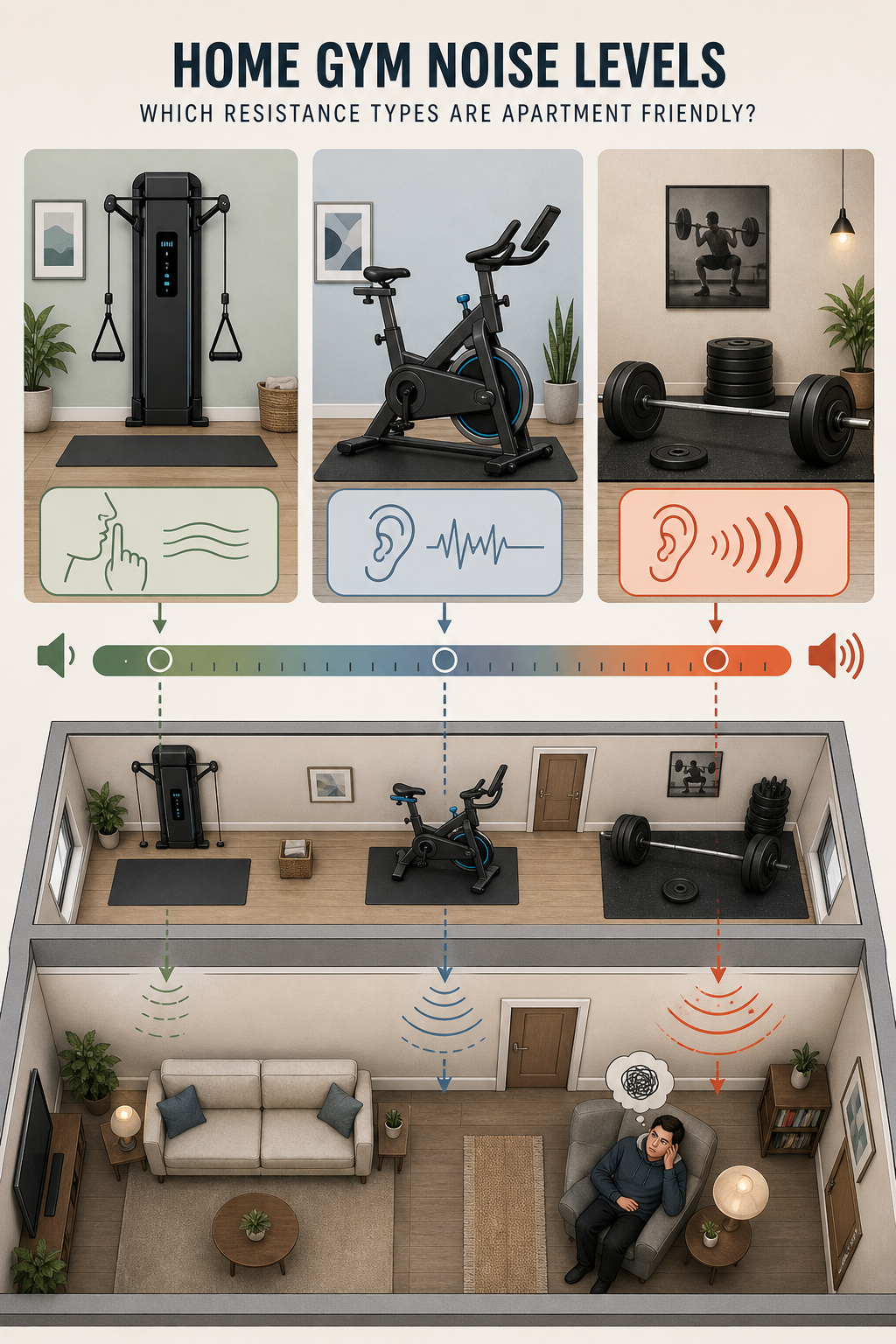
Floor protection is not about preserving your security deposit — it is about how sound travels. A concrete floor under thin carpet transmits impact much louder than a rubber mat on a ground-floor slab. If you are on the second floor, the combination of hard flooring, no mat, and free weight drops is a guarantee of noise complaints.
For any system that uses free weights — Tempo Move, or anything you supplement with dumbbells or a barbell — invest in a thick (1/2-inch or more) rubber mat. If you are above the ground floor, add a rule: do not drop weights. The Tempo Move sets up a virtual bar that prevents overreaching, but a dropped dumbbell at 90 dB will still travel through the floor. With a mat and discipline, you can manage it. Without, your neighbor will not care about your AI coaching tier.
The Trade-Offs Hiding in Plain Specs
MaxPRO's 300-Lb Riddle
The MaxPRO SmartConnect weighs 9 pounds and claims up to 300 pounds of resistance. That is a remarkable spec — until you understand that it is concentric-only resistance. You pull the cable, it resists; when you lower, there is no eccentric load. That makes it great for cable rows and tricep pushdowns, but it cannot replace free weights for exercises where eccentric loading matters (like a proper curl or pull-up). It is quiet, portable, and packs into a case, but it is not a full strength replacement.
Tonal's Space Shell Game
We already covered the 7 sq ft vs 7x7 ft discrepancy. It is worth repeating: the 7 sq ft number only counts the area directly under the unit. The actual usable space is 49 sq ft. That is a substantial living room corner. If you are in a studio or a one-bedroom under 600 sq ft, that space might be better used for furniture you use daily.
Speediance's Unverified Silence
Speediance uses digital resistance and is described as near-silent. The claim is plausible, but no third-party measurement confirms whether vibration transmits through the floor. If you are in a new-build apartment with lightweight wooden joists, even quiet motors can hum. I would not call this a deal-breaker — it is far quieter than free weights — but treat it as unverified until someone runs a decibel test with a neighbor present.
The Decision: Two Filters First, Then Features
Here is the framework I would use, and it starts with the two filters that actually matter: installation and noise. Only after passing those should you consider training style, AI features, or subscription cost.
- Can you install it? If it requires wall mounting, do you have the right walls and landlord permission? If not, look at freestanding systems only (Speediance, Tempo Move, MaxPRO).
- How noisy is it? Digital or magnetic resistance is almost always better than free weights. If you must use free weights (Tempo Move), commit to a thick mat and a no-dropping rule. Avoid barbell drops entirely.
- Now ask: does the space fit? Measure your actual workout area — not the brand's footprint — and compare it to the usable space needed. Add the folded depth if storage matters.
- Only then evaluate training style, AI coaching depth, and price. Those are the differentiators, not the primary decision drivers.
By that logic, for most apartment dwellers, Speediance Gym Monster is the baseline recommendation: no wall mount, digital resistance, foldable, and quiet enough for shared walls. But if you live on the ground floor and have a dedicated corner, Tempo Move with a good rubber mat and a strict no-drop rule can work — and it gives you the benefit of free-weight loading (eccentric included). Tonal is only for those who own the wall and have the space; it is a great system in the wrong building for most apartment residents.
Before you buy anything, measure your wall, check with your landlord, and think about the person living below you. The best smart home gym for an apartment is the one you can actually use without stress — not the one with the most features on paper.
For a deeper look at how smart home gyms compare on non-apartment dimensions, see our compact home gym approaches guide and the full 2026 constraint-based buying guide. If Tonal is still on your shortlist, read the unvarnished reality check first.
This result comes from one real apartment under the stated conditions — it is a strong signal, not a guarantee your space will measure identically.
Builds this evidence supports
Cable Machine Alternatives That Save Space and Money
Compare the best cable machine alternatives for home gyms – from resistance bands and pulley systems to suspension trainers and compact digital units – and find the right option for your space and budget.
How to Choose a Compact Home Gym That Works for Your Space, Budget, and Noise Tolerance
This article provides a structured decision framework for apartment dwellers and small-space residents to match their specific floor footprint, noise sensitivity, and budget to the most suitable compact home gym strategy — whether that's an all-in-one machine, modular build, smart digital system, or band/bodyweight setup.
The Garage Gym Reality Check: What Equipment Actually Fits in a Single-Car Garage
Most garage gym guides assume a two-car space. This article uses real dimensions, real equipment footprints, and three layout templates to show what fits—and what doesn't—in a single-car garage (10x20 to 12x20 ft).
Spot something off?
If this result didn't match your own space, let us know — floor-damage and noise claims carry real deposit-risk consequences if we get them wrong.