
Why Weatherproofing Matters: The Real Cost of Choosing Wrong
The difference between a smart investment and a costly mistake in outdoor fitness equipment often comes down to a single question: how well is it protected from the elements? A multi-gym or pull-up station that looks sturdy on the showroom floor can begin showing rust within a single season if its weatherproofing is inadequate. The financial consequence is not trivial. Poorly constructed equipment may fail in one to two outdoor seasons, while high-quality commercial-grade gear, when maintained correctly, is designed to last 10 to 20 years, according to manufacturers like TriActive USA.
The core problem is that most buyers evaluate outdoor equipment based on price, brand, or feature count without understanding the material science that determines longevity. They see a powder-coated frame and assume it is weatherproof, not realizing that the thickness of the steel, the type of coating, the quality of the fasteners, and the UV stability of the plastics are all independent variables that determine whether that frame will still be functional in year five. This article strips away the marketing language and explains exactly what makes outdoor fitness equipment last — and what signals should send you looking for a different product.
Material Science Deep-Dive: What Makes Outdoor Equipment Last
Weatherproof outdoor fitness equipment is not a single technology but a system of material choices that work together to resist rust, UV degradation, and mechanical wear. Understanding each component helps you evaluate a product's true durability rather than relying on vague claims.
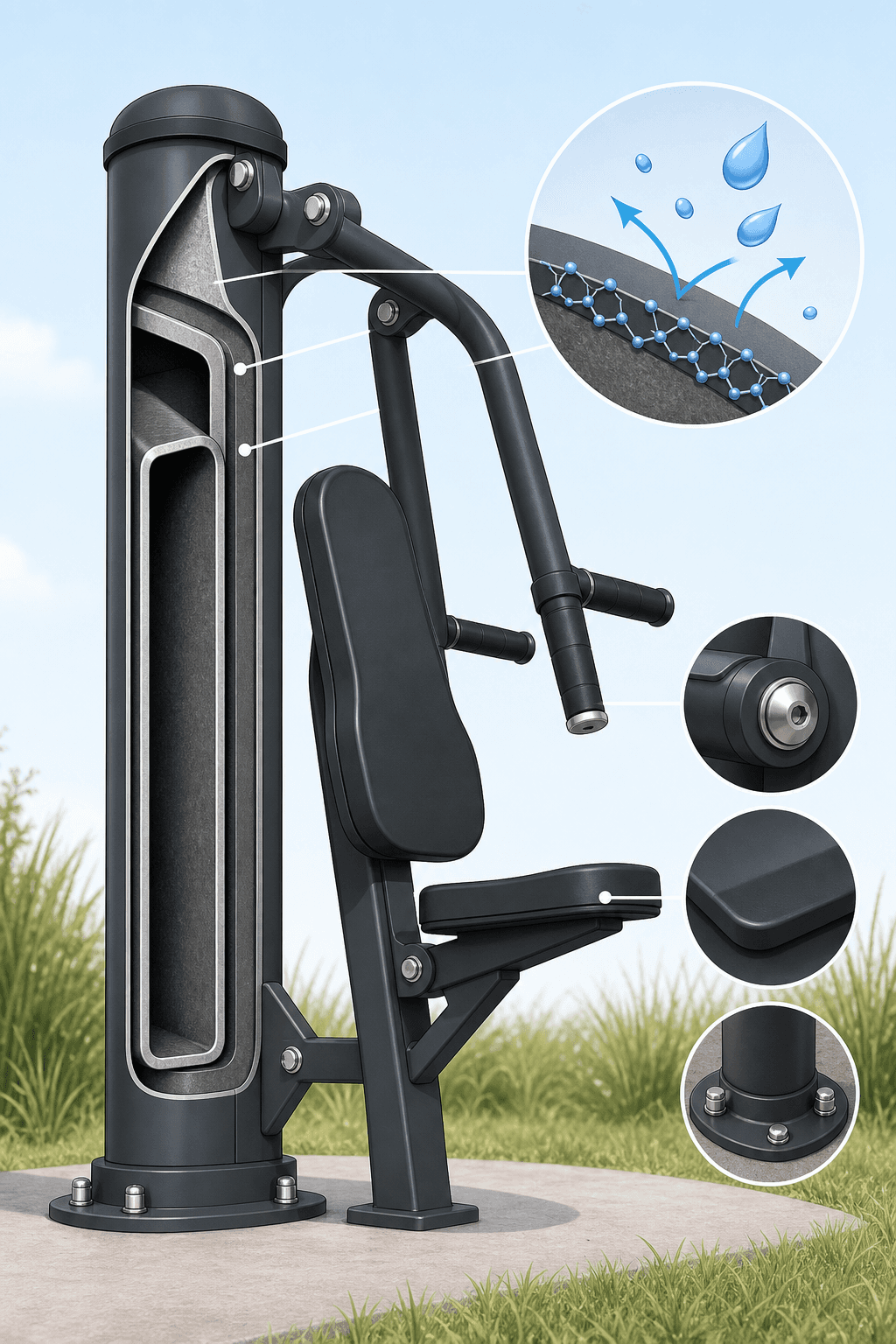
Powder-Coated Steel: The Backbone
The structural foundation of nearly all durable outdoor equipment is steel tubing. But the steel itself is only half the story. The protective coating applied to that steel is what determines whether it resists corrosion or becomes a rust hazard. The industry benchmark for serious weatherproofing is a powder coating tested to 1,000 hours of salt spray resistance, a specification cited by TriActive USA for their equipment. This test, conducted in a controlled salt-fog chamber, simulates years of coastal or humid exposure in a matter of weeks. A coating that passes 1,000 hours is dramatically more protective than one that passes only 200 or 300 hours.
Stainless Steel: When Rust Resistance Is Non-Negotiable
For components that face constant moisture or direct contact — weight stacks, guide rods, pulley systems — stainless steel offers a significant advantage. The chromium content in the alloy forms a passive oxide layer that prevents rust formation even when the surface is scratched. TriActive USA notes that stainless steel weight machines provide superior rust resistance precisely because of this chromium-driven self-healing property. For home users in coastal or high-humidity regions, stainless steel components on a multi-gym or cable machine can mean the difference between smooth operation for a decade and seized pulleys within two years.
HDPE and UV-Stable Plastics
Not all parts of outdoor equipment are metal. Seats, backrests, grip handles, and weight selector pins often use plastic or rubber. These components face a different threat: ultraviolet radiation from sunlight, which causes standard plastics to become brittle, crack, and fade. The ASTM F3101-15 standard, which ATX Playground identifies as the non-negotiable US safety standard for outdoor fitness equipment, specifies that plastic and rubber components must have a UV8 or higher stability rating. High-density polyethylene (HDPE) is a common choice for durable outdoor equipment because it resists moisture, UV light, and impact without degrading.
Marine-Grade Fasteners: The Hidden Weak Point
The bolts, screws, and washers that hold equipment together are often the first point of failure. Standard zinc-plated indoor hardware will corrode rapidly when exposed to rain and humidity. Marine-grade stainless steel fasteners — typically 304 or 316 grade — resist corrosion and maintain structural integrity over years of outdoor exposure. If a manufacturer uses standard hardware on a frame that is otherwise well-coated, the fasteners will rust, stain the surrounding coating, and eventually compromise the joint's strength.
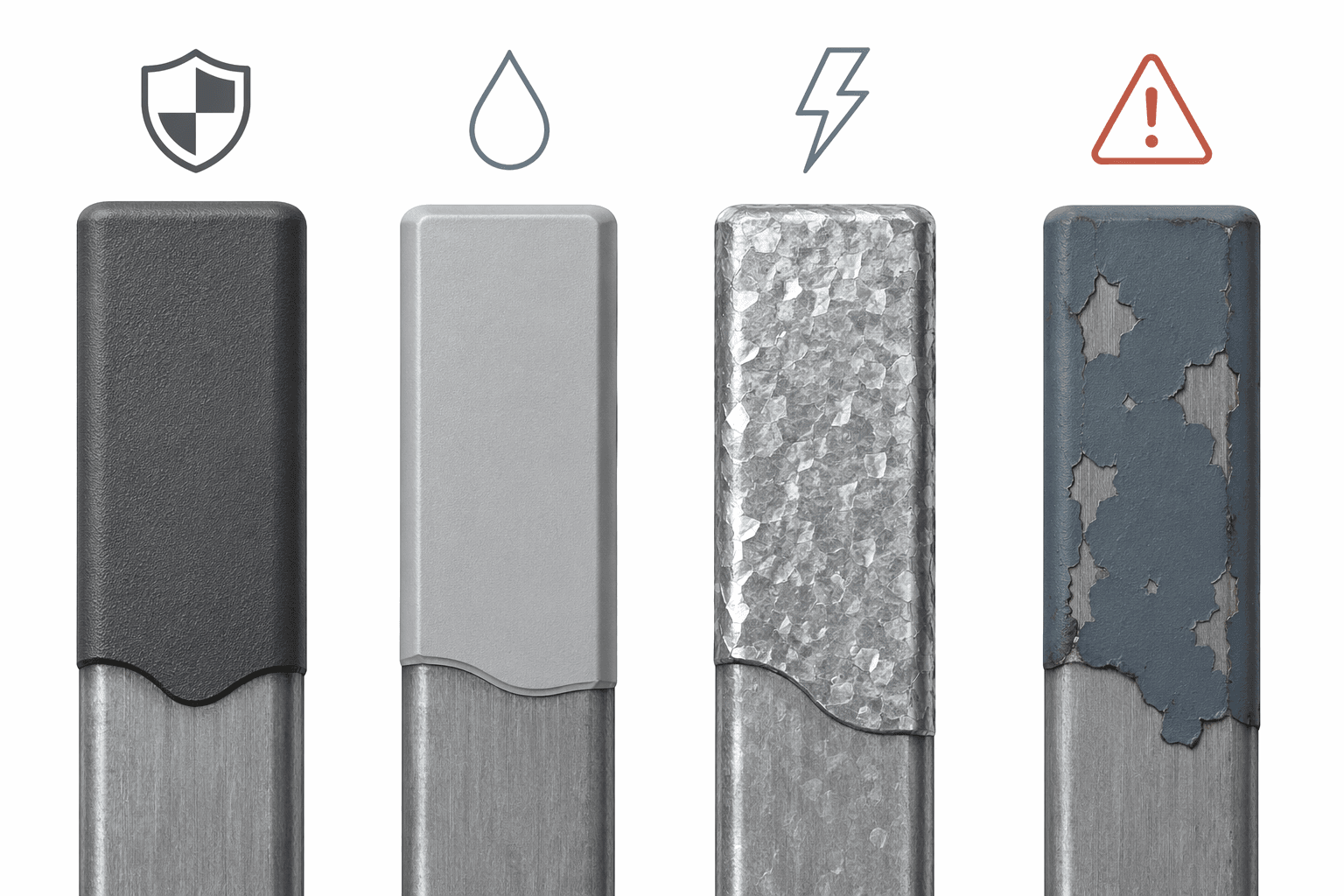
Coating Comparison: Powder Coat vs. E-Coat vs. Galvanized vs. Paint
The coating applied to the steel frame is the single most important factor in weather resistance. Not all coatings are created equal, and the terminology used by manufacturers can be confusing. The table below breaks down the four main coating types you will encounter when shopping for outdoor fitness equipment.
| Coating Type | Salt Spray Resistance | UV Stability | Application Process | Typical Lifespan | Cost Implication |
|---|---|---|---|---|---|
| Powder Coat (with e-coat primer) | Excellent (1,000+ hours tested) | High | Electrostatic spray + oven curing over e-coat primer | 15-20 years with maintenance | Higher upfront cost; best value long-term |
| E-Coat Primer Only | Good (500-700 hours) | Moderate | Electrodeposition dip coating | 8-12 years | Mid-range; often used as a base layer under powder coat |
| Hot-Dipped Galvanization | Excellent (1,000+ hours) | Moderate | Steel dipped in molten zinc | 20-30 years (structural) | Moderate; can be cost-effective for large frames |
| Standard Paint | Poor (100-200 hours) | Low | Spray or brush application | 1-3 years | Lowest upfront cost; highest long-term cost due to replacement |
The gold standard for outdoor fitness equipment is a two-layer system: an e-coat primer applied first, followed by a durable polyester powder top coat. Belson Outdoors describes this combination as the finish that eliminates rust, corrosion, or chipping. The e-coat primer provides uniform coverage even on complex geometries and internal surfaces, while the powder top coat adds thickness, UV resistance, and impact protection. If a product uses only a single layer of standard paint, it is a strong signal that the manufacturer has prioritized cost over durability.
Key Features That Extend Lifespan: Beyond the Coating
While the coating is the primary defense against the elements, several secondary design features determine whether equipment remains functional and safe over its intended lifespan. These features are often overlooked in product descriptions but are critical for long-term performance.
Captive Hardware and Tamper-Proof Bolts
Captive hardware refers to bolts, pins, and fasteners that are permanently attached to the equipment and cannot be removed without tools. This design serves two purposes: it prevents theft of removable components like weight plates, and it maintains structural integrity by ensuring that critical fasteners are never lost or improperly reinstalled. ATX Playground highlights captive weight systems as a key feature for outdoor equipment, noting that they provide the feel of real weightlifting without the risk of theft or injury from loose plates. Outdoor-Fit also emphasizes tamper-proof and weather-resistant construction as a core design principle for their multi-gym systems.
Sealed Bearings and Bushings
Moving parts like pulleys, cable guides, and pivot joints are vulnerable to moisture and debris infiltration. Sealed bearings — bearings with integrated rubber or metal shields that prevent contaminants from entering — are essential for outdoor equipment. Unsealed bearings will collect moisture, grit, and pollen, leading to rough operation, increased friction, and eventual seizure. Look for equipment that specifies sealed or shielded bearings on all rotating components.
UV-Stable Rubber Grips and Padding
Hand grips, seat cushions, and back pads are the most visible non-metal components on outdoor equipment. Standard rubber and foam degrade rapidly under UV exposure, becoming sticky, brittle, or cracked. The ASTM F3101-15 standard requires a UV8 or higher stability rating for these materials. When evaluating equipment, check whether the manufacturer specifies UV-stable materials or ASTM compliance. If the product description is silent on UV protection, assume the grips will need replacement within two to three years.
Drainage and Ventilation Design
Water can accumulate inside hollow steel tubing if there are no drainage holes at the lowest points. Over time, trapped water causes internal rust that can weaken the structure from the inside out. Quality outdoor equipment includes small drainage holes in the frame tubing and ventilation slots in plastic shrouds to allow moisture to escape and air to circulate. This is a subtle but important detail that separates well-engineered products from those that will fail prematurely.
Maintenance Protocols: Protecting Your Investment
Even the best-engineered outdoor fitness equipment requires regular maintenance to achieve its full lifespan. The difference between a 10-year and a 20-year service life often comes down to how well the equipment is cared for. The following maintenance schedule is based on recommendations from commercial equipment suppliers and is appropriate for home users.
- Weekly cleaning: Rinse the equipment with a garden hose to remove dust, pollen, bird droppings, and salt residue. For coastal areas, a weekly rinse is especially important to prevent salt buildup. Use a mild soap solution and a soft brush for grips and pads. Avoid pressure washers, which can force water into sealed bearings.
- Quarterly inspections: Check all bolts and fasteners for tightness. Look for signs of rust, especially around welds, bolt heads, and the edges of coating where it may have been scratched. Inspect cables for fraying and pulleys for smooth rotation. Test grips and pads for cracking or UV degradation.
- Seasonal care: Before winter, apply a light coat of silicone spray to moving parts and cable guides to prevent freezing and corrosion. In spring, inspect the coating for any chips or scratches that may have developed over the winter and touch them up with matching paint to prevent rust from starting. In hot, sunny climates, consider applying a UV protectant spray to rubber grips and plastic components twice a year.
- Covering: If you live in an area with heavy snow, hail, or extreme UV exposure, a breathable equipment cover can significantly extend the life of grips, pads, and coatings. Avoid non-breathable tarps, which trap moisture and accelerate corrosion.
For a more comprehensive look at protecting your equipment through all seasons, see our complete weatherproofing and maintenance guide.
Red Flags to Avoid When Shopping for Outdoor Equipment
Knowing what to look for is only half the battle. Equally important is knowing what signals should make you walk away from a product. The following red flags indicate that a manufacturer has cut corners on weatherproofing, and the equipment will likely fail long before its expected lifespan.
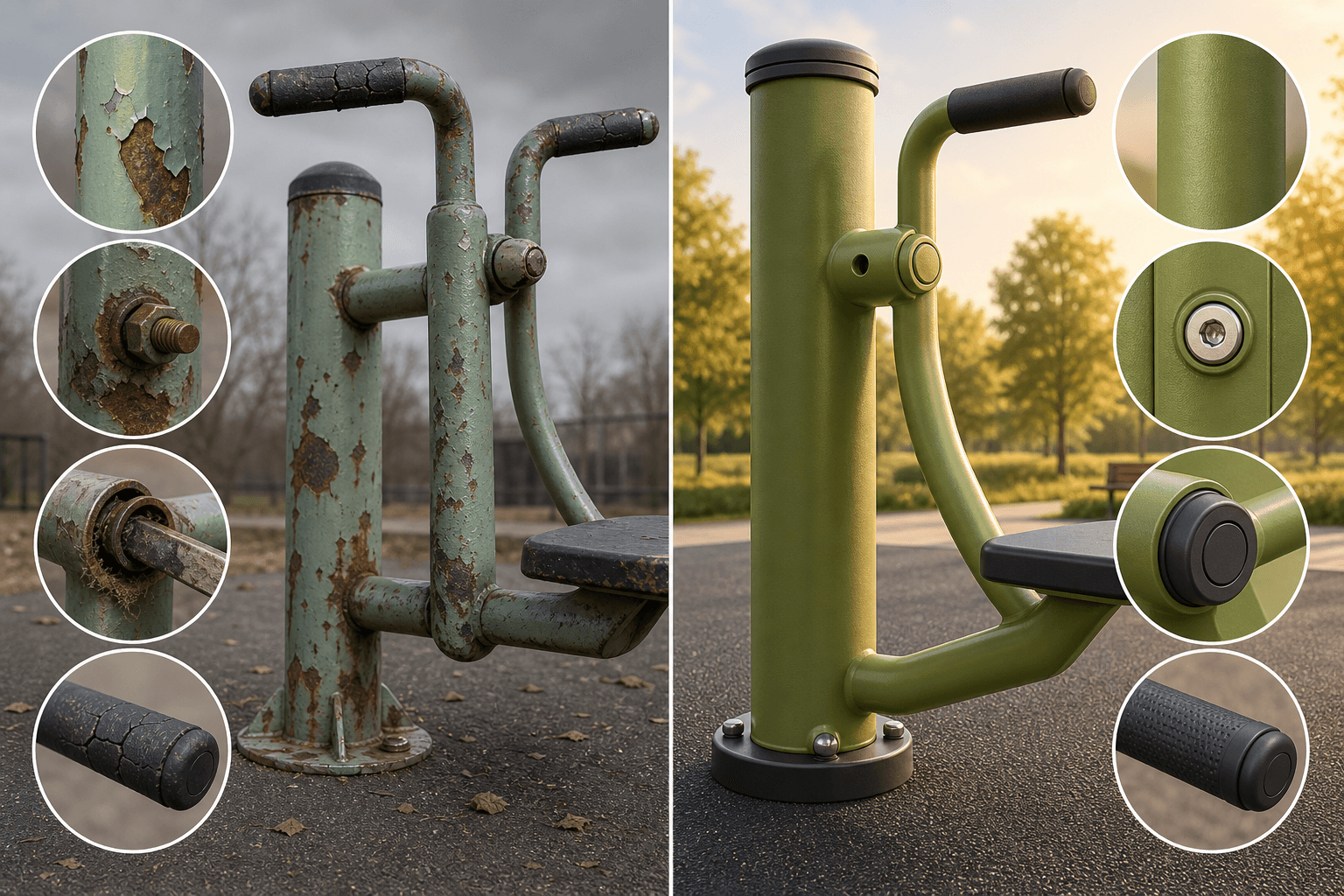
- Exposed moving parts: If pulleys, cables, or pivot joints are exposed without protective shrouds or seals, they will collect moisture and debris. TriActive USA specifically notes that quality outdoor equipment is designed without exposed moving parts, with bolts protected from harsh weather.
- Non-coated steel visible on joints or welds: Welds are often the first place rust appears because the heat of welding can burn off the coating. Quality equipment has post-weld coating applied to protect these vulnerable areas. If you can see bare metal at weld points, the equipment will rust there first.
- Thin paint that chips easily: Standard paint, especially if it is applied thinly, will chip from normal use and impact. Once the paint is compromised, rust follows quickly. If the coating looks like it could be scratched with a fingernail, it is not adequate for outdoor use.
- Standard indoor hardware: Zinc-plated bolts, Phillips-head screws, and non-stainless fasteners are a clear sign that the equipment was designed for indoor use. These will rust within months outdoors and can compromise the structural integrity of the equipment.
- No salt spray test certification: If a manufacturer does not provide a salt spray test rating for their coating, it is likely because the rating is low or non-existent. A 1,000-hour salt spray test is the industry benchmark for serious weatherproofing. Products that cannot meet this standard are not designed for long-term outdoor use.
- Lack of ASTM F3101-15 compliance: This standard covers safety, durability, and UV stability for outdoor fitness equipment. ATX Playground identifies it as the non-negotiable US standard. If a product does not claim compliance, it may not have been tested for outdoor conditions at all.
Expected Lifespan by Equipment Type and Climate Zone
The same piece of equipment will perform differently depending on where it is installed. A pull-up station that lasts 15 years in a temperate climate may need significant repairs after five years in a coastal salt environment. The table below provides realistic lifespan ranges for different equipment types across common climate zones, assuming proper maintenance and quality construction.
| Equipment Type | Coastal / High Humidity | Arid / Desert | Cold / Wet (Snow, Rain) | Temperate (Mild, Seasonal) |
|---|---|---|---|---|
| Multi-gym / Cable Machine | 8-12 years | 12-18 years | 10-15 years | 15-20 years |
| Pull-up / Dip Station | 10-15 years | 15-20 years | 12-18 years | 18-25 years |
| Outdoor Cardio (Bike, Elliptical) | 5-8 years | 8-12 years | 6-10 years | 10-15 years |
| Weight Bench / Rack | 8-12 years | 12-18 years | 10-15 years | 15-20 years |
| Suspension Trainer / Battle Rope Anchor | 3-5 years | 5-8 years | 4-6 years | 6-10 years |
These ranges assume that the equipment is made with the material standards discussed in this article: powder-coated steel with e-coat primer, marine-grade fasteners, sealed bearings, and UV-stable plastics. Equipment that lacks any of these features will fall at the lower end of the range or below it. For example, a multi-gym with standard paint and indoor hardware in a coastal climate may fail in as little as two to three years.
For a broader overview of equipment types and how to choose the right setup for your space, see our outdoor home gym equipment buyer's guide.
Final Verdict: Investing in Quality Saves Money Over Time
The decision to buy outdoor fitness equipment is a long-term investment in your health and your property. The upfront cost difference between a poorly weatherproofed product and a well-engineered one can be significant, but the math changes dramatically when you factor in replacement costs. A $500 pull-up station that rusts through in two years costs more over a decade than a $1,200 station that lasts 15 years with basic maintenance.
The non-negotiable factors are clear: steel gauge thick enough to resist bending, a powder coating with e-coat primer tested to 1,000 hours of salt spray resistance, marine-grade stainless steel fasteners, sealed bearings on all moving parts, and UV-stable plastics and grips rated to UV8 or higher per ASTM F3101-15. If a product checks all these boxes, it is built to last. If it cuts corners on any of them, you are paying for equipment that will need to be replaced long before you expected.
For readers who want to dive deeper into specific material comparisons, our outdoor exercise equipment materials guide provides additional detail on steel grades, coating chemistry, and fastener specifications.
Comments
Join the discussion with an anonymous comment.