
Plant-Based Meal Ideas That Support Home Workout Recovery
Home workout eaters going plant-based get a straight answer on what to eat: whole-food meals can support recovery when they hit roughly 25–40 g of protein with about 2.5 g of leucine. This guide explains the targets and lists specific no-powder meal combinations that clear them.
- Citation source
- Nutrients 2025 systematic review; 2024 McMaster trial
- Evidence level
- Informed synthesis; restrained inference from isolate-based trials
- Recommended frequency
- 20–40 g protein every 3–4 hours; recovery meal within ~2 hours after training
After a strength session at home, a useful plant-based recovery meal has to do more than look balanced. The practical target is roughly 25–40 g of protein, with about 2.5 g of leucine, in the meal you eat after training. That is the difference between “healthy plant food” and a plate built around the recovery dose used in sports-nutrition research.
The best short version of the evidence is this: plant protein performs well when the dose and leucine gap are handled deliberately. A 2025 systematic review of 24 randomized controlled trials concluded that well-formulated plant-protein blends at 30 g or more, with about 2.5 g of leucine, can match whey for post-resistance-exercise recovery outcomes, while single-source plant proteins were generally weaker in the reviewed evidence [1]. In a 2024 McMaster trial, a pea-and-canola protein blend fortified with leucine to whey-like levels stimulated muscle protein synthesis to the same extent as whey; the same plant blend without added leucine was about 12–16% less effective [2].
That does not mean a tofu bowl has been tested exactly like a lab-formulated protein isolate. It means the meal standard is reasonable: build the plate so the total protein lands in the 25–40 g range and the counted leucine gets close to 2.5 g. For a home-workout eater who wants food instead of powder, that is the useful bar.
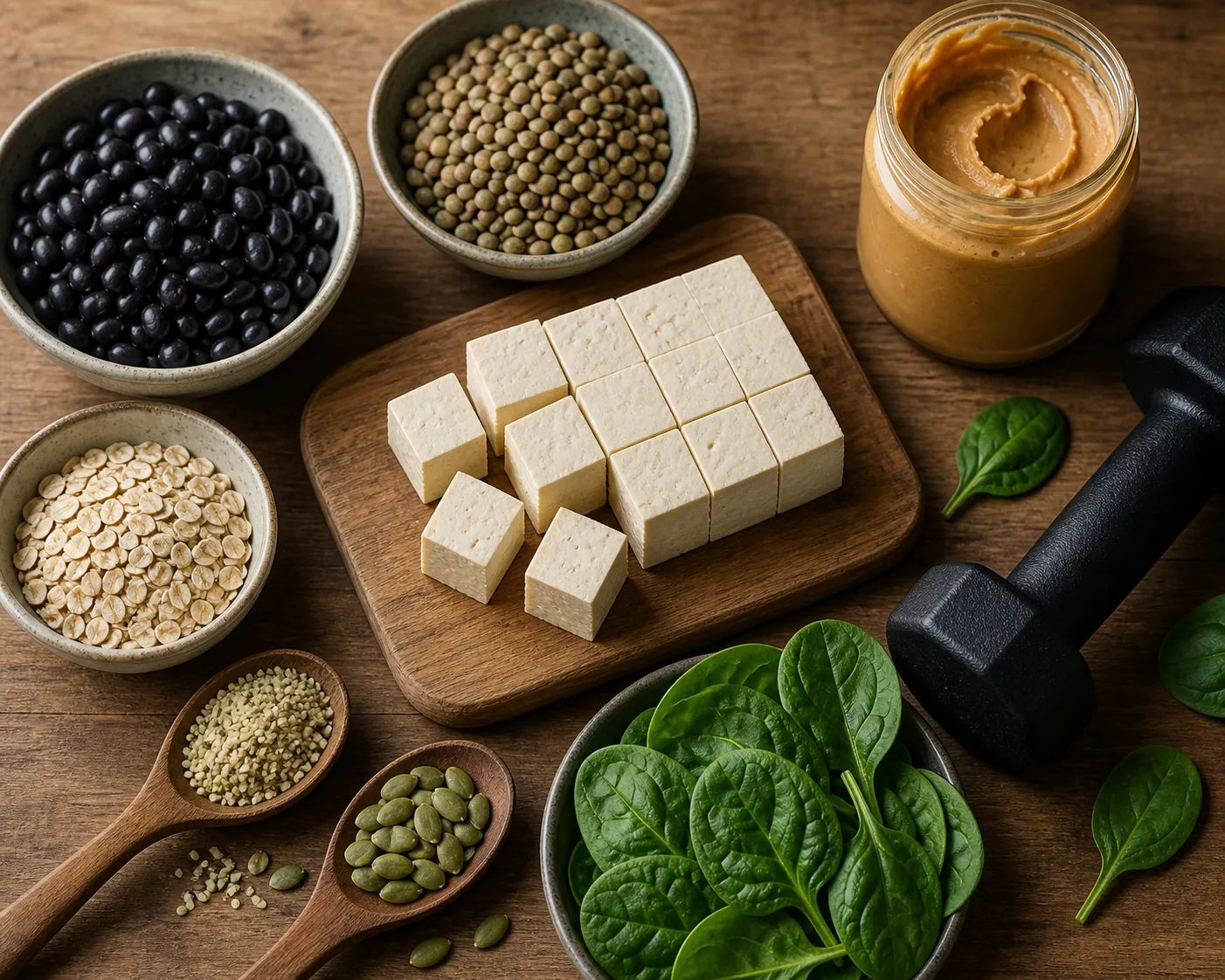
The leucine gap is where vague vegan recovery advice usually falls apart
Protein grams matter, but leucine is the part that often gets hidden inside the word “high-protein.” Leucine is one of the essential amino acids involved in triggering muscle protein synthesis. A dietitian review for vegan athletes describes leucine as a “light switch” for muscle repair and notes that serum leucine can drop by about 30% after strength exercise [3].
That is why a bowl of beans, grains, greens, and avocado may be a good meal and still be underbuilt for recovery if the protein anchor is too small. The fix is not complicated, but it has to be intentional: start with a leucine anchor, then add enough total protein to reach the recovery range.
The food math: count leucine first, then verify protein
The leucine values below come from a dietitian article citing USDA FoodData Central values. They are useful because they let you stop guessing whether a plant-based meal is actually close to the recovery trigger [3].
| Food | Counted serving | Leucine to count | How to use it after training |
|---|---|---|---|
| Firm tofu | 1/2 cup | ~1.0 g | Use as a main recovery anchor; 1 cup gives about 2.0 g leucine. |
| Black beans | 1 cup | ~1.2 g | Pair with tofu, oats, or peanut butter when a bowl needs a leucine lift. |
| Peanut butter | 2 tbsp | ~0.5 g | Useful as an add-on, not usually enough as the only leucine source. |
| Oats | 1 cup | ~0.5 g | Helpful in breakfast meals, especially when paired with tofu or peanut butter. |
| Lentils | Use label or database value | Not provided in the cited table | Good protein contributor, but do not rely on an uncited leucine number unless you check one. |
| Hemp or pumpkin seeds | Use label or database value | Not provided in the cited table | Good add-ons for protein, calories, minerals, and texture; count exact leucine only if your source gives it. |
For protein, use the nutrition labels on the foods you actually bought. Tofu firmness, bean brands, seed portions, and oat serving sizes can shift the total. The meals below are built around the 25–40 g protein target, but the final check belongs to your package labels: add the protein from the tofu, beans, lentils, oats, peanut butter, seeds, and grains, then adjust the anchor food if the total comes in short.
The leucine math is shown more explicitly because that is where plant-based recovery meals are easiest to overestimate. When a meal already clears about 2.5 g from the counted foods, lentils, seeds, grains, and vegetables can be treated as extra help rather than the only reason the meal works.
No-powder plant-based recovery meals for after a home workout
These are not delicate “wellness bowls.” They are recovery meals with an anchor. Each one uses ordinary whole foods and gives you a counted leucine floor from the foods with available values. For total protein, run the label math and keep the meal in the 25–40 g range.
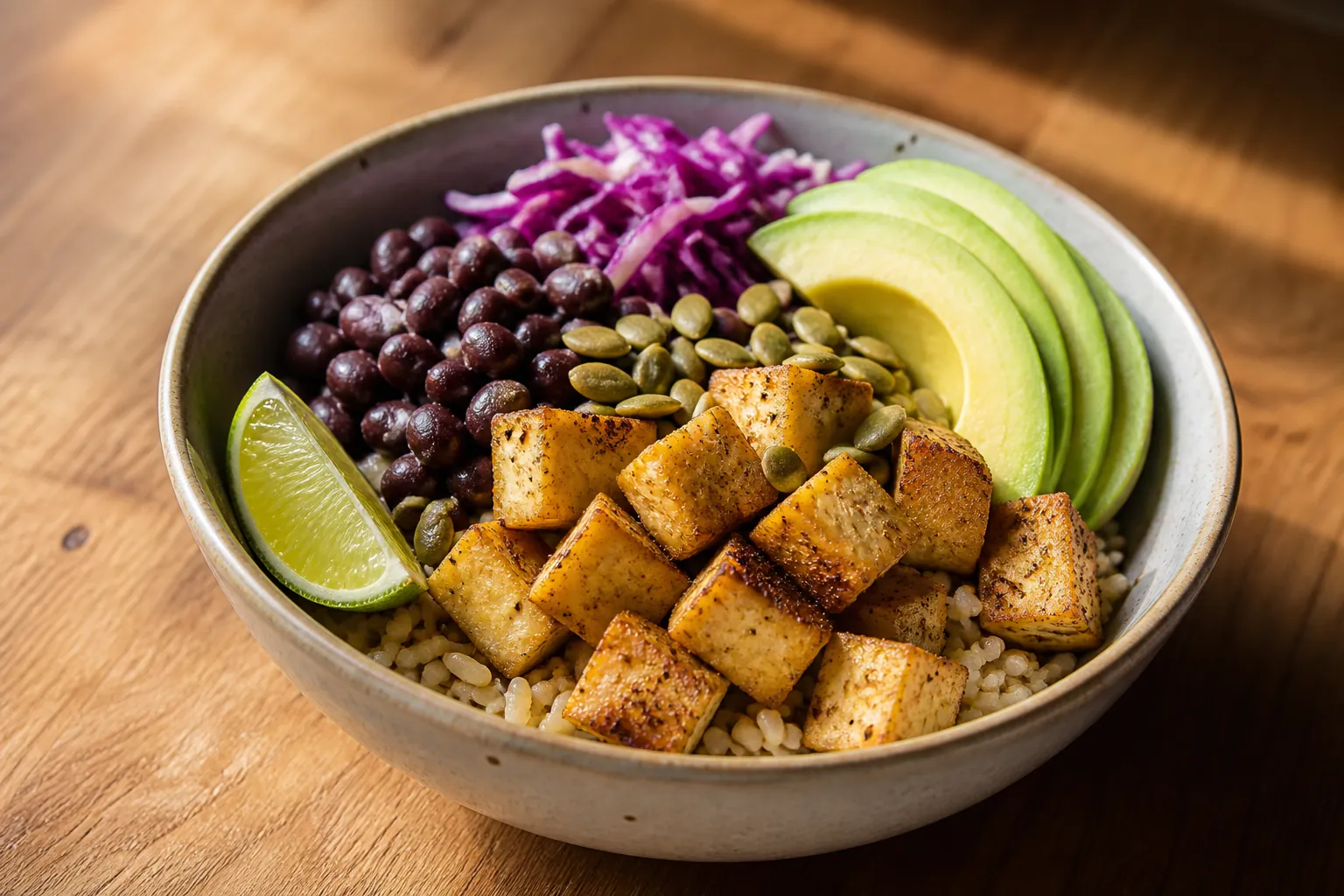
- Tofu-black bean rice bowl: Build the bowl with 1 cup firm tofu, 1 cup black beans, rice, shredded cabbage, salsa, lime, and pumpkin seeds. Counted leucine: about 3.2 g from tofu and black beans before the seeds or rice are counted. Protein check: tofu plus beans should do most of the work; use the seeds and grain to round out the meal, not to rescue an under-portioned bowl.
- Pan-seared tofu, lentils, and greens: Use 1 cup firm tofu over a lentil-and-greens base, then add 1/2 cup black beans if the meal needs a clearer leucine floor. Counted leucine: about 2.6 g from tofu plus 1/2 cup black beans; the lentils add protein, but their leucine is not included unless you check a separate value.
- Tofu scramble with black beans and toast: Scramble 1 cup firm tofu with spinach, peppers, nutritional yeast if you use it, and spices. Serve with 1 cup black beans and whole-grain toast. Counted leucine: about 3.2 g from tofu and beans. This is a strong option after a morning strength session because the anchor is obvious before the toast even enters the calculation.
- Savory oats with tofu and black beans: Cook oats savory-style with garlic, greens, and hot sauce, then top with 1 cup tofu and 1/2 cup black beans. Counted leucine: about 3.1 g from 1 cup tofu, 1/2 cup black beans, and 1 cup oats. Protein check: if your oat portion is small, let the tofu and beans carry the recovery load.
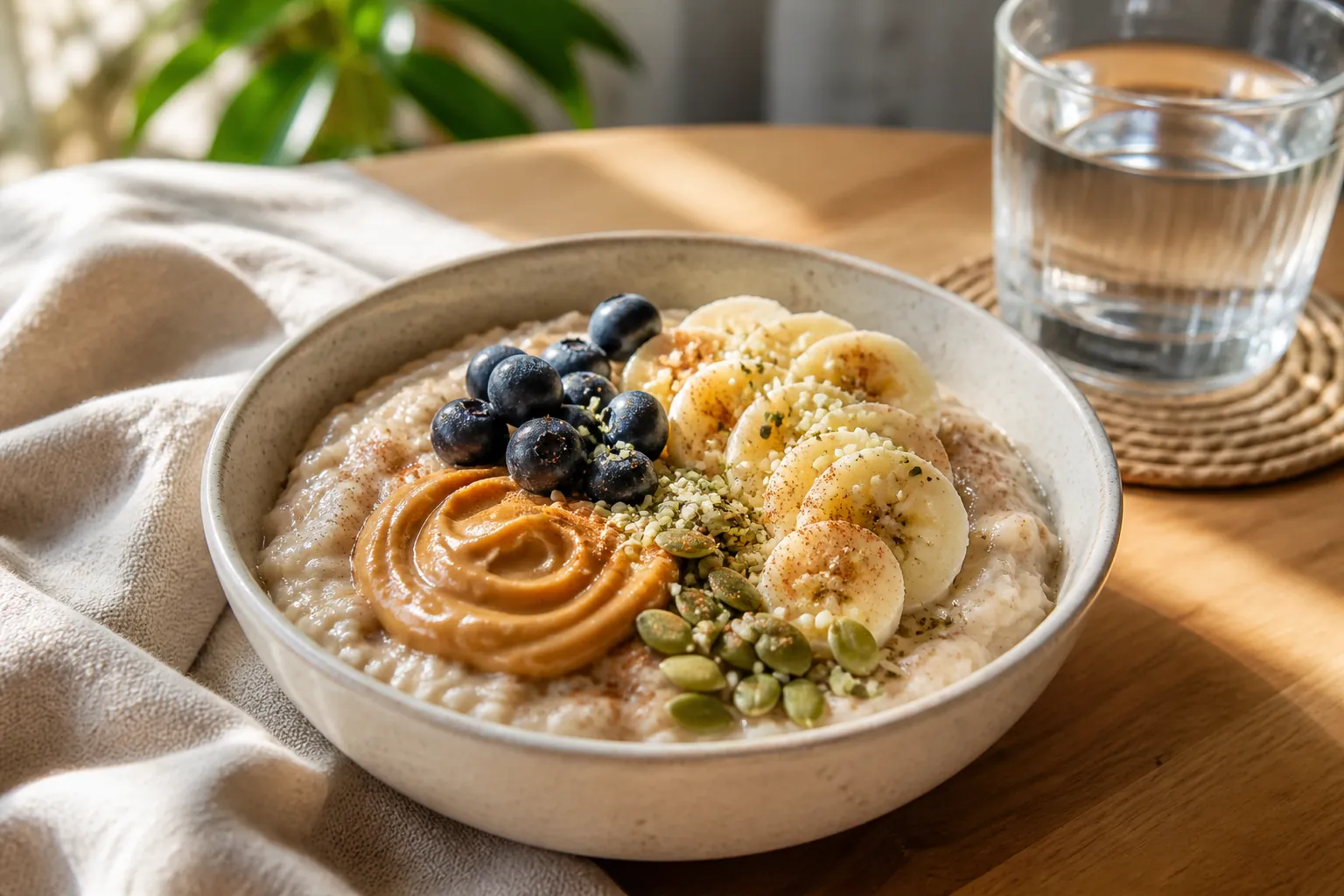
- Peanut-butter oat bowl with tofu on the side: Make oats with banana, cinnamon, berries, and 2 tbsp peanut butter, then eat 1 cup firm tofu on the side as crispy cubes or chilled with soy sauce and sesame. Counted leucine: about 3.0 g from 1 cup tofu, 1 cup oats, and peanut butter. The peanut butter helps, but the tofu is what keeps this from being just a carb-heavy breakfast.
- Black bean-tofu tacos: Fill tortillas with crumbled tofu, black beans, pico de gallo, lettuce, avocado, and pumpkin seeds. Use 1 cup tofu and 1 cup black beans across the tacos. Counted leucine: about 3.2 g. Protein check: tortillas and seeds can contribute, but the tofu-bean filling is the part that makes the meal recovery-relevant.
- Lentil pasta with tofu-black bean topper: Use lentil pasta or a lentil marinara as the base, then add crisp tofu cubes and a small black bean topper. With 1 cup tofu and 1/2 cup black beans, counted leucine is about 2.6 g before the lentil pasta or sauce is counted. This is a good example of using lentils for the protein total while using tofu and beans to make the leucine target visible.
- Black bean-lentil soup with tofu cubes: Make a thick soup with black beans, lentils, tomatoes, vegetables, and spices, then add pan-seared tofu cubes after cooking. If the bowl contains 1 cup tofu and 1 cup black beans, counted leucine is about 3.2 g. For protein, check the total serving size rather than assuming a broth-heavy soup is enough.
- Recovery snack plate when you do not want a full bowl: Use tofu cubes, black bean dip, oats or oat crackers, fruit, and peanut butter. A plate with 1 cup tofu, 1/2 cup black beans in the dip, and 2 tbsp peanut butter gives a counted leucine floor of about 3.1 g. Protein check: this only works if the portions are real meal portions, not tasting-board portions.
- Breakfast burrito after a living-room session: Wrap tofu scramble, black beans, potatoes or rice, greens, salsa, and pumpkin seeds in a large tortilla. With 1 cup tofu and 1 cup black beans, counted leucine is about 3.2 g. If the burrito is split into two smaller servings, count only the portion you actually eat after training.
How to adjust a meal that almost works
Most underbuilt plant-based recovery meals fail in one of two places: the protein total is too low, or the protein is spread across foods that do not clearly reach the leucine target. The adjustment should be boring and direct.
- If protein is low: increase the main protein food first — tofu, beans, lentils, or another labeled plant protein food — instead of adding more vegetables and hoping the bowl becomes a recovery meal.
- If leucine is low: add a counted anchor. Another 1/2 cup firm tofu adds about 1.0 g leucine; 1 cup black beans adds about 1.2 g; 2 tbsp peanut butter or 1 cup oats adds about 0.5 g.
- If appetite is low after training: use a smaller first plate and a second snack soon after, but still count the total recovery feeding. A few bites of tofu and fruit may be a good start; it is not automatically the whole recovery dose.
- If the meal is mostly grains and fats: keep it if you enjoy it, then add the missing anchor. Avocado toast, rice bowls, and peanut-butter oats can all fit, but they need enough protein-bearing food to reach the target.
This is also where taste matters. If the only mathematically perfect option is something you dread eating, it will not survive a normal week. Use the counted foods as anchors, then change the sauce, temperature, texture, and carb base until the meal feels like dinner rather than a spreadsheet.
When to eat it after a home workout
There is no separate evidence showing that living-room workouts need a special nutrition clock. Apply the general resistance-training guidance: get protein plus carbohydrates within roughly two hours after training, and think about total daily distribution rather than a frantic exact minute. ISSN-style guidance summarized by Healthline points to 20–40 g protein every 3–4 hours as a practical distribution pattern [4].
For a practical home setup, that means the recovery meal can be normal food: lunch after a late-morning session, dinner after an evening strength workout, or oats plus tofu after a short morning lift. If you want the food step inside a broader cool-down, hydration, and rest sequence, the post-workout recovery routine at home pairs well with this meal standard.
What this standard can and cannot promise
The encouraging part is real: plant-based recovery is not automatically inferior. The 2024 McMaster trial is useful precisely because it shows that when a plant blend was brought up to a whey-like leucine level, muscle protein synthesis matched whey in that study [2]. The 2025 systematic review supports the same direction for well-formulated plant blends at adequate dose and leucine levels [1].
The limit is also real. The 2025 review noted small sample sizes, moderate risk of bias, isolate-heavy evidence, and little vegan-only trial data [1]. So it would be too strong to say that every whole-food tofu-and-bean bowl has been proven equivalent to whey in a direct trial. The better claim is narrower and more useful: whole-food plant meals can be built to match the recovery dose pattern that the research keeps pointing toward.
If pairing meals with training cues helps you stay consistent, the guide on nutrition memory for home workouts can help connect the food habit to the workout habit. This article is general fitness nutrition education, not medical advice; anyone managing kidney disease, an eating disorder, diabetes medication, gastrointestinal disease, pregnancy nutrition, or clinical protein restrictions should personalize targets with a qualified clinician.
References
- Effect of Plant-Based Proteins on Recovery from Resistance Exercise-Induced Muscle Damage in Healthy Young Adults—A Systematic Review, Nutrients, 2025.
- Muscle Protein Synthesis in Response to Plant-Based Protein Isolates With and Without Added Leucine Versus Whey Protein in Young Men and Women, PubMed Central, 2024.
- Ask the Expert: Leucine and Vegan Athletes, Today’s Dietitian, 2022.
- What to Eat After a Workout: Post-Workout Nutrition, Healthline, updated 2026.
This is general fitness education, not medical advice. For diagnosis or treatment of pain or injury, consult a qualified clinician.
Pick your next session
Browse all routines to find an appropriately-spaced next session.
Spot something off?
This content sits adjacent to health guidance — tell us if a citation or figure needs a correction.