
What Are the Benefits of Time-Restricted Eating for Home Workouts?
Recent meta-analyses show that pairing time-restricted eating with regular home exercise results in modest fat loss while preserving muscle mass. This article examines the evidence and explains the key caveats for home trainers.
- Citation source
- Hays et al. 2025 meta-analysis
- Evidence level
- General guideline
The useful question is not whether time-restricted eating sounds clean on paper. It is whether a shorter eating window helps someone training in a spare bedroom, living room, or apartment corner lose fat without handing back the muscle and strength they have been building.
The best current answer is cautiously positive. In a 2025 meta-analysis of 15 randomized controlled trials with 338 participants, adding time-restricted eating to exercise produced about 1.3 kg more fat-mass loss and about a 1.3 percentage-point greater reduction in body-fat percentage than exercise alone, while fat-free mass did not significantly change.[1] That last clause matters as much as the fat-loss number: under the study conditions, the available evidence suggests the extra weight lost was not coming from lean tissue in a meaningful way.

A separate meta-analysis highlighted by the American Society for Nutrition points in the same direction: across 19 randomized controlled trials, time-restricted eating combined with exercise reduced total body mass by about 4.1 lb and fat mass by about 3.5 lb compared with a control diet plus exercise.[2] That is not a dramatic transformation claim. It is a small, measurable advantage layered on top of training.
What The Fat-Loss Benefit Actually Means
For home workouts, the main benefit of time-restricted eating is behavioral leverage. A 16:8 or 10:14 window can reduce the number of food decisions in a day. Fewer late snacks, fewer grazing episodes between work calls, and less open-ended evening eating can make a calorie deficit easier to maintain without weighing every ingredient at dinner.
The evidence does not show that the eating window itself melts fat regardless of the rest of the day. It shows that, when paired with exercise, time-restricted eating can produce a modest additional fat-loss effect. In practice, that is still useful if the habit is easier to repeat than a more complicated diet.
A 1.3 kg fat-mass difference is not enough to rescue inconsistent training or weekend overeating. But for someone already doing push-ups, dumbbell rows, split squats, band pulldowns, cycling, or quiet apartment circuits several times per week, it is enough to pay attention to. Small body-composition advantages become more valuable when they do not require a new machine, commute, supplement stack, or meal plan that collapses by Thursday.
| Evidence Point | What It Supports | What It Does Not Prove |
|---|---|---|
| Hays et al. 2025: 15 RCTs, 338 participants | TRE plus exercise produced about 1.3 kg more fat loss and no significant fat-free-mass loss | That every home exerciser will lose the same amount of fat |
| American Society for Nutrition meta-analysis: 19 RCTs | TRE plus exercise reduced body mass and fat mass compared with control diet plus exercise | That TRE is superior to any well-controlled calorie and protein plan |
| Exercise timing in the Hays analysis | Participants trained within the eating window | That deep-fasted workouts have the same body-composition outcome |
The Muscle-Preservation Condition Is Protein
The no-significant-loss-in-fat-free-mass finding should not be read as permission to compress the day, under-eat protein, and hope resistance training covers the gap. Muscle preservation still depends on the unglamorous basics: enough total protein, enough total food to support training, and enough resistance stimulus to tell the body the tissue is worth keeping.
Brad Schoenfeld’s guidance, discussed by FoundMyFitness, puts total daily protein near 1.6 g/kg of body weight as the primary anabolic driver, and describes both 8/16 and 10/14 approaches as compatible with anabolism when intake is handled properly.[3] The same discussion notes that resistance-trained females using an 8-hour time-restricted eating window had hypertrophy and performance outcomes similar to controls when calories and protein were matched.[3]
That is the practical dividing line. Time-restricted eating can work cleanly for a home trainee who can fit protein into the window. It becomes shakier for the person who closes the kitchen early, trains hard, and then discovers their day only contained a light lunch, a rushed dinner, and a protein bar they forgot to eat.
The harder the workout leans toward resistance training, the less negotiable this becomes. Adjustable-dumbbell work, weighted push-ups, heavy bands, pull-up progressions, and slow-tempo lower-body training all create a protein bill. The window can be 8 hours or 10 hours; the body still needs enough raw material across that window.
If protein timing is the part that breaks down after late workouts, a recovery plan may matter more than another fasting rule. A simple comparison of Fairlife milk, chocolate milk, and whey for post-workout recovery can help turn that last meal or shake into a muscle-preserving habit rather than an afterthought.
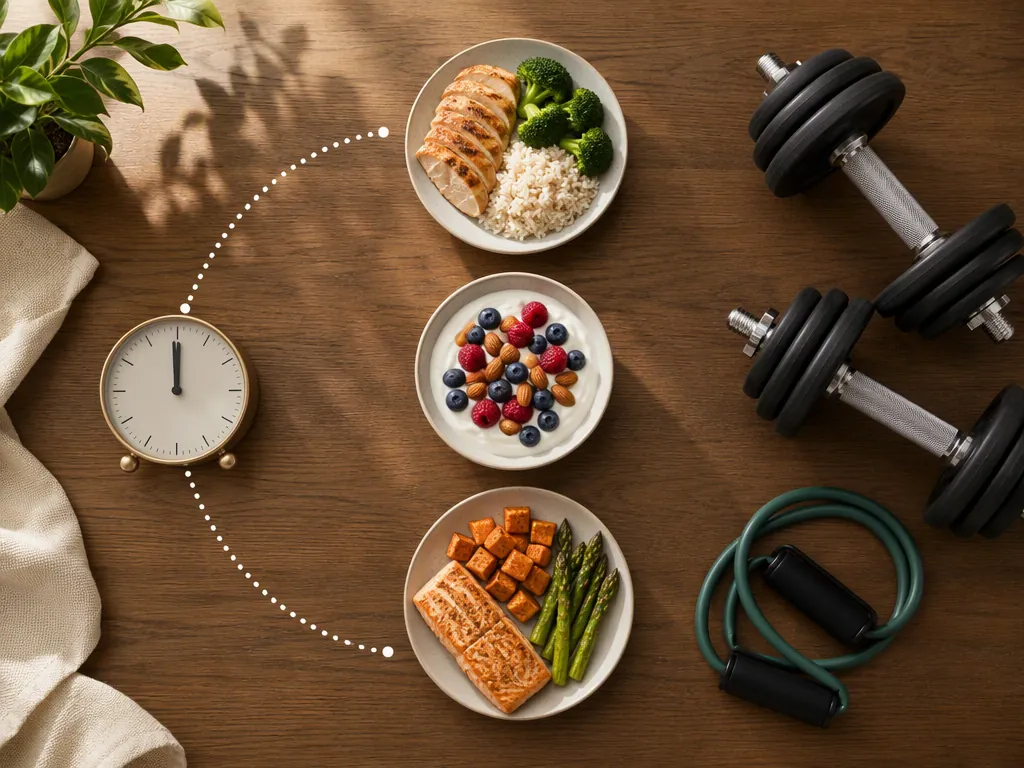
Resistance Training Is Where The Evidence Feels Most Relevant
The Hays meta-analysis included aerobic, resistance, and concurrent exercise studies, so the benefit is not tied to one training style.[1] For home exercisers, that is reassuring. A living-room program does not need to imitate a commercial gym to be compatible with time-restricted eating.
Still, resistance training deserves extra attention because it is the most direct answer to the muscle-loss worry. Fat loss is easier to celebrate than lean-mass retention, but the second outcome is what keeps a diet from becoming a smaller, weaker version of the same body.
The longer resistance-training evidence is limited but useful. In the Moro et al. 12-month study, time-restricted eating in resistance-trained participants was reported as feasible, safe, and effective in reducing inflammatory markers, with no muscle loss and no performance decrement.[4] A full year does not make the question closed, but it carries more real-life weight than a short intervention that ends before the habit has to survive vacations, work stress, and stale motivation.
For a home setup, the translation is straightforward but not automatic. If the training program has progressive overload, enough weekly volume, and movements that are actually challenging, TRE appears compatible with fat loss and lean-mass preservation. If the workout is a loose rotation of easy circuits done whenever the day allows, the research cannot promise the same result.
For scheduling and meal-window templates, the companion guide on how to combine time-restricted eating with home resistance training is the more practical place to solve the calendar problem. The evidence here mainly says the pairing is reasonable when the training and protein are real.
The Home-Workout Caveat
The studies behind the strongest body-composition findings did not test messy apartment life directly. The exercise protocols were supervised, most participants were healthy and active, and the average age in the Hays analysis was about 28.7 years.[1] That matters if the person applying the results is older, new to training, returning after injury, underslept, or trying to train around children and irregular shifts.
Most studies were also short, commonly lasting 4 to 12 weeks, and the body-composition outcomes showed high between-study variability.[1] That does not erase the finding. It does mean the honest conclusion is narrower than the social-media version: TRE plus exercise tends to improve fat loss modestly without clear lean-mass loss under study conditions, but individual results can vary.
One detail is especially easy to miss: in all 15 studies in the Hays meta-analysis, exercise happened inside the feeding window.[1] So if someone trains early in the morning after a long overnight fast, the strongest evidence does not directly tell us that the outcome is identical. Fasted training may feel fine for some people, but the body-composition data here mainly supports training during the eating window.
That distinction matters in small spaces because home workouts often happen at the edges of the day. A person may train before the first meeting because it is the only quiet hour available, or after dinner because the living room is finally empty. If the session is hard and the goal is preserving strength, placing it where protein can be eaten soon after is the safer interpretation of the research.
Metabolic And Recovery Signals Are Interesting, But Secondary
There are metabolic findings that make time-restricted eating more interesting than a simple snack-control trick. In the 2024 TIMET trial from UC San Diego, 108 participants with metabolic syndrome used a customized 10-hour eating window for 12 weeks and had significant improvements in HbA1c, blood pressure, and cholesterol without lean-mass loss.[5]
That study is not a home-workout study, and its participants had metabolic syndrome, so it should not be treated as proof that every healthy exerciser will see the same changes. It does, however, support the broader idea that a 10-hour eating window can be compatible with preserving lean mass while improving some cardiometabolic markers in a population that needed those markers to move.
The recovery-adjacent claims require even more restraint. FoundMyFitness summarizes evidence that early time-restricted eating from 8 a.m. to 2 p.m. reduced evening cortisol, increased BDNF, and increased autophagy-related gene expression by 22%.[6] Those are biologically interesting signals, not a guarantee that soreness disappears faster or that a late-night dumbbell session becomes easier to recover from.
For most home trainees, recovery still comes down to sleep, training dose, protein, and whether the next session is planned intelligently. If soreness and fatigue are the limiting factors, foam rolling and active recovery for home gym training is more actionable than trying to turn cortisol or autophagy markers into a daily decision rule.
So, What Are The Benefits For Home Workouts?
For someone training at home, the strongest supported benefits of time-restricted eating are modest additional fat loss, lower body-fat percentage, and no significant lean-mass loss when exercise is consistent and protein intake is adequate. The evidence is strongest for body composition, not for vague claims about detoxing, discipline, or metabolic reset.
- Fat loss: TRE plus exercise produced about 1.3 kg more fat-mass loss than exercise alone in the Hays meta-analysis.[1]
- Body-fat percentage: the same analysis found about a 1.3 percentage-point greater reduction compared with exercise alone.[1]
- Lean mass: fat-free mass did not significantly change in the Hays analysis, and the ASN meta-analysis also supports fat-mass reduction rather than a lean-mass-loss story.[1][2]
- Training compatibility: aerobic, resistance, and concurrent exercise all appear compatible with TRE in the available trials, though the protocols were supervised.[1]
- Metabolic context: a 10-hour TRE window improved several cardiometabolic markers in adults with metabolic syndrome without lean-mass loss over 12 weeks.[5]
The practical implication is restrained but useful. Time-restricted eating can be a solid add-on for home exercisers who want to lean out without sacrificing lean mass, especially if the window makes eating behavior simpler rather than more chaotic. It is not a shortcut around progressive training, enough protein, and expectations that match the size of the effect.
References
- The Effects of Time-Restricted Eating Combined with Exercise on Body Composition and Weight Loss: A Systematic Review and Meta-Analysis, International Journal of Obesity / Nature
- Time-restricted eating combined with exercise effective in managing weight and improving metabolic health, American Society for Nutrition
- Resistance training, protein timing, and time-restricted eating, FoundMyFitness
- Time Restricted Eating: effects on body composition and metabolic profile in resistance-trained males, PMC
- Study: Time-restricted eating may improve health of adults with metabolic syndrome, UC San Diego Health, September 30, 2024
- Time-restricted eating, FoundMyFitness
This is general fitness education, not medical advice. For diagnosis or treatment of pain or injury, consult a qualified clinician.
Pick your next session
Browse all routines to find an appropriately-spaced next session.
Spot something off?
This content sits adjacent to health guidance — tell us if a citation or figure needs a correction.