
What Your Walking Speed Says and How to Test It at Home
Walking speed is one of the best-studied markers of health in older adults, and a stopwatch plus a 4-meter hallway is enough to measure it at home. This guide explains the exact home test protocol, the age- and sex-based norms that make the number meaningful, and the limits of what a single measurement can tell you.
- Citation source
- NIH Toolbox 4-Meter Walk Gait Speed Test; JAMA
- Evidence level
- General guideline
A 4-meter walk test is small enough for a hallway and serious enough to be useful. You do not need a treadmill, a clinic lane, or a wearable subscription. You need a straight path, two floor markers, a stopwatch, and the discipline to repeat the same setup next time.
That last part matters. Walking speed is useful for older adults because it turns “stay active” into a number: meters per second. It has been treated in rehabilitation literature as a functional “sixth vital sign,” partly because usual walking speed reflects how several body systems are working together, not just how hard someone is trying on a given day.[1] But it is still a screening-style marker. It is not a diagnosis, and one hallway result should not be turned into a verdict.
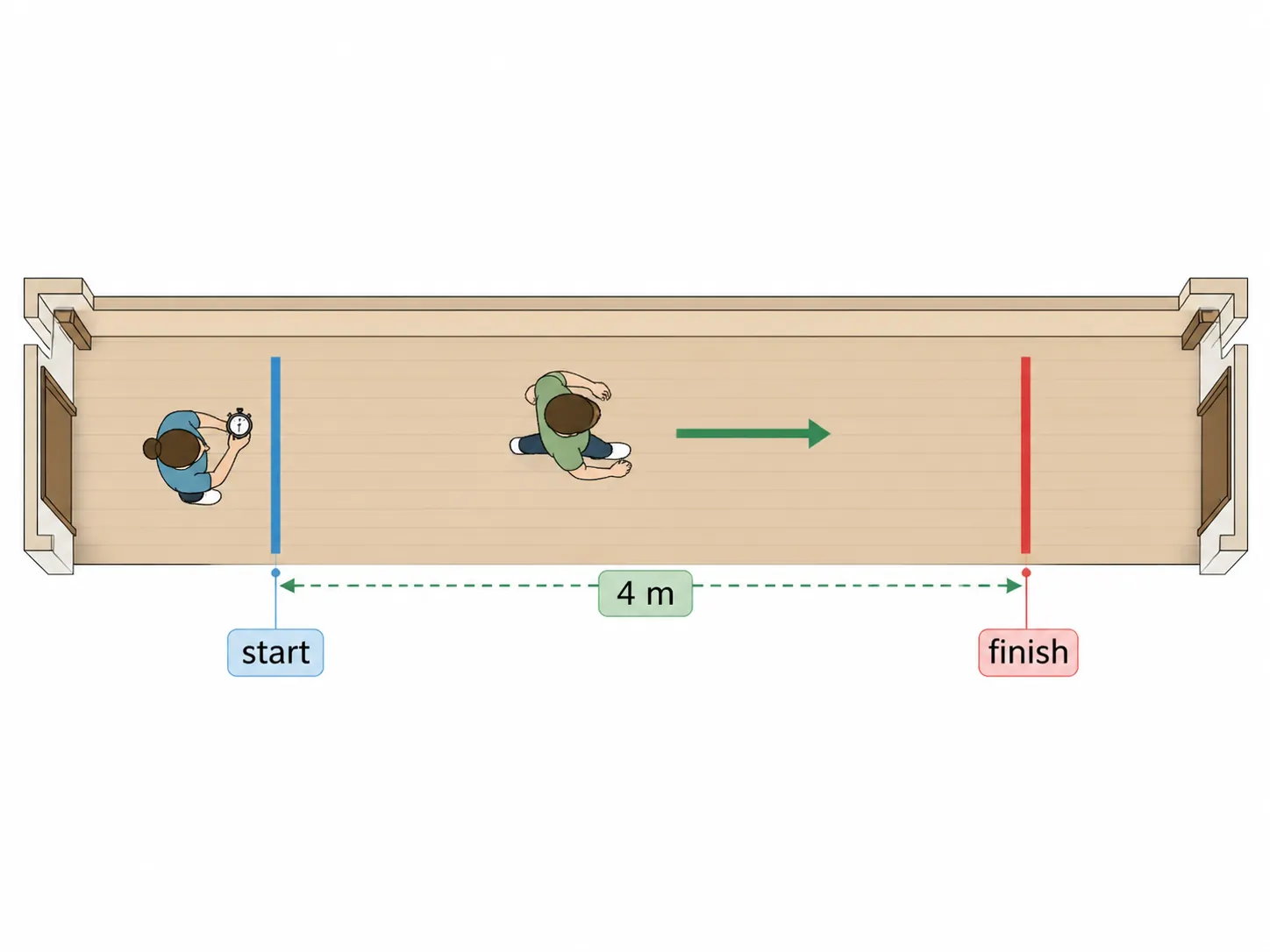
The home version: measure 4 meters, then protect the method
The standardized NIH Toolbox 4-Meter Walk Gait Speed Test is one of the main references for using a 4-meter walk to measure gait speed.[2] At home, the goal is not to pretend your hallway is a lab. The goal is to use a clean, repeatable version of the same idea so future results can be compared honestly.
Use the same route every time if you can. A different floor surface, different shoes, a pet wandering through the lane, or a helper who starts the stopwatch differently can change the number enough to create noise. For a home fitness marker, boring consistency is a feature.
What to set up
- A straight, uncluttered walking path at least 4 meters long.
- Two visible markers on the floor: one at the start line and one exactly 4 meters away at the finish line.
- A stopwatch or phone timer held by the helper, not by the walker if that would change arm swing or attention.
- The walker’s usual safe footwear and any usual walking aid. If someone normally uses a cane or walker, the test should not ask them to abandon it for the sake of a prettier number.
- A note sheet or phone note where the helper records the date, time, setup, footwear, walking aid, and result.
If the hallway is narrow, remove loose rugs, shoes, baskets, and anything that forces a curve around furniture. If the person being tested is unsteady, skip the home test and ask a clinician how to measure safely. A walking-speed number is not worth a fall.
How to run the test
| Step | What to do | Why it matters |
|---|---|---|
| 1 | Have the walker stand still just behind the start line. | A static start is easy to repeat at home. Do not mix it with a rolling-start version later. |
| 2 | Say: “Walk at your usual comfortable pace until you pass the finish line.” | The test is usual gait speed, not a race and not a slow balance drill. |
| 3 | Start timing on the agreed cue, such as “go,” as the person begins walking. | The timer needs one rule and should use the same rule every session. |
| 4 | Stop timing when the leading foot crosses the 4-meter finish line. | Stopping at the same event each time is more important than inventing a new timing style midstream. |
| 5 | Record the time in seconds to the nearest practical stopwatch reading. | The speed calculation depends on the time. |
| 6 | If safe, repeat the walk once after a short rest and record both trials. | Two trials help you see whether one attempt was obviously disrupted. |
Some clinical protocols use extra space before and after the timed zone so the person is already walking when the middle section is timed. That can be useful when there is enough room. In a small apartment, a static-start 4-meter version is often more realistic. The tradeoff is that the result may include the first step and acceleration, so you should not compare it casually with a clinic result taken under a different protocol.
If you repeat the test once, decide in advance what you will track: the average of the two trials, the faster trial, or simply both values side by side. For a household record, writing down both times and the calculated speeds is usually the cleanest option. It keeps the information instead of hiding it inside one chosen number.
The formula
Walking speed is distance divided by time:
Walking speed = 4 meters ÷ time in seconds| 4-meter time | Speed |
|---|---|
| 4.0 seconds | 1.00 m/s |
| 5.0 seconds | 0.80 m/s |
| 6.0 seconds | 0.67 m/s |
| 8.0 seconds | 0.50 m/s |
This is where the 4-meter test becomes practical. A person does not need to remember an abstract pace. If the walk takes 5 seconds, the speed is 4 ÷ 5, or 0.80 meters per second. If it takes 4 seconds, the speed is 1.00 meters per second.
What to write down
A useful record is not just “walked fast” or “looked slower.” It should make the next test comparable.
| Record field | Example of what to note |
|---|---|
| Date and time | Morning, afternoon, or evening |
| Path | Same hallway, start line by bedroom door |
| Footwear | Usual walking shoes, slippers, barefoot, or brace |
| Walking aid | None, cane, walker, rollator |
| Instructions used | Usual comfortable pace |
| Trial 1 time and speed | Seconds and calculated m/s |
| Trial 2 time and speed, if done | Seconds and calculated m/s |
| Anything unusual | Pain flare, dizziness, poor sleep, rushing, interruption |
The “anything unusual” line is not decoration. It prevents a bad night of sleep, a painful knee, or a stopwatch fumble from being mistaken for a meaningful change in function.
How to interpret the number without turning it into a scare tactic
Walking speed has earned attention because it has been studied in large older-adult populations. In a pooled JAMA analysis of 34,485 community-dwelling adults age 65 and older, faster usual gait speed was associated with better survival; each 0.1 m/s faster gait speed corresponded to a pooled hazard ratio of about 0.88 for death.[3] In that analysis, about 0.8 m/s corresponded to median life expectancy, 1.0 m/s to above-average life expectancy, and 1.2 m/s or faster to exceptional survival.[3]
That is important evidence. It is also population evidence. It does not mean a hallway stopwatch can tell one person how long they will live. Gait speed belongs in the same mental drawer as blood pressure screening or grip-strength testing: worth measuring, worth watching, and not something to diagnose from in isolation.
Start with age- and sex-based norms
A single cutoff is too crude for a living person. NIH Toolbox 4-meter norms give a more useful starting point because they report values by age and sex. In Bohannon and Wang’s NIH Toolbox analysis, average 4-meter gait speed was about 1.07 m/s for men ages 70–79 and about 0.99 m/s for women ages 70–79; for adults ages 80–85, reported values were roughly 0.95–0.97 m/s.[4]
| Group | NIH Toolbox 4-meter norm cited in the research |
|---|---|
| Men 70–79 | About 1.07 m/s |
| Women 70–79 | About 0.99 m/s |
| Adults 80–85 | Roughly 0.95–0.97 m/s |
These norms are not grades. They are context. A 79-year-old woman and a 66-year-old man should not be judged by the same lazy line on a chart. If your home number is clearly below the relevant norm, that is information to bring into a healthcare conversation. If it is near the norm and stable, the trend may matter more than a tiny difference from the table.
Another review of healthy community-dwelling older adults found typical walking speeds in the broad range of about 0.90–1.30 m/s.[5] That range is useful because it keeps the 0.8 m/s reference point in proportion. Below 0.8 m/s can be a concern, and a 4-meter walk taking more than about 5 seconds lands below that speed, but it should not be treated as a pass-fail exam.[3][6]
Do not over-read small changes
This is the part a home tester has to take seriously: gait speed is simple to measure, but small changes can be measurement noise. Middleton, Fritz, and Lusardi summarized a minimal detectable change for community-dwelling older adults of about 0.14 m/s.[1] Changes smaller than that may still be worth noting, especially if they repeat, but they should not be treated as proof that something meaningful has happened.
There is another reason for restraint. The NIH Toolbox 4-meter study found that the static-start 4-meter test had only fair test-retest reliability.[4] That does not make the home test useless. It means the method needs protection: same hallway, same start, same timing rule, same shoes, same walking aid, and no drama over a small month-to-month wobble.
A clearer pattern deserves more attention than a single off day. If several tests over time move in the same downward direction, or if the person suddenly needs more support to complete the same 4 meters, that is different from one slightly slower walk after a poor night.
Where walking speed fits in a home fitness routine
Walking speed is a marker, not the whole plan. A person can have a respectable 4-meter result and still need strength work, balance practice, mobility work, or more regular aerobic activity. The hallway test tells you something about usual movement capacity; it does not replace a weekly activity routine.
For older adults who are building cardio at home, walking can be one of the simplest options, especially in small spaces. If a hallway walk is too short to become a workout, quiet marching, step patterns, or low-impact circuits may fit better; those belong in a broader small-space cardio routine. If you are choosing between walking, a bike, a treadmill, or no machine at all, the practical question is not which option sounds most athletic; it is which one you can do safely and regularly at home. That broader comparison is covered in this guide to cardio at home.
Cadence can help some people find a brisker rhythm, and a basic step counter can remind someone to move more often. Neither is necessary for the 4-meter test. If a device changes how someone walks during the test, leave it out or use it only as a passive recorder.
When the result should prompt a healthcare conversation
Bring the result to a healthcare provider when the speed is clearly low for age and sex, when it is near or below the 0.8 m/s reference point, or when repeated tests show a clear decline. Also bring it up if the test is accompanied by new pain, dizziness, shortness of breath, falls, near-falls, new use of furniture for support, or a change in confidence walking around the home.
The most useful version of that conversation is specific: “We measured 4 meters in the same hallway, at usual pace, with the same cane and shoes, and the times changed from this to this.” That is better than “Mom seems slower,” because it gives the clinician a repeatable observation instead of a vague worry.
Keep the test modest and it becomes more powerful. Measure the same 4 meters. Use the same instructions. Calculate meters per second. Compare the result with age- and sex-based norms, then watch the direction over time. If the number is clearly low or clearly declining, do not argue with the hallway; take the record to someone qualified to interpret it.
References
- Walking Speed: The Functional Vital Sign. Journal of Aging and Physical Activity. 2014. https://pmc.ncbi.nlm.nih.gov/articles/PMC4254896/
- 4-Meter Walk Gait Speed Test. NIH Toolbox. https://nihtoolbox.org/test/4-meter-walk-gait-speed-test/
- Gait Speed and Survival in Older Adults. JAMA. 2011. https://pmc.ncbi.nlm.nih.gov/articles/PMC3080184/
- Four-Meter Gait Speed: Normative Values and Reliability Determined for Adults Participating in the NIH Toolbox Study. Archives of Physical Medicine and Rehabilitation. 2018. https://pmc.ncbi.nlm.nih.gov/articles/PMC6363908/
- Walking Speed: Reference Values and Correlates for Older Adults. Journal of Geriatric Physical Therapy. 2010. https://pmc.ncbi.nlm.nih.gov/articles/PMC2967707/
- 4 Metre Walk Test. Physiopedia. https://www.physio-pedia.com/4_Metre_Walk_Test
This is general fitness education, not medical advice. For diagnosis or treatment of pain or injury, consult a qualified clinician.
Pick your next session
Browse all routines to find an appropriately-spaced next session.
Spot something off?
This content sits adjacent to health guidance — tell us if a citation or figure needs a correction.