
Cardio at Home: Treadmill, Bike, Rower, or No Machine?
A practical framework for deciding whether to buy a treadmill, stationary bike, or rowing machine — or skip equipment entirely — based on your joint health, available space, bone density needs, and personal enjoyment.
- Duration
- 20 min
The awkward moment in shopping for cardio at home is not choosing between “high calorie burn” and “low calorie burn.” It is realizing that the machine with the best spreadsheet score may be the one you avoid, trip over, or regret every time your knee complains.
A treadmill, stationary bike, rowing machine, and no-machine routine can all support cardiovascular fitness. The American Heart Association’s general adult target is 150 minutes per week of moderate-intensity aerobic activity, or 75 minutes of vigorous activity, with individual needs varying by health status and fitness level.[1] The buying question is which setup makes those minutes realistic in your actual home.
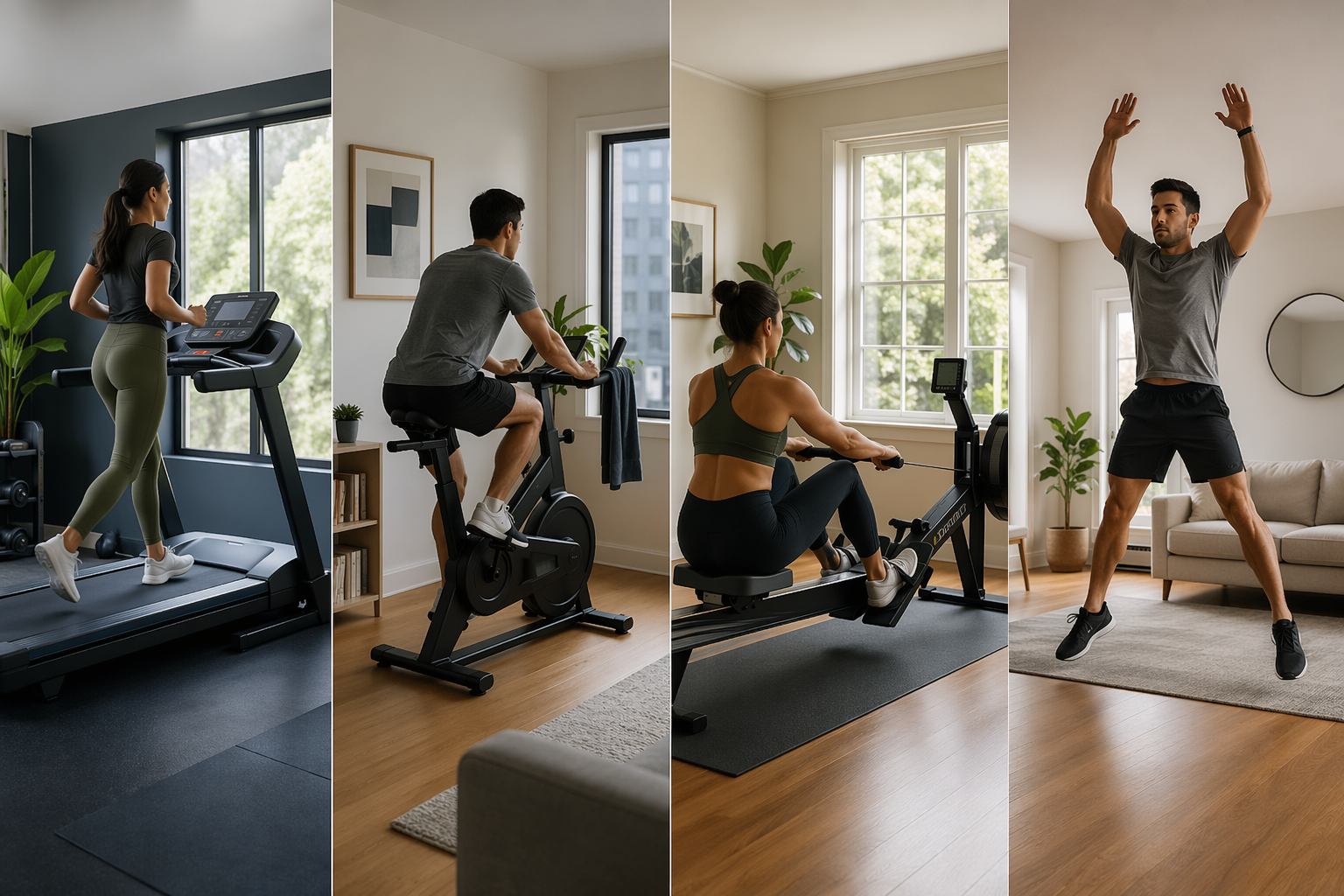
Start With The Constraint Match
Before comparing brands, motors, consoles, or app subscriptions, put the four options through the same test: joints, space and noise, bone stimulus, learning curve, and the kind of person who will keep using it when the novelty fades.
| Option | Joint impact | Space and noise burden | Bone stimulus | Learning curve | Best fit |
|---|---|---|---|---|---|
| Treadmill | Weight-bearing; can be gentle for walking but harder on sore knees or hips at speed or incline | Largest footprint; motor and footstrike noise; more maintenance than simpler machines | Yes, because walking and running are weight-bearing | Low for walking; higher if using incline or running progressions | Someone who will walk or run often, has room, and benefits from weight-bearing exercise |
| Stationary bike | Low impact and non-weight-bearing; often friendlier for knees and hips when adjusted well | Usually compact and quieter than a treadmill | No meaningful bone-loading stimulus | Low | Someone who wants easy starts, joint comfort, and a machine that can live in a small room |
| Rowing machine | Low impact, but demanding on hips, back, and technique | Long footprint when open; some models store upright; noise varies by resistance type | Limited compared with weight-bearing exercise | Moderate to high | Someone who wants full-body conditioning and is willing to learn the stroke |
| No machine | Depends on exercise choice; can be low impact or high impact | Lowest equipment burden; needs safe open floor space | Varies; jumping and some impact moves load bone, but not everyone should use them | Low to moderate, depending on programming | Someone who likes short, effortful sessions or should not spend money to solve a consistency problem |
The Conversation’s review reaches a similar practical split: treadmills offer high energy expenditure and bone benefits but require more space and maintenance; bikes are compact and joint-friendly but do not provide bone stimulus; rowers can be time-efficient and full-body, with the catch that technique matters.[2]
Joint Comfort Comes Before Theoretical Intensity
If your knees or hips already object to stairs, jogging, or long walks, do not let a treadmill ranking bully you into buying a machine that asks those joints to absorb more load several times a week. Walking on a treadmill can be perfectly reasonable for many people, but “reasonable” depends on speed, incline, footwear, body size, prior injury, and whether pain changes during or after the session.
A stationary bike is often the cleanest first answer for joint-sensitive cardio at home. It removes body weight from the movement, starts quickly, and lets you adjust resistance without adding footstrike. That does not make it automatically pain-free. A poor saddle height or a cramped knee angle can turn a supposedly gentle machine into an irritation device. But compared with running or incline walking, it gives sore joints fewer ways to complain.
The rower also gets called low impact, and mechanically that is true in the sense that there is no repeated landing. The problem is that rowing is not just sitting and pulling. A useful stroke asks the legs, hips, trunk, and arms to coordinate in sequence. If you round your back, yank with your shoulders, or never learn how the drive and recovery differ, the machine’s full-body promise shrinks fast.
For a painful knee or hip, the order of consideration is usually bike first, then rower if the movement feels good and you are willing to learn it, then treadmill if walking is comfortable and you can progress without chasing incline or speed too early. That is not a medical prescription; it is a buying filter. Pain that changes your gait or persists needs a clinician, not a better console.
Space And Noise Decide More Purchases Than Motivation Does
A dedicated room forgives a lot. A narrow hallway, a shared living room, or downstairs neighbors do not. This is where the treadmill often loses buyers who actually like walking. It needs enough room to use safely, enough clearance to step on and off, and enough tolerance for motor noise plus footstrike. Folding helps storage, but it does not make the machine weightless, silent, or pleasant to move twice a day.
If you are leaning treadmill and space is the only real objection, narrow your research before you buy. A small-space treadmill buyer’s guide is more useful at that point than another broad cardio comparison, because the details become very concrete: deck length, folded height, transport wheels, ceiling clearance, and whether the machine can stay open where you will actually use it.
Bikes tend to be easier roommates. Many fit into a corner, are quiet enough for apartments, and can be used while watching a show without turning the whole room into gym territory. That matters. A machine that stays accessible gets used more often than one that requires a furniture-moving ritual.
Rowers are sneakier. Some store upright beautifully, but when open they are long. Before buying one, measure the operating footprint, not the marketing photo. Also decide whether you will tolerate the sound of the resistance system during harder intervals. A machine can be technically compact and still be wrong for a room where someone else works, sleeps, or studies.
Bone Health Is Where The Treadmill Has A Real Edge
The treadmill’s strongest argument is not that it wins a calorie-burn contest. It is that walking and running are weight-bearing. That gives them a bone-loading quality that cycling and rowing do not meaningfully provide, a distinction The Conversation highlights in its comparison of home cardio options.[2]
That distinction matters most for people who have been told to pay attention to bone density, including many older adults and post-menopausal women. It does not mean every younger person with normal bone density should reject a bike. It means a bike solves the cardiovascular and joint-comfort problem without solving the bone-loading problem, so strength training, walking, or another weight-bearing activity may need to live elsewhere in the week.
The most tempting treadmill evidence is the 12-week home-based incline trainer study by Roberts and colleagues. Participants lost 9.1 kg of body weight and 7.9 kg of fat mass, reduced diastolic blood pressure by 6.1 mmHg, lowered resting heart rate by 8.2 bpm, and increased VO2max by 8.1 mL/kg/min.[3] Those are not small changes.
They are also not a blank check for buying an incline trainer and expecting the same outcome. The study combined home-based exercise training systems with diet, and the intervention included supervision and prepared meals.[3] That makes it useful evidence that structured incline training can work inside a home routine, not proof that an unsupervised treadmill parked in a spare room will automatically produce the same cardiometabolic results.
Enjoyment Is Not Fluff; It Is The Adherence Variable
Enjoyment sounds soft until the machine arrives. Then it becomes painfully practical. Do you like walking while listening to podcasts? A treadmill has a good chance. Do you like pedaling while a show runs in the background? A bike may beat every more “complete” option. Do you enjoy hard, focused intervals and learning a skill? A rower might fit. Do you hate all machines but will do ten hard minutes in the living room? Buying equipment may only add guilt and clutter.
This is where calorie tables become less helpful. A machine can have a higher potential output and still deliver less real training if you avoid it. The opposite is also true: a modest bike used four evenings a week can outperform a more impressive treadmill that spends most of its life folded behind a door.
A useful pre-purchase test is boring on purpose. For two weeks, mimic the behavior, not the machine. Walk outdoors or on any available treadmill if you are considering a treadmill. Use a gym or hotel bike if possible before buying a stationary bike. Try a beginner rowing video on a real rower before deciding you love rowing as an idea. For the no-machine route, run short bodyweight sessions in the exact room you plan to use. The point is to test friction: changing clothes, clearing space, managing sweat, tolerating noise, and repeating the session when you are not excited.
When The Treadmill Is The Right Choice
Choose the treadmill when walking or running is the activity you already trust yourself to repeat, your joints tolerate weight-bearing exercise, and your home has the space and noise margin for it. It is the most straightforward machine: step on, walk, adjust speed or incline, stop. That simplicity is underrated for beginners and for anyone who does not want to learn a new movement pattern.
It is also the category where ownership costs deserve a sober look. Belts wear, motors matter, decks need room, and delivery can be its own project. If you have already decided on a treadmill, the next useful question is not “Is treadmill cardio good?” but what the real five-year cost of ownership looks like and whether a small-space treadmill can meet your room constraints without becoming a daily obstacle.
When The Bike Is The Right Choice
Choose the stationary bike when joint comfort, compactness, and low-friction use matter most. It is often the easiest machine to fit into a bedroom or apartment corner, and it asks less from balance and coordination than a rower. For many people, that makes it the most sustainable cardio at home option, even if it is less dramatic on paper.
The limitation is bone loading. Cycling is excellent at letting you work your heart and legs without impact, but that same non-weight-bearing quality means it should not be treated as a complete answer for bone-density needs.[2] If you choose the bike, pair it with strength training, walking, or another appropriate weight-bearing activity when bone health is part of the goal.
When The Rower Is The Right Choice
Choose the rower when you want a full-body conditioning tool and you are willing to learn the movement well enough to use it hard. The appeal is real: legs, trunk, and upper body all contribute, and a focused rowing session can feel efficient in a way steady-state bike work may not.
The caution is equally real. If you dislike technical cues, never want to watch a form video, or already know that hip hinging bothers your back, a rower may become an expensive coat rack with a long rail. It is a better choice for the person who enjoys skill practice than for the person who wants the least possible thinking between work and exercise.
The No-Machine Option Deserves A Real Seat At The Table
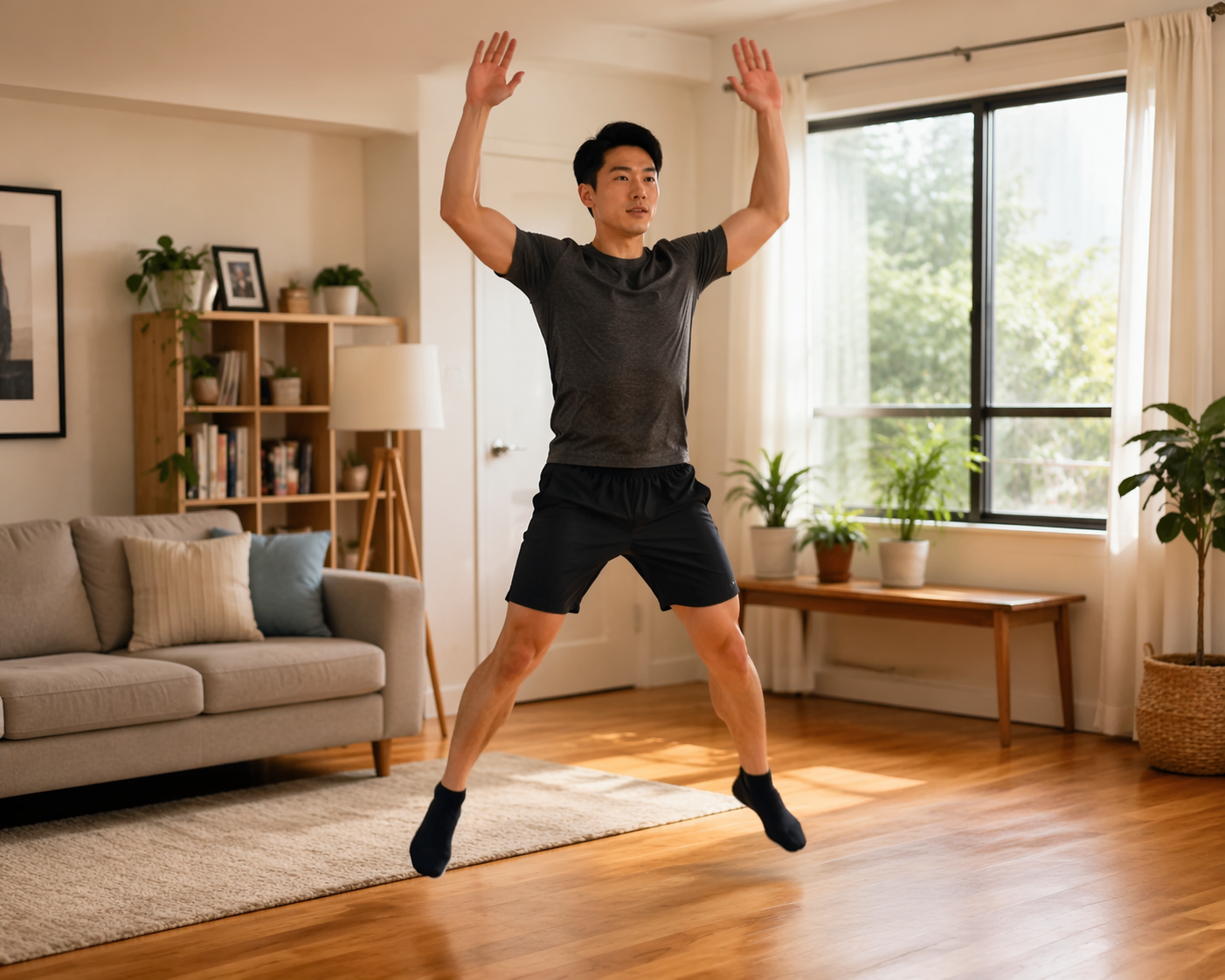
Skipping equipment is not the consolation prize. For some homes and some temperaments, it is the cleanest answer. Bodyweight cardio removes delivery, assembly, maintenance, storage, and resale from the decision. It also exposes the real issue quickly: if you will not do short no-equipment sessions in an open patch of floor, a large machine may not fix the consistency problem.
The evidence case is strong enough to take seriously. Bodyweight-only HIIT protocols can produce cardiovascular improvements comparable to machine-based training when effort and consistency are matched. Healthline also outlines low-impact cardio exercises that can be done in 20 minutes or less, which is useful for people who need a low-equipment starting point rather than another machine category.[4]
No-machine training has its own constraints. Jumping jacks, burpees, and high knees are not friendly to every knee, pelvic floor, downstairs neighbor, or living room. Low-impact substitutions help, but they often require more attention to effort because removing impact can also remove intensity. You may need intervals, timers, music, or an app to create the structure a machine would otherwise provide.
This route fits especially well when budget is tight, space is genuinely limited, or you already know you enjoy short bursts more than steady machine sessions. If that is you, look for an exercise-snacks plan built around five-minute cardio bursts or a beginner no-equipment workout app before spending hundreds or thousands of dollars on hardware.
A Simple Routing Decision
- Choose a treadmill if you will reliably walk or run, want weight-bearing cardio, have healthy enough joints for it, and can handle the footprint, noise, and maintenance.
- Choose a stationary bike if joint comfort, quiet use, compact storage, and easy starts matter more than bone-loading stimulus.
- Choose a rower if you want full-body conditioning, have room for the rail when open, and are willing to learn technique before chasing intensity.
- Choose no machine if space, budget, or enjoyment make equipment a liability and you can commit to bodyweight intervals or low-impact cardio sessions.
- Delay the purchase if you are hoping the machine itself will create the habit; test the routine first, then buy the tool that removes friction.
General aerobic exercise has well-established health benefits, including support for cardiovascular fitness and overall health.[5] At home, though, the winning option is the one that survives the room, the body using it, and the evenings when motivation is ordinary.
References
- American Heart Association Recommendations for Physical Activity in Adults and Kids — American Heart Association
- Treadmill, exercise bike, rowing machine: what's the best option for cardio at home? — The Conversation
- Effects of Home-Based Exercise Training Systems, Combined with Diet, on Cardiometabolic Health — PMC/NCBI — 2019
- 6 Low Impact Cardio Exercises in 20 Minutes or Less — Healthline
- Aerobic exercise: Top 10 reasons to get physical — Mayo Clinic
What a small equipment investment adds
We don't have a build tagged to this exact tier yet. Browse all builds.
How often should you repeat this?
What Your Walking Speed Says and How to Test It at Home
Walking speed is one of the best-studied markers of health in older adults, and a stopwatch plus a 4-meter hallway is enough to measure it at home. This guide explains the exact home test protocol, the age- and sex-based norms that make the number meaningful, and the limits of what a single measurement can tell you.
Spot something off?
Tell us if a movement, tier assumption, or duration didn't match your experience.