
Expectations, Not Effort, Sabotage Weight Loss Motivation
Feeling stalled on your weight-loss journey and losing motivation for home workouts? The real problem is usually expectation mismatch, not weak effort — and the fix is resetting goals to the evidence-backed pace: about 1–2 lb per week and a 5–10% loss within six months, treating plateaus as normal.
- Citation source
- CDC
- Evidence level
- General guideline
- Recommended frequency
- At least 150 min/week moderate-intensity aerobic activity (or 75 min vigorous); muscle-strengthening activity 2 days/week

Three or four weeks into a home weight-loss routine is a brutal place to lose faith. You have done the workouts. You have moved furniture, sweated on the mat, said no to things you used to eat without thinking, and the scale has responded with the emotional generosity of a parking meter.
Before deciding your motivation has failed, compare the work against the right numbers. A gradual pace of about 1–2 pounds per week is the CDC’s steady weight-loss range, and people who lose weight gradually are more likely to keep it off than people who lose faster; the same CDC guidance notes that even a 5% reduction in body weight can improve health risk markers, such as a 10-pound loss for someone starting at 200 pounds.[1] NHLBI guidance cited by Healthline frames a realistic six-month target as about 5–10% of starting body weight.[2] Mayo Clinic also describes weight-loss plateaus as typical, not exceptional.[3]
That math is not glamorous, which is partly why it is useful. It means a person starting at 200 pounds may be doing something meaningful long before they look dramatically different in a mirror. It also means a week that shows half a pound, no change, or a temporary bump may be part of a normal pattern rather than proof that home workouts are pointless.
The scoreboard most people use is rigged against them
The problem is rarely that someone expected the work to be easy. Most people know weight loss takes effort. The problem is that they silently expect the scale to pay them back on a schedule that exercise, calorie balance, water shifts, menstrual cycles, sodium, sleep, stress, and digestion never agreed to follow.
| What the discouraged brain expects | What the evidence-backed target actually allows |
|---|---|
| A visible drop almost every week | A gradual average of about 1–2 pounds per week, with normal fluctuations |
| A major body change after a few disciplined weeks | A 5–10% starting-weight loss over about six months as a realistic clinical target |
| Exercise to drive most of the scale change | Calorie reduction to do most of the weight-loss work, with activity helping health, adherence, and maintenance |
| A plateau as a sign the plan stopped working | A plateau as an expected point that calls for reassessment |
That table is not a permission slip to ignore nutrition, activity dose, or consistency. It is a way to stop treating normal physiology as a character flaw. If your expectation is “I should be down 12 pounds by now,” then a 3-pound loss feels like punishment. If your expectation is “I am aiming for a sustainable average, with pauses,” the same 3 pounds may be evidence that the system is starting to work.
What a slow-looking first two months can actually mean
Imagine a hypothetical beginner training at home for eight weeks. They walk more, do three short strength sessions, reduce snack calories, and stop ordering takeout as often. Their weigh-ins look annoying: down 2 pounds, up 1, flat, down 1.5, flat again, down another pound. There is no cinematic transformation. There is also no failure hidden in that pattern.
Weight loss is usually judged too zoomed in. A bathroom scale reading is a single measurement taken inside a noisy system. The trend matters more than the mood of one morning. For a home exerciser without a coach, that distinction is more than technical; it is the difference between adjusting the plan and abandoning it.

Mayo Clinic’s plateau explanation is especially helpful here because it removes some of the mystery. Early weight loss can be faster partly because the body releases stored glycogen, which carries water with it. As weight drops, the body needs fewer calories, and metabolism can decline along with body mass. Eventually, the same habits that once produced loss may produce maintenance instead.[3]
The practical response is not panic. It is reassessment: check whether intake has crept up, activity has drifted down, portions have become less accurate, recovery is poor, or the original calorie target no longer fits the smaller body. Mayo’s guidance discusses modest calorie reduction while cautioning against dropping below about 1,200 calories a day, but that should not be read as a universal prescription. Anyone dealing with medical conditions, disordered eating history, pregnancy, medications, or aggressive calorie restriction needs individualized medical guidance.[3]
For the basic math behind the food side of the process, a separate guide on how to actually lose weight at home without equipment is a better place to get specific about calorie deficits than trying to solve everything from a disappointing Tuesday weigh-in.
Home workouts matter, just not in the fantasy way
A lot of weight-loss frustration comes from asking exercise to do a job it usually cannot do alone. The CDC is blunt on this point: most weight loss comes from decreasing calories, while regular physical activity is important for keeping weight off. The CDC also notes that some people may need more than 150 minutes a week of moderate-intensity activity to lose weight and maintain that loss.[4]
That does not make home workouts decorative. It makes them part of the system rather than the whole system. Training can preserve the habit loop, improve fitness, support strength, make daily movement easier, and give the day a structure that keeps the food side from drifting. It can also keep someone psychologically attached to the process when the scale is being unimpressive.
The adult activity baseline is still a sensible anchor: at least 150 minutes a week of moderate-intensity aerobic activity, or 75 minutes of vigorous-intensity activity, plus muscle-strengthening activity on two days a week.[5] For many home exercisers, that does not require a perfect program. It may look like brisk walking, step-ups, low-impact cardio, bodyweight strength, resistance-band training, cycling, or quiet apartment-friendly circuits spread across the week.
If you need a practical weekly structure, a 12-week home workout plan is more useful than chasing random punishment workouts every time the scale annoys you. For a heart-health framing of the 150-minute target, see this heart-healthy home workout routine.
The maintenance data is humbling and reassuring
The National Weight Control Registry data discussed by Cox in Diabetes Spectrum is useful precisely because it refuses the easy story. Among successful weight-loss maintainers in that registry, 94% included exercise in their weight-control program, but only 1% used exercise alone. The same paper reports an average exercise energy expenditure of about 383 calories per day, roughly equivalent to about an hour a day of physical activity.[6]
Those findings are descriptive, not a randomized trial proving that every person must copy the same routine. The registry is also self-selected and made up of people who have already succeeded at long-term maintenance, with demographic limits that matter. Still, it offers a cleaner expectation than the usual fantasy: long-term maintainers commonly move a lot, but they rarely rely on exercise alone.[6]
That matters for motivation because it changes what your home workouts are “for.” They are not just a weekly attempt to force the scale downward. They are practice for being the kind of person who can maintain weight loss once the exciting early phase is gone. More on that distinction belongs in a maintenance-focused discussion, such as this guide to whether you can lose 100 pounds with home workouts, because large-loss maintenance is where the exercise-dose conversation gets serious.
What to track when the scale is being loud
The scale is not useless. It is just overpromoted. If weight loss is the goal, body weight has to be monitored somehow. But using one number as the only judge of a home routine is how people talk themselves out of training that is helping them.
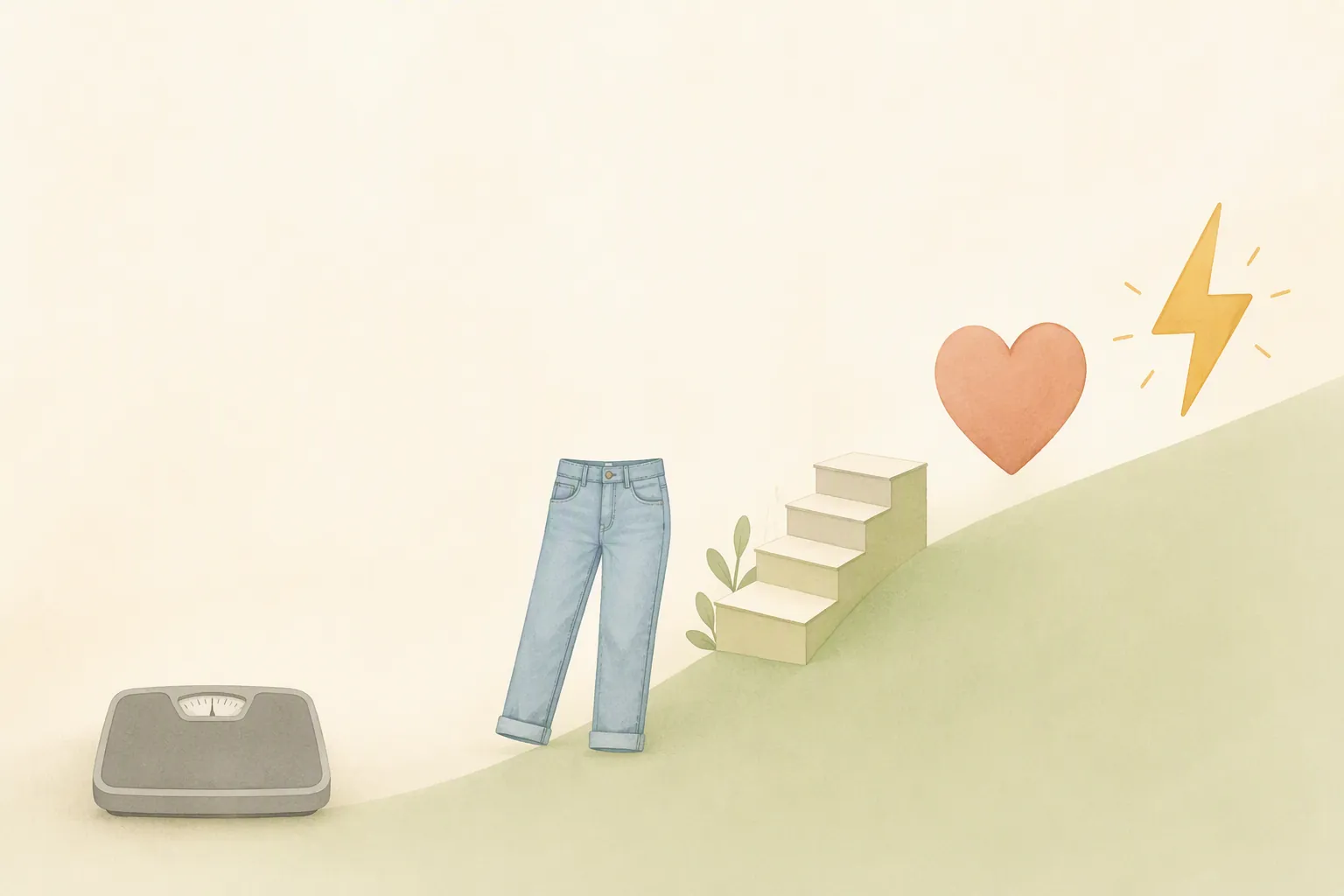
Use the scale as one input, then give the rest of the system a chance to speak. Useful signs include:
- Workouts completed as planned, even if they were shorter than ideal
- More total weekly movement, such as walks, chores, stairs, or active breaks
- Strength improvements, such as more controlled reps, longer sets, or heavier resistance
- Better conditioning, such as recovering faster between intervals or feeling less winded
- Clothes fitting differently, waist measurements changing, or posture improving
- More consistent meals, fewer unplanned snacks, or better awareness of portions
- Improved sleep, energy, mood, or confidence moving through daily life
Some of those are subjective. That does not make them fake. A person who can climb stairs more easily, finish a low-impact circuit without stopping, and keep a food routine for five days in a row is not in the same place they were, even if the scale has not delivered a neat applause line.
Plateau protocol for a home routine
A plateau does not require drama. It requires a boring audit, which is usually better.
- Confirm the time window. A few flat weigh-ins are not automatically a plateau. Look at the trend across several weeks, not one emotional measurement.
- Check food accuracy before adding punishment exercise. Portions, drinks, cooking oils, weekend meals, and “small bites” are common places where the deficit disappears.
- Review activity dose. If workouts have become easier, shorter, or less frequent, rebuild consistency before assuming your body is broken.
- Keep strength training in the plan. Scale loss is not the only goal; preserving function and making daily movement easier matter.
- Protect recovery. Poor sleep, soreness, and constant fatigue make adherence worse. Rest days are not a confession.
- Make one change at a time. If you cut calories, add cardio, change meal timing, and switch programs all at once, you will not know what helped.
For recovery structure, a simple post-workout recovery routine at home can keep rest from becoming either neglect or overcorrection.
Motivation gets easier when the target stops lying
A lot of “stay motivated” advice asks people to generate better feelings while ignoring the bad math that wrecked those feelings in the first place. If someone expected fast, visible loss from home workouts alone, then ordinary progress feels like humiliation. No playlist, quote, or fresh notebook fixes that for long.
This is where fresh-start energy can still be useful, as long as it does not become another trap. If Mondays help you restart, use them. Just do not make Monday enthusiasm responsible for solving a six-month process. The pattern is covered more directly in why Monday fitness motivation fades.
The more durable standard is less dramatic: aim your expectations at about 1–2 pounds per week on average, recognize that 5–10% over six months can be meaningful, treat plateaus as normal checkpoints, and judge the home routine by process, activity, strength, recovery, and non-scale changes as well as weight. That does not guarantee a specific result by a specific date. It does give you a scoreboard that does not punish you for being human.
References
- Steps for Losing Weight — CDC
- 16 Ways to Motivate Yourself to Lose Weight — Healthline
- Getting past a weight-loss plateau — Mayo Clinic
- Physical Activity and Your Weight and Health — CDC
- Adult Activity: An Overview — CDC
- Role of Physical Activity for Weight Loss and Weight Maintenance — Diabetes Spectrum, 2017
This is general fitness education, not medical advice. For diagnosis or treatment of pain or injury, consult a qualified clinician.
Pick your next session
Browse all routines to find an appropriately-spaced next session.
Spot something off?
This content sits adjacent to health guidance — tell us if a citation or figure needs a correction.