
Build a Heart-Healthy Home Workout Routine in 8 Weeks
An 8-week progressive home routine that meets the AHA/CDC heart-health targets — 150 minutes of moderate or 75 minutes of vigorous cardio plus two strength days a week — using bodyweight movement alone. You'll learn how to verify effort with the talk test and target heart-rate zones when you don't own a monitor.
- Equipment tier required
- none
- Duration
- 150 min
- Difficulty
- beginner
- Target area
- full body
- Space footprint needed
- small clear floor space
- Noise level
- low
Yes: a heart-healthy home workout routine can meet the same public-health target you see in gym-based advice. For adults, the American Heart Association and CDC recommend at least 150 minutes a week of moderate-intensity aerobic activity, 75 minutes of vigorous-intensity aerobic activity, or an equivalent mix, plus muscle-strengthening activity on at least 2 days a week.[1][2] The catch is not usually motivation. It is knowing what to do on Monday, what “hard enough” feels like on Thursday, and how to progress without turning your living room into a fitness test.
The plan below uses bodyweight movement only. It builds toward the 150-minute weekly target over 8 weeks, keeps 2 strength days in the week, and uses the talk test first—because you do not need a watch, treadmill screen, or app to notice whether you can speak while you move.
That structure matters because the simple target is still missed by many people: the AHA describes only about 1 in 5 U.S. adults and teens as getting enough exercise to maintain good health.[1] That is not a character flaw. A loose pile of workout videos does not automatically become a week.

The weekly shape: 6 exercise days, 1 rest day
The scaffold comes from an 8-week UC Davis Health exercise plan for heart health by exercise physiologist Jose J. Gonzalez Tinoco. That plan uses 6 exercise days and 1 rest day, mixes interval work with easier days and endurance days, includes a longer activity day, and follows a three-weeks-on, one-recovery-week rhythm.[3] Here, the same weekly logic is adapted for a small home space with no equipment.
If you can walk outside, you can use walking for the easy, endurance, and long sessions. If you are indoors, the replacements are simple: marching in place, step-touch, side steps, knee lifts, low-impact skater steps, shadow boxing, squat-to-reach, and easy pacing around the room. No jumping is required.
| Day | Main job | At-home version |
|---|---|---|
| Monday | Interval cardio + strength A | 30-second brisk low-impact moves alternated with 15-second easy marching; then a short bodyweight strength circuit |
| Tuesday | Easy cardio | Comfortable marching, step-touch, indoor walking, or outdoor walking |
| Wednesday | Endurance cardio | Longer steady movement at a moderate talk-test pace |
| Thursday | Interval cardio + strength B | Another interval session, kept low impact; then a second bodyweight strength circuit |
| Friday | Easy cardio | Light-to-moderate movement that leaves you fresher than the interval days |
| Saturday | Long activity | Your longest continuous session of the week: walking, indoor marching blocks, or mixed low-impact cardio |
| Sunday | Rest | No planned workout; easy mobility is fine if it helps you feel better |
That weekly shape stays almost boring on purpose. Beginners do not need a new format every day; they need enough repetition to learn their breathing, joints, and recovery. Variety can come from the movements you choose inside the session, not from rebuilding the whole week.
The 8-week home routine
The table gives you the whole path first. Cardio minutes mean the planned aerobic work for the day. Strength days are listed separately because the AHA/CDC target asks for both aerobic work and muscle-strengthening work; a 20-minute strength circuit is useful, but it does not replace the need to accumulate aerobic minutes unless you are actually moving continuously at aerobic intensity.[1][2]
| Week | Monday | Tuesday | Wednesday | Thursday | Friday | Saturday | Sunday | Weekly cardio aim |
|---|---|---|---|---|---|---|---|---|
| 1 | 18 min intervals + strength A | 20 min easy cardio | 25 min steady cardio | 18 min intervals + strength B | 20 min easy cardio | 30 min long cardio | Rest | About 130 min |
| 2 | 20 min intervals + strength A | 22 min easy cardio | 28 min steady cardio | 20 min intervals + strength B | 22 min easy cardio | 35 min long cardio | Rest | About 145 min |
| 3 | 22 min intervals + strength A | 25 min easy cardio | 30 min steady cardio | 22 min intervals + strength B | 25 min easy cardio | 35 min long cardio | Rest | About 155 min |
| 4 | 16–18 min easy intervals + light strength A | 20 min easy cardio | 25 min steady cardio | 16–18 min easy intervals + light strength B | 20 min easy cardio | 25–30 min long easy cardio | Rest | Recovery week: about 120–130 min |
| 5 | 22 min intervals + strength A | 25 min easy cardio | 32 min steady cardio | 22 min intervals + strength B | 25 min easy cardio | 40 min long cardio | Rest | About 165 min |
| 6 | 24 min intervals + strength A | 25 min easy cardio | 35 min steady cardio | 24 min intervals + strength B | 25 min easy cardio | 40 min long cardio | Rest | About 170 min |
| 7 | 24 min intervals, with optional vigorous bursts + strength A | 25 min easy cardio | 35 min steady cardio | 24 min intervals, with optional vigorous bursts + strength B | 25 min easy cardio | 45 min long cardio | Rest | About 175 min |
| 8 | 18–20 min controlled intervals + strength A | 22–25 min easy cardio | 30 min steady cardio | 18–20 min controlled intervals + strength B | 22–25 min easy cardio | 35–40 min long easy cardio | Rest | Recovery and consolidation: about 145–155 min |
Weeks 1 and 2 are deliberately close to the target without pretending a sedentary adult has to become a different person by Wednesday. Week 3 reaches the usual 150-minute moderate-intensity benchmark. Week 4 pulls back so the plan does not quietly become a grind. Weeks 5 through 7 rebuild and extend the work, and Week 8 backs off just enough to make the routine repeatable.
If you already tolerate 150 minutes comfortably, keep the recovery weeks closer to 150 by extending Tuesday, Friday, or Saturday at an easy pace. Do not make the recovery week harder by adding more intervals. The point of the lower week is to reduce accumulated fatigue while keeping the habit intact.
Interval days: 30 seconds brisk, 15 seconds easy
For the interval days, use the UC Davis-style 30:15 pattern as the basic unit: 30 seconds of brisk movement, then 15 seconds of easy marching or stepping.[3] Repeat that pattern for the session time listed. You can keep it completely equipment-free by rotating through movements like fast marching, step-touch, side steps, standing knee drives, low-impact skater steps, shadow boxing, and squat-to-reach.
The brisk parts should feel clearly harder than your easy days, but they should not wreck the next day. In Weeks 1 through 5, most beginners should keep these intervals in the upper-moderate range. In Weeks 6 and 7, you may let a few 30-second bursts become vigorous if you pass the safety checks later in this article and recover well between rounds.
Easy, endurance, and long days
Easy cardio days are not failed hard days. They are where you collect minutes without making every session feel like a challenge. Use relaxed indoor walking, marching, step-touch, or an outdoor walk if weather and location allow.
Endurance days are steadier and a little longer. You should settle into a pace you can maintain without constantly checking the clock. Saturday’s long session can be one continuous block, or it can be split into two blocks on the same day if your space, schedule, or feet are not ready for the full duration at once.
Strength days: keep them simple and repeatable
On Monday and Thursday, do one of these short circuits after cardio, or several hours apart if that feels better. Move with control. Stop each set while you still have clean form.
| Strength A | Strength B |
|---|---|
| Sit-to-stand or bodyweight squat | Reverse lunge to a comfortable depth, or split squat holding a wall for balance |
| Wall push-up or countertop push-up | Incline push-up or slow wall push-up |
| Glute bridge | Hip hinge or bodyweight good morning |
| Dead bug or heel taps | Bird dog |
| Standing calf raises | Side-lying leg raise or standing side leg lift |
Start with 1 round in Week 1. Use 2 rounds in Weeks 2 and 3 if the first week felt manageable. In the recovery weeks, return to 1 easier round or keep 2 rounds but reduce the range of motion and effort. For extra help making the strength days fit a real midlife schedule, the turning-40 home workout plan pairs well with this routine’s two-day strength requirement.
How to know you are working hard enough without a monitor
The talk test is the first tool to trust because it is available in the middle of the workout. The CDC describes moderate-intensity activity as effort that lets you talk but not sing. Vigorous-intensity activity means you can say only a few words before pausing for breath.[4]
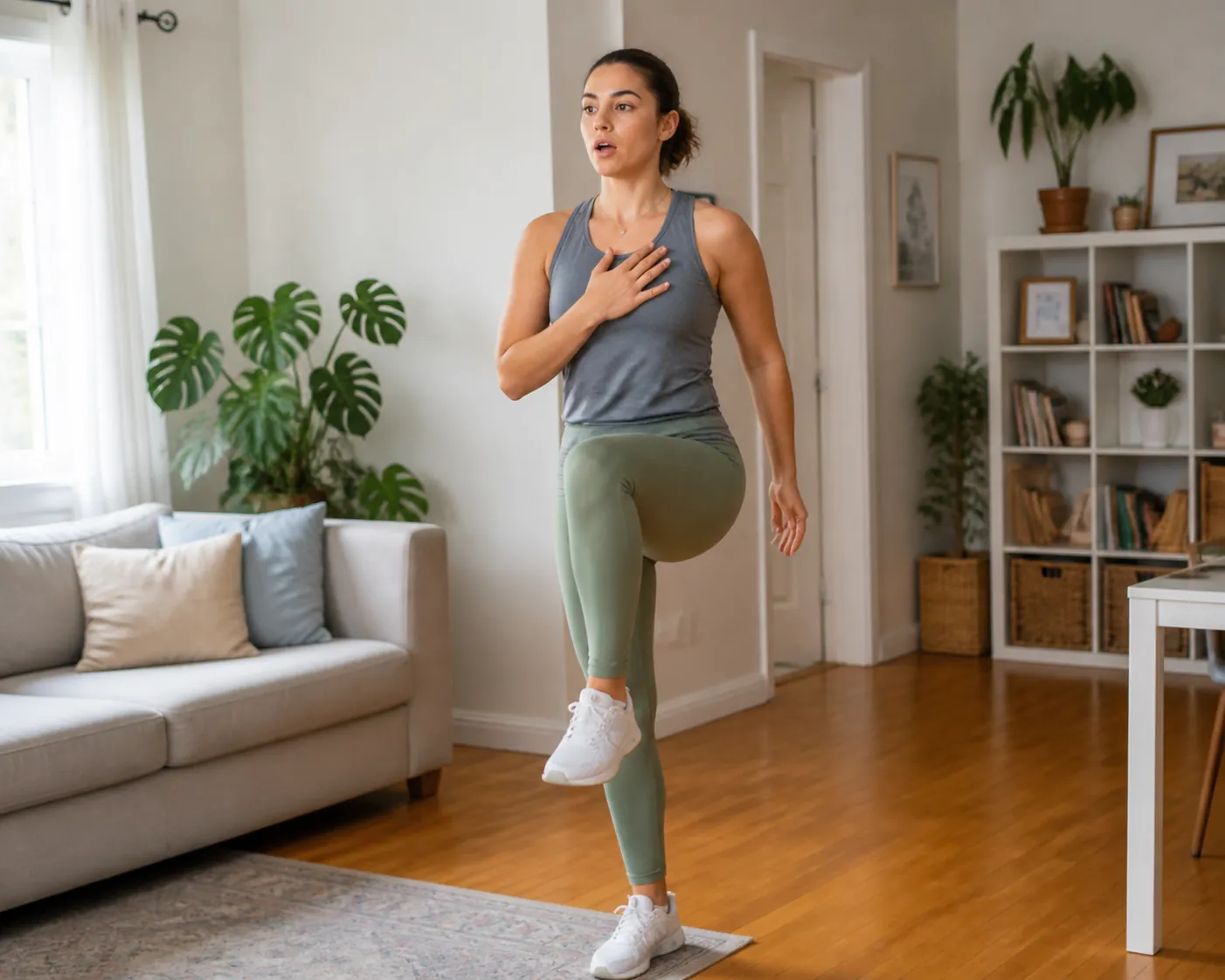
Use that standard during the session, not afterward when memory gets generous. During a moderate steady day, say a full sentence out loud. If you can sing it, increase the pace slightly. If you can only gasp out a few words, slow down. During optional vigorous bursts in Weeks 6 and 7, a few words before a breath is enough; you should not be trying to hold a conversation.
This matters most on interval days. A beginner can make a workout look impressive by moving fast early and then spending the rest of the session barely recovering. That is not better heart-health training. It is usually just poor pacing. The talk test keeps the work honest.
Optional cross-check: target heart-rate zones
If you want a number check, the AHA describes moderate intensity as about 50% to 70% of maximum heart rate and vigorous intensity as about 70% to 85% of maximum heart rate. It also gives a rough maximum-heart-rate estimate of 220 minus your age.[5]
Without a monitor, you can still count your pulse manually. The AHA describes finding your pulse on the inside of the wrist on the thumb side, using the tips of the first two fingers, pressing lightly over the artery, and counting beats.[5] Mayo Clinic also describes a pulse-count method for checking exercise intensity.[6]

There is one credibility note worth making because heart-rate math often gets presented too neatly. The AHA uses the rough 220-minus-age estimate for maximum heart rate.[5] Mayo Clinic describes a different estimate: 208 minus 0.7 times your age.[6] Those formulas can produce different numbers. For this routine, do not treat either one as a perfect personal lab result. Use heart rate as a cross-check, and let the talk test decide in real time whether the effort is truly moderate or vigorous.
How the plan progresses without overreaching
The safest-looking beginner plans often fail because they do not say when to advance. The reckless ones fail because every week becomes a bigger dare. Mayo Clinic’s general progression guidance is useful here: increase activity by about 10% a week so the body has time to adapt.[6] The schedule above mostly does that by adding a few minutes at a time, then using Week 4 and Week 8 as lower-load weeks.
Progression can come from several places, but you should usually change only one at a time:
- Add a few total cardio minutes to the week.
- Make a moderate session steadier instead of stop-start.
- Add one strength-circuit round.
- Let only a few interval bursts become vigorous after you have handled several weeks of moderate work.
Do not advance because the calendar says Week 5 if Week 4 did not actually feel like recovery. Repeat the prior week instead. Repeating a week is not falling behind; it is often the thing that keeps the routine alive long enough to matter.
Where flexibility fits
Aerobic exercise is the main driver of the weekly heart-health target, and strength training protects the routine by keeping daily movement more manageable. Johns Hopkins describes aerobic exercise, resistance training, and flexibility work as three kinds of exercise that support heart health, while noting that flexibility work does not directly contribute to heart health in the same way aerobic exercise does.[7]
So stretch if it helps you start, cool down, or feel less stiff the next day. Just do not let a stretching session quietly replace the aerobic minutes or the two strength days. Five easy minutes after a workout is enough for most people using this plan.
Before you make it vigorous
This article is general fitness education, not medical advice. If you are older, have a heart condition, have multiple cardiovascular risk factors, are returning after a long inactive period, or are unsure whether vigorous training is appropriate, get medical clearance before using the vigorous options. You can complete the plan at moderate intensity and still work toward the AHA/CDC target.[1][2]
For most beginners, the best version of this routine is not the hardest version. It is the version where Tuesday still happens after Monday, Thursday does not ruin Friday, and Saturday’s longer session feels possible without bargaining with yourself for an hour.
How to adapt it when home is small, loud, hot, or inconvenient
The routine assumes the $0 tier: floor space, shoes if you prefer them, and bodyweight movement. If you want to keep your setup that simple, use the $0-tier home workout build as the equipment baseline rather than shopping for tools before you have a schedule.
If weather knocks out an outdoor walk, replace it with the same number of indoor minutes. For a quiet option, use the storm-day apartment workout. If heat is the problem, the home workout alternatives for a heat advisory can stand in for Tuesday, Wednesday, Friday, or Saturday without changing the weekly structure.
If your larger goal is brain health as well as heart health, the science-backed home workout plan to reduce dementia risk uses the same 150-minute dose in an apartment-friendly format. Use one plan as your main schedule; do not stack both at full volume.
The target is reachable at home. What makes it reachable is not a special exercise; it is a week with jobs assigned, a gradual increase in work, and an honest check on effort before the workout gets counted as moderate or vigorous.
References
- American Heart Association Recommendations for Physical Activity in Adults and Kids, American Heart Association
- Adult Activity: An Overview, CDC
- Simple 8-week exercise plan for a healthy heart, UC Davis Health
- How to Measure Physical Activity Intensity, CDC
- Target Heart Rates Chart, American Heart Association
- Exercise intensity: How to measure it, Mayo Clinic
- 3 Kinds of Exercise That Boost Heart Health, Johns Hopkins Medicine
What a small equipment investment adds
We don't have a build tagged to this exact tier yet. Browse all builds.
How often should you repeat this?
See our recovery and rest reference for citation-anchored rest-interval guidance.
Spot something off?
Tell us if a movement, tier assumption, or duration didn't match your experience.