
Use WHOOP HRV and Resting Heart Rate to Plan Home Workouts
A practical daily decision guide for home-only WHOOP users: how to read your morning HRV and resting heart rate against your own baseline, apply the green-yellow-red recovery buckets, and run a quick confounder check — so you can make a concrete push, modify, or rest call for today's home workout without a coach.
- Citation source
- WHOOP
- Evidence level
- General guideline; restrained inference
- Recommended frequency
- Daily morning readiness check
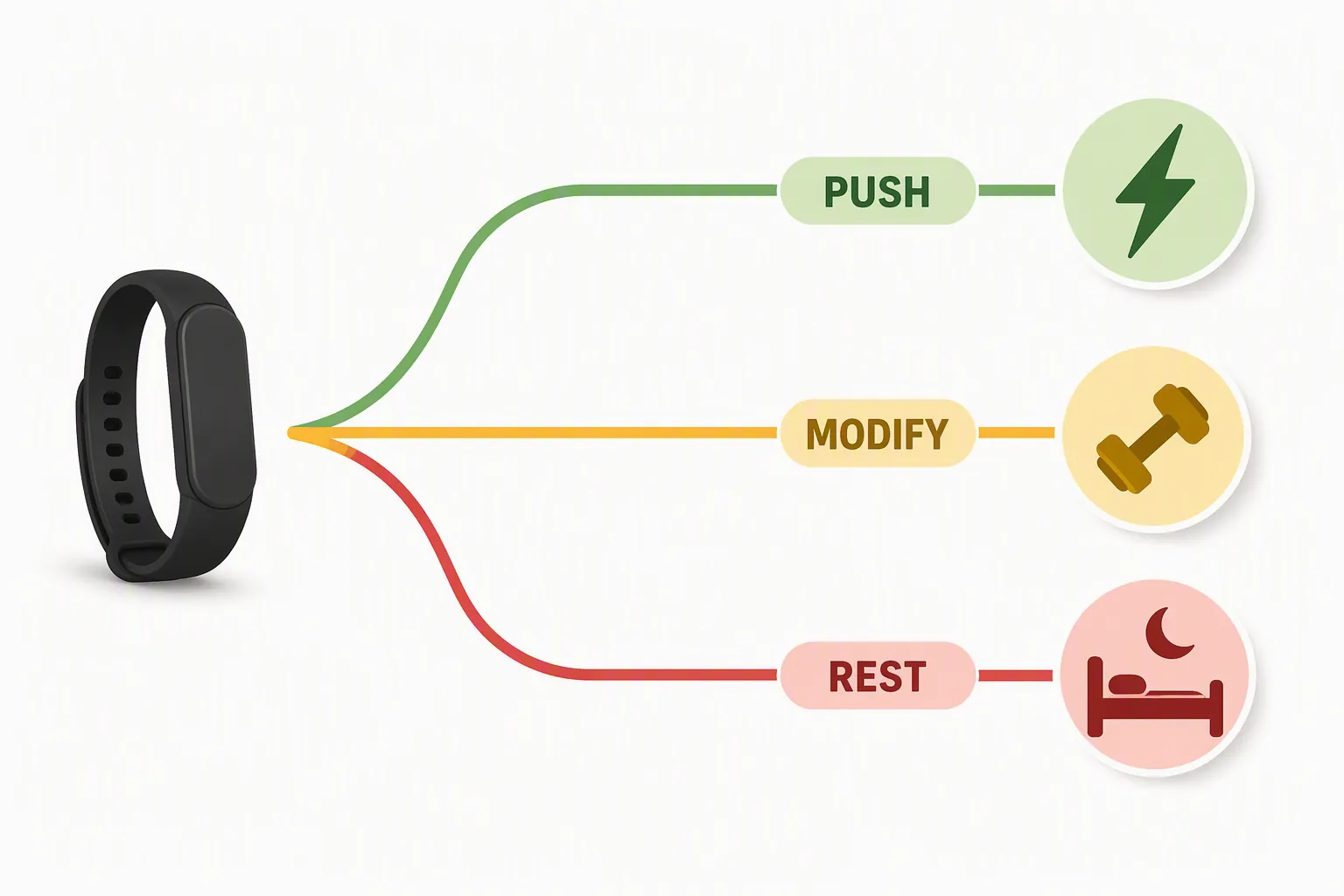
Your home workout is scheduled, but WHOOP shows low HRV, elevated resting heart rate, or a red Recovery. Before canceling the session—or deciding the band is wrong—compare both measurements with your own baseline, look at their direction over several days, and check what else happened before you slept. The useful output is not the score itself. It is a concrete call: push, modify, or rest.
WHOOP’s HRV training guidance associates predominantly green recovery with strain that remains within capacity, yellow with functional overreaching, and red with non-functional overreaching. The paired pattern becomes progressively less favorable as HRV falls and resting heart rate rises.[1] That framework is useful, but a color should open the decision process rather than end it.
| Morning bucket | HRV and resting heart rate | Trend and confounder check | Today’s call | Practical home-workout adjustment |
|---|---|---|---|---|
| Green | HRV is near or above your baseline; RHR is near or below it | No concerning multi-day deterioration; no significant illness symptoms | Push as planned | Keep the scheduled strength, interval, or conditioning session. Normal warm-up and technique checks still apply. |
| Yellow | One marker is unfavorable, or HRV is down while RHR is up for a single morning | Check recent sleep, psychological stress, alcohol, hydration, illness, and whether the measurement conditions were typical | Modify | Shorten the session, lower load or intensity, avoid training to failure, or switch to mobility and conversational cardio. |
| Red | HRV is substantially suppressed, RHR is elevated, or the paired HRV-down/RHR-up pattern is continuing | Give more weight to several-day deterioration, poor sleep, illness symptoms, or persistent unexplained fatigue | Back off or rest | Use gentle mobility or an easy walk only if those feel appropriate; otherwise take a full rest day. |
Read HRV and resting heart rate as a pair
Low HRV by itself does not tell you why it is low, and an elevated resting heart rate by itself does not prove that training caused it. When HRV moves down while RHR moves up relative to your normal range, however, two different readiness signals are pointing in the same unfavorable direction. That deserves more weight than either isolated number.
Start with direction, not drama. A mildly low HRV reading after one unusual night belongs in yellow until the surrounding information says otherwise. If HRV keeps declining across several mornings while RHR keeps rising, confidence in a back-off decision increases. WHOOP itself advises looking for a downward HRV trend over several days rather than treating one low measurement as independently actionable.[2]
The same logic works in the other direction. If HRV is around its usual level, RHR is stable, sleep was ordinary, and the recent pattern is not deteriorating, there is little reason to dismantle the workout merely because one metric looks imperfect. A personal rolling baseline absorbs the fact that some people normally have much higher or lower HRV than others.
Yellow means change the dose, not necessarily the habit
Yellow is the difficult bucket for someone training alone. You may be capable of completing the planned session, but completion is a poor test of whether the dose was sensible. At home there is no coach watching bar speed, coordination, breathing, or the gradual disappearance of good form. The safest modification is therefore one you can define before the warm-up turns into a negotiation.
- Keep the planned movements but reduce total work by removing sets or shortening the session.
- Lower the resistance or use an easier variation, especially for technically demanding exercises.
- Leave more repetitions in reserve instead of approaching failure.
- Replace intervals with steady, conversational cardio that does not require you to chase a pace.
- Redirect the session toward mobility, light band work, or technique practice if the warm-up feels disproportionately difficult.
Choose the modification before starting. For example, if heavy adjustable-dumbbell work is on the schedule, decide that the session will use easier variations and stop well before form deteriorates. Do not begin the original workout and rely on motivation to produce restraint halfway through.
A warm-up can provide another signal, but it should not become a loophole for overriding a sustained bad trend. If movement becomes smoother and effort feels proportionate, continue with the modified plan. If ordinary warm-up work feels unusually taxing, coordination is poor, or symptoms emerge, stop. That new information moves the decision toward rest.
Run the confounder check before blaming the workout
The HRV-down/RHR-up pattern indicates that the body may be under load; it does not identify the source. Training is only one candidate. Before interpreting the morning as evidence that yesterday’s squats were excessive, review the previous day and night.
- Sleep: Was sleep shorter, more fragmented, or at an unusual time?
- Stress: Was work, caregiving, travel, or another demand unusually intense?
- Alcohol: Did you drink, even if you do not feel hungover?
- Hydration and fueling: Was intake noticeably different from your usual routine?
- Illness: Are there respiratory, gastrointestinal, feverish, or otherwise unfamiliar symptoms?
- Measurement conditions: Was the device worn normally, and was the recorded sleep period representative?
Vendor-generated findings illustrate why this check matters, although they do not establish causation. In a WHOOP analysis based partly on member journal entries, logging stress was followed by an average increase of 1 bpm in resting heart rate, a 4 ms reduction in HRV, and a 6% reduction in Recovery.[3] These were correlations in a self-selected member population, not the result of a controlled trial.
WHOOP also says one night of drinking can suppress HRV for as long as five days.[2] That does not mean every low reading several days later was caused by alcohol. It means the effects may outlast the obvious hangover, so the recent pattern needs more context than yesterday’s workout alone.
Finding a likely confounder does not automatically restore permission for a hard session. If alcohol, poor sleep, or psychological stress produced the unfavorable pattern, the body is still dealing with that load. The explanation changes how you learn from the data; it does not erase the data.
When red should actually mean rest
One red score after an unusual night can support a lighter day without proving that complete rest is necessary. A continuing HRV-down/RHR-up pattern is different. If it persists across several days, especially alongside worsening sleep, poor function during ordinary activity, or illness symptoms, the case for backing off becomes stronger.
For a home trainee, rest should not be defined as failing to complete the calendar. It is a deliberate reduction in load. Depending on how you feel, that might permit gentle mobility or an easy walk, but there is no requirement to manufacture a recovery workout. Fever, significant illness symptoms, dizziness, chest discomfort, unusual shortness of breath, or feeling markedly unwell are reasons not to test readiness with a hard session.
Why WHOOP’s overnight measurements are useful—but limited
WHOOP reports HRV as RMSSD and takes its daily HRV measurement during the deepest period of sleep.[2] For resting heart rate, the company weights measurements toward slow-wave sleep.[4] Holding the measurement window relatively consistent removes some of the variation that would arise if you compared a reading taken after breakfast one day with one taken while lying in bed the next.
That consistency is the strongest reason to use the readings for daily planning. It does not make them diagnostic. WHOOP describes Recovery as drawing on HRV, resting heart rate, respiratory rate, and sleep performance, and says the combined signal is more informative about next-day capacity than any one marker.[5] The precise weighting of those inputs should not be treated as independently established, however, because the calculation is proprietary.
Measurement method matters as well. RMSSD is a recognized time-domain HRV metric, but wrist-based photoplethysmography and clinical electrocardiography are not automatically interchangeable. Nor should ultra-short, short-term, and 24-hour HRV measurements be compared as though they were the same test.[6] A number from another app, a chest strap, or a clinic may use a different recording window and method.
For workout decisions, consistency usually matters more than cross-device comparison. Wear WHOOP under comparable conditions, keep an eye out for missing or implausible data, and judge the result against the baseline generated by that same system.
Population averages are context, not a target
WHOOP has reported member-average HRV values of 65 ms for men and 62 ms for women, with age-banded averages declining from 78 ms at age 25 to 44 ms at age 55.[2] Its reported member-average resting heart rates are 55.2 bpm for men and 58.8 bpm for women.[4] These figures describe a self-selected wearable-user population. They do not tell you what your HRV must be before you are allowed to train.
Even the broader resting-heart-rate reference range is wide: the American Heart Association describes 60–100 bpm as typical for most adults and notes that physically active people may have resting rates around 40 bpm.[7] A value can sit inside a population range while still being unusually high for you that morning. Conversely, a person with consistently lower HRV than a WHOOP average may be perfectly stable relative to their own history.
The boundary of the training decision
WHOOP can make a defensible daily adjustment easier: compare HRV and RHR with your baseline, check whether the direction persists, review confounders, and then push, modify, or rest. Its practical value is often less glamorous than optimization. It can make accumulated strain harder to dismiss on a morning when motivation is supplying a more flattering story.
It cannot explain persistent fatigue, diagnose illness, or determine why an abnormal pattern continues. Repeated red readings, sustained HRV suppression with elevated RHR, unexplained performance decline, or fatigue that persists despite reducing training warrants clinical guidance rather than another dashboard interpretation. For planning loads between those boundaries, use the broader home-training workload guide. For differences in how consumer devices frame readiness, see the comparison of WHOOP and Oura for home-workout recovery.
References
- HRV Training: Use HRV for Better Training Decisions, WHOOP.
- What Is a Good HRV? Average HRV Ranges by Age for Adults, WHOOP.
- Impact of Stress on HRV, Resting Heart Rate & Recovery, WHOOP, 2021.
- Resting Heart Rate: What's Normal, and How to Improve, WHOOP.
- Heart Rate Variability: What It Means for Fitness and Health, WHOOP.
- An Overview of Heart Rate Variability Metrics and Norms, Frontiers in Public Health, 2017.
- Target Heart Rates Chart, American Heart Association.
This is general fitness education, not medical advice. For diagnosis or treatment of pain or injury, consult a qualified clinician.
Pick your next session
Browse all routines to find an appropriately-spaced next session.
Spot something off?
This content sits adjacent to health guidance — tell us if a citation or figure needs a correction.