
6 Post-Pitching Arm Care Exercises for Home Recovery
After a pitching outing, your arm needs more than rest. This routine uses six targeted exercises with just a resistance band and towel to restore lost mobility and reduce injury risk, all in under 25 minutes at home—provided you are not managing a diagnosed shoulder or elbow injury.
Primary source: RPP Baseball
Claim type: guideline
Last reviewed:
Why the arm feels cooked
If your arm feels cooked after pitching, the answer is not to punish it. These home rehab exercises for baseball pitchers are for the night after an outing when the arm is tired, stiff, and still salvageable. If the pain is sharp, the elbow or shoulder feels unstable, or you already have a diagnosed tear, this is not the lane; use a clinician-directed plan instead, such as The Right Shoulder Recovery Exercises at Every Stage.
The reason to take that boundary seriously is simple: Little League, citing Dr. James Andrews, reports that pitching while fatigued raises injury risk 36 times compared with pitching when well-rested [1]. That is not a license for panic; it is a reason to handle the post-outing window like it matters.
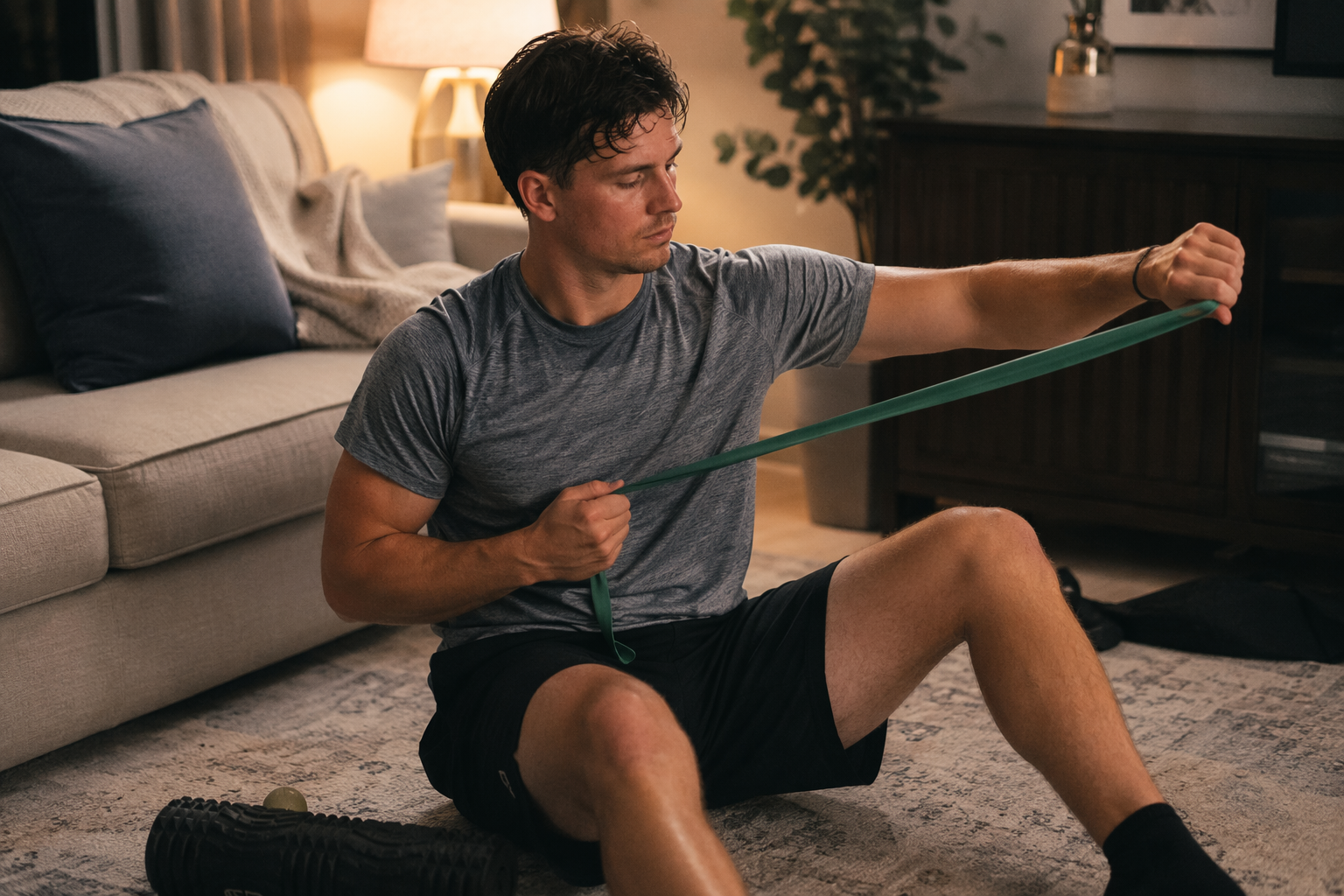
The six-move home reset
The sequence below follows the post-pitching arm care routine described by RPP Baseball [2]. Keep the band light, the motion clean, and the goal modest: restore movement, get blood flowing, and shut down the habit of turning recovery into a workout. If you anchor a band to a door, use a setup made for that job; a loose latch is not worth a shoulder.
For a safe door setup, use this door anchor guide before you start.
| Order | Move | Job |
|---|---|---|
| 1 | Rebounders | Ease the shoulder and elbow out of the outing and prepare the joint for controlled movement. |
| 2 | Half Kneeling Shoulder CARS | Use slow, controlled circles to restore motion and joint awareness. |
| 3 | Band Pull Aparts | Open the shoulders back up and counter the forward posture of pitching. |
| 4 | Band No Money | Train external rotation with the elbows pinned and the load kept light. |
| 5 | Hip Flow Circuit | Give the lead hip some attention so the whole chain does not stay jammed up. |
| 6 | Side Lying Cross Body Stretch | Restore posterior shoulder motion without forcing the old sleeper stretch position. |
1) Rebounders and shoulder CARS
Start by letting the joint move without drama. Rebounders are the opening reset: they help the elbow and shoulder absorb what the outing just asked of them instead of locking up immediately. Half-kneeling shoulder CARS come next, and they matter because they take the shoulder through clean circles with control, not speed. That is how you wake up a tired joint without asking it to prove anything.
2) Band pull aparts
Pull aparts are the first real scapular reset in the routine. Pitching leaves the shoulder living in a forward, stressed position, and this is one of the simplest ways to pull it back toward normal without turning the night into strength training. Keep the band light enough that the motion stays honest. RPP Baseball is clear on the point here: the band is for activation and blood flow, not load, and if the band is too heavy the lat starts stealing the work from the smaller cuff muscles [2].

3) Band no money
The no-money drill keeps the elbows pinned, which is exactly why it belongs here. It narrows the work to the external rotators instead of letting the movement spread into a shrug or a whole-back compensation pattern. That makes it useful after pitching and useless if you get greedy with resistance. A heavy band does not make this better; it just makes it less like recovery [2].
4) Hip flow circuit
This is not a bonus lower-body add-on. The lead hip takes real stress during deceleration and the lead-leg block, so hip mobility belongs in a pitching recovery routine instead of sitting off to the side like an afterthought [2]. If the hip stays locked up, the arm often gets asked to cover for it somewhere else. That is how a whole-chain problem starts looking like an arm problem.
5) Side lying cross body stretch
This is the stretch I would trust more than the old sleeper stretch for a tired arm. RPP Baseball notes that pitchers can lose about 10 degrees of internal rotation after an outing, and the side-lying cross-body stretch addresses that posterior shoulder tightness without the same scapular-instability concern [2]. Keep it gentle. If you have to force the position, you are not recovering anymore.

How often to use it
Use the routine after every outing, not just when the arm feels sore. In season, that means a short, repeatable reset that keeps the shoulder and hip moving without adding fatigue. Off season, the same sequence still works, but the job does not change: this is recovery, not a place to chase strength, and the band should stay light enough that the movement feels like activation and blood flow, not resistance training [2].
If any move causes pain instead of mild stretch discomfort, stop. If a diagnosed shoulder or elbow injury is part of the picture, hand the plan to the clinician and keep this routine out of rehab-by-internet territory.
References
- Pitching while fatigued increases injury risk 36 times, Little League.org
- Post Pitching Arm Care Routine for Pitchers, Rockland Peak Performance
Source: RPP Baseball
Have a question about this guidance?
This is a question and correction channel, not an open discussion thread — recovery topics sit close to a medical-advice boundary, so we review submissions rather than publishing them instantly.