
How Much Coffee Before a Workout for Better Results
This article examines the evidence for drinking coffee before exercise, including performance improvements, optimal dose and timing, and recovery effects, with practical guidance for home gym athletes on a budget.
Primary source: International Society of Sports Nutrition position stand on caffeine and exercise performance (2021)
Claim type: explainer
Last reviewed:
For most people, the useful answer is simple: drink enough coffee to provide about 3–6 mg of caffeine per kilogram of body mass roughly 60 minutes before training. In the International Society of Sports Nutrition position stand, that dose range is the main practical target for exercise performance, and coffee that provides the same caffeine dose is treated as comparable to anhydrous caffeine for performance purposes.[1]
For a 150 lb person, that usually lands somewhere around 1–2 cups of brewed coffee, depending on how strong the coffee is and how large the cup actually is. The payoff is not magic, but it is measurable: the evidence summarized by ISSN supports roughly 2–4% endurance improvement and about 6–7% muscular-endurance improvement at effective caffeine doses.[1] A separate systematic review and meta-analysis also found small but real improvements in strength and power, in the range of about 2–7%.[2]
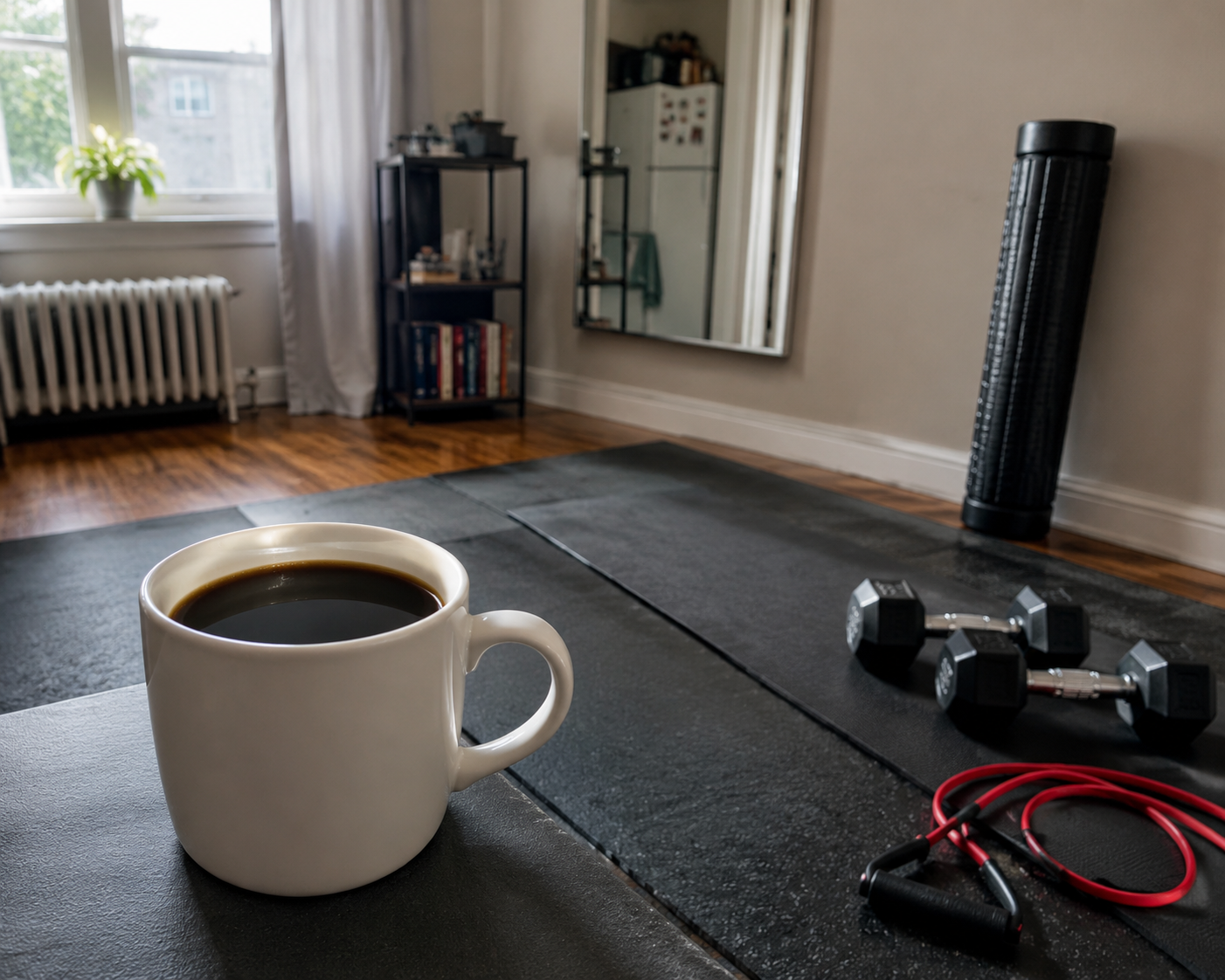
That is the practical case for drinking coffee before a workout without turning a normal kitchen habit into a subscription tub. Coffee is cheap, familiar, and already on the counter. The part that matters is not whether the label says “pre-workout.” It is whether the drink delivers enough caffeine, early enough, without wrecking the rest of your day.
The Dose Matters More Than the Mug
The annoying thing about coffee is also the honest thing about coffee: a “cup” is not a scientific unit. A small mug from a drip machine, a strong pour-over, and a giant travel cup can all be called one coffee while delivering very different amounts of caffeine. That is why the 3–6 mg/kg target is more useful than a blanket instruction to drink one cup.
| Body weight | 3 mg/kg caffeine | 6 mg/kg caffeine | Plain-language translation |
|---|---|---|---|
| 120 lb | About 164 mg | About 327 mg | Often around 1–2 brewed coffees |
| 150 lb | About 204 mg | About 408 mg | Often around 1–2 brewed coffees |
| 180 lb | About 245 mg | About 490 mg | Often around 2 coffees, depending on brew strength |
| 210 lb | About 286 mg | About 572 mg | May push beyond a comfortable coffee dose for some people |
The lower end is the better place to start. Three mg/kg is already inside the evidence-backed performance range, and it is easier to repeat without jitters, reflux, bathroom urgency, or a sleep penalty. The upper end is not a badge of seriousness. It is simply the top of the common effective range used in the ISSN recommendation.[1]
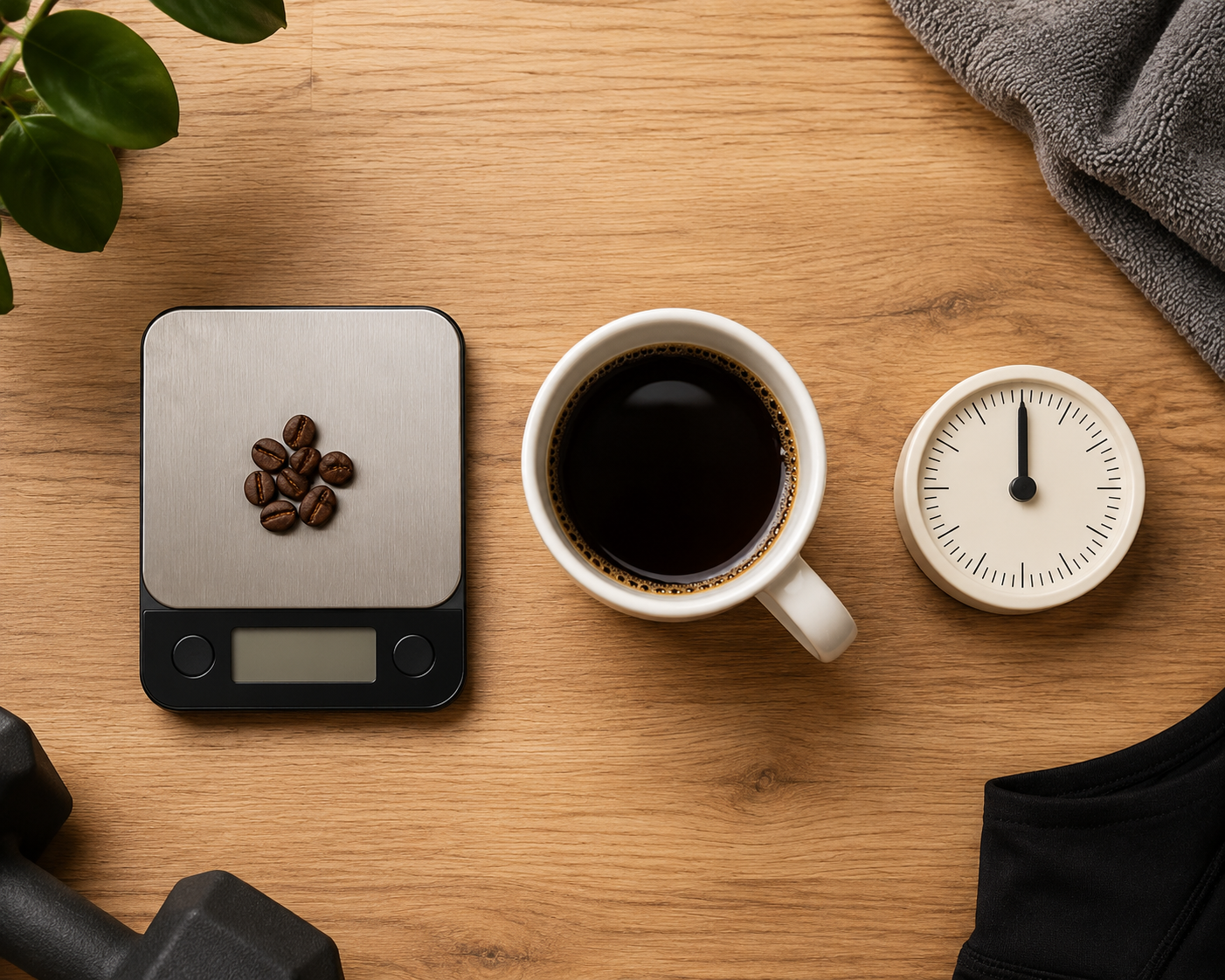
The 60-minute timing target also has a practical reason. Caffeine needs time to be absorbed and become useful during the work set, interval, or longer ride. If the mug is still cooling while the warm-up starts, the hard part of the workout may arrive before the caffeine does. For a home session, that usually means making coffee before changing clothes, setting up dumbbells, or dragging the bike trainer into position.
What Coffee Can Actually Improve
Endurance is where the evidence is most comfortable. If your home training is a treadmill run, bike trainer ride, rowing interval, jump-rope session, or longer circuit, caffeine is more likely to show up as a small but useful ability to hold pace, delay fatigue, or tolerate the unpleasant middle of the session. The ISSN position stand reports endurance improvements of about 2–4% with caffeine, which is not huge on paper but can be noticeable when the workout is long enough to expose fatigue.[1]
Muscular endurance is the other strong fit for a home gym. Sets of push-ups, split squats, kettlebell swings, dumbbell presses, band rows, and high-rep accessory work all live in the zone where doing a few more quality reps matters. ISSN reports muscular-endurance improvements of about 6–7%, which is a more visible effect than many legal, cheap performance aids can claim.[1]
Max strength is more modest. A 2018 systematic review and meta-analysis found caffeine improved muscle strength and power, with effects in the range of roughly 2–7%.[2] That does not mean coffee turns a bad program into a good one or makes a wobbly folding bench safer. It means that, when training is already sensible, caffeine can slightly improve output.
That distinction matters in a small home setup. If the limiting factor is that your adjustable dumbbells top out too early, coffee will not create heavier dumbbells. If the limiting factor is that the last sets of Bulgarian split squats feel like a negotiation with gravity, coffee may help you do the work a little better.
Coffee Is the Budget Winner Only If You Keep It Boring
Home-brewed black coffee is hard to beat on cost: roughly $0.15–$0.50 per serving compared with about $1–$3 per serving for many commercial pre-workout supplements. That difference is exactly the kind of small leak that matters when the same budget also has to cover flooring, plates, a pull-up bar, or the next piece of equipment that actually changes what you can train.
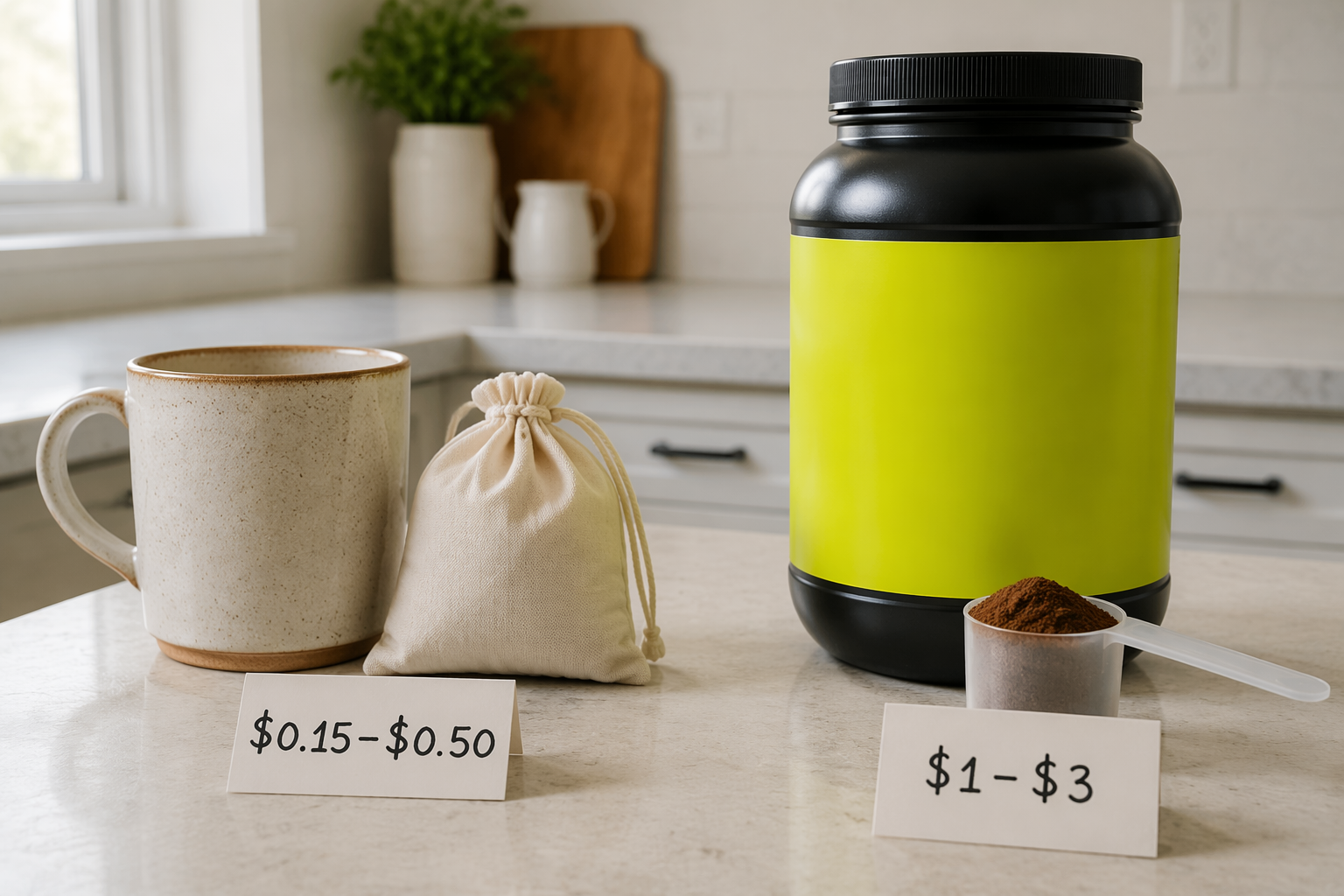
The cost argument gets weaker the moment coffee becomes a coffee-shop habit. A bought drink can still contain caffeine, but it stops being the penny-level shortcut that makes sense beside a resistance band and a mat. If the whole point of training at home is to keep recurring costs low, coffee works best when it stays part of the kitchen, not part of a daily checkout line.
That same spending logic is why coffee fits naturally beside other low-footprint choices, like building around compact gear instead of filling a room with machines. If you are already comparing the long-term math of a home setup against recurring gym costs, a cheap caffeine source is one more place where boring usually beats branded. For more on that broader budget tradeoff, see home gym versus gym membership cost.
Pre-Workout Coffee and Recovery Are Not the Same Protocol
The performance plan is 3–6 mg/kg about 60 minutes before training. The recovery evidence is more interesting than most coffee articles admit, but it is not the same recommendation wearing a different hat.
In a 2021 double-blind randomized trial of 11 endurance-trained male cyclists, coffee plus carbohydrates after exhaustive exercise increased muscle glycogen recovery by 153% compared with carbohydrates alone. The effect size was reported as large, but the caffeine dose was 8 mg/kg, and the participants were endurance athletes, not a mixed group of recreational home lifters.[3]
That makes the result useful but narrow. It suggests coffee can help replenish glycogen when paired with carbohydrates after hard endurance work, especially when the next session depends on restoring fuel. It does not prove that the same pre-workout mug improves recovery after a casual dumbbell session, and it definitely does not mean everyone should jump from 3 mg/kg to 8 mg/kg.
There is also evidence that caffeine can reduce delayed-onset muscle soreness. In a 2007 study, caffeine equivalent to about two cups of coffee significantly reduced quadriceps muscle pain 24–48 hours after eccentric exercise.[4] The caveat is important: this kind of DOMS research largely uses caffeine anhydrous, not brewed coffee. The caffeine dose may be comparable, but brewed coffee contains other compounds, so it is cleaner to say caffeine has evidence here, while brewed coffee is a plausible delivery method rather than the exact tested product.
When Coffee Is a Bad Trade
The most common mistake is treating caffeine as free performance. It is cheap, but it is not free if it steals sleep. A late-afternoon or evening workout changes the math: a slightly better session is a poor bargain if it makes you lie awake and under-recover from the training you just did.
Genetics also changes the experience. ISSN discusses individual differences in caffeine response, including CYP1A2-related metabolism, and evidence in this area suggests slow or intermediate caffeine metabolizers may see smaller endurance benefits or more side effects than fast metabolizers.[1] In plain terms, two people can drink the same coffee before the same workout and get different results.
- Start near 3 mg/kg, not 6 mg/kg, especially if you already feel caffeine strongly.
- Avoid testing a new dose before a max-effort lift, race, long ride, or group class.
- Skip late-day caffeine if it makes sleep worse, even when the workout feels better.
- Do not stack coffee with a pre-workout unless you know the total caffeine dose.
- If you have anxiety, heart conditions, are pregnant, or have been told to limit caffeine, ask a clinician before changing intake.
Side effects are not a moral failure or a sign that you lack discipline. They are data. If coffee makes you shaky during tempo squats, anxious before intervals, or wired at midnight, the smart move is to reduce the dose, move it earlier, or drop it for sessions where the cost is too high.
A Simple Way to Test It in a Home Gym
Use coffee like you would use any other training variable: change one thing, watch the result, and keep the setup repeatable. That matters more in a home gym, where distractions, cramped space, and improvised equipment can already make sessions inconsistent.
- Pick a repeatable workout: a bike interval session, a fixed dumbbell circuit, a push-up test, or a run route you know well.
- Try about 3 mg/kg caffeine from brewed coffee 60 minutes beforehand.
- Track one useful outcome: total reps, average pace, watts, completed rounds, or how much the last set falls off.
- Also track the downside: jitters, stomach issues, anxiety, and sleep quality that night.
- Only increase toward 6 mg/kg if the lower dose helps and the downside stays low.
This is also where equipment choices and caffeine choices overlap. If your space is tight, the best upgrade may not be another tub on a shelf; it may be a better pair of adjustable dumbbells, a safer mat, or a smarter layout. Coffee is useful because it does not compete for space. If space is the main constraint, the same logic applies to choosing home gym equipment for small spaces.
The cleanest practical rule is this: use coffee when it improves the session you are actually doing and does not damage the recovery you need afterward. For many home athletes, that means a normal brewed coffee about an hour before morning or midday training, starting at the low end of the 3–6 mg/kg range. For late training, caffeine-sensitive people, or anyone chasing recovery with an 8 mg/kg protocol, the better decision may be restraint.
References
- International Society of Sports Nutrition position stand: caffeine and exercise performance, Journal of the International Society of Sports Nutrition, 2021, https://pmc.ncbi.nlm.nih.gov/articles/PMC7777221/
- Effects of caffeine intake on muscle strength and power: a systematic review and meta-analysis, Journal of the International Society of Sports Nutrition, 2018, https://jissn.biomedcentral.com/articles/10.1186/s12970-018-0216-0
- Coffee increases post-exercise muscle glycogen recovery in endurance athletes, Nutrients, 2021, https://pmc.ncbi.nlm.nih.gov/articles/PMC8537367/
- Caffeine attenuates delayed-onset muscle pain and force loss following eccentric exercise, The Journal of Pain, 2007, https://www.jpain.org/article/S1526-5900(06)01023-6/fulltext
Have a question about this guidance?
This is a question and correction channel, not an open discussion thread — recovery topics sit close to a medical-advice boundary, so we review submissions rather than publishing them instantly.